The short version
Enrichment is anything that lets your dog do what dogs are built to do: sniff, forage, chew, lick, shred, solve and choose. It settles most dogs far more reliably than extra distance on a walk, and you need not buy a thing. A towel, a cardboard box, a handful of their own dinner and a new route cover most of it.
If your dog is restless in the evenings, pesters you the moment you sit down, or comes home from a long walk more wired than they left, you are not doing it wrong. You are meeting the wrong need.
Dogs need to move, but they also need to work: to use their nose, make decisions and find out what happens. A dog who never does any of that has energy with nowhere to go, and it comes out as pacing, barking, chewing your things, or shadowing you around the house. Happily, it is a cheap problem to fix.
What enrichment actually is
The word comes from zoos, where keepers found that animals with nothing to do developed repetitive, unhappy habits, and that a chance to hunt, forage and explore made those habits fade. The same logic transfers to your living room.
Enrichment is not entertainment, and it is not exercise. It means your dog gets to perform natural behaviours with a satisfying result at the end: sniffing that leads to food, chewing that softens something, shredding that makes a good mess.
That explains why a dog can be physically tired and still not settled. The legs have done plenty. The nose and brain have done nothing.
Why a sniffing dog is a calmer dog
Scent is the sense dogs lead with. A large part of the canine brain is given over to smell, and following a scent is hard mental work, which is why ten minutes of nose work often takes more out of a dog than half an hour of fetch.
Sniffing also changes how a dog feels, not only how tired they are. Dogs allowed to sniff freely tend to slow down, breathe more steadily and come home lower in the shoulders. Trainers see it so consistently that “let them sniff” is standard advice for anxious dogs.
Fetch works the other way. Repetitive chasing pushes arousal up, and a dog who plays a lot of high-speed fetch can end up unable to switch off. Fine in small amounts, but a poor main course.
Twenty enrichment ideas that cost almost nothing
Use your dog’s normal daily food for anything involving eating, rather than adding extra.
- Scatter feeding. Throw a handful of dry food across the lawn or a rug and let your dog hunt it out. A thirty-second meal becomes ten minutes of foraging.
- A snuffle mat made from a towel. Lay a towel flat, sprinkle food over it, then scrunch it loosely so your dog must nose through the folds.
- The muffin-tin game. Drop food into the cups of a muffin tin and cover each one with a ball or a scrunched sock. Things must be moved before dinner appears.
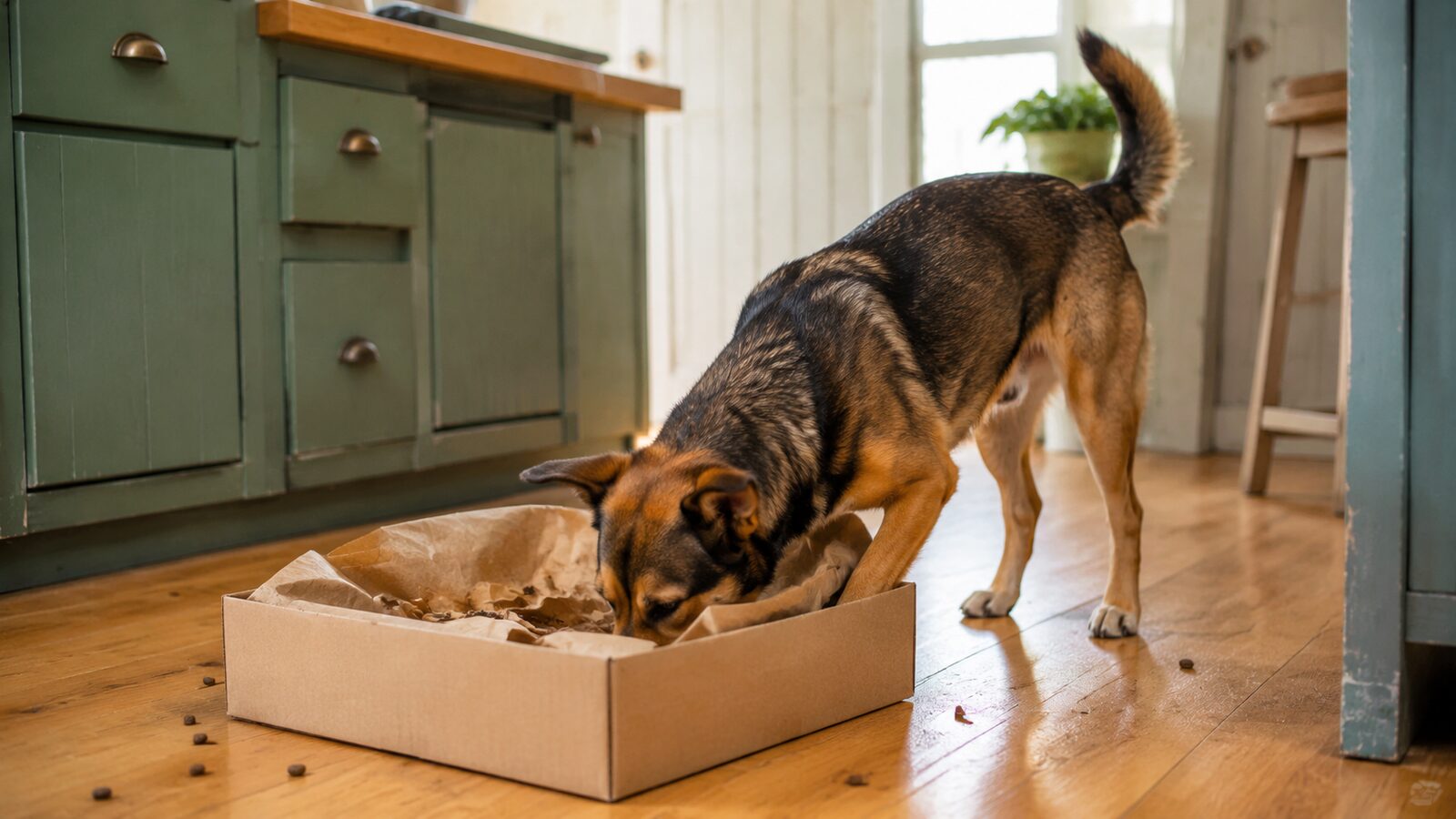
- Cardboard box demolition. Put food or a toy inside a box, fold the flaps shut and hand it over. Shredding cardboard deeply satisfies most dogs.
- A frozen stuffed toy. Pack a hollow rubber food-dispensing toy with soaked or wet food and freeze it. Frozen lasts far longer, and licking is calming in itself.
- The towel roll. Sprinkle food along a towel, roll it up like a swiss roll and let your dog unroll it. Tuck the ends in to make it harder.
- Find-it games. Ask your dog to wait, hide a treat somewhere easy, then release them with “find it”. Build up to four hiding places.
- Name the toy. Say one toy’s name each time your dog picks it up, and reward. Once they know two, put both out and ask for one.
- A dig box. Fill an old storage box or a corner of the garden with soil, sand or shredded paper and bury toys in it. Diggers dig where you do not mind.
- Water play. A shallow paddling pool, a bowl with food to bob for, or a sprinkler on a hot day. Supervise, and let your dog choose to join in.
- A new walking route. Start somewhere different, even ten minutes further on. New smells are the point, and a familiar loop is a book your dog has already read.
- Letting your dog choose the route. Once a week, go out with no destination and follow your dog at every junction. Having a say in their own day matters.
- A plastic bottle puzzle. Remove the cap and plastic ring, put food inside an empty bottle and let your dog roll it. Supervised only, and binned once it cracks.
- Tug with rules. Tug is proper play, not a route to aggression. Teach “take it” and “drop”, let your dog win often, and stop while everyone wants more.
- Chewing. Chewing releases tension and helps a great many dogs settle. Offer a natural chew or sturdy chew toy, sized so it cannot be swallowed.
- Licking surfaces. Smear something soft and dog-safe over a textured mat or the inside of a hollow toy. Long, slow licking brings a wound-up dog back down.
- Training as enrichment. Five minutes of teaching something new counts: spin, chin rest, nose to your hand. The learning is the point, not the trick.
- A window seat. If your dog watches the world calmly, a chair by a window is free entertainment all day. If it makes them bark, close the curtains.
- Novel safe surfaces. Walking over a wobbly cushion, a plank on the grass or a patch of gravel gives a dog information through their feet, and builds confidence.
- A scent trail. Drag strong-smelling food along the ground, around a corner and behind a chair, then release your dog at the start. Keep early trails obvious.
Keeping it safe
- Supervise anything destructible. Cardboard, bottles, towels and boxes are for use while you are in the room, never for a dog left alone.
- Nothing small enough to swallow. Every object and chew should be too big to fit past the back teeth, including once it has worn down.
- Take it away when it breaks. The moment something cracks, splinters, sheds stuffing or comes apart, the game is over. Bin it.
- Watch the dog who eats the packaging. Some dogs shred cardboard and leave it. Others swallow it. If yours is the second kind, stick to food games.
- Count the food, and give it space. Enrichment food comes out of the daily ration, and dogs who guard food should be puzzled in separate rooms.
Matching enrichment to the dog in front of you
There is no universal plan, because there is no universal dog. The right activity is the one your dog would pick.
Follow what they already do
A dog who digs the flowerbeds wants a dig box. A dog who shreds cushions wants cardboard. The behaviour you find annoying is usually a plain statement of an unmet need, and a legal outlet beats telling the dog off.
Think about what they were bred for
Dogs from scenting backgrounds tend to love trails and find-it games. Dogs bred to work closely with people often prefer training. Terrier types want to dig and shred. Treat that as a starting point and let your own dog correct you.
Anxious dogs need easy wins
A worried dog will not engage with anything confusing or clattery. Start well below what you think they can manage, use food they love, and let them walk away whenever they like. Licking and gentle sniffing games suit them best.
Puppies, seniors and slow starters
Puppies need short sessions, soft materials and close supervision. Older dogs often stay keen on scent games long after they lose interest in running, and a scatter feed is kind on stiff joints. If a dog looks at a puzzle and gives up, make it easier. Frustration is not enrichment.
A week you could actually run
Ten minutes a day is plenty. A sample, not a prescription.
- Monday. Scatter dinner across the lawn or a rug.
- Tuesday. Five minutes of new training, then a chew.
- Wednesday. Towel roll for breakfast, cardboard box at night.
- Thursday. A sniffing walk, no route and no rushing.
- Friday. Frozen stuffed toy while you eat.
- Saturday. Somewhere new, then find-it at home.
- Sunday. Muffin-tin game, then a scent trail through the house.
Tonight, if you do one thing, tip your dog’s dinner across the lawn instead of into the bowl, and watch how they are afterwards.
When to get professional help
Enrichment helps most bored dogs, but it is not the answer to everything. If your dog cannot settle even after a full and varied day, panics when left alone, guards food, or has changed suddenly for no reason you can see, speak to your vet first to rule out pain or illness, then to a qualified behaviourist or accredited trainer who uses reward-based methods. A dog who repeatedly swallows things needs veterinary advice, not a new game.
Frequently asked questions
How much enrichment does a dog need each day?
Most dogs do well on ten to twenty minutes spread across the day rather than one long session. Two food-based activities and one proper sniffing opportunity is a sensible baseline for an adult dog, and working types and adolescents need more. If your dog settles in the evening and is not pestering you, you are about right.
Can enrichment replace walks?
Not entirely, because dogs also need movement, fresh air and a change of scene. It does take pressure off the walk itself, which helps if your dog is recovering from injury, frightened of the outside world, or stuck indoors by weather. On days when a walk is impossible, scattered food, chewing and scent games stand in well.
My dog destroys everything I give them in two minutes. What now?
That is normal for strong chewers and shredders, and it is not a failure. Make activities last longer rather than harder: freeze food-stuffed toys, add layers of packaging, or split one portion across three games. Choose sturdier toy categories for anything unsupervised, and accept that cardboard is a consumable.
Is it safe to let my dog play with cardboard and plastic bottles?
With supervision, for most dogs, yes. Remove tape, staples, labels, bottle caps and plastic rings first, stay in the room, and take the item away as soon as it starts breaking into pieces. If your dog swallows what they shred, skip these ideas and use food-based games instead.
My dog isn’t interested in puzzles. Have I got a lazy dog?
Almost certainly not. Dogs opt out when a task is too hard, when the food is not worth the effort, or when they have never learned that objects can be worked at. Make it much easier, use something better than dry biscuit, and reward any attempt. Some dogs simply prefer scent games to objects.
Read next
- Scent Work at Home: The Easiest Way to Tire a Dog Out
- Choosing the Right Toy for Your Dog’s Play Style
- Chews and Chew Toys: How to Choose Safely
More in Enrichment & Play.
A note on this article
This is general information for owners who want more for their dog than a walk and a bowl. It is not veterinary advice, and it cannot account for your dog’s health or history. If your dog is unwell, in pain, or struggling beyond simple boredom, your vet and a qualified behaviourist who can meet the dog are the right people to ask.