
The short version
Scent work is the quickest, cheapest way to tire a dog mentally. Start by scattering treats on the floor while your dog watches, then hide them out of sight, then across more rooms, then add a cue such as “find it”. Ten focused minutes of searching leaves most dogs genuinely settled, and it needs no equipment and very little space.
There is a particular kind of evening most owners know. The dog has been walked. The dog has been fed. The dog is still standing in the middle of the room at nine o’clock, wanting something you cannot name.
Walking further rarely fixes that. Giving your dog something to do with their nose usually does, and a handful of their dinner is the entire budget.
Why the nose is the shortcut
A dog’s sense of smell is not a slightly better version of ours. It is a different way of experiencing the world, and a large share of your dog’s brain is given over to processing it. When a dog sniffs, they are not passing time. They are reading.
Mental work also drains a dog in a way physical work does not, and walking further mostly produces a fitter dog who needs walking further still. Searching is quiet, self-paced work with a clear finish, and dogs come out of it loose and ready to lie down.
The progression, step by step
The whole game is one idea repeated: your dog uses their nose to find food, and finding it is the reward. Move up a stage when they succeed easily three or four sessions running, and drop back a stage rather than helping if it goes wrong.
Stage one: treats they can see
Pop your dog behind a door. Scatter ten or fifteen small treats across a rug in plain sight, let them in, and say nothing. They will hoover them up in seconds, and that is the point: the floor is now a place where food appears, and searching is allowed.
Stage two: out of sight, one room
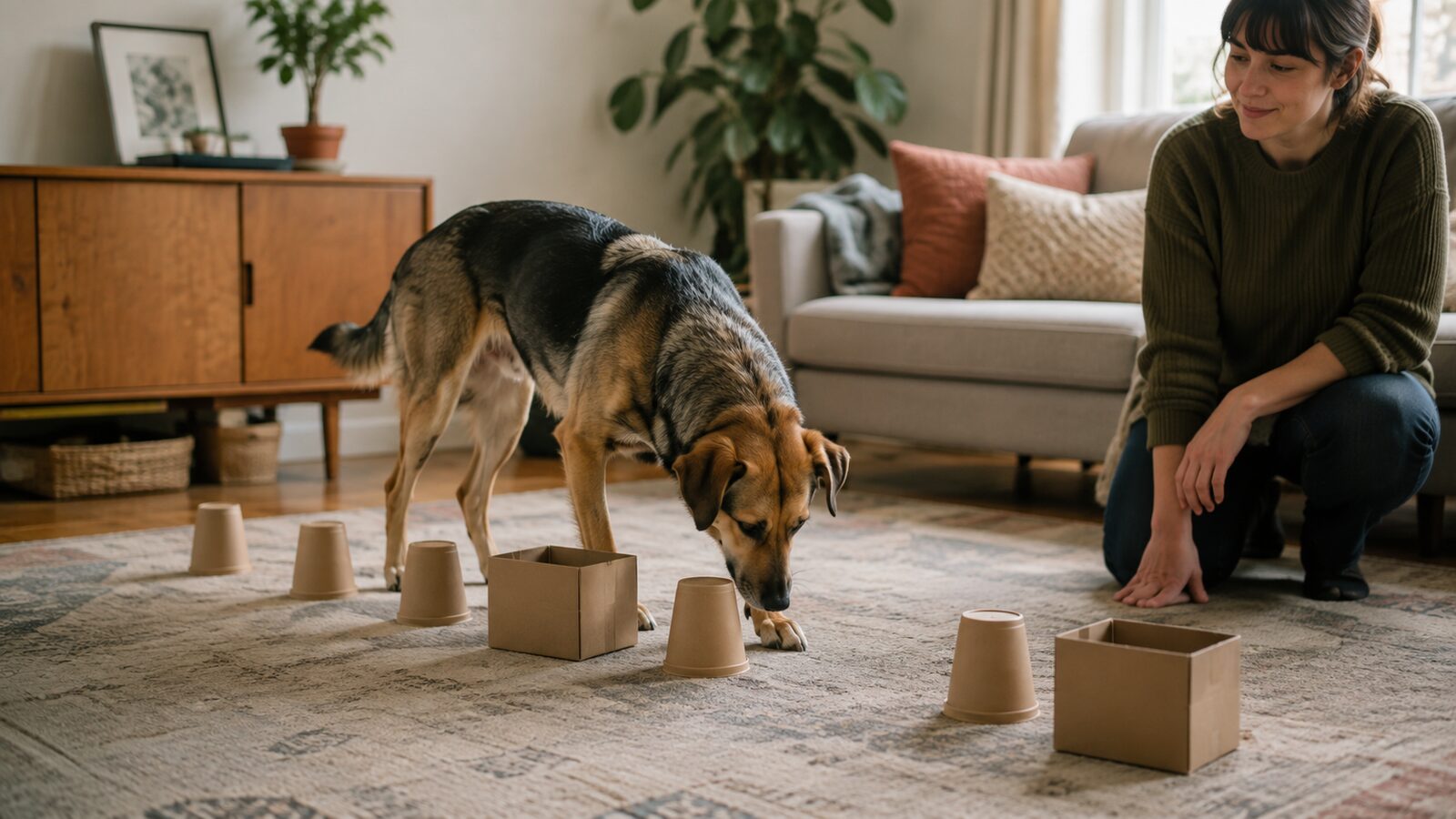
Same room, but tuck the treats where they cannot be seen. Behind a chair leg, under a cushion edge, inside a cardboard tube, in the folds of a towel. Keep hides low, and resist pointing. If your dog stalls, wander near a hide and let them work it out.
Stage three: more rooms
Once one room is easy, use two, then the hallway, then the stairs. Fewer treats, further apart. The search now takes real time, because your dog has to hunt rather than graze. Shut doors on out-of-bounds rooms, so the answer is always findable.
Stage four: adding a search cue
Now the game is familiar, give it a name. As you release your dog, say “find it” once, calmly, and only when there genuinely is something to find. Within a couple of weeks most dogs switch into working mode on hearing it, which gives you a way to occupy your dog anywhere: a hotel room, a friend’s kitchen, a car park.
Stage five: duration and difficulty
From here you make the problem longer, not only harder:
- Hide fewer treats over a bigger area, so there is more searching between finds
- Use height: a chair seat, a low shelf, a windowsill
- Hide inside things: a closed box, a paper bag, a stack of towels
- Let the hides sit a few minutes before you release your dog
- Set the hides while your dog is out of the room, so there are no visual clues
Watch your dog, not the clock. Slow and methodical means they are enjoying it; frantic and checking your face means the problem is too hard.
Stage six: a target scent
This is the step that turns a game into a skill. Your dog now searches for one specific smell and tells you where it is. The usual setup is a cotton bud carrying a drop of a single scent, inside a small tin with holes in the lid. Herbal scents are traditional, because they are distinctive and not otherwise found around a house.
Teach it in three steps. Hold the tin out and feed the instant your dog’s nose touches it, until they push at it deliberately. Then set it somewhere obvious on the floor and feed the moment they find it. Then hide it properly and pay them for showing you. The reward now comes from you, so feed at the source.
If your dog “isn’t interested”
Almost every dog will do this. A dog who will not is usually telling you one of a few things. Start in the room where they are most relaxed, then check the list below.
- The food is not worth it. Dry kibble on a hard floor is a weak start. Use something strong-smelling, and play before a meal rather than after.
- They do not know they are allowed. Dogs told off for scavenging often hesitate. Sit down, be boring, and let a few very easy sessions pass without a word from you.
- You are helping too much. Pointing, hovering and praising mid-search pull attention onto you. Your dog should be reading the room, not reading you.
If your dog has never been interested in food and seems flat generally, mention it to your vet rather than treating it as a personality trait.
Why this suits a fearful or reactive dog
Scent work asks nothing socially. No eye contact, no stranger, no other dog, no handling, no performing in front of anyone. It also gives a worried dog something they can be right about, and that kind of repeated success tends to show up in a dog’s confidence over weeks.
Sniffing is also incompatible with scanning. A dog with their nose down cannot be on lookout at the same time, which is why many trainers reach for a scattered handful of food when a nervous dog needs to come down a notch. For a lead-reactive dog, a “find it” cue gives you something calm to do when another dog appears at a distance, used early, before your dog fixes on the trigger.
Taking the game outdoors
Outside is harder, because the air moves and the ground is already full of competing smells. That is the next level, not a problem.
- Garden scatter. A handful of food thrown into long grass. Simple, and absorbing.
- Fence-line hides. Food tucked into the base of a fence or a plant pot rim while your dog waits indoors.
- The sniffing walk. A long lead, a well-fitted harness, and twenty minutes where your dog picks the route and the pace.
- Find the person. Someone your dog likes hides behind a tree in a quiet park, and you send your dog to find them.
Only scatter food where you are happy for your dog to eat off the ground, and skip it near any dog who guards food.
What to do tonight, and the fortnight after
Tonight, shut your dog out of the living room, scatter a handful of their dinner across the carpet in plain sight, and let them in. That is session one, and it takes four minutes.
- Days one to three: visible scatters, once or twice a day, same room.
- Days four to seven: same room, hides just out of sight, ten or so per session.
- Days eight to ten: two rooms, fewer hides, and start saying “find it” as you release them.
- Days eleven to fourteen: add height, add a closed box, and let one search run five minutes or longer.
Two short sessions beat one long one. Finish while your dog still wants more.
If you catch the bug
What you have built is roughly the opening chapter of a real dog sport. Competitive scent work varies by country, but the shape is the same: the dog searches an area for a target scent and indicates the source. It suits old dogs, deaf dogs, tiny dogs and dogs who cannot cope with others nearby, since most formats run one dog at a time. If you fancy it, find an instructor early, because scent work habits are easy to build and slow to unpick.
When to get professional help
Speak to your vet if your dog’s interest in food or sniffing drops off noticeably, or if a dog who used to search well starts struggling in a way that looks physical rather than bored.
If scent work is part of managing fear, reactivity or separation problems, get a qualified behaviourist involved in the wider plan, ideally through your vet.
Frequently asked questions
How long should a scent work session last?
Five to fifteen minutes suits most dogs, and beginners often do best with under five. Scent work is concentrated mental effort, so dogs tire faster than owners expect. Two short sessions in a day do more for a restless dog than one long one, and stopping while your dog is keen keeps them enthusiastic.
Can scent work replace a walk?
It replaces the settling effect of a walk, not the physical exercise or the change of scene. On a day when walking is not possible, because of weather, illness or an unsafe environment, a scent session usually leaves a dog far more content than pacing indoors. Most owners use it alongside walks, not instead of them.
My dog wanders around instead of searching. What am I doing wrong?
Usually the hides are too hard, too spread out, or too freshly placed for the smell to have travelled. Go back to visible treats for a few sessions, use stronger-smelling food, and keep to one small area. Check too that you are not talking, following or pointing, since a dog watching you for clues is not using their nose.
Is scent work suitable for a puppy?
Yes, and it is one of the better things to do with a puppy who cannot walk far yet. Keep it short, easy and completely successful, with visible or barely hidden food in a familiar room. Avoid hides that involve climbing on furniture or jumping down, and let them stop when they lose interest.
Read next
- Dog Enrichment: Twenty Ideas That Cost Almost Nothing
- Building Confidence in a Fearful or Rescue Dog
- Choosing the Right Toy for Your Dog’s Play Style
- Chews and Chew Toys: How to Choose Safely
More in Enrichment & Play.
A note on this article
This is general guidance for healthy dogs playing a gentle game at home. It is not veterinary advice, and not a behaviour plan written for your dog. If your dog is unwell, recovering from injury, or being treated for anxiety or reactivity, check with your vet or a qualified behaviourist first.