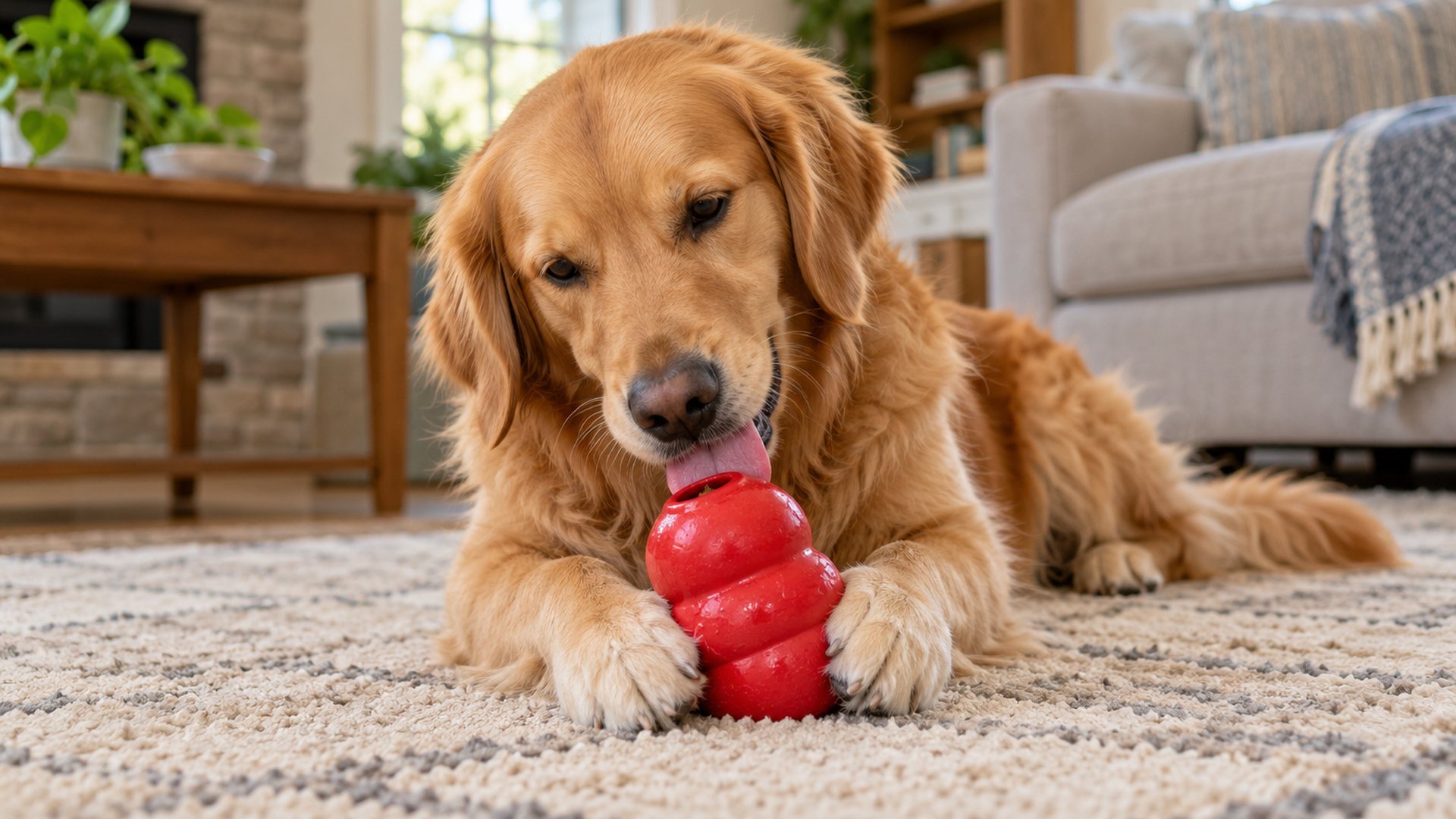
The best things to put in a Kong are foods your dog already eats safely: their own kibble or wet food, small pieces of plain cooked meat or vegetables, and a smear of something sticky such as xylitol-free peanut butter or plain yoghurt to hold it together. Start easy so your dog wins quickly, then make it harder by packing it tighter or freezing it. Pick the right size and rubber for your dog’s age and jaw, and count the filling as part of their daily food.
This article contains affiliate links. As an Amazon Associate I earn from qualifying purchases, at no extra cost to you. Affiliate disclosure.
This guide explains what the classic Kong dog toy is, how to choose the right size, and gives fillings sorted by difficulty and by life stage, plus a clear list of what never goes in.
At a glance
- A Kong is a hollow, snowman-shaped rubber toy that can be stuffed with food; the red Classic suits most adult dogs.
- Choose a size where the largest ring is bigger than the back of your dog’s mouth, and size up if unsure.
- Work through three levels: easy (loose kibble), stuffed (packed and sealed), then frozen.
- Never use anything containing xylitol, grapes, raisins, onions, garlic, chocolate, macadamia nuts or cooked bones.
- Use part of your dog’s daily ration so the Kong adds fun, not extra weight.
What is a Kong?
A Kong is a tough, natural-rubber toy shaped like a stack of three rounded rings, with a large hole at one end and a small hole at the other. It bounces unpredictably when thrown, but its real value is as a food toy: when you stuff it, your dog has to lick, chew and work to get the food out. That licking and problem-solving is calming for many dogs, which is why Kongs are a staple of dog enrichment, crate training and settling routines.
The KONG Company makes several rubber strengths, colour-coded so you can tell them apart:
| Version | Colour | Who it suits | Can it be stuffed and frozen? |
|---|---|---|---|
| KONG Puppy | Pink or blue | Puppies up to about nine months and light chewers | Yes; frozen fillings can be soothing during teething |
| KONG Classic | Red | Most adult dogs and average chewers | Yes |
| KONG Extreme | Black | Powerful chewers | Yes, and frozen fillings last longer |
| KONG Senior | Purple | Older dogs and gentle chewers, including dogs missing some teeth | Yes, with soft fillings |
People sometimes search for a “Kong ball”. The company does make ball-shaped toys, but the classic hollow shape is the one designed for stuffing, and that is what this guide covers.
How to choose the right Kong size
Size is a safety issue, not just a comfort one. A toy that is too small can become lodged in the mouth or throat. The KONG Company’s own guidance is that the largest ring of the toy should be bigger than the back of your dog’s mouth, that homes with several dogs should size every Kong to the largest dog, and that you should size up if your dog falls between sizes.
| Size | Manufacturer’s weight guide | Rough metric equivalent |
|---|---|---|
| XS | Up to 5 lb | Up to about 2 kg |
| S | Up to 20 lb | Up to about 9 kg |
| M | 5 to 35 lb | About 2 to 16 kg |
| L | 30 to 65 lb | About 14 to 29 kg |
| XL | 60 to 90 lb | About 27 to 41 kg |
| XXL | 85 lb and over | About 39 kg and over |
Weight is only a starting point. A broad-headed dog may need the next size up, and a puppy will need a bigger Kong as they grow. For more on matching toys to jaw strength, see our guide to choosing the right dog toy.
Safe and unsafe Kong fillings
The safest fillings are ones your dog already eats without problems. If your dog has a sensitive stomach or is on a special diet, use only their usual food.
| Usually safe in small amounts | Never put in a Kong |
|---|---|
| Your dog’s own kibble, soaked or dry | Anything containing xylitol (also called birch sugar or wood sugar), including some peanut and nut butters |
| Your dog’s own wet food | Grapes, raisins, sultanas and currants |
| Plain cooked chicken, turkey or lean meat, no seasoning | Onions, garlic, chives and foods cooked with them, such as gravy or stuffing |
| Plain cooked egg | Chocolate and cocoa |
| Plain mashed pumpkin or cooked carrot | Macadamia nuts |
| Plain unsweetened yoghurt, a little, if your dog tolerates dairy | Avocado |
| Xylitol-free peanut butter, a thin smear | Cooked bones, fatty scraps and anything heavily salted |
| Small pieces of banana, apple (no core or seeds) or blueberries | Sugar-free sweets, gum or baked goods |
The United States Food and Drug Administration warns that xylitol can be life-threatening to dogs and that some peanut and nut butters contain it, so read the label every time, even on a brand you have bought before. For a fuller list, see our guide to what human foods dogs can eat. If you think your dog has eaten something toxic, contact your vet or an animal poison helpline straight away; do not wait for signs and do not try home remedies.
What to put in a Kong, by difficulty
The secret to a Kong your dog loves is starting easy. A dog who gives up in frustration learns that Kongs are boring. A dog who gets a quick win wants to try again.
Level 1: Easy (first-timers)
- Drop a handful of dry kibble loosely into the Kong so pieces fall out when it rolls.
- Add two or three tasty pieces, such as plain cooked chicken, so the first few seconds are rewarding.
- Smear a little wet food just inside the large opening for an instant lick.
Level 2: Stuffed (once your dog empties Level 1 easily)
- Soak kibble in warm water until soft, mash it, and pack it in with a spoon.
- Layer: something easy at the bottom, mashed kibble or wet food in the middle, a firmer plug at the top.
- Seal the opening with a thin smear of xylitol-free peanut butter or a wedge of a larger biscuit.
Level 3: Frozen (for experts and long settles)
- Pack the Kong with soaked kibble mixed with wet food or plain pumpkin, then freeze it upright in a mug overnight.
- For a longer challenge, freeze in layers, adding a little more each time.
- Keep two or three in the freezer so one is always ready for a vet visit, a busy evening or a stormy night.
How to stuff a Kong: step by step
- Weigh or measure your dog’s daily food and set aside the portion you will use.
- Plug the small hole with a dab of peanut butter or a piece of soft food if you are using runny fillings.
- Add a few loose pieces at the bottom so the reward comes quickly.
- Pack the middle with soaked kibble or wet food, pressing it in with a spoon.
- Seal the top with something firmer, leaving a little sticking out to get your dog started.
- Freeze if you want it to last longer.
- Give it in a calm spot, such as their bed or crate, and stay nearby for the first few sessions.
- Pick it up when it is empty and wash it before the next use.
What to put in a Kong for a puppy, an adult and a senior dog
| Life stage | Good fillings | Tips |
|---|---|---|
| Puppy | Their own puppy kibble soaked until soft, puppy wet food, a little plain pumpkin | Use a Puppy Kong; keep it easy; frozen fillings may soothe teething gums; avoid rich new foods that upset small tummies |
| Adult | Soaked kibble, wet food, plain cooked meat, vegetables, a smear of xylitol-free peanut butter | Work up to frozen Kongs; use the Classic or Extreme depending on chewing strength |
| Senior | Soft wet food, well-soaked kibble, plain mashed vegetables | Use a Senior Kong; keep fillings soft and lickable; avoid rock-hard frozen fillings for dogs with sore teeth |
When choosing what to put inside a Kong for a puppy, remember that a puppy’s main job is to learn that settling quietly is rewarding. A Kong given in the crate or pen helps build that habit, and it also gives sharp baby teeth something better to work on than your hands. Our guides to stopping puppy biting and when puppies lose their baby teeth explain how chewing changes as they grow.
Using a Kong as part of training
A Kong is a reward in its own right. You can use it to teach your dog to settle on a mat, to make your leaving the house predictable and pleasant, or to give a busy dog something calm to do after a walk. Hand it over when your dog is already relaxed, so the Kong rewards calm behaviour rather than barking or pestering. If your dog finds being left alone distressing, a Kong can help, but it is not a fix on its own; our guide to separation anxiety in dogs covers a gradual, kind plan.
Our picks on Amazon: Kong toys and fillings
The classic stuffable toy and a ready-made filler for busy days.
- KONG Classic Stuffable Dog Toy: the original hollow rubber toy, sized for different dogs.
- KONG Stuff’N Paste: a squeezable filler made for Kong toys. Count it in your dog’s daily food.
Prices and availability change. Check sizing against your own dog’s measurements and always supervise with new toys or equipment.
Common mistakes
- Making it too hard too soon. A frozen, tightly packed Kong is a lot for a beginner. Start with Level 1.
- Adding food on top of meals. Kong fillings count. Take them out of the daily ration, especially for dogs who gain weight easily.
- Using the wrong size. Too small is a choking risk. Check the largest ring against the back of the mouth and size up if in doubt.
- Not checking the label. Xylitol can appear in peanut butter and spreads under other names.
- Leaving a damaged toy. Throw away any Kong with cracks, chunks missing or loose pieces.
- Feeding two dogs Kongs side by side. High-value food can cause tension. Give them in separate rooms or behind a baby gate.
- Skipping the wash. Old food goes stale fast. Rinse with hot water and a bottle brush after each use.
Cleaning and safety checklist
- Rinse straight after use and scrub inside with a bottle brush.
- Soak stubborn fillings in warm soapy water, then rinse well.
- Check for cracks, tears and worn patches before each use.
- Supervise the first few sessions and any time your dog has a new type of Kong.
- Take it away if your dog starts biting off pieces of rubber.
- Keep frozen Kongs in a separate, labelled freezer bag.
If you want more ways to keep meals interesting, our guide to puzzle feeders compares lick mats, snuffle mats and slow feeders.
Related guide: Is Peanut Butter Good for Dogs? The Safe, Smart Answer.
Sources this guide draws on: The KONG Company’s official size guide and product guidance; the United States Food and Drug Administration consumer update on xylitol and dogs; the ASPCA’s guidance on people foods pets should avoid.
Frequently asked questions
Is peanut butter safe in a Kong?
Plain peanut butter without xylitol is generally fine as a thin smear. Check every label, because some peanut and nut butters contain xylitol, which can be life-threatening to dogs. It is high in fat, so use small amounts and count it as part of daily food.
How long should a stuffed Kong last?
It depends on the dog and the filling. A loosely filled Kong may be empty in a minute or two, while a frozen one can keep a dog busy for much longer. If your dog empties it very quickly, move up a level; if they give up, make it easier.
Can I give my dog a Kong every day?
Yes. Many owners serve part of every meal in a Kong. Just take the filling out of your dog’s daily ration and wash the toy between uses.
What can I put in a Kong instead of peanut butter?
Your dog’s own wet food, mashed soaked kibble, plain mashed pumpkin or a little plain yoghurt all work well as a sticky layer. They are often lower in fat than peanut butter too.
Can a puppy have a frozen Kong?
Yes, using a Puppy Kong of the right size and a filling based on their usual puppy food. Keep it soft enough to lick and supervise the first few times.
Is the classic Kong dog toy safe for strong chewers?
The red Classic suits average chewers. Powerful chewers are usually better with the black Extreme. Whatever you choose, inspect it regularly and replace it if it shows damage.
A well-stuffed Kong is one of the simplest, kindest ways to give your dog something to look forward to. Start easy, stay safe with your fillings, and let your dog discover how good it feels to work things out.