The short version
There is no universal number. What your dog needs depends on age, what their breed type was built to do, health, temperament and the weather, and the kind of exercise matters as much as the length. Most dogs do better with a mix of sniffing, free movement and thinking than with the same brisk hour daily. Watch the dog, not the clock.
Somebody decided that dogs need an hour a day, and the number has followed us around ever since. It gets quoted to owners of nine-week-old puppies and fourteen-year-old terriers alike.
It answers the wrong question. An hour trotting along a pavement and an hour nosing through a hedgerow are not the same event.
Why “one hour a day” is close to meaningless
The number treats exercise as a single currency, as though a dog had a fuel tank emptying at a fixed rate. Dogs have bodies that need to move and minds that need something to chew on, and one activity rarely fills both.
It also ignores what the hour contains. A tense hour on a busy road, dodging traffic and other dogs, can leave a dog more wound up than when they set off. A shorter outing in a quiet field often leaves them calmer.
What actually decides how much your dog needs
Five things do most of the work, and none of them appear on a chart.
Age
Puppies need short bursts and a great deal of sleep. Adolescents want more than is good for them and have little judgement about stopping. Older dogs do better with shorter, gentler, more frequent outings than one long march.
What the breed type was built to do
A dog bred to work sheep all day, or to quarter a field ahead of a gun, comes with stamina and an urge to use it. Sighthound types are sprinters rather than marathon runners, and many are happy with a short burst and a long nap.
Terrier types often want to hunt, dig and solve problems more than distance. Flat-faced, heavy-coated and giant breeds each have their own limits. With a mix, look at the dog rather than the label.
Health and body condition
Joints, hearts, airways and weight all change what a dog can comfortably do. A dog carrying extra weight, or one with early stiffness, often needs a different plan rather than less of the same, and that plan is a conversation with your vet.
Temperament
Some dogs are content with a potter round the block and a good chew. Others are switched on from the moment they wake and are hard to satisfy. Neither is a fault, and neither is something you caused.
Weather, terrain and the day itself
Heat, cold, mud and hard ground all change what a walk costs, and so does the rest of the day. A dog who has had visitors, a car journey and a bath needs sleep, not a long walk on top.
A tired dog is not the same as a satisfied dog
“A tired dog is a good dog” is one of the most repeated lines in dog ownership, and it quietly misleads people. Tiredness and satisfaction are different states.
You can exhaust a dog and still leave them frustrated. That is the dog who comes home from a long run, lies down for ten minutes, then spends the evening barking at the window.
What settles a dog is a mixture: movement, sniffing, chewing, a problem to solve, company, and then real uninterrupted rest. Dogs sleep a great deal when the day is well shaped, and restless sleep often means something in the mix is off.
The over-exercised, over-aroused dog
The opposite problem gets less attention. Some dogs are not under-exercised at all; they are running on adrenaline and cannot come down from it.
Repetitive high-speed chasing, especially thrown balls, is the usual culprit. It can leave a dog in a state of arousal that lingers long after the walk, and the pacing and whining that follow get read as “still needs more”.
There is a fitness trap here too. Ask a healthy dog for two hours a day and their body adapts, so they need more to reach the same tiredness. What helps more is teaching the dog to switch off: sniffing, chews, and walks that end in a potter rather than a sprint.
Sniffing and thinking count as exercise
A dog’s nose is their main way of reading the world, and using it is demanding work. Many owners find half an hour of unhurried sniffing leaves their dog more settled than a much longer brisk walk.
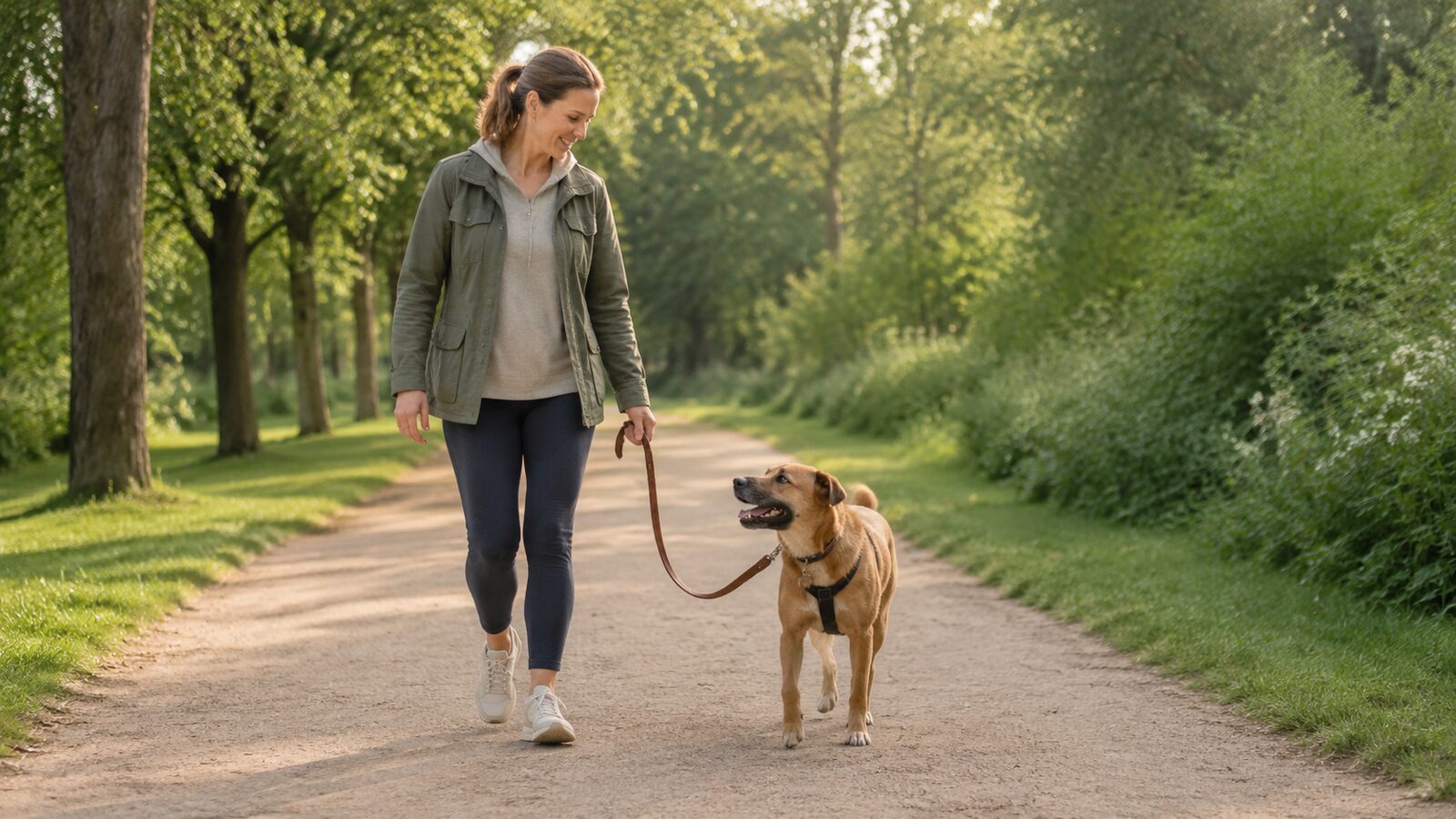
A sniffing walk looks like almost nothing from the outside. You go somewhere quiet, ideally on a long line or off lead where that is safe and legal, and let the dog choose the pace. Your job is to be patient.
Scattering part of the daily food in the grass, hiding a toy indoors, or working at a food-dispensing puzzle does similar work on a wet day. For many dogs that is the more satisfying half of the routine.
Puppies and growing bodies
Puppies have soft growth plates at the ends of their long bones, and those close at different ages depending on size and breed. Until then, repeated forced exercise is what to be careful with: long jogs beside a bike, repetitive jumping, endless stairs. Free play, where the puppy sets the pace, is different.
You will see a rule of thumb quoted about minutes of walking per month of age. Treat it as a rough shape rather than a standard, because it was never a veterinary rule. Your vet is the person to ask, particularly with a large breed.
Heat, cold and the days you cut it short
Dogs cope with heat far less well than people do, and are not good at stopping when they should. On warm days, walk in the cooler hours, carry water, choose grass over pavement, and check the ground with the back of your hand.
Older dogs, very young dogs, flat-faced dogs and heavy-coated dogs feel heat sooner. If a dog seems distressed by heat, stop, cool them and ring your vet straight away.
Cold matters too, especially for thin-coated, small, young or elderly dogs. Shorter and more frequent beats long, and it is worth rinsing paws after gritted pavements.
Reading your own dog, and building a week around it
Your dog gives you the answer every day, mostly in the hours after a walk rather than during it.
Signs there may not be enough
- Difficulty settling in the evening, pacing, or following you room to room.
- Chewing, digging or shredding things that are not theirs.
- Gradual weight gain with no change in food.
Signs it may be too much, or the wrong sort
- Stiffness or lagging behind, especially the next morning.
- Hesitating at the door, or lying down partway through a walk.
- Sore or worn paw pads.
- Coming home wired rather than pleasantly tired.
Limping, obvious pain or laboured breathing is a vet visit, not a training question.
A week that suits most healthy adult dogs
Adapt it. The point is variety, and a rhythm your dog can predict.
- Two or three outings that are mostly sniffing, at the dog’s pace.
- One or two with more movement: a longer walk, a swim, or free running if recall is reliable.
- One walk where you practise a little training in short bursts.
- Two or three evenings with a chew, a scatter feed or a puzzle instead of distance.
- At least one deliberately quiet day, especially after anything exciting.
Then watch. If your dog is settled and sleeping well, the mix is right. If not, change one thing and give it a week.
When to get professional help
Talk to your vet before increasing exercise for a dog who is overweight, elderly, recovering from surgery, or living with a heart, airway or joint condition. Any limp or drop in stamina deserves a check rather than a wait.
If your dog cannot settle, becomes frantic around movement, or gets more wound up the more you do, a qualified behaviourist or accredited trainer will help more than another hour of walking.
Frequently asked questions
Is one walk a day enough for a dog?
For plenty of dogs, one good walk plus sniffing, chewing and company at home is enough. Others do better with two or three shorter outings, particularly puppies, older dogs and those who struggle to settle. Judge it by how your dog is afterwards, not by the number of walks.
Can I skip a walk if the weather is awful?
Yes, occasionally. In real heat, shortening or skipping is the safer choice. Fill the gap with sniffing games, a scatter feed or a chew, and make sure your dog can relieve themselves. Most dogs cope well with a quiet day, and some benefit from one.
My dog never seems tired. What am I doing wrong?
Probably nothing. Some dogs are built to keep going, and fast repetitive exercise can raise arousal rather than meet needs. Try swapping some distance for sniffing, chewing and problem-solving, and end walks calmly. If your dog still cannot switch off, a qualified behaviourist can help.
How much exercise does a puppy need?
Little and often, with plenty of sleep in between and free play where the puppy sets the pace. Repetitive forced exercise, such as jogging or endless stairs, is what to be cautious about while they grow. Rules of thumb about minutes per month of age circulate online, but ask your vet.
Does a garden count as exercise?
Not on its own. A familiar garden offers few new smells and little to think about, so most dogs potter for a few minutes and come back in. It is useful for toileting and for games with you, but the interest of a walk is new information.
Read next
- Dog Enrichment: Twenty Ideas That Cost Almost Nothing
- Scent Work at Home: The Easiest Way to Tire a Dog Out
- How to Read a Dog Food Label Without Getting Fooled
- Home Grooming by Coat Type: A Routine That Actually Fits Your Dog
More in Everyday Care.
A note on this article
This is general guidance about exercise for healthy dogs, written to help you think about your own dog rather than to prescribe a routine. It is not veterinary advice and cannot account for an individual dog’s health, so if your dog is unwell, sore or recovering, ask your vet.