
The short version
Match the toy to how your dog actually plays. Shredders want something to take apart, chewers want something they cannot destroy, fetchers want something that moves, tuggers want something to hold on to with you. Buy for size and safety first, keep most toys put away and rotate them, and bin anything that has started to come apart.
Most homes have a box of ignored toys. There is usually an expensive one in there, bought with real hope, sniffed once and abandoned for an empty cardboard box.
That is not fussiness. Dogs do not play generically. Each has a preferred way of playing, shaped by breed history and personality, and a toy that suits one style means little to another.
Work out which kind of player you have and toy choice becomes simpler, cheaper and far more fun for the dog.
Why play style matters more than the label
Play is not just burning energy. It is a harmless outlet for the parts of hunting dogs were selected for: searching, stalking, chasing, grabbing, shaking, carrying and taking apart. Different dogs were bred to specialise in different parts of that sequence.
Give a dog a toy that fits their part of the sequence and play feels satisfying, and a satisfied dog settles. Fit nothing they care about, and it is a lump of rubber on the floor.
Most dogs show two or three styles, with one clear favourite. Watch what your dog does in the first ten seconds with any new object. That is your answer.
The seven play styles
The shredder
Wants to take things apart, layer by layer, and is happiest surrounded by the debris. The process matters more than the object.
Give them things designed to be dismantled: layered fabric toys, snuffle mats, toys that hide smaller toys inside, and plenty of free cardboard. Supervise, because shredding is only safe when nobody eats the pieces.
The chewer
Wants steady, repetitive pressure between the back teeth. Chewing releases tension and helps many dogs wind down, so this dog needs an outlet daily, not occasionally.
Choose the toughest categories: solid natural rubber chew toys, firm rubber bones, and long-lasting natural chews sized so they cannot be gulped. Plush toys are unsuitable and become a swallowing risk within minutes.
The fetcher
Wants movement. The joy is in the chase and the return, and the toy is almost incidental as long as it travels well.
Durable rubber balls, bouncy retrieve toys and floating toys for water dogs all work. Keep sessions short: repetitive high-speed fetch winds many dogs up rather than settling them, and hard turns are demanding on joints.
The tugger
Wants to hold on, pull against you, and feel resistance. This is social play, which makes it one of the best relationship builders available.
Rope toys, fabric tugs with handles and rubber rings all suit. Tug does not create aggression, but it needs rules: a clear start, a taught “drop”, regular wins for the dog, and an end while everyone still wants more.
The shaker
Grabs the toy, shakes it violently and then usually parades it about. This is the finishing part of the hunting sequence, and it looks alarming while being entirely normal play.
Long plush toys and toys with limbs suit this dog perfectly, and expect them to be destroyed. Choose ones without hard plastic eyes or noses, and remove squeakers once exposed.
The puzzle solver
Wants a problem. This dog paws, noses and studies objects, and gets more from working out a mechanism than from any amount of chasing.
Food-dispensing toys, sliding puzzle boards, treat-releasing balls and homemade foraging games all suit. Start easy so they succeed, then raise the difficulty. Too hard, and most dogs simply walk away.
The carrier
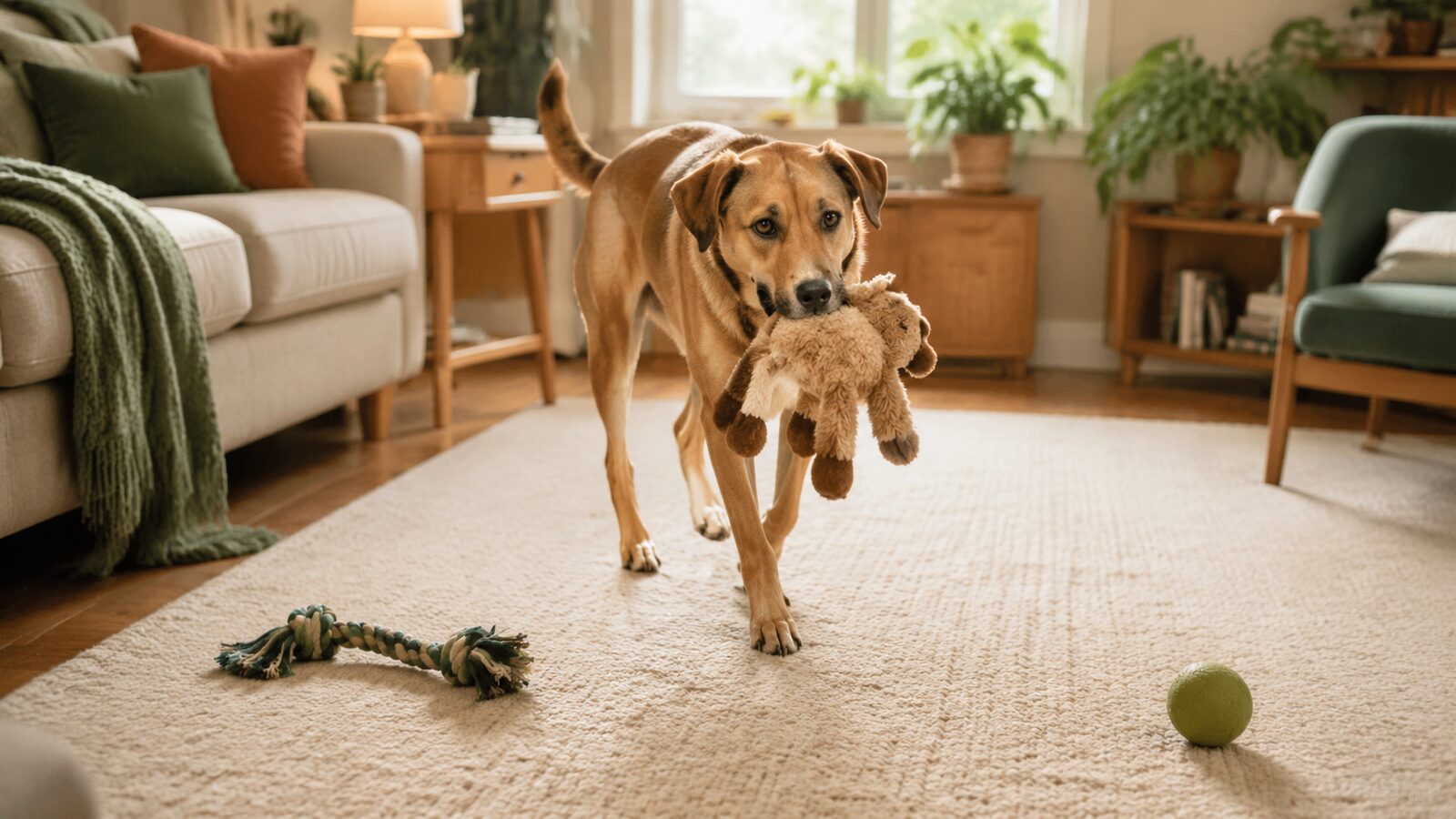
Wants something in their mouth. They greet you with a shoe, sleep with a toy, and often will not chew or destroy it at all.
Soft plush toys of a comfortable size, or anything with a good shape to hold, are what this dog wants. Carriers are often gentle, so a favourite can last years. Let them have it.
Size, swallowing and honest durability
The single most important choice is size. A toy should be too big to fit entirely behind the back teeth, and that must stay true as it wears down. Balls are the classic risk, because one that looks fine can be crushed and swallowed by a large dog.
Now the honest part: no toy is indestructible. Every “tough” claim means tougher than average, tested against average jaws. A determined dog with time and motivation will eventually get through anything, and the marketing language on packaging is not a safety guarantee.
That is not a reason to avoid sturdy toys. It is a reason to treat toys as supervised equipment rather than furniture. Match toughness to your dog, watch the first few sessions with anything new, and put away what you would not want them working on alone.
Two more points. Avoid anything harder than a tooth, since very hard objects are a common cause of fractured teeth. And check that any toy left with a dog has no small removable parts and nothing they can pull off in one go.
When to throw a toy away
Toys are consumable. Retire one when you see any of the following.
- It has cracked, split or started to come apart into pieces.
- Stuffing or squeakers are exposed.
- It has been chewed down small enough to swallow.
- Rope has frayed into loose strands, which can be swallowed.
- Rubber has gone sticky, brittle or has chunks missing.
- Your dog has changed from playing with it to systematically eating it.
A quick check when you tidy up in the evening is enough. If in doubt, bin it. A replacement costs far less than a trip to the vet.
Why the cardboard beats the expensive toy
Because cardboard is novel, it makes a noise, it changes as they work on it, and above all it is destructible. The expensive toy is often none of those things, and a toy that does nothing until the dog does something clever is ignored by a dog who wanted to shred.
Novelty does an enormous amount of the work, which is why rotation matters more than quantity. Keep three or four toys out and the rest in a cupboard, then swap them every few days. A toy that vanishes for a fortnight comes back interesting.
Two things revive a dull toy: bring it into a game with you, and put food in it. Most dogs will play with almost anything if you play too, which is the honest explanation for why some toys only work when you are holding them.
Working out your dog’s style this week
Set aside ten minutes and run a test. Put out four things: something soft, something rubber and hollow, something rope-shaped, and a cardboard box with food inside.
Watch which one they go to and, more importantly, what they do with it. Shake and kill, or lie down and chew? Bring it to you, or take it to a corner? Paw at it for food, or carry it about?
Repeat it twice more that week, because dogs choose differently on different days. Then buy for what you saw, not what you hoped. Three toys that suit your dog beat a box of twelve that do not.
When to get professional help
Speak to your vet if your dog swallows toy parts, chews with an urgency that seems compulsive, or suddenly loses interest in play they used to enjoy, since pain and dental problems often show up that way first. If your dog guards toys from people or other dogs, or plays in a way that tips over into biting hands, a qualified behaviourist or accredited reward-based trainer can help you sort it while it is still small.
Frequently asked questions
How many toys does a dog actually need?
Far fewer than most homes have. Three or four in rotation, chosen to suit your dog’s play style, plus something to chew, covers nearly every dog. Variety helps more than volume, so a soft one, a tough one and something food-based beats six versions of the same thing. Anything ignored for a month can be passed on.
Are rope toys safe?
They are fine for tug and for most supervised play, and they suit tuggers particularly well. The risk is swallowed strands, which can cause serious problems inside the gut. Take a rope toy away once it starts shedding threads, and do not leave one with a dog who unpicks it rather than pulling on it.
My dog destroys every toy within minutes. What should I buy?
Buy fewer, tougher and larger, and change your expectations. Solid natural rubber and firm chew toys in the biggest suitable size last longest, but nothing will last forever with a determined chewer. Give shredding a legal outlet with cardboard under supervision, so that the sturdy toys are not the only thing available to dismantle.
Is tug of war bad for my dog?
No. It is excellent exercise and it builds a strong relationship, provided it has rules. Teach a clear release, let your dog win often, keep the tug low rather than lifting the dog, and stop if teeth touch skin. Avoid heavy tugging with young puppies whose teeth are changing, and with dogs who have neck or back problems.
Should I leave toys out all day while I am at work?
Leave only things you would be happy for your dog to be alone with: sturdy, one-piece, too big to swallow, with nothing to pull off. Everything soft, shreddable, rope-based or already damaged should be put away. If your dog struggles when alone, a food-stuffed toy can help settle them, but the underlying worry needs addressing separately.
Read next
- Chews and Chew Toys: How to Choose Safely
- Dog Enrichment: Twenty Ideas That Cost Almost Nothing
- Scent Work at Home: The Easiest Way to Tire a Dog Out
More in Enrichment & Play.
A note on this article
This is general guidance to help you choose toys with more confidence, not veterinary advice. Toy safety depends on the individual dog, their size, their teeth and how they play, and no article can judge that from a distance. If you think your dog has swallowed part of a toy, or their chewing changes suddenly, ring your vet.