The short version
Chewing is a normal canine need, not a vice. Choose chews you can dent with a thumbnail rather than rock-hard items, big enough that your dog cannot fit the whole thing in their mouth, and matched to how hard your dog chews. Supervise every chew, take it away once it is small enough to swallow, and speak to your vet about anything involving teeth or tummies.
Standing in a pet shop aisle looking at forty different chews is confusing. The packaging says much the same thing on all of them, and there is no obvious way to tell which one suits your dog.
Most of it comes down to three questions: how hard is it, how big is it, and how does your dog chew? You are not sorting good products from bad, you are matching an item to the dog you have.
Chewing is a need, not a vice
Dogs chew for the same reason they sniff. It is built in, it feels good, and a dog with no outlet will find one you did not choose, usually a skirting board or the sofa.
Chewing and licking are also how many dogs settle themselves. You will see it after visitors leave, or when a dog has been wound up and needs to come back down. It is rhythmic and self-directed, which is often what a dog needs to switch off.
So “stop my dog chewing” is rarely the right goal. The goal is to give it somewhere to go, on things you have chosen.
How hard is too hard
Hardness is the most useful thing to judge, and the one most owners never think about. Something that does not give at all has to lose that contest with something, and the only other candidate is your dog’s tooth. Three rough tests:
- The thumbnail test. Press your thumbnail firmly into it. A mark, or a little give, means it sits in a sensible range. If your nail slides off stone, think again.
- The knee test. Tap it hard against your kneecap. If you wince, it is harder than you want in your dog’s mouth.
- The flex test. Try to bend it. Something that flexes, or wears into shavings, behaves differently from something rigid that cracks.
Watch how a chew breaks down, too. Items that splinter into shards, or snap into one large chunk, are a different proposition from items that shred slowly. None of this makes a chew safe or unsafe in the abstract, but it lets you compare two items in the shop.
The main kinds of chew, honestly
Every category below suits some dogs and not others, and each has a downside worth knowing.
Non-edible chew toys
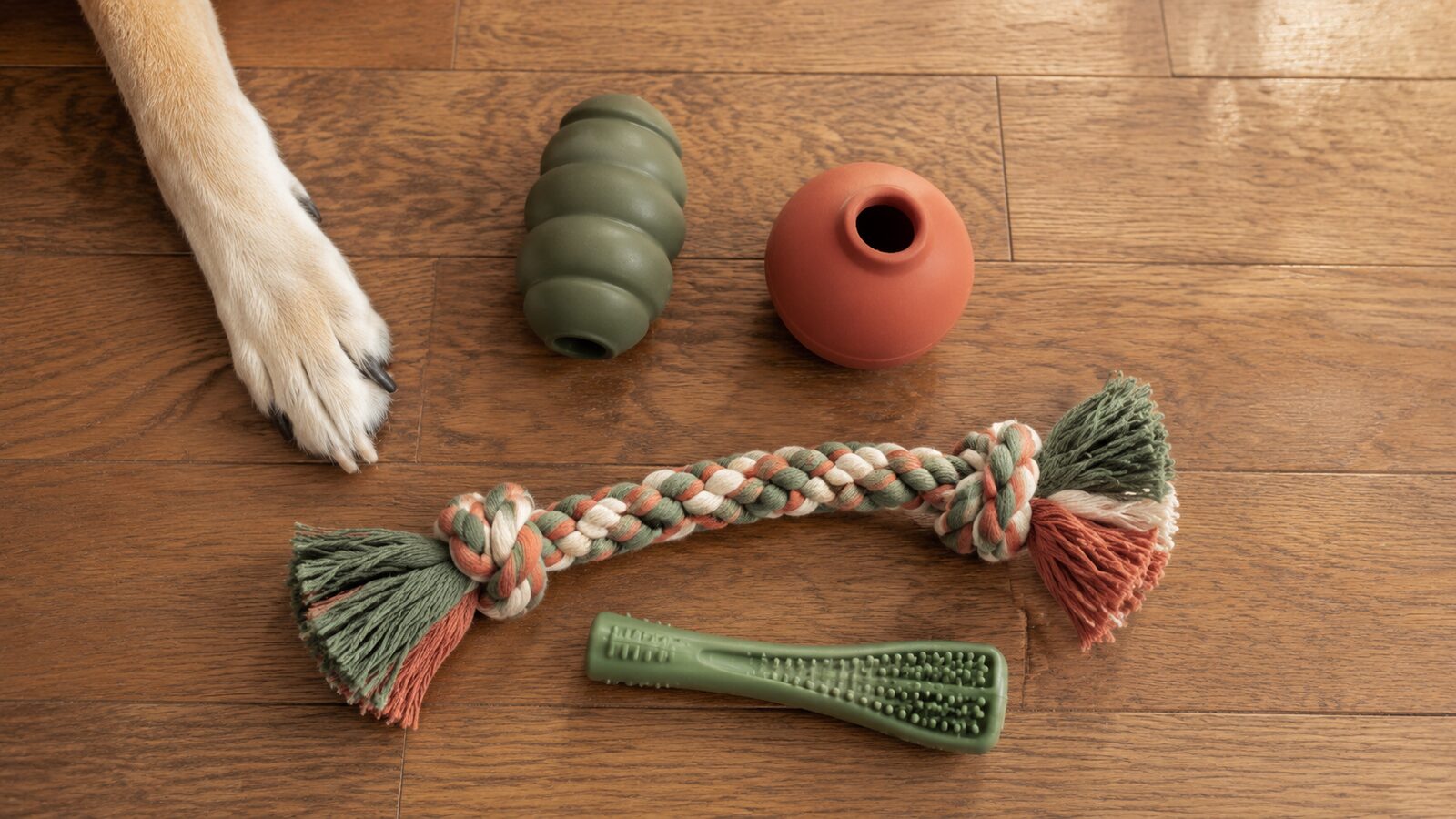
- Firm rubber toys. Solid or hollow, often stuffable and freezable. Easy to judge, long-lasting and washable. A determined chewer can still tear pieces off a worn one, so retire them once the surface is ragged.
- Nylon and hard plastic chews. Very durable, which is the appeal for powerful chewers, but they sit at the hard end of the scale. Apply the thumbnail test honestly, and check for sharp worn edges.
- Rope and fabric chews. Soft, cheap and popular with shredders. Swallowed strands and stuffing are the issue, so these suit supervised play rather than a dog left to dismantle one.
- Wood-composite chews. Aimed at heavy chewers, and designed to shave off flakes rather than splinter. Wear varies a lot, so inspect often and remove when short.
Edible chews
- Dried single-ingredient animal chews. Ears, skins, tendons, tracheas, fish skins. Most dogs love them and the size range is useful. They are food, so they count towards the day’s intake, and some want a mat under them.
- Very hard natural items. Antler, horn, hoof and dense bone products. They last a very long time, which is why people buy them, and they are the category most often raised as a hardness concern. Plenty of vets suggest avoiding them.
- Hide-type chews. Cheap and widely available. They soften as they are worked, and the usual issue is a dog who tears off and gulps a softened piece. Size up, and remove the last stub.
- Compressed and moulded chews. Starch, gelatin or meal-based items pressed into shapes. Usually softer, which suits gentler chewers, though a strong-jawed dog goes through one in minutes.
- Filled and frozen items. Less a type than a method: a hollow rubber toy packed with something soft and frozen. Good for a dog who needs to settle, and adjustable in difficulty.
Whatever the category, no chew replaces the dental care your vet recommends.
Size and swallow risk
Most chew accidents are about size rather than material. The rule is simple: a chew should be too big for your dog to fit entirely inside their mouth, and still too big when half worn down. Buy up a size if you are between options, particularly for a dog who bolts food.
Watch how your dog holds it. A dog lying down and working on a chew with their back teeth is doing what you hoped. A dog manoeuvring the whole thing towards the back of their mouth is telling you it is too small for them.
Supervision, and when to take it away
Supervision is the non-negotiable part. Chews are not something to hand over as you leave the house, and not a solo crate activity, because the things that cause trouble happen fast and silently.
Take a chew away when:
- It has worn down small enough to fit fully inside your dog’s mouth
- A piece has broken off, or a softened chunk is being pulled loose
- It has developed a sharp edge or point
- Your dog stops chewing and starts trying to swallow it
- Your dog is guarding it, going stiff, or gulping it down because someone is near
- You see blood on the chew, or your dog seems uncomfortable
Swap rather than snatch. Offer something good, take the chew as your dog steps away, and keep it routine. If your dog already guards chews, treat that as a separate behaviour question, and give chews somewhere quiet in the meantime.
Chewing needs by life stage
Teething puppies
A puppy’s mouth is sore, and chewing is one of the few things that helps them cope. Keep everything soft and pliable, use cold or frozen items, and expect a lot of demand. Hard items belong to later in life, and a puppy chewing everything usually needs more sleep as well as more chews.
Adolescents and adults
The chewiest phase of most dogs’ lives lands between six and eighteen months, when adult teeth are settling in and the dog has more jaw strength than sense. Increase the supply rather than the telling off. After that it settles into a habit rather than a compulsion, though heavy chewers stay heavy chewers for life.
Older dogs
Many older dogs still want to chew but cannot manage what they used to. Softer items, filled and frozen toys and licking-based options let them keep the habit. Reluctance to chew, dropping food, chewing on one side or new bad breath is a vet visit, not a change of chew.
Calories, and where chews sit in the diet
Edible chews are food. A dog getting several a day is eating rather more than the bowl suggests, and it creeps up quietly where more than one person hands them out. Treat chews as part of the daily ration rather than as extras, and trim meals a little on generous days. If you are unsure of the balance, ask your vet.
Putting together a chew kit
You do not need forty products. Most households do well with four or five items in rotation:
- One hard-wearing non-edible toy that passes the thumbnail test, for every day
- One hollow, stuffable toy you can fill and freeze, for the evening wind-down
- Edible chews in a size that is comfortably too big to swallow
- Something soft and shreddable for supervised play, if your dog enjoys shredding
- A mat or towel that chewing happens on, to keep mess contained
Inspect everything each time it comes out, and offer a chew before your dog needs it, rather than after the sofa has suffered.
When to get professional help
Ring your vet promptly if your dog breaks a tooth, swallows a large piece of anything, retches, gags, drools heavily, goes off their food, seems bloated or sore, or has vomiting or diarrhoea after a chew. Blockages and dental damage are veterinary matters, and both are easier dealt with early.
Your vet is also the person to ask which chew types they are happy with for your dog, particularly if there is a history of dental work or gut trouble. For guarding or frantic chewing, ask an accredited, reward-based trainer or a qualified behaviourist.
Frequently asked questions
How do I know if a chew is too hard for my dog?
Press your thumbnail into it. If it leaves a mark, or the surface gives slightly, it is in a reasonable range. If your nail slides off with no impression, it is at the hard end. Tapping it against your kneecap is the same idea, and if either test makes you wince, choose something softer.
Can I leave my dog alone with a chew?
It is safer not to. The things that cause trouble, such as a piece breaking off or a chew wearing down to a swallowable size, happen quickly and silently. If you need to occupy your dog while you are out, a food-dispensing puzzle toy is lower risk than something they can bite chunks from.
My dog destroys every chew in five minutes. What should I try?
Look at durability rather than hardness, since going harder is not the answer. Hard-wearing non-edible toys, larger sizes of edible chew, and stuffed frozen toys that take time to work through all last longer for a powerful chewer. Rotating items helps, because dogs work fastest at something new.
How often should my dog have a chew?
Most dogs do well with something to chew every day, at the point when they are most restless. How much of that comes from edible chews depends on your dog’s diet and build, so if you are handing out several a day, ask your vet how to balance them against meals.
Read next
- Choosing the Right Toy for Your Dog’s Play Style
- Dog Dental Care: The Bit Almost Everyone Skips
- Dog Enrichment: Twenty Ideas That Cost Almost Nothing
- Scent Work at Home: The Easiest Way to Tire a Dog Out
More in Enrichment & Play.
A note on this article
This is general information to help you compare chews sensibly. It is not veterinary advice, and makes no claims about what any chew does for your dog’s teeth, gums or digestion. Your vet knows your dog’s mouth and history, and their guidance comes before anything you read here.