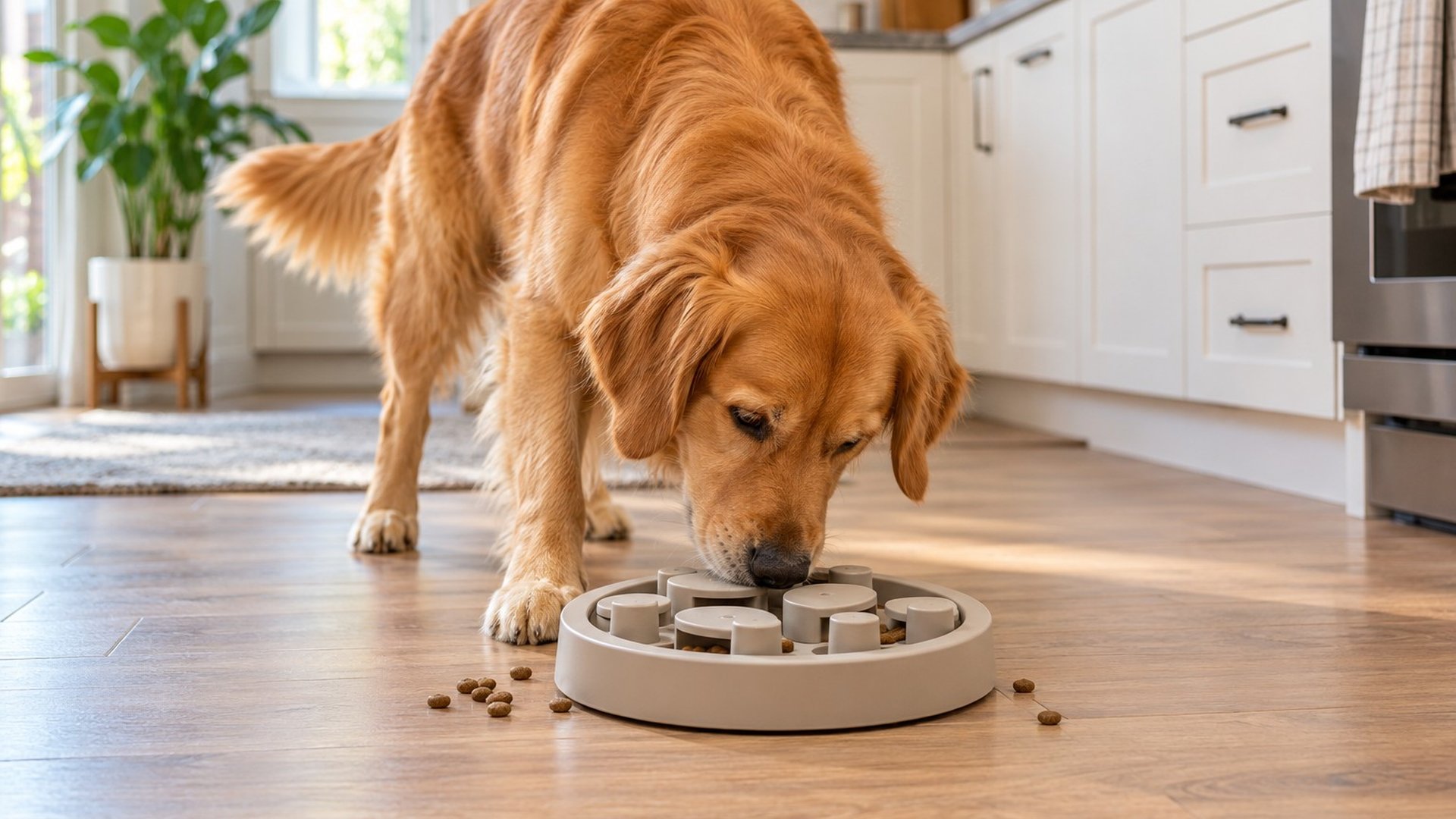
The best puzzle feeder for your dog is the one that matches how they eat, how they chew and how experienced they are with food puzzles. For a fast gulper, a slow-feeder bowl is usually the simplest start. For a dog who needs calming, a lick mat often suits. For a curious sniffer, a snuffle mat. For a confident problem-solver, a treat dispenser or a puzzle toy with levels. Whatever you choose, start easy, supervise, and make sure your dog wins early and often.
This guide compares the main types side by side, explains how to match one to your dog’s skill and chewing style, covers safety and cleaning, shows you how to introduce a feeder step by step with rewards, and finishes with free DIY options you can make from things already in your home.
At a glance
- Slow-feeder bowls slow down meals; lick mats, snuffle mats, dispensers and puzzle toys add more mental work.
- Choose by your dog’s chewing style first. A strong chewer needs tougher materials and closer supervision.
- Start with the easiest setting so your dog succeeds straight away, then raise the difficulty gradually.
- Use part of your dog’s daily food allowance in the feeder so they do not gain weight.
- Check feeders for damage and wash them after every use, as food residue can build up in grooves and fabric.
Why use a puzzle or slow feeder at all?
Dogs are natural foragers. In a bowl, a meal can disappear in seconds. In a feeder, the same food becomes a few minutes of sniffing, licking, pawing and thinking. That can help to:
- Slow down dogs who gulp their food
- Give busy, young or under-stimulated dogs a satisfying job
- Offer a calm activity for dogs who need to rest, such as during recovery when your vet has advised restricted exercise
- Build confidence in shy dogs through small, easy successes
- Create a pleasant routine when you leave the house or settle for the evening
Puzzle feeders work best as one part of a wider enrichment routine that includes walks, sniffing and play. For more ideas, see our list of 20 easy dog enrichment ideas.
The main types compared
| Type | How it works | Best for | Difficulty | Watch out for |
|---|---|---|---|---|
| Slow-feeder bowl | Ridges, mazes or bumps in the bowl make the dog work around them | Fast eaters, everyday meals | Easy | Patterns too deep for short-nosed dogs; deep grooves are harder to clean |
| Lick mat | Soft food is spread into a textured surface and licked off | Calming, grooming or nail-trim distraction, dogs on rest | Easy | Chewing or tearing the mat; use soft, dog-safe foods only |
| Snuffle mat | Dry food or treats are hidden among fabric strips for the dog to sniff out | Sniffers, dogs new to puzzles, short-nosed breeds | Easy to medium | Chewing and swallowing fabric; needs frequent washing |
| Treat-dispensing toy | A ball, wobbler or stuffable toy releases food as it is rolled, nudged or licked | Active dogs, independent play, longer-lasting meals | Easy to hard (adjustable on some) | Noise on hard floors; strong chewers may break thinner plastic |
| Puzzle toy with levels | Sliders, flaps, lids or spinners hide food; often graded by level | Confident problem-solvers, dogs who enjoy working with you | Easy to very hard | Small removable parts; frustration if started too hard |
How to choose the right one for your dog
1. Start with your dog’s chewing style
This is the most important safety question. If your dog shreds soft toys or chews plastic, start with sturdy, solid feeders and stay with them while they eat. Soft fabric snuffle mats and thin plastic puzzles suit gentle dogs who use their nose and paws rather than their teeth. RSPCA Queensland’s guidance on food-dispensing toys notes that some dogs chew parts such as lids or inserts, and that the wrong plastic can cause cuts if chewed. Our guide to choosing chews and chew toys safely explains how to judge your dog’s chewing strength.
2. Match the feeder to your dog’s skill level
A dog who has never used a puzzle may give up quickly if no food comes out. A dog who has done dozens may finish an easy toy in seconds and lose interest. RSPCA Queensland makes the same point: match the toy to your dog, because fast learners get bored with easy toys while others give up on hard ones.
- Beginner: slow-feeder bowl with shallow ridges, lick mat, snuffle mat with food scattered loosely, a stuffable toy filled loosely.
- Intermediate: rolling or wobbling dispensers, a snuffle mat with food tucked deeper, a level-one puzzle with simple flaps.
- Advanced: puzzles with sliders, lids and combined steps; frozen stuffable toys; adjustable dispensers on harder settings.
3. Think about your dog’s body
Short-nosed (flat-faced) breeds may struggle with deep, narrow slow-feeder patterns and often do better with snuffle mats, lick mats or shallow designs. Puppies need size-appropriate feeders that cannot be swallowed or broken into pieces. Senior dogs or dogs with stiff joints may prefer a feeder that stays still on a mat at a comfortable height rather than one that rolls across the room. See caring for a senior dog for more on adapting activities as dogs age.
4. Choose the right size
Any dispensing toy should be too big to fit fully in your dog’s mouth or be swallowed. Slow-feeder bowls should hold a full meal for your dog’s size without overflowing the ridges.
5. Consider your home
Rolling dispensers can be noisy on tiles and timber floors. Lick mats and slow bowls with suction cups or non-slip bases stay put. If you have more than one dog, give each their own feeder in a separate space so no one feels they have to guard their food.
6. Check how easy it is to clean
Look for feeders you can take apart, scrub easily or put in the dishwasher if the maker says it is dishwasher safe. RSPCA Queensland’s guidance points out that some puzzle toys are much harder to clean than others, which is worth thinking about before you buy.
Safety checklist
- Supervise your dog with any new feeder until you know how they use it, and always with fabric mats or toys with removable parts.
- Check the feeder before and after each use for cracks, sharp edges, loose pieces or chewed fabric. Throw away anything damaged.
- Choose sturdy, food-safe materials from reputable makers, and follow the maker’s care instructions.
- Pick up the feeder when the food is finished if your dog tends to chew it.
- Avoid foods that are toxic to dogs, including anything containing xylitol (a sweetener found in some peanut butters and sugar-free products), chocolate, grapes, raisins, onions and garlic.
- Feed dogs separately if there is any tension around food.
- If your dog swallows part of a feeder, or shows vomiting, gagging, a swollen belly or distress, contact your vet straight away.
Cleaning: a simple routine
- Rinse the feeder soon after use, before food dries in the grooves.
- Wash with hot, soapy water and a bottle brush or old toothbrush, paying attention to ridges, corners and inside openings.
- For snuffle mats, shake out crumbs and wash as the maker recommends, then dry completely so mould cannot grow.
- Rinse thoroughly and let everything dry fully before the next use.
- Have two of your most-used feeders so one can be drying while the other is in use.
How to introduce a puzzle feeder with rewards
The goal is for your dog to think “this is easy and fun” from the very first try. Frustration teaches dogs to walk away.
- Pick a quiet time when your dog is a little hungry but not frantic, such as before a normal meal.
- Use high-value food for the first sessions: small, tasty pieces your dog loves.
- Set it to the easiest level. Leave lids open, put food on top of the snuffle mat, fill dispensers loosely, or spread lick mats thinly.
- Let your dog see you load it, then place it on the floor and step back.
- Praise any interest. A sniff, a nudge or a paw all count. If your dog seems unsure, drop a treat beside the feeder, then on it.
- Keep sessions short and end while your dog is still enjoying it.
- Increase difficulty in small steps once your dog empties it quickly and confidently: close one flap, tuck food deeper, or move to a slightly harder toy.
- If your dog gets frustrated, such as barking, chewing the toy or walking away, go back a step and make it easier.
This is the same reward-based approach used in all good training. Our beginner’s guide to positive reinforcement explains why it works so well. Once your dog loves using their nose, scent work at home is a natural next step.
Using feeders as part of your dog’s daily food
Treats and food used in feeders all count towards your dog’s daily intake. The simplest way to avoid weight gain is to serve part or all of a regular meal through the feeder instead of adding extra on top. Measure your dog’s daily allowance first, then divide it between the bowl and the feeders. If you use soft foods on a lick mat, account for those too. Our guide on what to feed your dog covers balanced daily feeding, and your vet can help if your dog has a special diet or needs to lose weight.
Free and cheap DIY options
You do not need to spend money to get started. These ideas use everyday items, and all need supervision because dogs can chew and swallow cardboard, paper or fabric.
- Muffin tin game: put a few treats in a muffin tin and cover some cups with tennis balls or toys for your dog to lift away.
- Towel roll: lay an old towel flat, scatter dry food on it, roll it up loosely and let your dog unroll it.
- Cardboard box forage: scrunch paper inside a box with treats hidden among it. Suits dogs who do not eat paper.
- Toilet roll parcels: fold the ends of a cardboard tube over a few treats.
- Scatter feeding: scatter a portion of dry food on clean grass or a large mat for your dog to sniff out.
- Find-it game: hide small portions of food around one room, starting in plain sight.
Plastic bottles are best avoided for strong chewers, because broken plastic can have sharp edges. For more toy ideas by play style, see choosing the right toy for your dog’s play style.
Who each type suits, and who it does not
| Type | Great for | Less suitable for |
|---|---|---|
| Slow-feeder bowl | Gulpers, everyday meals, busy owners | Dogs needing a longer mental challenge |
| Lick mat | Calm time, grooming distraction, rest days | Dogs who chew through rubber or silicone |
| Snuffle mat | Beginners, sniffers, flat-faced dogs, seniors | Dogs who chew or eat fabric |
| Treat dispenser | Energetic dogs, longer independent play | Homes where noise is a problem; very strong chewers with thin toys |
| Levelled puzzle | Problem-solvers, shared play with you | Dogs who chew parts off, or who frustrate easily at first |
Common mistakes to avoid
- Starting too hard. A difficult first puzzle can put a dog off feeders entirely.
- Leaving fabric or plastic feeders with an unsupervised chewer. Swallowed pieces can cause serious problems.
- Adding feeder food on top of full meals. This is an easy way for dogs to gain weight.
- Only ever using one feeder. Rotating two or three keeps them interesting.
- Using a feeder as a substitute for time together. Feeders add enrichment; they do not replace walks, play and company. For dogs who struggle when alone, see our guide to separation anxiety in dogs.
- Skipping cleaning. Food left in grooves and fabric can go off quickly.
- Taking food away mid-puzzle as a “test”. This can create stress around food. Let your dog finish in peace.
Sources this guide draws on: RSPCA Queensland’s fact sheet on food-dispensing toys, general guidance from animal welfare organisations on canine enrichment, and well-established veterinary guidance on foods that are toxic to dogs. No product endorsements are made; check each maker’s care and safety instructions.
Handy gear for this guide
Practical picks we think suit this topic. As an Amazon Associate, Mind A Dog earns from qualifying purchases, at no extra cost to you. Prices and availability are set by Amazon and may vary by country.
- Outward Hound Fun Feeder Slo Bowl
Ridged bowl that slows down dogs who gulp their meals.
View on Amazon - LUKITO Lick Mat for Dogs (2 Pack)
Spread a little dog-safe food over it for a quiet licking activity.
View on Amazon - Amazon Basics Airtight Pet Food Storage Containers (3 Piece)
Keeps kibble and treats fresh and out of reach.
View on Amazon
Frequently asked questions
What is the best puzzle feeder for a dog who has never used one?
A snuffle mat with food scattered on top, a lick mat, or a shallow slow-feeder bowl is usually the easiest start. These give quick success with very little frustration. Once your dog is confident, move to a dispensing toy or a beginner-level puzzle.
Is a slow feeder the same as a puzzle feeder?
Not quite. A slow feeder is mainly designed to make a dog eat more slowly by putting obstacles in the bowl. A puzzle feeder asks the dog to solve something, such as sliding, lifting or rolling, to reach the food, so it offers more mental work.
Are puzzle feeders good for dogs every day?
For most dogs, yes, as long as the food is part of their daily allowance, the feeder is safe for their chewing style and they enjoy it. Rotate feeders to keep them interesting, and keep giving normal walks, play and time with you.
Can puppies use puzzle feeders?
Yes, with easy, size-appropriate feeders and close supervision. Puppies chew a lot, so avoid small parts and soft fabric they could swallow. Keep sessions short and very easy so they learn that feeders are fun.
My dog gets frustrated and gives up. What should I do?
Make it easier straight away. Use tastier food, open flaps or scatter food on top, and praise every attempt. Increase difficulty only when your dog empties the feeder quickly and happily. Some dogs simply prefer certain types, so try a different style.
How do I clean a snuffle mat or lick mat?
Shake crumbs out of a snuffle mat after each use and wash it as the maker recommends, then dry it completely. Rinse lick mats soon after use, scrub the grooves with a brush and hot soapy water, and let them dry fully. Replace either if they become torn or chewed.
The right puzzle feeder turns an ordinary meal into something your dog looks forward to. Start with the easiest option that suits their chewing style, keep it safe and clean, and build the challenge slowly. A dog who wins often will want to play again tomorrow.