
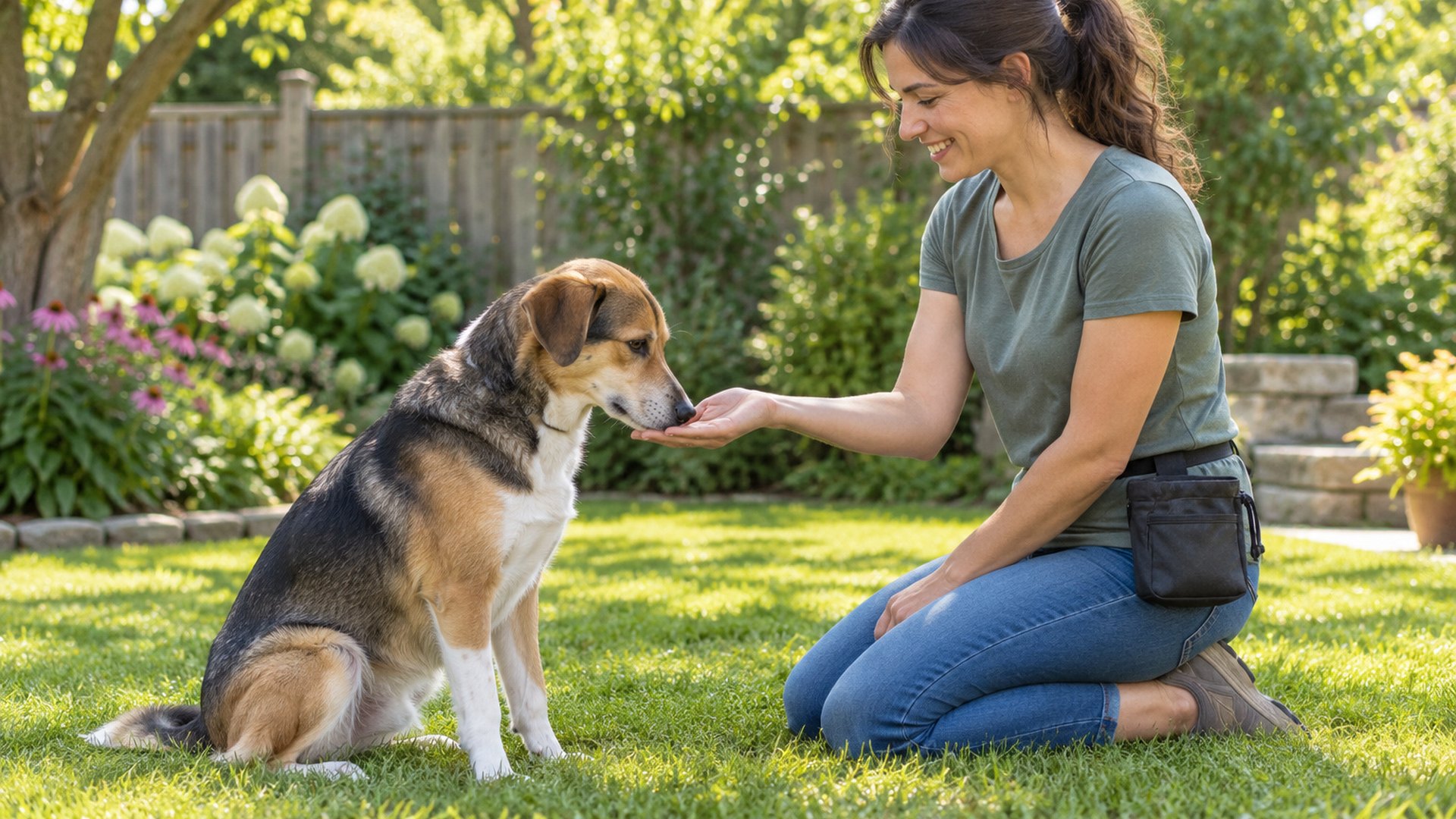
The easiest tricks to teach your dog are sit, down, touch (nose to your hand), watch me and wait. Most dogs pick each one up over a few short, reward-based sessions. Start with one trick, mark the exact moment your dog gets it right with a word such as “yes” or a click, reward straight away, and keep sessions to a few minutes.
This guide sets out a three-level “trick ladder”, from first steps to show-off tricks. Each trick comes with numbered steps and a fix for when your dog gets stuck, and the guide explains which skill each trick builds, how to adapt tricks for puppies, seniors and dogs with sore joints, and how to plan a session that ends on a win.
At a glance
- Start with sit, touch or watch me. They’re quick wins that build focus.
- Mark and reward immediately. Say “yes” or click the instant your dog gets it right, then give a small, tasty reward.
- Keep sessions short, a few minutes at a time, and stop while your dog is still keen.
- Never push, pull or force your dog into position. Lure or capture the behaviour instead.
- Pick tricks that suit your dog’s age, body and confidence.
Before you start: the reward-based method in five minutes
Every trick in this guide uses reward-based training, the approach recommended by the American Veterinary Society of Animal Behavior (AVSAB). Its position statement on humane dog training recommends reward-based methods exclusively, and advises against tools and techniques that rely on force, pain or intimidation. For the background, start with the basics of reward-based training. The essentials are:
- A marker. A short word (“yes”) or a clicker that tells your dog “that’s the bit that earned the reward.” Blue Cross suggests pairing the marker with a treat around 20 times before you start, so your dog learns what it means.
- A reward. Usually a pea-sized piece of something your dog loves. Some dogs work just as happily for a quick game with a toy.
- Timing. Blue Cross advises that the reward needs to happen immediately after the action, so your dog links the two. The marker lets you be precise even when you can’t hand over the treat instantly.
- Luring. Guiding your dog into position with a treat held at their nose. Fast for sit, down and spin.
- Capturing. Marking and rewarding something your dog does naturally, such as a stretch that becomes “take a bow.”
- Shaping. Rewarding small steps towards a finished trick, such as tidying toys away.
Treats add up. WSAVA’s guide to feeding treats recommends that treats make up no more than 10% of a dog’s daily calories, so use tiny pieces and count them as part of the day’s food.
Choosing the right first trick for your dog
Each trick builds a useful life skill as well as being fun. Use this table to pick a starting point that suits your dog.
| Trick | Difficulty (1 to 3) | Skill it builds | Good for | Skip or adapt if |
|---|---|---|---|---|
| Sit | 1 | Focus, polite greetings | Every dog, including puppies | Sore hips or back: teach “stand” instead |
| Down | 1 | Settling, calm | Every dog | Discomfort lying down: use a soft mat |
| Touch (hand target) | 1 | Focus, moving with you, confidence | Nervous dogs, puppies, seniors | Rarely needs adapting |
| Watch me | 1 | Focus around distractions | Excitable or easily distracted dogs | Don’t stare at worried dogs; reward a glance |
| Wait | 1 | Impulse control | Dogs who rush at food or doors | Keep it very short at first for young puppies |
| Stay | 2 | Impulse control, calm | Dogs who already know sit or down | Very young puppies: keep to a few seconds |
| Paw (shake) | 2 | Body awareness, handling | Calm, food-motivated dogs | Sore front legs or dogs who paw at people |
| Spin | 2 | Body awareness | Energetic dogs | Back, neck or balance problems |
| Fetch and drop it | 2 | Cooperation, play | Toy-loving dogs | Joint problems: roll the toy rather than throw it |
| Roll over | 3 | Body awareness, trust | Healthy, flexible dogs | Back, joint or tummy problems: ask your vet first |
| Take a bow | 3 | Body awareness, stretching | Most adult dogs | Sore shoulders or front legs |
| Go to your mat | 3 | Settling, calm at home and out | Busy households, visitors, cafés | Rarely needs adapting |
| Tidy up | 3 | Problem solving, chaining steps | Clever dogs who need a job | Dogs who guard toys: work on swaps first |
Level 1: foundation tricks
Sit
- Hold a treat at your dog’s nose, then slowly move it up and back over their head.
- As their nose lifts, their bottom will naturally lower. The moment it touches the floor, mark (“yes”) and reward.
- Repeat until your dog sits quickly as soon as your hand moves.
- Now say “sit” just as they start to sit, then mark and reward.
- Gradually use an empty hand as a signal, then the word alone, rewarding every success.
Stuck? If your dog jumps up, your hand is too high; keep the treat just above their nose. If they back up, practise with their back to a wall. Never press down on your dog’s rear.
Down (lie down)
- Start with your dog sitting.
- Hold a treat at their nose and slowly lower it straight down to the floor between their front paws.
- Pause, letting them work it out. Mark and reward the moment their elbows touch the floor.
- Add the word “down” as they lower themselves, once they follow the lure reliably.
- Fade the treat to a hand signal, then the word alone.
Stuck? If their bottom pops up, you’re moving the treat forward too fast; lower it straight down and slowly. Some dogs find it easier to crawl under your bent leg or a low coffee table to reach the treat. RSPCA guidance also suggests keeping “down” only for lying down, and using a different word such as “off” for getting off the sofa.
Touch (hand target)
This may be the most useful trick of all. It lets you move your dog without pulling, helps nervous dogs approach new things, and gives an easy way to get their attention.
- Hold your open hand, palm facing your dog, a few centimetres from their nose.
- Most dogs will sniff it. Mark the moment their nose touches your palm, then reward from your other hand.
- Repeat, moving your hand slightly left, right, higher and lower.
- Add the word “touch” just before you present your hand.
- Gradually move your hand further away so your dog takes a step or two to reach it.
Stuck? Rub a little treat on your palm to make it interesting, then fade this quickly.
Watch me (eye contact)
- Hold a treat, then wait. Most dogs will look from the treat to your face.
- Mark the instant they glance at your eyes, then reward.
- Once they offer eye contact reliably, add “watch me” just before.
- Build up to a second or two of eye contact, then practise with mild distractions nearby.
Stuck? Bring the treat up towards your eyes to draw their gaze, then fade this. For shy dogs, a brief glance is plenty; never force eye contact.
Wait (including before meals)
- Hold your dog’s bowl at chest height. If they jump or rush, simply raise it again.
- Start lowering it. The moment they hold still, keep going; if they move towards it, lift it back up.
- When the bowl reaches the floor and they are still, say a release word (“okay”) and let them eat.
- Add the word “wait” at the start once they understand, and slowly increase the pause, a second at a time.
Stuck? Make it easier: a half-second pause is a win at first. Keep it kind; the goal is self-control, not frustration, and the meal is always the reward.
Level 2: next-step tricks
Stay
Stay builds on sit or down. Work on one thing at a time: first duration (how long), then distance (how far), then distraction (what’s happening around them).
- Ask for a sit or down, say “stay” with a flat-palm signal, wait one second, then mark and reward while your dog is still in position.
- Gradually increase the wait, a second or two at a time. RSPCA guidance suggests building slowly towards around 20 seconds.
- Next, take one small step away and straight back, then reward. Build distance slowly.
- Finally, add mild distractions, such as bouncing a ball gently, while you stand close.
- Always end with your release word so your dog knows when stay is over.
Stuck? If your dog breaks the stay, you’ve made it harder too quickly. Go back to the last step they could do and practise when they’re slightly tired. Never use “stay” to leave a dog alone near a road or other danger.
Paw (shake)
- With your dog sitting, hold a treat in a closed fist low down near one front paw.
- Most dogs will sniff, then paw at your hand. Mark the moment the paw lifts or touches your hand, then open your hand to reward.
- Gradually wait for a higher lift, then present an open, flat hand for them to place their paw on.
- Add “paw” or “shake” once the movement is reliable.
Stuck? If your dog just mouths your hand, move it lower and to one side. Never lift the paw for them.
Spin
- Hold a treat at your dog’s nose and slowly draw a wide circle at their head height.
- Mark and reward when they complete the full circle.
- Gradually make your hand movement smaller until it becomes a little circling signal.
- Add “spin” for one direction and a different word, such as “twist,” for the other.
Stuck? Break it into quarter turns and reward each one, then half turns.
Fetch and drop it
Fetch is easier to teach as a game of swaps than as a chase. It also helps to choose the right toy: a Scottish BVA president has warned that throwing sticks can be very dangerous, as sticks can cut a dog’s mouth or lodge in the throat, and suggested rubber toy sticks, balls or frisbees as safer options. See this guide to safe toys for fetch.
- Play with a toy for a few seconds, then offer a treat or a second, identical toy right at your dog’s nose.
- The moment they let go, mark (“drop”) and reward, then give the first toy back. Giving up the toy should always lead to something good.
- Toss the toy a short distance. When your dog picks it up, back away a few steps and call them cheerfully.
- When they come to you, swap for the treat or second toy, then throw again.
- Gradually increase the distance as your dog gets the pattern.
Stuck? If your dog runs off with the toy, practise in a hallway or small room, and never chase them; it turns into a game of keep-away.
Level 3: show-off tricks
Roll over
Only teach this to a healthy, comfortable dog, on a soft surface. Skip it, or check with your vet first, for dogs with back, joint or tummy problems, and for deep-chested breeds if you’re unsure.
- Start from a down. Hold a treat by your dog’s nose and move it back towards their shoulder, so they roll onto one hip. Mark and reward.
- Next, continue the lure over their shoulder so they roll onto their side. Mark and reward.
- Then lure a little further so they roll onto their back and over to the other side.
- Add “roll over” once they complete the movement, and fade the lure to a hand circle.
Stuck? Reward each stage separately for a few sessions before linking them together.
Take a bow
- Capture it: many dogs bow naturally when they stretch after a nap. Mark and reward the moment they do it.
- Or lure it: with your dog standing, lower a treat from their nose towards the floor between their front paws, drawing it slightly back towards their chest.
- Mark the moment their elbows dip while their bottom stays up, then reward.
- Add “bow” and gradually ask for a second of holding the position.
Stuck? If your dog lies down fully, mark sooner, as soon as the elbows start to dip. A gentle hand under the tummy is not needed; just reward earlier.
Go to your mat
Teaching a dog to go to a mat and relax there is a brilliant life skill for visitors, mealtimes and cafés. It deserves a full plan of its own, so follow the full settle-on-a-mat guide.
Tidy up (put your toys away)
This is a “chain” of three smaller tricks: pick up, carry and drop into a box. Teach each link, then join them.
- Teach “drop” over a low, open box: hold the box under your dog’s mouth when they let go of a toy, then mark and reward.
- Gradually move the box a little further away, so they take a step to drop the toy in.
- Place a toy on the floor near the box. Reward picking it up and dropping it in.
- Add more toys and a little more distance, one change at a time.
- Add the cue “tidy up” once the whole chain is smooth.
Stuck? Go back to the last link that worked and reward it generously before adding the next one.
How to plan a five-minute trick session
- Choose one trick and a quiet spot with few distractions.
- Prepare 15 to 20 pea-sized treats, counted as part of your dog’s daily food.
- Decide on your marker word and use the same one every time.
- Do 5 to 10 repetitions, then take a short play or sniff break.
- Stop on a success, while your dog still wants more. Blue Cross suggests sessions of about two to five minutes, little and often.
- Note what worked. Next time, make it slightly harder in one way only.
Tricks for puppies, seniors and dogs with sore joints
Puppies learn fast but tire quickly. Stick to Level 1 tricks, keep sessions to a minute or two, and fold training into play. Touch, sit and watch me are perfect early lessons.
Older dogs can absolutely learn new tricks. Training keeps their minds busy, and gentle, low-impact tricks such as touch, watch me, nose targets and scent games suit them well. Use a non-slip surface and skip anything that involves jumping, spinning fast or rolling.
Dogs with joint, back or other health problems should skip roll over and fast spins, and may find sit or down uncomfortable. “Stand,” touch and watch me are kind alternatives. If you’re unsure whether a trick is suitable, check with your vet first.
Troubleshooting: when your dog gets stuck
| Problem | Likely reason | Try this |
|---|---|---|
| Dog loses interest | Session too long, or the reward isn’t exciting enough | Shorter sessions and a tastier treat; train before meals, not straight after |
| Dog jumps at the treat | Lure held too high or moved too fast | Keep the treat at nose level and move slowly |
| Won’t lie down | Hard or slippery floor, or the lure moves forward | Use a soft mat and lower the treat straight down |
| Breaks the stay | Too much time, distance or distraction added at once | Go back a step and change one thing at a time |
| Won’t drop the toy | Dropping it means the game ends | Always swap for something good, then give the toy back |
| Only does it at home | Dogs don’t generalise easily to new places | Practise in new rooms, then the garden, then quiet outdoor spots |
If you’d like hands-on help, here is how to find a reward-based trainer.
Common mistakes
- Sessions that go on too long, so your dog gets bored or frustrated.
- Adding the cue word too early, before your dog reliably does the behaviour.
- Repeating the cue: “sit, sit, SIT” teaches your dog the cue is “sit” said three times.
- Marking late, so the reward lands on the wrong behaviour.
- Pushing your dog’s rear down or forcing a paw, which erodes trust and slows learning.
- Raising time, distance and distraction all at once.
- Throwing sticks for fetch instead of a dog-safe toy.
- Scolding mistakes. Simply reset and make the next attempt easier.
- Missing stress signals such as lip licking, yawning or turning away. Learn the signs your dog needs a break.
Sources this guide draws on: the American Veterinary Society of Animal Behavior’s position statement on humane dog training; Blue Cross guidance on dog and puppy training; the RSPCA’s guide to teaching basic commands; the WSAVA Global Nutrition Committee’s guide to feeding treats; and the British Veterinary Association’s warning about throwing sticks for dogs.
Handy gear for this guide
Practical picks we think suit this topic. As an Amazon Associate, Mind A Dog earns from qualifying purchases, at no extra cost to you. Prices and availability are set by Amazon and may vary by country.
- Mighty Paw Dog Training Treat Pouch
Magnetic clasp keeps treats handy and stops spills on walks and training sessions.
View on Amazon - Dog Training Clicker with Wrist Strap
A clear, consistent marker sound for reward-based training.
View on Amazon - Zak George’s Dog Training Revolution (book)
A friendly, reward-based guide to raising a well-behaved dog.
View on Amazon
Frequently asked questions
What is the easiest trick to teach a dog?
Sit is usually the quickest, because a treat moved over the head makes most dogs sit naturally. Touch, where your dog presses their nose to your hand, is just as easy and even more useful.
How long does it take to teach a dog a trick?
Simple tricks such as sit or touch often click within a few short sessions, while chained tricks like tidying up can take weeks. Short, regular sessions of a few minutes work far better than one long one.
How do you teach a dog to stay?
Start with a one-second stay right beside your dog, reward, and release. Then build duration, distance and distraction slowly, one at a time, going back a step whenever your dog breaks the stay.
How do I teach my dog to fetch and bring the toy back?
Teach “drop” first by swapping the toy for a treat or a second toy, then give the first toy back. Throw it a short way, back away and call your dog cheerfully, and swap again when they reach you.
Can you teach an older dog new tricks?
Yes. Older dogs often enjoy the mental workout, and calm, low-impact tricks such as touch, watch me and scent games suit them. Skip anything that strains their joints, and check with your vet if your dog has health problems.
Do I need a clicker to teach tricks?
No. A short marker word such as “yes,” said the same way every time, works well. A clicker can be a little more precise, and a hand signal such as a thumbs up works for deaf dogs.
Tricks are play with a purpose. A few minutes a day builds a calmer, more confident dog and a better bond. When your dog has mastered a few, try scent games as a next step, browse more ways to keep your dog’s brain busy, or work on recall, the most important trick of all.