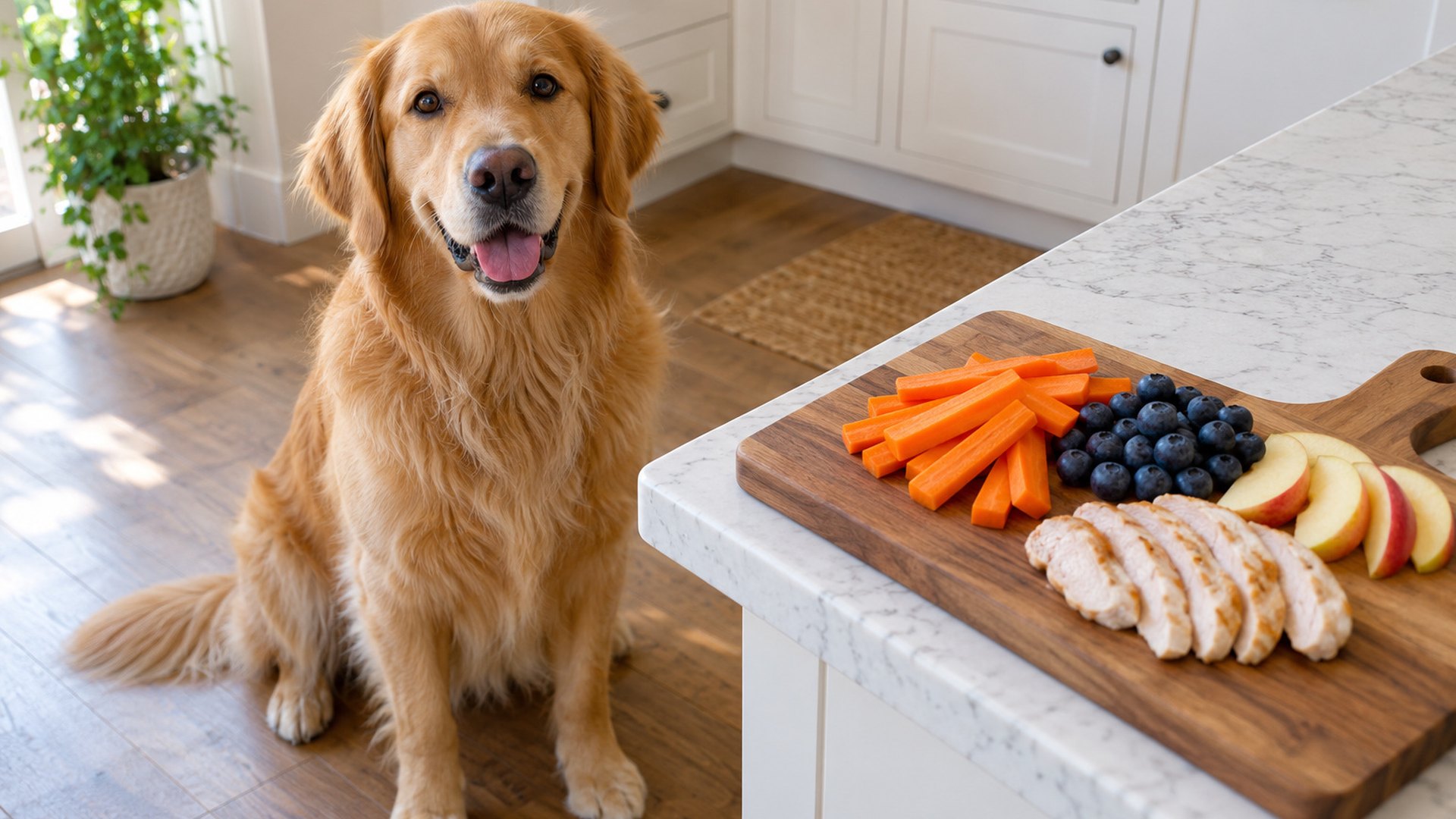
Many plain human foods are safe for dogs in small amounts, including cooked lean chicken or turkey, fully cooked eggs, plain boiled rice, carrots, cucumber, apple (without the core or seeds), blueberries and seedless watermelon. Some everyday foods are dangerous even in small amounts, especially grapes and raisins, chocolate, onions and garlic, macadamia nuts and anything containing the sweetener xylitol. Keep all treats to a small share of your dog’s daily food, and call your vet or a pet poison helpline straight away if your dog eats something on the “never” list.
This guide gives you a quick traffic-light table of common foods, how to serve the safe ones, why the dangerous ones are dangerous, a full section on milk and dairy, a label check for hidden xylitol, a seasonal hazard calendar for both hemispheres, and a simple checklist to use before you share.
At a glance
- Plain is key: no onion, garlic, salt, butter, sauces or seasoning.
- Never: grapes, raisins, currants and sultanas; chocolate; onion, garlic, leeks and chives; macadamia nuts; xylitol; alcohol; caffeine; raw yeast dough; cooked bones.
- Treats, including human food, should be no more than 10% of your dog’s daily calories.
- Dogs have little of the enzyme that digests milk sugar, so dairy upsets many tummies.
- If your dog eats something dangerous, call for advice now. Don’t wait for symptoms.
If your dog has eaten something on the “never” list
- Call your vet, an emergency vet or a pet poison helpline straight away, even if your dog seems fine. Signs of some poisonings take hours to appear.
- Helplines by region: in the US, the ASPCA Animal Poison Control Center and Pet Poison Helpline; in the UK, Animal PoisonLine, which charges a fee per case; in Australia and New Zealand, the Animal Poisons Helpline, which runs 24/7 and says it is free for pet owners there. Fees and services can change, so check when you call.
- Have ready: what was eaten (keep the packaging), roughly how much, when, and your dog’s weight, age and any health conditions.
- Don’t try to make your dog vomit unless a vet or helpline tells you to. The American Kennel Club advises against using hydrogen peroxide at home, and vets warn that home attempts can cause more harm.
For other symptoms, here is a guide to when to call the vet.
The safe, caution and never list
Use this table for a quick answer. “Safe” means safe for most healthy dogs in small, plain portions; dogs with health conditions or special diets may need different advice from their vet.
| Food | Verdict | Why | How to serve (or what to do) |
|---|---|---|---|
| Chicken | Safe | Lean protein | Cooked, plain, skinless and boneless |
| Turkey | Safe | Lean protein | Cooked; remove skin, fat and bones; no seasoning |
| Lean beef | Safe | Protein | Cooked, plain, fat trimmed |
| Salmon | Safe | Protein | Fully cooked and boneless; raw or undercooked salmon can carry parasites |
| Eggs | Safe | Protein | Fully cooked, plain |
| Prawns (shrimp) | Caution | Fine in small amounts | Fully cooked, shell removed, only a few occasionally |
| Tuna | Caution | Mercury and salt | Small amounts only; tinned in water, unseasoned |
| Rice | Safe | Plain carbohydrate | Boiled in water with no seasoning |
| Bread | Caution | Little nutritional value | A small piece of plain bread only; never with raisins |
| Sweet potato | Caution | Fine in small amounts | Cooked soft and peeled; never raw |
| Carrots | Safe | Low-calorie crunch | Raw or cooked, washed, cut into bite-sized pieces |
| Cucumber | Safe | Low-calorie, watery | Washed, sliced; never pickled |
| Tomato (ripe red fruit) | Caution | Green parts contain toxins | A little ripe flesh only; no green tomatoes, leaves or stems |
| Mushrooms (shop-bought) | Caution | Plain ones are generally safe | Plain only, no butter, garlic or onion |
| Wild mushrooms | Never | Toxic types are hard to tell apart | Contact your vet straight away if eaten |
| Corn kernels | Caution | Fine off the cob | Plain kernels only |
| Corn on the cob | Never | The cob can block the intestines | Bin cobs where your dog can’t reach |
| Popcorn | Caution | Salt, butter and unpopped kernels | Plain, air-popped, fully popped, a few pieces |
| Apple | Safe | Crunchy, fibre | Washed; remove core, seeds and stem; slices or cubes |
| Banana | Safe | Higher in natural sugar | Peeled, an occasional small piece |
| Blueberries | Safe | Low-calorie | Washed; halve for very small dogs |
| Strawberries | Safe | Low-calorie | Fresh or frozen, stems and leaves removed, cut small; never syrup-packed |
| Watermelon | Safe | Very watery | Seeds and rind removed, bite-sized pieces |
| Avocado | Caution | High fat; the stone can cause choking or a blockage | Best skipped; never guacamole, skin or stone |
| Coconut flesh | Caution | Can upset the stomach | A tiny amount at most; keep the husk away |
| Cheese | Caution | High fat; some lactose | A small cube; lower-fat types; never with garlic, onion or chives |
| Plain yoghurt | Caution | Dairy can upset some dogs | Plain, no added sugar or sweeteners, a spoonful |
| Milk | Caution | Lactose can cause diarrhoea | Water is the better drink; see the milk section |
| Peanut butter | Caution | Some brands contain xylitol | Check the label every time; unsalted, a small smear |
| Cashews | Caution | High fat and calories | Unsalted, only one or two occasionally |
| Almonds | Never | Can cause choking or blockages if not chewed | Keep away, especially salted ones |
| Pecans and walnuts | Never | High fat; can cause vomiting, diarrhoea and possibly pancreatitis | Keep away |
| Ham | Caution | High in salt and fat | A small piece occasionally at most |
| Salty snacks (crisps, pretzels) | Never | Too much salt can make dogs very ill | Keep out of reach |
| Raw meat and raw eggs | Caution | Can carry bacteria such as Salmonella and E. coli | Cook it; ask your vet before feeding any raw diet |
| Cooked bones | Never | Can injure or block the gut | Use a vet-approved chew instead |
| Grapes, raisins, currants, sultanas | Never | Can cause kidney damage; no known safe amount | Call your vet or a helpline straight away |
| Chocolate and cocoa | Never | Methylxanthines; darker chocolate is worse | Call your vet or a helpline straight away |
| Onion, garlic, leeks, shallots, chives | Never | Damage red blood cells | Watch for hidden sources in gravy, stock and seasoning |
| Macadamia nuts | Never | Weakness, tremors, vomiting, high temperature | Call your vet or a helpline straight away |
| Xylitol (birch sugar) | Never | Dangerously low blood sugar; possible liver damage | Call your vet immediately; don’t wait for signs |
| Alcohol | Never | Absorbed quickly; can be life-threatening | Call your vet straight away |
| Coffee, tea, energy drinks | Never | Caffeine | Call your vet or a helpline |
| Raw yeast dough | Never | Expands in the stomach and produces alcohol | Call your vet straight away |
Safe human foods for dogs, and how to serve them
The safest way to share is to treat human food as a small, plain extra, not a meal. Introduce one new food at a time in a small amount, and watch for an upset tummy over the next day.
Proteins
Plain cooked chicken, turkey and lean beef, fully cooked fish such as salmon, and fully cooked eggs are all good options. The WSAVA Global Nutrition Committee’s treat guide lists lean, skinless cooked chicken and turkey breast among the lower-calorie choices. Always remove bones, skin and visible fat, and never add seasoning, garlic or onion. The American Kennel Club (AKC) advises against raw or undercooked salmon because of parasites, and the ASPCA notes that raw meat and eggs can carry bacteria.
Vegetables
Carrots and cucumber are crunchy, low-calorie favourites. The AKC suggests cutting carrots into bite-sized chunks to reduce choking risk, and serving cucumber plain rather than pickled. Ripe red tomato is fine in small amounts, but the green parts of the plant are not. Sweet potato should always be cooked soft and peeled, and only given in small amounts. Corn is fine off the cob.
Fruit
Apple slices (core, seeds and stem removed), blueberries, strawberries, peeled banana and seedless watermelon without the rind are popular treats. Fruit contains natural sugar, so keep portions small: a slice or a few berries, not a bowlful. Frozen pieces of safe fruit make a cooling summer treat, and small food rewards work well in puzzle feeders too.
Grains and starches
Plain boiled rice is gentle and commonly used in dog foods. A small piece of plain bread is acceptable, though the AKC notes it adds little nutritional value. Never share garlic bread, buttery or sauced dishes, or anything containing raisins.
For the bigger picture of what your dog needs day to day, see the basics of a complete, balanced diet.
Foods to give with caution
- Fatty foods and table scraps. The Merck Veterinary Manual notes that eating rubbish, large amounts of table scraps or other unsuitable food is believed to be a common risk factor for pancreatitis in dogs, a painful inflammation of the pancreas. Fatty roast trimmings, skin and gravy are the classic culprits.
- Cheese. The AKC notes cheese is high in fat, so offer only small amounts and choose lower-fat types. Avoid cheeses with garlic, onion or chives.
- Peanut butter. Many dogs love it, but some brands contain xylitol. Read the label every time, even on a brand you’ve bought before.
- Corn. The kernels are fine; the cob is a serious blockage risk.
- Salty foods. Ham, salted nuts and crisps are high in salt, and the ASPCA warns that too much salt can cause vomiting, tremors and worse.
- Avocado. The ASPCA’s main concern is for birds, rabbits and horses rather than dogs, but avocado is very fatty and the stone can cause choking or a blockage, so it’s best skipped.
Foods dogs should never eat, and why
Grapes, raisins, currants and sultanas. These can cause kidney damage. The exact toxin is still debated: the ASPCA suspects tartaric acid. Some dogs react badly to small amounts while others seem unaffected, and there is no known safe amount, so treat any ingestion as an emergency. Watch out for fruit cake, hot cross buns, trail mix and cereal bars.
Chocolate. Chocolate contains methylxanthines (theobromine and caffeine), which can cause vomiting, diarrhoea, a racing heart, tremors and seizures. Dark chocolate, baking chocolate and cocoa powder are the most dangerous; white chocolate carries the least risk, but it is still not a treat.
Onions, garlic, leeks, shallots and chives. This family of plants (alliums) can damage red blood cells and lead to anaemia. The AKC notes that garlic is significantly more toxic than the others and that signs can be delayed by days. They often hide in gravy, stock, sauces and seasoning mixes.
Macadamia nuts. These can cause weakness, wobbliness, vomiting, tremors and a raised temperature, usually within 12 hours.
Xylitol. This sweetener can cause a dangerous drop in blood sugar and, according to the ASPCA, liver damage. See the label section below.
Alcohol, caffeine and raw yeast dough. Alcohol is absorbed quickly; caffeine affects the heart and nervous system; and raw bread dough can expand in the stomach, causing painful bloating, while also producing alcohol.
Cooked bones. Bones can splinter, injure the mouth or gut, or cause a blockage that needs surgery. WSAVA advises that bones, cooked or raw, can be very dangerous. There are safer chew options than cooked bones.
Can dogs drink milk? Dairy and lactose explained
Many people picture a puppy lapping a saucer of milk, but milk isn’t an ideal drink for dogs. According to the ASPCA, pets have little lactase, the enzyme needed to break down lactose (milk sugar). Undigested lactose can cause diarrhoea, wind and other tummy upsets.
So, is milk bad for dogs? Not poisonous, but often poorly tolerated. Some adult dogs manage a small lick of milk without trouble; others get an upset stomach from a little. Fresh water is always the right everyday drink.
- Cheese and yoghurt contain less lactose than milk, so many dogs tolerate a small amount of plain yoghurt, cottage cheese or a cube of cheese. The AKC suggests lower-fat options such as cottage cheese.
- Puppies should not be given cow’s milk. VCA Animal Hospitals explains that cow’s milk has much less protein than a mother dog’s milk and more lactose, and that commercial puppy milk replacers are recommended for puppies who need milk feeding. Once weaned, puppies don’t need milk at all.
- Lactose-free “dog milk” products are sold in many countries. They’re a treat rather than a necessity, and they count towards the daily treat allowance.
If dairy seems to upset your dog, skip it. Here is more on supporting your dog’s digestion.
Hidden dangers: reading labels for xylitol
Xylitol is the one to watch, because it appears in products that don’t seem “sweet.” The AKC lists places it can turn up, including:
- Sugar-free chewing gum and mints.
- Some peanut butters, especially specialty brands.
- Toothpaste and other dental products for people.
- Chewable vitamins, supplements and some flavoured medicines.
- Sugar-free yoghurt, puddings, baked goods and chocolate.
It may be listed as xylitol or birch sugar. Phrases such as “sugar-free,” “reduced sugar” or “no added sugar” are a cue to read the ingredients closely. Keep handbags, coat pockets and bathroom cabinets out of your dog’s reach. The habit of reading labels like a pro is useful well beyond dog food.
Seasonal food hazards through the year
Holidays fall in different seasons depending on where you live, so this calendar is arranged by occasion.
| Occasion | When | Watch out for |
|---|---|---|
| Christmas | December (winter in the north, summer in the south) | Chocolate, Christmas pudding, mince pies and fruit cake (raisins, currants, sultanas), fatty roast scraps, cooked bones, alcohol |
| Easter | March or April (spring in the north, autumn in the south) | Chocolate eggs, hot cross buns (raisins and currants) |
| Barbecue season | Roughly June to August in the north, December to February in the south | Corn cobs, cooked bones, fatty sausages and scraps, onion- and garlic-heavy marinades, salty snacks, alcohol |
| Halloween | 31 October | Chocolate, sugar-free sweets and gum (xylitol), raisin snack boxes |
| Birthdays and parties | All year | Cake, chocolate, unattended plates and drinks, sugar-free treats |
At busy gatherings, give your dog a quiet spot with a chew or puzzle toy, and ask guests not to share food.
How much human food is OK?
WSAVA’s guidance is that treats, including human food, should make up no more than 10% of a dog’s daily calories, and should never replace a complete and balanced meal. In plain words: if you picture your dog’s daily food as ten equal parts, treats of every kind, including training rewards and table titbits, should add up to no more than one of those parts. On days you share more, give a little less of the regular food.
The quiet risk is weight gain. Small extras add up quickly, especially for small dogs, and extra weight puts strain on the body. Here is why a healthy weight protects joints. Crunchy vegetables such as carrot and cucumber are a lower-calorie way to share, and they fit well alongside a regular dental care routine as an alternative to high-calorie chews.
A safe-sharing checklist
- Is it on the safe list?
- Is it plain: no onion, garlic, salt, butter, sauces or seasoning?
- Have bones, stones, seeds, cores, skins and rinds been removed where needed?
- Is it cut to a safe size for your dog?
- Does the label list xylitol or birch sugar?
- Is it a small treat that fits within the daily allowance?
- Is it new? Try a small amount first and watch for tummy upset.
- Does your dog have a health condition or special diet? Check with your vet first.
Common mistakes
- Sharing leftovers cooked with onion or garlic, such as stews, gravy and stuffing.
- Giving cooked bones from the roast or barbecue.
- Assuming a “natural” peanut butter is xylitol-free without reading the label.
- Thinking one grape or raisin won’t hurt.
- Fatty scraps after holiday meals.
- Giving cow’s milk to puppies.
- Letting human food become too much of the diet.
- Waiting for symptoms after a dangerous food instead of calling for advice straight away.
Related guide: Can Dogs Eat Pineapple? The Safe, Smart Way to Share It.
Related guide: Can Dogs Have Cinnamon? The Safe Truth and Mistakes to Avoid.
Related guide: Can Dogs Eat Avocado? The Right, Safe Answer for Owners.
Related guide: Can Dogs Eat Eggs? The Safe, Simple Way to Serve Them.
Related guide: Is Peanut Butter Good for Dogs? The Safe, Smart Answer.
Sources this guide draws on: the ASPCA Animal Poison Control Center’s guidance on people foods to avoid feeding pets; the WSAVA Global Nutrition Committee’s guide to feeding treats to your dog; the American Kennel Club’s owner guidance on human foods, individual fruits and vegetables, grapes and xylitol; the Merck Veterinary Manual’s owner information on pancreatitis; VCA Animal Hospitals on feeding orphaned puppies; and the PDSA (Animal PoisonLine) and the Animal Poisons Helpline for helpline details.
Handy gear for this guide
Practical picks we think suit this topic. As an Amazon Associate, Mind A Dog earns from qualifying purchases, at no extra cost to you. Prices and availability are set by Amazon and may vary by country.
- Outward Hound Fun Feeder Slo Bowl
Ridged bowl that slows down dogs who gulp their meals.
View on Amazon - LUKITO Lick Mat for Dogs (2 Pack)
Spread a little dog-safe food over it for a quiet licking activity.
View on Amazon - Amazon Basics Airtight Pet Food Storage Containers (3 Piece)
Keeps kibble and treats fresh and out of reach.
View on Amazon
Frequently asked questions
What human food can dogs eat every day?
Small amounts of plain foods such as cooked lean chicken, carrots, cucumber or a few blueberries can be part of most dogs’ daily treat allowance. Keep all treats to no more than about 10% of daily calories, and make sure the main diet is a complete and balanced dog food.
Can dogs drink milk?
Some dogs can manage a small amount, but many have trouble digesting lactose, which can cause diarrhoea. Water is the best drink, and puppies who need milk should have a puppy milk replacer, not cow’s milk.
Can dogs eat cheese or yoghurt?
Usually yes, in small amounts. Choose plain yoghurt with no added sugar or sweeteners, and lower-fat cheeses without garlic, onion or chives, and skip dairy if it upsets your dog’s tummy.
Are grapes really that dangerous for dogs?
Yes. Grapes, raisins, currants and sultanas can cause kidney damage, some dogs react to small amounts, and there is no known safe amount. If your dog eats any, call your vet or a pet poison helpline straight away.
Can dogs eat peanut butter?
Plain, unsalted peanut butter without xylitol is fine as an occasional small treat. Always check the label for xylitol or birch sugar, because some brands contain it and it is very dangerous for dogs.
What should I do if my dog ate something toxic?
Call your vet, an emergency vet or a pet poison helpline straight away, even if your dog seems well. Have the packaging, the amount and the time to hand, and don’t try to make your dog sick unless you’re told to.
Sharing food can be a lovely part of life with a dog. Plain, small and safe is the rule, and when in doubt, leave it out.