
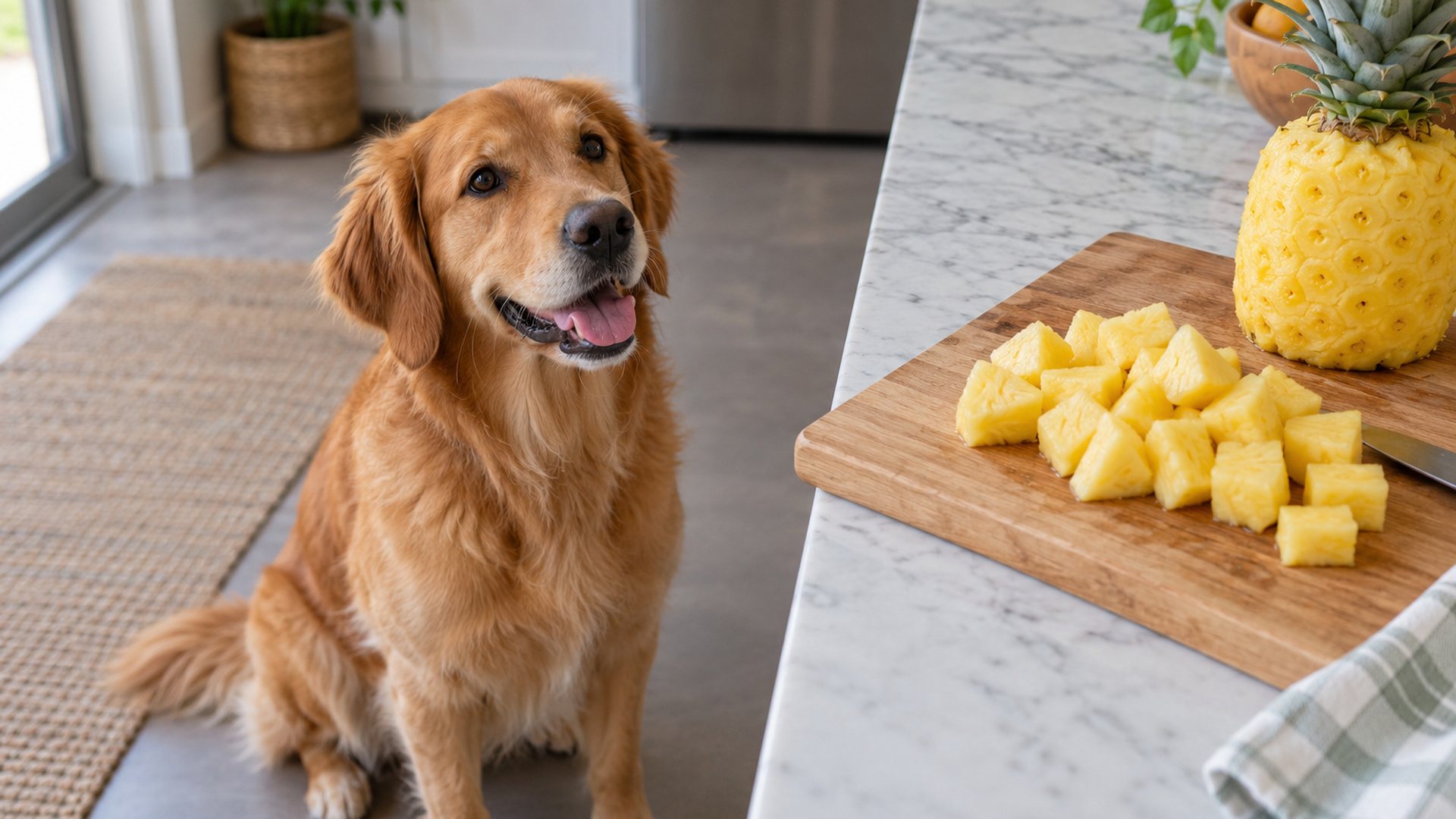
Yes, most healthy dogs can eat a little fresh pineapple. Peel it, remove the hard core and cut the soft flesh into small pieces, and treat it as an occasional snack rather than part of the main diet. Skip canned pineapple in syrup, sweetened dried pineapple and anything with the skin, crown or core attached.
This guide covers which forms of pineapple are fine and which are not, how much makes sense for dogs of different sizes, who should skip it altogether, and what the evidence really says about the popular claim that pineapple stops dogs eating poop.
At a glance
- Fresh, ripe pineapple flesh is not toxic to dogs and is fine as a small, occasional treat.
- The core, spiky skin and leafy crown are tough and can cause choking or a gut blockage, so never offer them.
- Canned pineapple in syrup and sweetened dried pineapple carry extra sugar; fresh or plain frozen is the better choice.
- All treats together, pineapple included, should stay under 10% of your dog’s daily calories, the limit WSAVA (the World Small Animal Veterinary Association) recommends.
- No published study shows pineapple stops dogs eating poop, so don’t rely on it for that.
Is pineapple good for dogs?
Pineapple is a safe fruit for most dogs rather than a health food they need. The American Kennel Club lists raw pineapple, in small amounts, as a good snack. It is mostly water and contains natural sugar, a little fibre and vitamin C. According to USDA FoodData Central, 100 g of raw pineapple has about 50 kcal, roughly 9.9 g of sugars, 1.4 g of fibre and around 48 mg of vitamin C.
That nutrition label sounds impressive for a fruit, but keep it in perspective. A dog eating a complete and balanced dog food already gets the vitamins and minerals it needs, and healthy dogs can make their own vitamin C. Think of pineapple as a juicy, low-fat reward that many dogs enjoy, not as a supplement. The real benefit is that it can replace a richer, higher-fat treat now and then.
The downsides are the sugar and fibre. Pineapple is quite sweet for a fruit, and a big serving can bring on loose stools or an upset stomach, especially in dogs that are not used to new foods. The AKC notes that if pineapple gives your dog diarrhoea or a sore tummy, it is simply not a good fit for that dog.
Fresh, frozen, canned or dried: which pineapple is safe?
The form of pineapple matters more than the fruit itself. Here is how the common options compare.
| Form | Verdict | Why | How to serve |
|---|---|---|---|
| Fresh, ripe flesh | Best choice | Plain fruit, about 50 kcal per 100 g (USDA) | Peeled, cored, cut into small bite-size pieces |
| Frozen plain chunks | Fine in small amounts | Same fruit, just cold; check there is no added sugar | Thaw a little or cut smaller so it is not too hard to chew |
| Canned in juice | Occasional at most | Drained juice-pack pineapple has about 60 kcal and 14 g sugars per 100 g (USDA) | Drain and rinse; a piece or two only |
| Canned in syrup | Avoid | The syrup adds a lot of extra sugar | Choose fresh instead |
| Dried or candied pineapple | Avoid | Drying concentrates sugar and calories, and many products are sweetened | Choose fresh instead |
| Pineapple juice | Avoid | Sugar without the fibre, and easy to overdo | Offer fresh water instead |
| Core, skin and crown | Never | Hard and fibrous, so a choking and blockage risk | Put them straight in a lidded bin |
| Pineapple in desserts, pizza or cocktails | Avoid | Other ingredients may be fatty, salty, alcoholic or contain xylitol | Keep human dishes off the menu |
Why the core and skin are the real hazard
The AKC warns that the tough core and spiny skin can cause obstructions, so only the soft flesh should be fed. The core is dense and fibrous, and a dog that grabs a whole chunk from a chopping board or rummages in the kitchen bin can swallow pieces too big to pass. If your dog has eaten a core, a large piece of skin or the leafy crown, contact your vet or an animal poison helpline for advice, and watch for the signs listed further down.
How much pineapple can a dog eat?
There is no official “pineapple portion” for dogs, so the sensible guide is WSAVA’s treat rule. Treats should always make up less than 10% of a dog’s daily calories, and fruit counts as a treat. WSAVA’s treat guide gives approximate maximum daily treat calories for an average healthy adult dog at an ideal weight. The table below converts those figures into fresh pineapple, using the USDA value of about 50 kcal per 100 g.
| Dog’s body weight | Max treat calories per day (WSAVA) | Fresh pineapple that would use up the whole allowance | A sensible share |
|---|---|---|---|
| 2 kg | 14 kcal | About 28 g | One or two very small pieces |
| 10 kg | 47 kcal | About 94 g | A few small cubes |
| 20 kg | 79 kcal | About 158 g | A small handful of cubes |
| 30 kg | 108 kcal | About 216 g | A handful of cubes |
The middle column is the most your dog should have from all treats in a day, not a pineapple target. If your dog also gets training rewards, a chew or a filled toy, the space left for fruit shrinks. A good habit is to give pineapple instead of another treat, not on top of one. Your vet can work out your own dog’s calorie needs, which vary with age, activity and whether they are neutered.
Worked example
Take a 10 kg dog whose treat allowance is about 47 kcal. If that dog already has a small dental chew and a few training treats most days, there may be only 15 to 20 kcal left. That is roughly 30 to 40 g of fresh pineapple, which is a few small cubes. For a 2 kg toy dog the same thinking leaves room for little more than a fingertip-sized piece or two.
How to give your dog pineapple safely
- Choose ripe, fresh pineapple, or plain frozen chunks with no added sugar.
- Cut away the skin and crown, then remove the hard central core completely.
- Cut the soft flesh into pieces smaller than your dog would gulp whole. Smaller dogs need smaller pieces.
- Start with one small piece the first time, then wait a day to check for loose stools, vomiting or itchiness.
- If all is well, keep portions within the treat allowance in the table above.
- Bin the scraps in a lidded bin your dog cannot open, and keep fruit bowls out of reach.
- Stop and speak to your vet if your dog shows any tummy upset or seems unwell afterwards.
Frozen pineapple can be a nice cooling reward on hot days. Freeze small pieces rather than big chunks so they are easy to chew, and you can tuck a piece inside a stuffed toy (see these ideas for what to put in a Kong) for a longer-lasting snack.
Who should skip pineapple?
Pineapple is not a problem for most dogs, but some should avoid it or only have it with their vet’s blessing.
- Dogs with diabetes: pineapple has natural sugar, and any change to a diabetic dog’s food can affect their blood sugar control. Ask your vet before offering any fruit.
- Overweight dogs on a weight plan: every treat calorie counts. Lower-sugar options such as cucumber may fit better; your vet can advise.
- Dogs with sensitive stomachs or a history of diarrhoea: the sugar and fibre can trigger an upset.
- Dogs on a prescription or elimination diet: extra foods can interfere with the diet’s purpose, so check first.
- Young puppies: their diet should be built around a complete puppy food; keep extras tiny and occasional.
- Dogs that gulp: cut pieces especially small, or skip it.
Does pineapple stop dogs eating poop?
This is one of the most repeated tips online, and it does not hold up. The usual idea is that pineapple, or an enzyme in it, makes a dog’s droppings taste bad so the dog stops eating them. This guide could find no published study showing that pineapple has this effect.
What research does exist is not encouraging for food-based deterrents in general. A large owner survey by Benjamin Hart and colleagues at the University of California, Davis, published in Veterinary Medicine and Science in 2018, looked at many remedies owners had tried. Commercial products added to food, or given as tablets, were reported to succeed only 0% to 2% of the time, and the behavioural methods owners used were reported to work only 1% to 4% of the time. In other words, nothing added to the bowl reliably fixed the habit.
What usually helps more is management and kind training: picking up droppings promptly, walking on a lead in areas where poop is common, and rewarding your dog for coming away and looking at you. If the habit is new, sudden or comes with weight loss, a big appetite or other changes, it is worth a vet check, because health and diet problems can play a part. Our guide to why dogs do odd things explains more about where these habits come from, and positive reinforcement training gives you the tools to teach a reliable “leave it”.
Signs your dog has had too much, or swallowed something it shouldn’t
A few extra pieces of fresh pineapple usually cause nothing worse than soft stools. Problems are more likely if your dog ate a large amount, a sweetened product, or the core, skin or crown.
| What happened | Signs to watch for | What to do |
|---|---|---|
| Ate a lot of fresh flesh | Soft stools, diarrhoea, wind, an upset stomach | Skip treats for the day, offer water and call your vet if it lasts or your dog seems unwell |
| Ate the core, skin or crown | Repeated vomiting, not eating, tummy pain, straining, lethargy | Contact your vet or an animal poison helpline straight away |
| Ate a pineapple dessert, cake or drink | Depends on ingredients, such as xylitol, chocolate, raisins or alcohol | Check the ingredients and contact your vet or an animal poison helpline without waiting for signs |
If you are ever unsure, it is better to ring early. Our guide on when to call the vet sets out which signs need same-day help, and the dog diarrhoea guide explains when loose stools are serious.
Common mistakes
- Leaving the core in. It is the part most likely to cause a blockage. Cut it out every time.
- Using canned pineapple in syrup. The syrup adds sugar your dog does not need. Choose fresh or plain frozen.
- Assuming dried fruit is the same. Dried pineapple packs much more sugar into each bite, and many products are sweetened.
- Adding pineapple on top of other treats. Swap it in for another reward so the daily total stays under 10%.
- Sharing human dishes. Pineapple cakes, pizzas, smoothies and cocktails can contain ingredients that are dangerous for dogs.
- Relying on pineapple to stop poop eating. There is no evidence it works. Management and reward-based training do more.
- Leaving scraps in an open bin. Many dogs will raid the bin for the sweet core and skin.
Better or equal alternatives
If your dog enjoys fruit, there are other options with similar appeal. Our list of which human foods dogs can eat compares fruits and vegetables side by side, and the guide to healthy dog treats explains how to build a treat routine that fits the 10% rule. For training sessions, small soft rewards usually work better than fruit; see the guide to the best treats for training.
Sources this guide draws on: American Kennel Club guidance on pineapple for dogs; USDA FoodData Central nutrient data for raw and canned pineapple; WSAVA’s “Feeding treats to your dog” guide; Hart and colleagues, “The paradox of canine conspecific coprophagy”, Veterinary Medicine and Science (2018); ASPCA Animal Poison Control general guidance on contacting a vet or poison line.
Handy gear for this guide
Practical picks we think suit this topic. As an Amazon Associate, Mind A Dog earns from qualifying purchases, at no extra cost to you. Prices and availability are set by Amazon and may vary by country.
- Outward Hound Fun Feeder Slo Bowl
Ridged bowl that slows down dogs who gulp their meals.
View on Amazon - LUKITO Lick Mat for Dogs (2 Pack)
Spread a little dog-safe food over it for a quiet licking activity.
View on Amazon - Amazon Basics Airtight Pet Food Storage Containers (3 Piece)
Keeps kibble and treats fresh and out of reach.
View on Amazon
FAQ
Can dogs have pineapple every day?
A small piece of fresh pineapple most days is unlikely to harm a healthy dog, as long as it fits within the 10% treat allowance. Variety is better than a daily habit, though, because pineapple is fairly sugary. If your dog has diabetes, a weight problem or a sensitive stomach, check with your vet first.
Can puppies eat pineapple?
Puppies can try a tiny piece of fresh, cored pineapple, but their diet should be built around a complete puppy food. Their stomachs are often more sensitive, so start very small and stop if stools go soft. Ask your vet if you are unsure.
Can dogs eat pineapple skin or the core?
No. The skin and core are hard and fibrous and can cause choking or a gut blockage. If your dog has eaten either, contact your vet or an animal poison helpline, especially if you see vomiting, tummy pain or a loss of appetite.
Is canned pineapple okay for dogs?
Pineapple canned in syrup is best avoided because of the extra sugar. Juice-pack pineapple, drained and rinsed, is less of a concern as an occasional piece, but fresh is always the better option.
Does pineapple stop dogs eating poop?
There is no published evidence that it does. A 2018 University of California, Davis survey found that products added to food rarely stopped the habit. Picking up promptly and teaching a rewarded “leave it” are more reliable approaches.
My dog ate a lot of pineapple. What should I do?
If it was only the soft flesh, watch for diarrhoea or an upset stomach and skip other treats for the day. If your dog ate the core or skin, a sweetened dessert or seems unwell, contact your vet or an animal poison helpline straight away.
Fresh pineapple can be a sweet, simple reward that most dogs enjoy. Keep it small, keep the core and skin well away, and let it replace a richer treat rather than add to one, and it can have a happy place in your dog’s routine.