
The short version
Dog dental care has two halves that do different jobs. At home you can look at your dog’s mouth regularly, teach them to accept gentle handling, and brush with a paste made for dogs, never human toothpaste. The other half belongs to your vet, who is the only person able to examine, diagnose and treat what is actually happening in there.
Almost nobody starts out brushing their dog’s teeth. It is not on the list you get when you bring a dog home, it feels faintly ridiculous the first time, and dogs are good at turning it into a wrestling match.
Then one day you notice the smell, or your dog turns their head from your hand. That does not mean you have failed your dog. It means mouths are easy to forget, and this is about closing that gap in small pieces.
Why mouths get neglected
Teeth are hidden. You see your dog’s coat and their weight every day, and the inside of their mouth almost never. Dogs also mask discomfort in the mouth well, and many keep eating through problems that would have a person on the phone to a dentist.
Then there is the awkwardness. If your dog has never had their face handled, the first reaction is to duck, mouth at your hand, or wander off. Most owners reasonably take that as a no, which is why the job never starts. The way through is not more determination. It is smaller steps.
What you can look at, and what looking is not
Once your dog will let you lift a lip, look every week or two, in good light, and simply note what you see.
Things owners can reasonably notice
- Breath that has turned strong or sour rather than simply doggy
- Gums that look different from usual, including redness along the gum line
- Discoloured build-up near the gum, especially towards the back
- A tooth that looks broken, worn flat, or a different colour from its neighbours
- Blood on a chew toy or in the water bowl
- Chewing on one side, dropping food, or slowing down at meals
- Pawing at the face, or turning away from your hand
- Swelling around the muzzle or jaw, or new drooling
The firm line
Noticing is not diagnosing. You can see that something has changed. You cannot tell from the outside whether a tooth is dying, whether there is disease below the gum line, or whether the smell is coming from the mouth at all. Your job is to notice early and report accurately. That is where it ends.
Teaching your dog to accept having their mouth handled
This is the part almost everyone skips, and it decides whether dental care becomes normal life or a fight you both lose. Work in sessions of ten or twenty seconds and stop before your dog wants to. End early, every time, so the next session starts from a good place.
A week that usually works
- Days one and two. Touch the side of the muzzle for a second, follow it with something they like, a few times, then stop.
- Days three and four. Lift the lip on one side for a second so you can see the teeth. Let go, reward, stop. Do the other side later.
- Day five. Lift and hold for two or three seconds, look properly, reward, finish.
- Day six. Run a finger along the outside of the teeth and gums. No paste yet.
- Day seven. Offer a dog toothpaste to lick off your finger, and stop there.
A duck, a freeze or a walk-away means you have moved faster than your dog can follow. Go back a step and stay there for several days. Nobody is behind schedule.
If a dog who never minded face handling suddenly objects, book a vet appointment. Pain is a common reason a dog changes their mind about being touched.
The mechanics of brushing
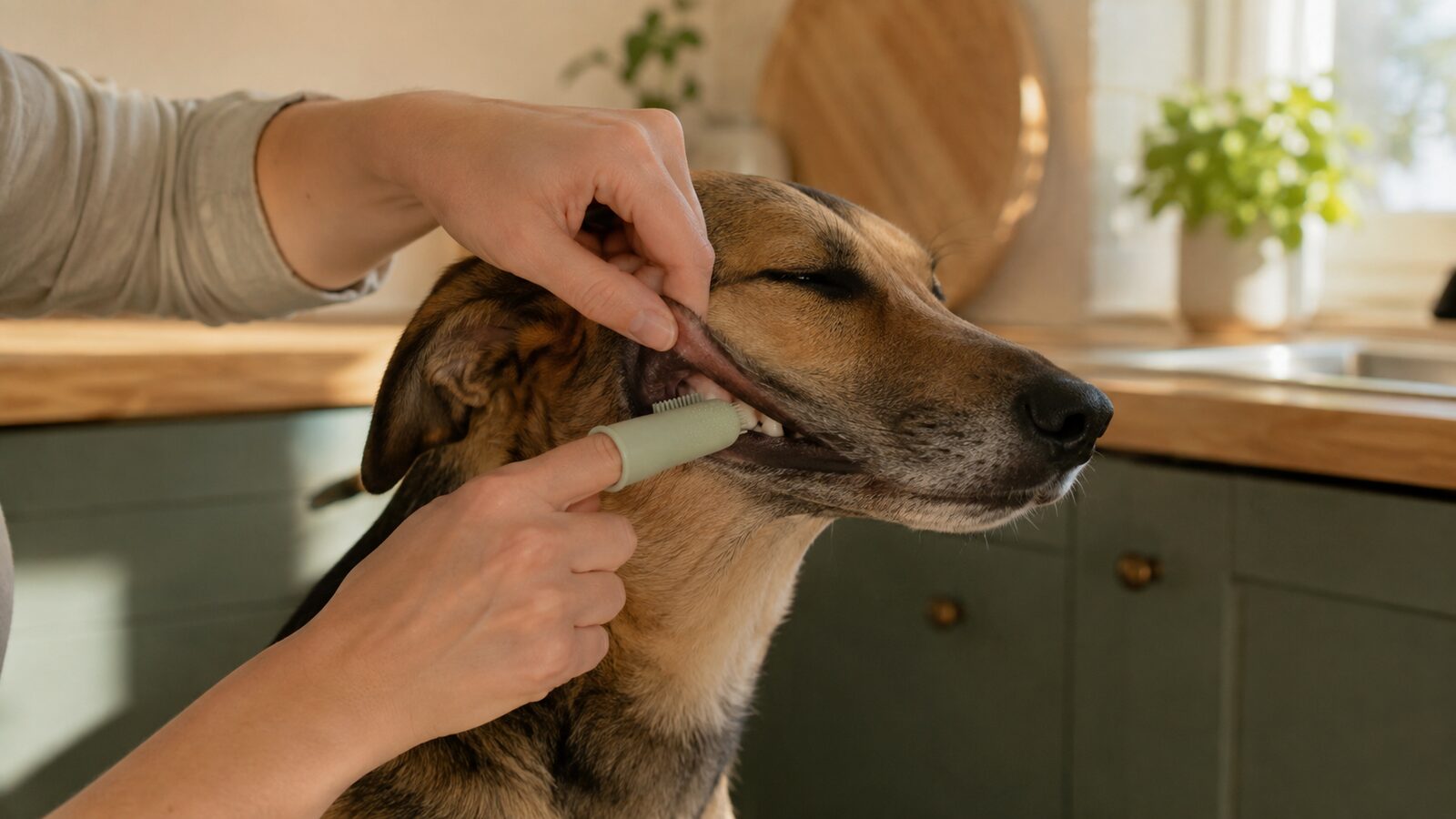
The target is the outside surfaces of the teeth, along the gum line, where build-up gathers. The inner surfaces matter far less and are much harder to reach, so most owners never get to them.
Use a soft brush made for dogs and a paste formulated for dogs. Angle the bristles towards where tooth meets gum, use small circular movements, and work a section at a time.
Little and often beats thorough and rare. A short daily pass is worth more than a heroic monthly session, which also teaches your dog to avoid the whole business.
Why human toothpaste is not used on dogs
Dogs cannot spit. Everything on the brush gets swallowed, so the paste has to be safe to swallow, and human toothpaste is not made with that in mind. It contains sweeteners and other ingredients that do not belong in a dog.
Pastes made for dogs are designed to be swallowed and usually taste of something a dog actively wants, If your dog ever gets into human toothpaste, ring your vet rather than judging it yourself.
What chews and dental products can and cannot do
The honest picture here is more modest than the packaging suggests.
What they can plausibly do. Chewing is natural and satisfying for most dogs, and some chews and dental-shaped products reduce surface build-up through simple mechanical action. Water additives and dental diets exist too, and your vet can say whether any are worth your money.
What they cannot do. Replace brushing, reach below the gum line, or resolve a problem that already exists. No chew treats disease. A dog with a sore mouth chewing a dental product is not being treated, they are chewing.
Two cautions. Very hard items risk fracturing a tooth, and anything chewable carries a choking or blockage risk if pieces come away. Supervise chewing.
Why professional dental work is a different thing entirely
What your vet does is not a bigger version of what you do at home. Most of what matters happens below the gum line, where you cannot see or reach. Assessing it needs a full examination, usually imaging, and a completely still, comfortable patient, which is why dental procedures are done under anaesthesia, with a team monitoring the dog throughout.
It is also why anaesthesia-free scaling worries the profession. Scraping visible tartar off makes teeth look tidier without touching what lies underneath. If it is offered, ask your vet first.
Book a vet appointment
Ring your vet, rather than waiting to see whether it settles, if you notice any of this.
- Signs of pain: flinching from touch, crying when eating, or a change in temperament
- Bleeding from the mouth, or blood on toys, bedding or in the water bowl
- Breath that has become strong, sour or noticeably worse
- Reluctance to eat, dropping food, or wanting only soft food
- A broken, loose or discoloured tooth
- Swelling of the face or jaw, or new and excessive drooling
- Any lump, growth or sore in the mouth
A dog who has gone off food entirely, or seems unwell as well as sore, should be seen soon. When you are unsure, ring. Reception teams field this question constantly.
When to get professional help
Everything diagnostic belongs to your vet: the smell you are unsure about, the odd-looking tooth, and whether a procedure is needed. Veterinary nurses are an underused resource for the home side, and many practices run nurse appointments where someone will show you how to brush, on your own dog. If your dog finds handling frightening rather than novel, a qualified behaviourist or accredited trainer can help, once your vet has ruled out pain.
Frequently asked questions
How often should I brush my dog’s teeth?
Daily is what most vets aim for, because build-up starts forming again quickly after cleaning. A few times a week done calmly is still far better than nothing, and better than an occasional forced session. Thirty seconds each evening beats a longer effort you dread.
My dog will not let me near their mouth. What do I do?
Stop trying to brush. Spend a week or two pairing gentle face touching with something your dog likes, in sessions of a few seconds, then build up to lifting a lip, then a finger along the gum line, then paste. If your dog was fine before and now objects, book a vet appointment first.
Can I use my own toothpaste on my dog?
No. Dogs swallow whatever you put in their mouth rather than spitting it out, and human toothpaste is not formulated to be swallowed. It contains sweeteners and other ingredients unsuitable for dogs. Use a paste made for dogs instead. If your dog eats human toothpaste, ring your vet.
Do dental chews actually work?
They can help a little with build-up on the surfaces a dog chews with, and most dogs enjoy them. They do not clean below the gum line, replace brushing, or treat a problem that already exists. Choose something with a little give rather than rock hard, and supervise chewing.
Is bad breath in dogs normal?
Ordinary doggy breath is one thing. Breath that has changed, or turned strong or sour, is worth a vet appointment rather than a mint-flavoured product. Mouth problems are a common cause but not the only one, and breath is a symptom rather than a condition.
Read next
- Chews and Chew Toys: How to Choose Safely
- When to Call the Vet: A Calm Guide to Symptoms That Worry Owners
- How to Read a Dog Food Label Without Getting Fooled
- How Much Exercise Does Your Dog Actually Need?
More in Everyday Care.
A note on this article
This is general education, written to help you notice things early and build good habits at home. It is not veterinary advice, it cannot diagnose or treat anything, and it is no substitute for a vet who can examine your own dog. Every decision about your dog’s mouth belongs to them.