
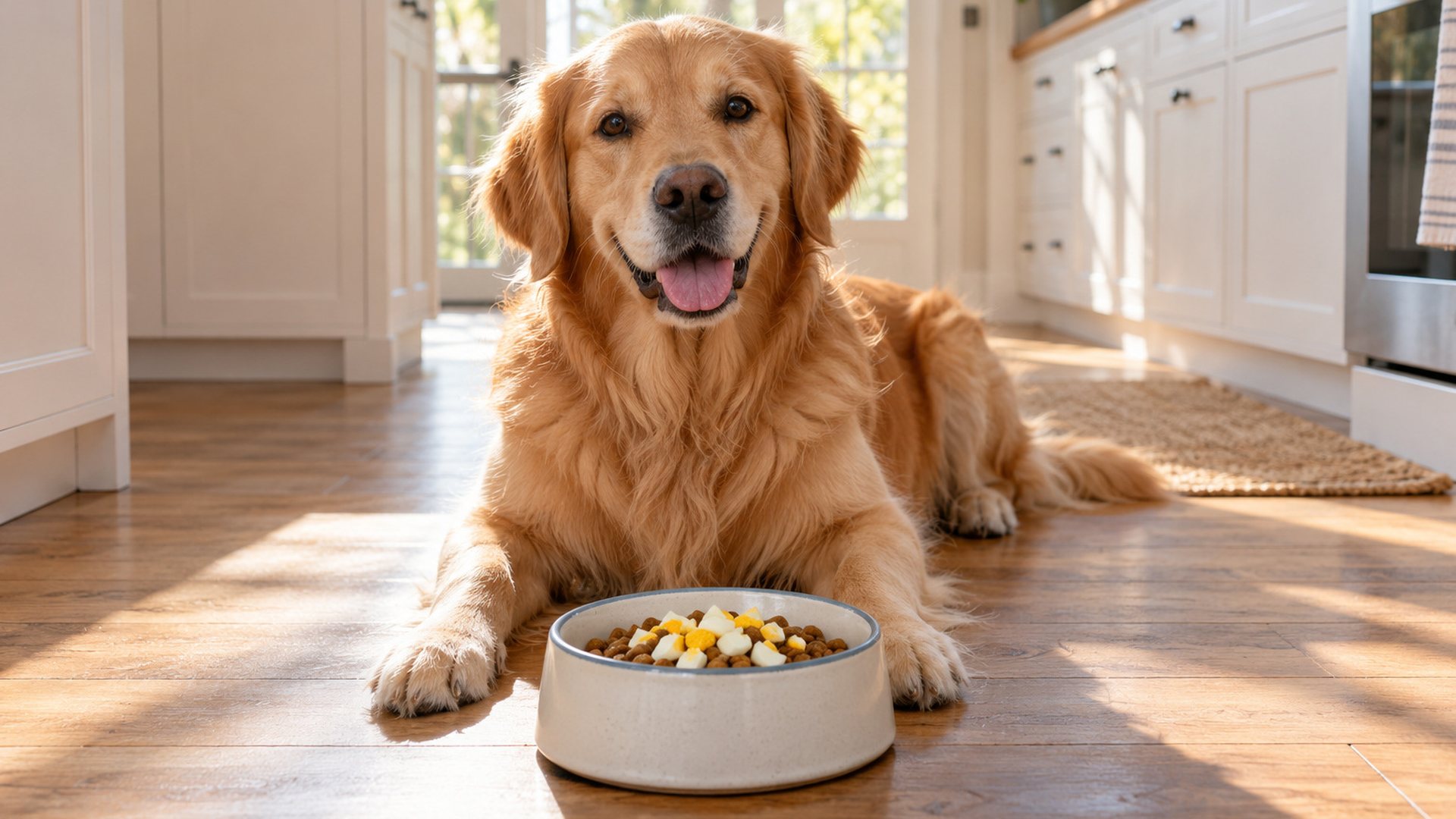
Yes, dogs can eat eggs, as long as they are fully cooked and served plain. Scrambled or hard-boiled eggs made without butter, oil, salt, onion or seasoning are a fine occasional treat for most healthy dogs. Raw eggs and eggshells carry risks, and eggs are rich enough that portion size matters, especially for small dogs.
This guide covers the best way to cook eggs for dogs, why most vets advise against raw eggs, the truth about eggshells and calcium, a calorie-based portion guide by dog size, and who should check with a vet first.
At a glance
- Fully cooked, plain eggs are safe for most dogs as an occasional treat or food topper.
- Most vets recommend cooking eggs; raw eggs can carry Salmonella, which can make both dogs and people ill.
- Raw egg white contains avidin, which blocks the absorption of the vitamin biotin.
- Eggshells are not a sensible DIY calcium supplement, especially for puppies.
- One large hard-boiled egg is about 78 kcal (USDA), which is the whole daily treat allowance for a 20 kg dog under WSAVA’s 10% guideline.
Are eggs good for dogs?
Eggs are a nutritious, easy-to-digest food. The American Kennel Club notes that they provide protein and fat along with vitamins and minerals such as vitamin A, vitamin B12, riboflavin, folate, iron and selenium. USDA FoodData Central lists a large hard-boiled egg (about 50 g) at roughly 78 kcal and just over 6 g of protein.
That said, eggs are not an essential part of a dog’s diet. A complete and balanced dog food already supplies everything your dog needs, so eggs are an extra rather than a fix for anything missing. The AKC also points out that plain cooked egg may help settle an upset stomach in some cases, but if your dog is unwell, speak to your vet before changing their food. For the bigger picture, see our guide to what to feed your dog.
Cooked vs raw eggs: which is safer?
| Option | Verdict | Why |
|---|---|---|
| Hard-boiled, plain | Best choice | Fully cooked, easy to portion, no added fat |
| Scrambled, plain, no butter or milk | Good choice | Fully cooked; cook in a non-stick pan with no oil or a splash of water |
| Poached, plain | Good choice | Fine as long as the yolk and white are fully set |
| Fried in butter or oil | Avoid | Extra fat and calories that can upset the stomach |
| Omelette or scrambled eggs with onion, chives, garlic, cheese or salt | Avoid | Onion, chives and garlic are toxic to dogs; salt and cheese add little good |
| Runny or soft-boiled | Not recommended | Partly raw, so the same bacteria and avidin concerns apply |
| Raw egg | Not recommended | Salmonella risk for dogs and people; avidin blocks biotin |
| Eggshells | Not recommended | Sharp edges; not a balanced calcium source |
Why most vets advise against raw eggs
The AKC states that most veterinarians recommend cooking eggs before feeding them to dogs. There are two main reasons.
- Salmonella. Raw eggs, like other raw foods, can carry Salmonella bacteria. The AKC notes that both dogs and their owners can be exposed, and that infection in dogs can cause fever, vomiting, diarrhoea and lethargy. Even a dog that seems well can pass bacteria on, which matters in homes with young children, older adults or anyone with a weakened immune system. Public health agencies, including the US Centers for Disease Control and Prevention, have long advised washing hands with soap and water after handling raw animal-based pet foods and treats.
- Avidin and biotin. Raw egg white contains a protein called avidin, which binds to biotin (a B vitamin that supports skin, coat and metabolism) and stops it being absorbed. The AKC notes that deficiency is rare in dogs, but cooking deactivates avidin, so it removes the issue entirely.
The trend for cracking a raw egg over a dog’s dinner is popular on social media, but cooking keeps the nutritional value while avoiding both problems.
Can dogs eat eggshells?
Eggshells are mostly calcium, which is why they are often suggested as a “natural supplement”. The AKC notes that while shells contain calcium, there are easier sources, and that sharp shell fragments can injure the throat or gut.
The bigger issue is balance. Calcium works together with phosphorus and other nutrients, and complete dog foods are formulated to get those ratios right. Adding calcium on top can tip that balance. This matters most for puppies. VCA Animal Hospitals explains that puppies fed a commercial food generally do not need extra calcium, that excess calcium is a particular concern for large and giant breeds, and that it is linked to orthopaedic problems such as osteochondrosis in susceptible breeds. VCA also notes that puppies cannot regulate how much calcium they absorb until about 10 months of age, so supplements should only be given under a vet’s guidance.
If you feed a home-prepared diet, a board-certified veterinary nutritionist is the right person to work out calcium, not guesswork with ground shells. The AKC mentions that eggshell membrane has been studied for joint support in dogs, but that is a specific, processed supplement, not the same as feeding shells; ask your vet if you are interested.
How much egg can a dog eat?
There is no single right number of eggs, because it depends on your dog’s size, age, activity and health. The AKC describes eggs as calorie-dense and best used as an occasional treat rather than a daily staple unless your vet recommends otherwise. The practical limit is WSAVA’s treat guideline: treats should always make up less than 10% of a dog’s daily calories.
The table below uses WSAVA’s approximate maximum daily treat calories for an average healthy adult dog at an ideal weight, and USDA’s figure of about 78 kcal for one large hard-boiled egg.
| Dog’s body weight | Max treat calories per day (WSAVA) | Egg that would use the whole allowance | A sensible occasional share |
|---|---|---|---|
| 2 kg | 14 kcal | About one-sixth of an egg | A teaspoon or two of chopped egg |
| 6 kg | 32 kcal | About two-fifths of an egg | A small spoonful |
| 10 kg | 47 kcal | About half an egg | A quarter of an egg |
| 20 kg | 79 kcal | About one egg | Half an egg |
| 30 kg | 108 kcal | About one and a third eggs | Half to one egg |
| 40 kg | 134 kcal | About one and three-quarter eggs | One egg |
Remember that the allowance covers all treats in the day. If your dog gets a chew, training rewards or a stuffed toy, there is less room for egg. On days you give egg, you can cut back on other treats. Your vet can calculate your own dog’s energy needs, which vary a lot with activity, age and neutering.
Worked example
A 10 kg dog has a treat allowance of about 47 kcal a day. A whole large egg (about 78 kcal) would put that dog well over the limit, before any other treats. A quarter of an egg, chopped and scattered over dinner or used as training rewards, is about 20 kcal and leaves room for a few other small rewards.
How to cook eggs for your dog
- Use fresh eggs that are within their date and have been stored properly.
- Hard-boil the egg until both yolk and white are firm, or scramble it in a non-stick pan with no butter, oil or milk.
- Do not add salt, pepper, cheese, onion, chives, garlic or any seasoning.
- Peel the egg fully and discard the shell in a lidded bin.
- Let it cool, then chop it into small pieces that suit your dog’s size.
- Portion it using the table above, and reduce other treats that day.
- Refrigerate leftovers promptly and use them within a day or two.
- Wash your hands and any surfaces after handling raw eggs.
Chopped egg works well as a high-value training reward or as a topper. You can also mix a little into a stuffed Kong or scatter it in a puzzle feeder for extra enrichment.
Who should check with a vet first?
- Dogs with a history of pancreatitis or on a low-fat diet: yolks contain fat, so ask before offering any.
- Overweight dogs: eggs are calorie-dense and easy to overdo.
- Dogs with food allergies or on an elimination diet: egg allergy is uncommon but possible, and any extra food can spoil an elimination trial. See our guide to dog allergies.
- Dogs with kidney or other chronic conditions: extra protein or minerals may need to be accounted for in a prescribed diet.
- Puppies: the AKC says puppies can have small amounts, in even smaller portions than adults. Keep it occasional, and never use shells as a calcium supplement.
When you introduce egg for the first time, start with a small amount and watch for vomiting, diarrhoea, itching, hives or swelling. Contact your vet if any of these appear, and treat swelling of the face or difficulty breathing as an emergency.
Common mistakes
- Cooking eggs the human way. Butter, oil, salt, cheese, onion and chives are the problem, not the egg.
- Feeding raw eggs for a “shinier coat”. Cooking avoids the Salmonella and biotin issues without losing the benefits.
- Giving a whole egg to a small dog. For a 10 kg dog, one large egg is more than the whole day’s treat allowance.
- Making eggs a daily extra on top of a full meal. That adds calories and can lead to weight gain.
- Using eggshells as a calcium supplement. It can upset the balance of a complete diet, and puppies are especially vulnerable.
- Leaving cooked eggs out too long. Spoiled eggs can grow bacteria that make dogs ill.
- Forgetting hygiene. Wash hands, bowls and surfaces after handling raw eggs.
For more everyday options, see the list of which human foods dogs can eat and the guide to healthy dog treats.
Sources this guide draws on: American Kennel Club guidance on eggs for dogs; USDA FoodData Central nutrient data for hard-boiled eggs; WSAVA’s “Feeding treats to your dog” guide; VCA Animal Hospitals guidance on supplements for puppies; US Centers for Disease Control and Prevention advice on handling raw pet treats; ASPCA Animal Poison Control Center information on onion and garlic.
Handy gear for this guide
Practical picks we think suit this topic. As an Amazon Associate, Mind A Dog earns from qualifying purchases, at no extra cost to you. Prices and availability are set by Amazon and may vary by country.
- Outward Hound Fun Feeder Slo Bowl
Ridged bowl that slows down dogs who gulp their meals.
View on Amazon - LUKITO Lick Mat for Dogs (2 Pack)
Spread a little dog-safe food over it for a quiet licking activity.
View on Amazon - Amazon Basics Airtight Pet Food Storage Containers (3 Piece)
Keeps kibble and treats fresh and out of reach.
View on Amazon
FAQ
Can dogs eat scrambled eggs?
Yes, if they are fully cooked and plain. Scramble the egg in a non-stick pan without butter, oil, milk, salt or seasoning, let it cool and offer a portion that fits your dog’s treat allowance.
Can dogs eat boiled eggs?
Hard-boiled eggs are one of the easiest ways to feed egg. Peel them completely, chop them into small pieces and portion them by your dog’s size. Soft-boiled or runny eggs are partly raw, so a firm yolk is the safer choice.
Can I feed my dog raw eggs?
Most vets advise against it. Raw eggs can carry Salmonella, which can make dogs and people ill, and raw egg white contains avidin, which blocks biotin absorption. Cooking removes both concerns.
Can dogs eat eggshells?
It is best not to. Shell fragments can be sharp, and adding calcium can unbalance a complete diet. Puppies, especially large breeds, are particularly sensitive to excess calcium, so only use calcium supplements on your vet’s advice.
How many eggs can a dog eat a week?
There is no set number. Eggs count towards the 10% treat allowance, so a small dog may only manage a fraction of an egg on the days it has one, while a large dog might have half to one egg. Ask your vet for a figure that suits your dog.
Can puppies eat eggs?
Puppies can have small amounts of plain, fully cooked egg as an occasional extra, in smaller portions than adults. Their main diet should be a complete puppy food. Our puppy first-year guide covers feeding stages in more detail.
Plain cooked eggs can be a simple, healthy treat most dogs love. Cook them through, skip the butter and seasoning, keep portions small, and they can be a happy part of your dog’s routine.