The short version
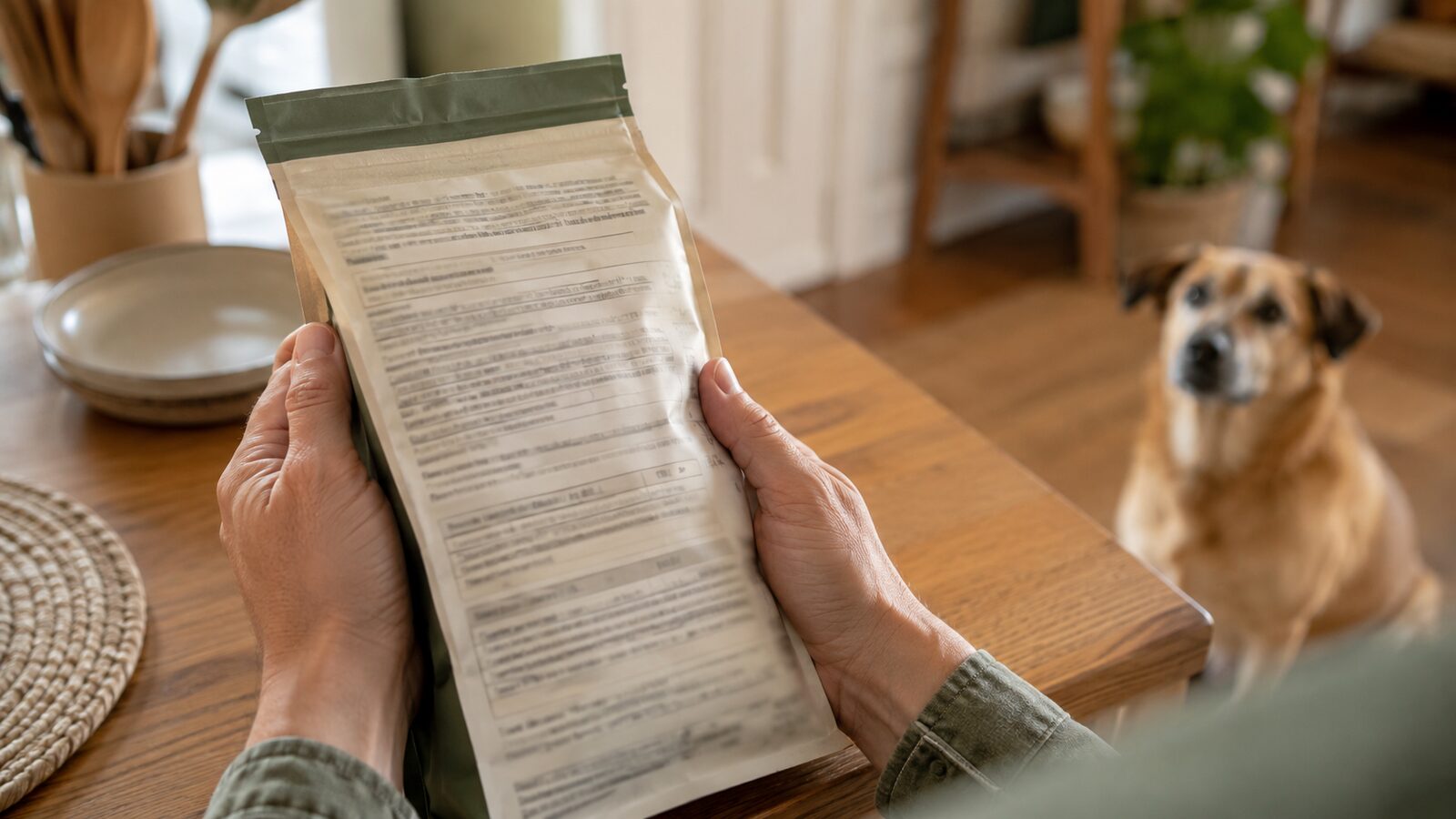
Read the bag from the back. The nutritional adequacy statement, which says whether a food is complete and for which life stage, is the most useful line on it. Ingredient lists are ordered by weight before cooking, so they flatter fresh meat, and words like premium and holistic have no legal meaning in most markets. What your dog should eat is a question for your vet.
Standing in the pet food aisle is a strange experience. Every bag is covered in photographs of vegetables and mountain streams, and each insists it is the best thing you could put in the bowl.
The useful information is there, mostly on the back in small type, and this article is about reading it. What an individual dog should eat stays a conversation for you and your vet.
How the ingredient list is ordered
In most markets, ingredients are listed in descending order by weight, measured going into the mixer rather than coming out of it. Fresh meat is roughly three-quarters water, so once the food is cooked and dried, an ingredient heavy enough to top the list can contribute far less to the finished kibble than something below it. “Fresh chicken listed first” therefore tells you less than the front of the bag suggests.
The splitting trick
Because the order depends on the weight of each separate entry, one raw material can appear as several. Rice might be listed as rice, rice flour and brewers rice; peas as peas, pea protein, pea flour and pea fibre. Each entry is lighter alone, so each sits lower down, and the meat above them looks more dominant than it is. Add the related entries together and the picture often shifts.
What “meal” and “by-product” actually mean
A meal, as in chicken meal or lamb meal, is animal tissue cooked down and dried before it goes into the recipe. The water and much of the fat are already gone, so by weight it is far more concentrated in protein than fresh meat. A meal listed third can be delivering more protein than a fresh meat listed first.
By-product, or derivative, is a defined term in many markets, usually covering parts of the animal that are not skeletal muscle: liver, kidney, lung, spleen. Definitions generally exclude hair, horn, hooves and teeth.
Organ meat is not filler; it is nutrient-dense food dogs have always eaten. The fair limitation is that the term is broad, naming a category rather than a tissue, so “lamb meal” tells you more than “meat meal”.
The analysis panel, and what it leaves out
Depending on where you live, this is the guaranteed analysis, the typical analysis or the analytical constituents. It gives crude protein, fat, fibre and moisture, often ash. “Crude” is not a comment on quality, only on the method used to measure it.
In some markets those figures are guarantees, minimums for protein and fat and maximums for fibre and moisture; in others they are typical values. Either way they describe quantity, not usefulness: the panel says how much protein is present, not which amino acids it supplies or how much your dog can absorb.
Comparing a tin with a bag of dry food
You cannot compare numbers straight off two labels if one is wet and one dry, because the wet food is mostly water. Convert to a dry matter basis: subtract the moisture percentage from 100, then divide the nutrient figure by that number and multiply by 100.
A tin showing, as a worked example, 8% protein and 78% moisture is 8 divided by 22, times 100, so around 36% protein once the water is out.
Words with a standard behind them, and words with nothing
Some words on a bag are regulated. Others are adjectives a copywriter chose, and nothing tells you which is which. In most markets these carry no legal definition:
- Premium, super premium, ultra. No standard, no minimum anything.
- Holistic. Sounds systemic, means nothing measurable.
- Vet formulated. A vet was involved somewhere, and that is all it says.
- Human grade. Enforceable in a few markets, decorative elsewhere.
- Natural. Has a working definition in some markets, none in others.
Complete and complementary usually do carry a standard. A complete food supplies everything a dog needs from that product alone. A complementary food, which covers most toppers, mixers and treats, is meant to sit alongside something else.
Product names are regulated too. Rules commonly tie how prominently an ingredient features in the name to how much must be present, so “chicken dog food”, “chicken dinner”, “with chicken” and “chicken flavour” sit on a ladder from a lot to barely any, with thresholds that vary by country.
The nutritional adequacy statement: the most useful line on the bag
Somewhere on the back, usually near the feeding guide, is a sentence saying whether the food is nutritionally complete, and for which dogs. It matters more than anything on the front, because it is the only line telling you the food was built against a published nutrient standard.
You want two things from it: whether the food is described as complete, or complete and balanced, and which life stage that covers. Some markets also state how adequacy was established, either by formulating to a published nutrient profile or by running a feeding trial, meaning dogs ate the food under a defined protocol.
If a bag carries no such statement, or says complementary, that is not a fault. It simply means the food was never designed to be the whole diet.
Life stage labelling
The usual categories are growth, adult maintenance, and all life stages, which meets the higher requirements of growth and so covers adults too.
Growth foods for large-breed puppies are often flagged separately, because the mineral balance suiting a small puppy is not the one suiting a puppy who will reach forty kilos. If you have a big-breed puppy, raise it with your vet.
Senior is different. In most markets it is not a defined life stage at all, so a senior food is legally an adult maintenance food in a marketing label.
Feeding guides are a starting point, not an instruction
The table matching body weight to grams per day is an average drawn from average dogs. Two dogs of identical weight can need different amounts, and age, neutering, coat, climate and whether the day is spent on a sofa or moving sheep all change it.
Most guides assume the listed amount is the whole day’s food. Training treats, chews and the corner of toast at breakfast all count, and they add up faster than owners expect.
Start where the bag suggests, then watch across a few weeks: weight, shape, energy, stools. Your vet or a veterinary nurse can show you how to assess body condition by hand.
Labelling rules stop at the border
Pet food labelling is national or regional, never global. The same recipe can legally be described three different ways in three countries.
What varies includes which panels are compulsory, whether figures are guarantees or typical values, whether ingredients may be grouped into categories such as “cereals”, and what “natural” may mean. Wherever you live, your agriculture or food safety regulator will have a plain-language page on labelling.
A five-minute label check you can do today
Take the bag you feed now and work through it in order.
- Turn it over. Nothing on the front counts.
- Find the adequacy statement. Complete, or complementary?
- Check the life stage against the dog next to you, including large-breed growth.
- Read the first five ingredients, then look for repeats of the same material lower down.
- Compare the feeding guide with what actually goes in the bowl, treats included.
- Note where the batch code and best-before date are.
When to get professional help
A label tells you what is in a food. It cannot tell you what your dog needs, and that gap is where your vet comes in.
Book a conversation if your dog has a diagnosed condition, is gaining or losing weight for no obvious reason, has recurring digestive upsets or itchy skin, is a large-breed puppy, or is a senior whose appetite has changed.
A diet that departs from commercial complete food, including home-prepared, raw or restricted-ingredient plans, belongs with your vet, and in complex cases a veterinary nutritionist.
Frequently asked questions
Is the first ingredient on the list the most important one?
Not necessarily. Ingredients are ordered by weight before cooking, and fresh meat is mostly water, so an ingredient at the top can shrink dramatically once the food is made. A dried meal listed third may deliver more protein. Treat the first entry as a clue, not a verdict.
Are by-products bad for dogs?
No. In most markets, by-products are the parts of the animal other than skeletal muscle, such as liver, kidney and lung, and definitions typically exclude hair, hooves and teeth. Organ meat is nutrient-dense and dogs eat it happily. The fair criticism is that the term names a broad category, not a specific tissue.
What does “complete and balanced” actually mean?
It means the food is formulated to supply all the nutrients a dog is known to need, in workable proportions, for a stated life stage, with nothing else added. A complementary food, such as a topper or most treats, is not designed to do that job, and the exact wording varies by country.
Does a higher protein percentage mean a better food?
Not on its own. The panel tells you how much protein is present, not which amino acids it supplies or how well your dog digests it. Percentages cannot be compared between a tin and a dry food unless you convert to a dry matter basis first. Whether a level suits your own dog is a question for your vet.
Is grain-free better?
Grain-free describes what has been left out, not the quality of what went in, and grains are usually replaced by other carbohydrate sources. Some dogs eat grain-free for reasons their vet identified, and most do not. Ask your vet before choosing a diet type on health grounds.
How much of the feeding guide should I actually give?
Treat it as a starting point and adjust. The table is built from averages, and it assumes the listed amount covers the entire day, treats included. Feed that amount for two or three weeks, watch weight, shape and energy, then change it gradually if you need to.
Read next
- Chews and Chew Toys: How to Choose Safely
- How Much Exercise Does Your Dog Actually Need?
- Home Grooming by Coat Type: A Routine That Actually Fits Your Dog
- Dog Dental Care: The Bit Almost Everyone Skips
More in Everyday Care.
A note on this article
This is general education about how pet food labels are written and how to read them, not veterinary or nutritional advice, and not a recommendation of any diet or product. Labelling law varies by country, and so does the dog in front of you. What your own dog should eat belongs with a vet who knows them.