
The short version
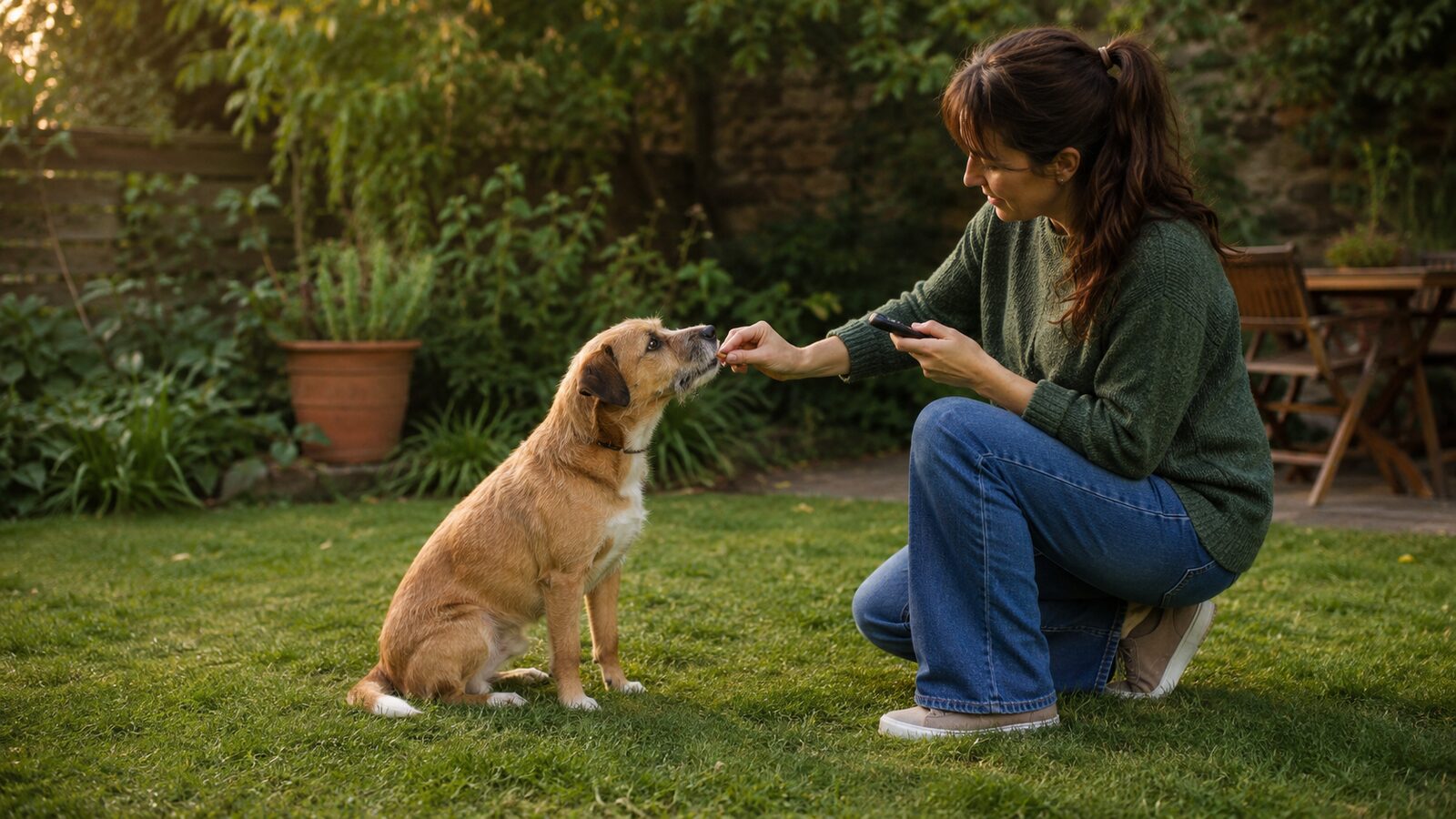
Positive reinforcement training means adding something your dog wants immediately after a behaviour, so that behaviour becomes more likely. Three things decide whether it works: your timing, the value of the reward, and how gradually you raise difficulty. Mark the moment the behaviour happens with a clicker or a short word, pay within a second or two, and only make things harder once the easy version is reliable.
Starting from the same place
Most owners come to training with a dog already doing something inconvenient and a head full of advice that contradicts itself. Treats are bribery, says one person. Be firm, says another. Someone mentions dominance. None of it tells you what to do tonight.
Positive reinforcement is not a philosophy you have to sign up to. It describes how learning works: behaviour that pays off gets repeated, behaviour that stops paying off fades away. Once that lands, training stops feeling like a battle of wills.
What “reinforcement” actually means
A reinforcer is anything that makes the behaviour before it more likely to happen again. That is the whole definition, and it is a measurement, not an opinion.
You do not get to decide what your dog finds reinforcing. Your dog decides, and you find out by watching what happens to the behaviour. If a dry biscuit follows a sit and sitting does not increase, that biscuit was not a reinforcer.
You are also reinforcing things all day without meaning to. The dog barks at the door, you open it, barking is reinforced. Turned the other way, that is your best tool. Lying quietly while you cook, or glancing back at you on a walk, are moments that cost you nothing and usually go unpaid.
Timing is nearly everything
Your dog connects a reward to roughly what they were doing when the good thing arrived, not to the last five minutes of their life. A reward two seconds late may reinforce standing up rather than the sit you thought you were paying for. This is the most common reason training feels like it is not working: the owner is doing everything else right and paying the wrong instant.
Why a marker fixes it
You cannot always get food into a dog’s mouth within a second, but you can tell them which moment earned it. That is what a marker does: a short, distinctive signal meaning one thing, that, right there, has earned you food. A clicker is precise and never carries your mood. A word like “yes” is always in your pocket. Consistency matters more than the choice.
Teaching it
Sit down with a handful of small treats. Click or say “yes”, then hand over a treat, and do nothing else. Repeat about fifteen times across two short sessions. After that, mark the instant the behaviour happens, then deliver the food.
Reward value, and the reward hierarchy
Dogs rank rewards, and the ranking shifts with the situation. Kibble might be plenty in the kitchen and irrelevant in the park. Think in three rough tiers.
- Everyday: normal food, dry treats. For easy behaviours in quiet places.
- Good: softer, smellier treats, small pieces of cheese. For new behaviours and mild distraction.
- Exceptional: whatever your dog would sell you for. Roast chicken, sardine, liver. Saved for hard things and recall.
Food is not the only currency. A tug game, a thrown ball, or permission to go and sniff can all be powerful, and some dogs rate them above food. The harder the situation, the better the pay. Underpaying in a difficult environment is a wages problem, not a discipline problem.
Criteria: one step at a time
Criteria is the standard you are currently paying for. The common mistake is raising several at once, then deciding the dog is stubborn. If your dog sits beautifully in the kitchen and ignores you in the street, you changed the location, the noise and your own body language all at once. That is a different exercise, not the same one done badly.
The three D’s
Behaviours get harder along three lines, and naming them helps you move one at a time.
- Duration: how long your dog holds it. Build in seconds, not minutes.
- Distance: how far you are from your dog, or your dog from you.
- Distraction: everything else going on. Usually hardest.
Move one and keep the other two easy. Add distraction, and you shorten the duration and close the distance. When something falls apart you have found the edge: go back a step, take a few easy wins, then build up again.
Three ways to get the behaviour
Before you can reward something, it has to happen. Three methods make that likely.
Luring
You use food in your hand to guide your dog into position, moving it over the head for a sit or down between the front paws for a down. Luring is fast and forgiving, but it is easy to get stuck there. Take the food out of your hand within a few repetitions, keep the movement as your signal, and pay from the other hand.
Shaping
You reward small approximations heading in the right direction. Teaching a settle on a mat, you might mark a glance at it, then a step towards it, then a paw on it, then a down. Shaping is slower but builds confidence, because your dog is working out what pays rather than following your hand.
Capturing
You wait for your dog to offer the thing on their own and mark it. This is the most underused method and the easiest to fit into real life: your dog stretches into a lovely down while you watch television, so mark it and pay it.
Fading the food without losing the behaviour
The worry that you will be carrying sausage forever is fair. The answer is not to stop abruptly, because dogs asked to work for free tend to stop working. What changes is the schedule. Once a behaviour is fluent, stop paying every repetition and start paying the better ones, varying it so your dog cannot predict which pays.
Then broaden what counts as payment: praise, a scratch on the chest, a game, the lead coming off. Keep food in the rotation for hard things. A recall away from a squirrel deserves proper pay every time.
Two ideas worth putting down
“He knows he’s done wrong”
You come home to a chewed cushion and your dog is slinking, ears flat, eyes averted. It looks exactly like guilt. What it almost certainly is, is a response to you: your posture, your face, your tone.
Dogs read human body language well and are poor at connecting a telling-off to something they did an hour ago. The display tells you your dog has predicted trouble, not that they understand why. The useful response is to manage the environment, provide something satisfying to chew, and ask whether the chewing is boredom, adolescence or distress.
Why modern trainers have moved away from aversives
Aversive methods work by making a dog uncomfortable: a lead check, a raised voice, a shock or prong collar. Punishment can suppress behaviour, which is why it was used for so long.
The reasons the field has moved on are practical as much as ethical. Punishment tells a dog what not to do but never what to do instead. It has to be very well timed and very consistent to work at all, and tends to need escalating intensity as a dog gets used to it. It also builds associations you never intended, so a dog corrected near another dog may come to feel worse about other dogs. And a dog who is uneasy about how you will react stops offering behaviour, which makes them harder to teach.
Your first week, ten minutes a day
You do not need a training hour. Short and frequent beats long and occasional, because dogs tire mentally faster than owners expect.
- Days one and two: load the marker. Two sessions of fifteen clicks and treats, nothing else asked.
- Days three and four: one behaviour in the quietest room in the house, five minutes twice a day. Stop while your dog still wants more.
- Day five: same behaviour, new room. Expect it to be worse. That is normal.
- Day six: add exactly one D. A few seconds of duration, or one step of distance. Not both.
- Day seven: take it to the garden or a quiet corner of the street, drop your criteria back to easy, and pay well.
Alongside that, carry a few treats and catch your dog doing something you like three times a day. That often changes more than the sessions themselves.
When to get professional help
Training help is worth having sooner than most people ask for it, and it is not a sign you have failed. A qualified, accredited trainer using reinforcement-based methods can save you weeks in a single session, just by watching your timing.
Go further if fear, aggression or real distress is involved. Growling, snapping, biting, panic when left alone, or a dog who cannot settle belong with your vet first, then a qualified behaviourist. Pain changes behaviour, so any sudden change in a previously happy dog deserves a vet check before it is treated as a training problem.
Frequently asked questions
Isn’t giving treats just bribery?
A bribe comes before the behaviour, to persuade a reluctant dog. A reinforcer comes after it, as payment. If you wave food about to get your dog to come, that is a bribe. If your dog comes and then discovers food, that is reinforcement. Keep food out of sight until after your marker.
Will I have to carry treats forever?
No, but keep paying for hard things. Once a behaviour is solid, reward unpredictably rather than every time, and widen your payments to include play, praise and access to what your dog wants. Most experienced owners still carry something good for recall, because that is where the value sits.
My dog won’t take food when we’re out. What now?
Usually the treats are not good enough for that environment, your dog has just eaten, or your dog is too worried to eat. The third matters most: a dog who takes food at home and refuses it outside is often over threshold rather than disobedient. Move further from whatever is bothering them.
How long does it take to train a dog?
A simple behaviour in a quiet room can take a few short sessions. Making it reliable everywhere takes far longer, because you are effectively teaching it again in each new context. Rather than counting weeks, watch for it holding up in one more difficult place than last time.
What should I do when my dog gets it wrong?
Nothing dramatic. Stay quiet, pause, and make the next repetition easier so your dog can succeed. Repeated errors are information for you: criteria too high, environment too busy, reward too weak. A dog getting it wrong roughly one time in five usually means the difficulty is set about right.
Read next
- Puppy Socialisation: The Window That Matters Most
- Dog Enrichment: Twenty Ideas That Cost Almost Nothing
- How to Stop Your Dog Pulling on the Lead
- Teaching a Recall Your Dog Will Actually Come Back For
More in Training & Communication.
A note on this article
This article is general education about how dogs learn. It is not veterinary advice or behavioural medicine, and it cannot account for your own dog’s health, history or temperament. If your dog is frightened, aggressive, in pain, or simply not making sense to you, speak to your vet and to a qualified behaviourist.