
The short version
Almost everything your dog does comes from one of five things: instinct, what has been rewarded before, how they feel emotionally, how they feel physically, and what the environment is offering right now. Dogs are not being naughty, stubborn or spiteful. They are doing what works, or what feels necessary, in the moment.
You have probably watched your dog and thought, quietly, what on earth are you doing? They follow you into the bathroom. They tear around the living room at ten at night. They roll a clean shoulder into something unspeakable on the verge.
None of it is random. Once you know the handful of forces behind dog behaviour, most of the mystery falls away.
Dogs are not small people in fur coats
The most useful shift you can make is to stop translating your dog’s behaviour into human motives. We are wired to see intention everywhere, so when a dog chews a shoe we reach for words like defiant, jealous or knew better.
Dogs do have rich emotional lives. They feel fear, excitement, frustration, contentment and attachment, and those feelings drive a great deal of what they do. What they do not appear to do is plan revenge or work out that a chewed skirting board would teach you a lesson. A dog who empties the bin while you are out is not making a point. They are a bored animal with a nose and nothing else to do for four hours.
The five drivers behind nearly every behaviour
Instinct and breed history
Every dog carries behaviours that need no teaching. Sniffing, chewing, chasing, digging, guarding a resource, alerting to a noise at the door. These are not faults in the design, they are the design, and you cannot delete them. You can only give them somewhere sensible to go.
On top of that sits whatever a dog’s ancestors were selected for: moving livestock, following a scent for miles, digging after animals underground. Those tendencies show up in the living room. A dog who herds children at a birthday party is doing what their body was built around.
Learning history
Dogs repeat what works. If barking at the window makes the postman leave, barking works. If jumping up gets eye contact, a shove and a shriek, jumping works, because attention of any kind beats none.
Your dog’s behaviour is a record of what has been reinforced, often by accident. That is good news, because the mechanism runs both ways. Whatever you reward gets stronger.
Emotional state
A frightened dog and a frustrated dog can look almost identical from across the park, and both can look like a badly behaved dog. Underneath, the behaviour is pushed by how the dog feels, not by anything the dog has decided.
Physical state
Pain, itching, an upset stomach, poor sleep, ageing eyes and ears. All of these change behaviour, and they are easy to miss because dogs are good at carrying on.
Any behaviour change that arrives suddenly, without an obvious trigger, deserves a conversation with your vet before it is treated as a training problem. Grumpiness out of nowhere in a previously easy dog is a health question first.
Environment and what it is offering
Behaviour happens in a context. A quiet flat, a garden backing onto a footpath, a house with toddlers, a street with foxes at night. Each hands your dog different things to react to, which is why moving the bin solves more problems than people expect.
Behaviour is communication and need
Treat every behaviour as a sentence with two halves: this is how I feel, and this is what I need.
A dog pacing at nine in the evening has unspent energy and no outlet. A dog who goes stiff when a stranger reaches over their head would like space. A dog who nudges your hand off the keyboard is saying the day has been long and empty.
Answer the need and the behaviour usually softens. Suppress the behaviour alone and the need is still there, so it comes out somewhere else.
The most common “why does my dog…” questions
Why does my dog follow me to the bathroom?
Because dogs are a social species that evolved to stay near their group, and because you are the most interesting thing in the house. There is rarely more to it. In some dogs, constant shadowing sits alongside real distress at being left alone, which is a separate issue worth taking seriously.
Why does my dog get the zoomies?
Those sudden bursts of galloping are a normal release of built-up excitement or tension. You will see them after a bath, after a nap, and very often in puppies in the evening. They are usually a good sign rather than a problem. Clear the coffee table and let it pass.
Why does my dog lick me?
Licking starts in puppyhood as a greeting and care behaviour, and stays useful because we respond to it. It can be self-soothing in a slightly unsettled dog, and some dogs lick because we taste of salt and dinner. Repetitive licking of one spot on their own body, or of floors and furniture, is a different thing and worth mentioning to your vet.
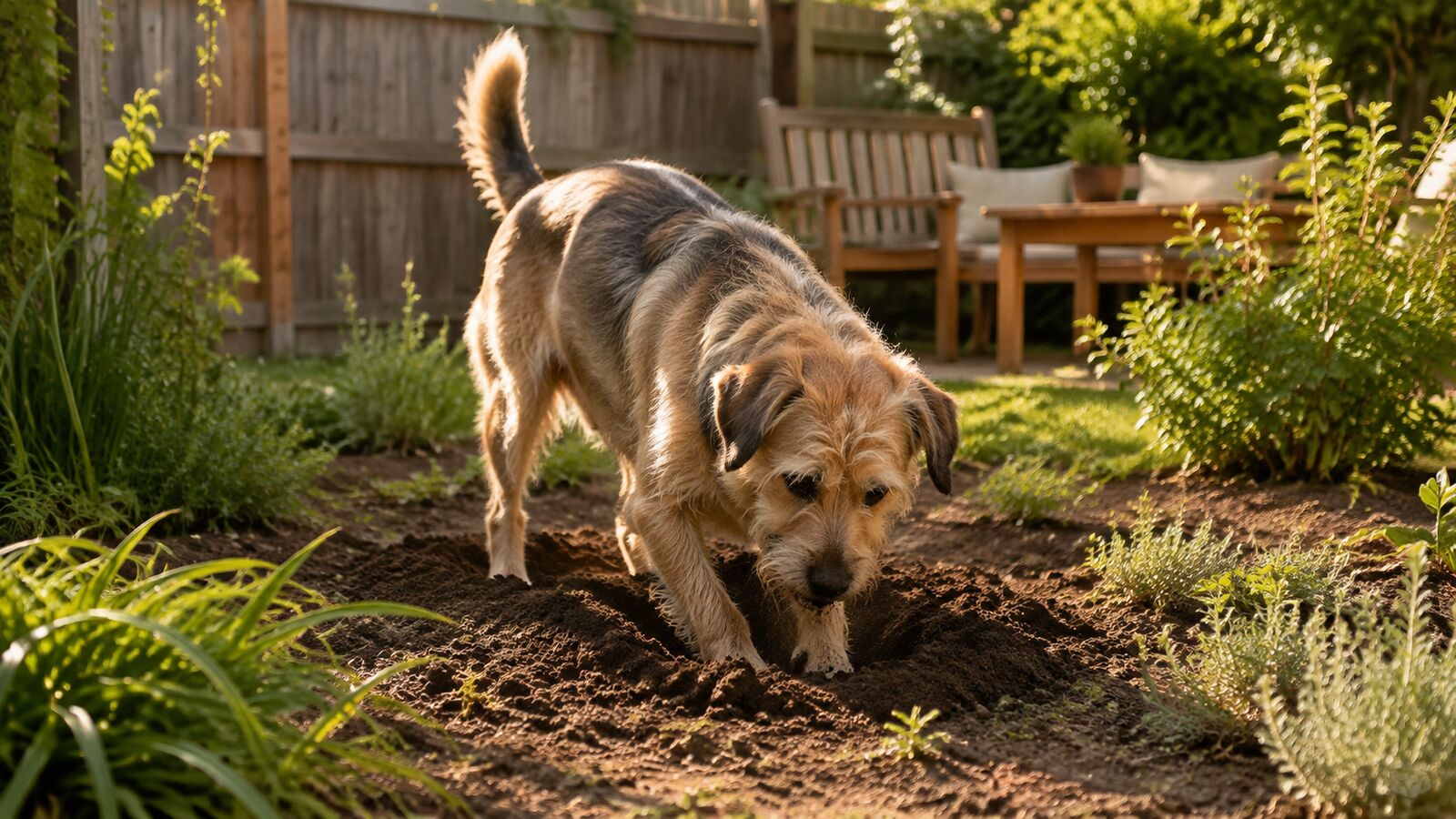
Why does my dog dig?
Digging cools a hot dog, hides a valued item, uncovers smells and burns off frustration. Some dogs dig because their ancestors were paid to. Fighting it rarely works. Giving them a legal place to do it, a sandpit or a corner of the garden you can live with, works better.
Why does my dog roll in disgusting things?
Nobody can tell you for certain, and anyone who says otherwise is guessing. The usual suggestions are that dogs are masking their own smell, or carrying interesting information back to their group. What is clear is that the smells we find revolting are, to a dog, rich and worth wearing.
Why does my dog stare at me?
Soft, relaxed staring is usually affection and attention seeking, especially near dinner time. Dogs learn quickly that looking at us produces results. Hard staring is a different signal altogether, with a stiff body and a still tail, and it means back off rather than come closer.
Why does my dog lean on me?
Leaning is contact seeking, and in most dogs it is simple companionship. In an anxious dog it can be reassurance somewhere they find difficult, so look at the rest of the body. A loose, wiggly dog leaning on your knee is happy. A tense dog pressed against your leg at the vet is coping.
Why does my dog eat grass?
Grass eating is very common and most dogs who do it are otherwise perfectly well. Various explanations get offered, from boredom to taste to fibre, and none is settled. Occasional grazing in a bright, comfortable dog is not usually a worry.
What matters more is change. If your dog suddenly starts grazing frantically, or is repeatedly sick, off their food or not themselves, that is a conversation for your vet rather than something to interpret at home. Mind where they graze, too, since verges and lawns are sometimes treated with chemicals.
How to read your own dog: a method for tonight
Pick one behaviour that puzzles you and spend a few days as a note taker rather than a fixer.
- What happened immediately before? Note the last thirty seconds, not the last hour. Triggers are usually close by.
- What exactly did the dog do? Describe it as a camera would. “Stood still, tail high, three low barks” tells you far more than “went mad”.
- What happened straight after? Attention, distance, food, escape, a game? That is what is paying for the behaviour.
- What was the day like? Sleep, exercise, meals, visitors, weather. A dog on a thin day is not the same dog as one on a full day.
After three or four days you will usually see a pattern, and the pattern points at the answer. If the behaviour is paid for by attention, change what you attend to. If it comes from an unmet need, meet it. If it comes from fear, make the world smaller and safer before you ask for anything else.
Tonight, do the one thing that helps almost every dog: add ten minutes of sniffing. Scatter part of their dinner in the grass, or let them choose the route on a short lead walk. Using the nose settles most dogs more reliably than a longer run.
When to get professional help
Speak to your vet first if a behaviour changed suddenly, if your dog seems sore, if toileting, appetite, sleep or temperament have shifted, or if an older dog seems confused. Physical causes sit underneath a surprising amount of behaviour.
For fear, aggression, or anything involving a bite or a near miss, ask your vet to refer you to a qualified behaviourist. For everyday manners, lead skills and recall, an accredited reward-based trainer will get you there faster and more kindly.
Frequently asked questions
Is my dog being stubborn when they ignore me?
Almost never. A dog who does not respond is usually distracted, unsure what you are asking, too worried to think, or has learned that responding is not worth it. Stubbornness describes how it feels to us. It explains nothing. Check whether your dog can do the same thing somewhere easier, then build back up.
Do dogs feel guilty when they have done something wrong?
The famous guilty look is best understood as appeasement. Your dog is reading your face, voice and body, and offering calming signals because you look cross. It appears when the owner arrives, not when the mess is made. Telling a dog off after the event does not connect the two, and tends to make the dog anxious about your return instead.
Why does my dog behave perfectly at home and not outside?
Dogs do not generalise the way we do. A cue learned in the kitchen is, to a dog, a kitchen cue until it has been practised elsewhere. Add the smells, noise and movement outdoors and your dog is both less sure of the request and far more distracted. Practise the same skills in gradually busier places rather than assuming they transfer.
Does my dog need more exercise or more mental work?
Most dogs who are restless in the evening need more mental work, not more running. Sniffing, chewing, food puzzles and training games tire dogs in a way a longer walk often does not. A physically exhausted but mentally under-used dog will frequently still pace, and adding distance builds fitness rather than calm.
Can an older dog still change their behaviour?
Yes. Older dogs learn perfectly well, and many are easier to teach than adolescents because they are calmer and more focused. Long-standing habits take longer to shift, and comfort matters more, so keep sessions short and check with your vet that nothing hurts. Progress may be slower, but it is real.
Read next
- Signs of Stress in Dogs That Most Owners Miss
- Dog Enrichment: Twenty Ideas That Cost Almost Nothing
- What Your Dog’s Tail Is Actually Telling You
- Why Dogs Bark: Six Kinds of Bark and What Each One Means
- Understanding Canine Body Language: What Your Dog Is Really Telling You
More in Understanding Your Dog.
A note on this article
This is general education, written to help you understand normal canine behaviour. It is not veterinary advice, not a behavioural diagnosis, and it cannot account for your own dog’s history or health. If something worries you, a vet or qualified behaviourist who can see the dog in front of them will always be better placed than any article.