
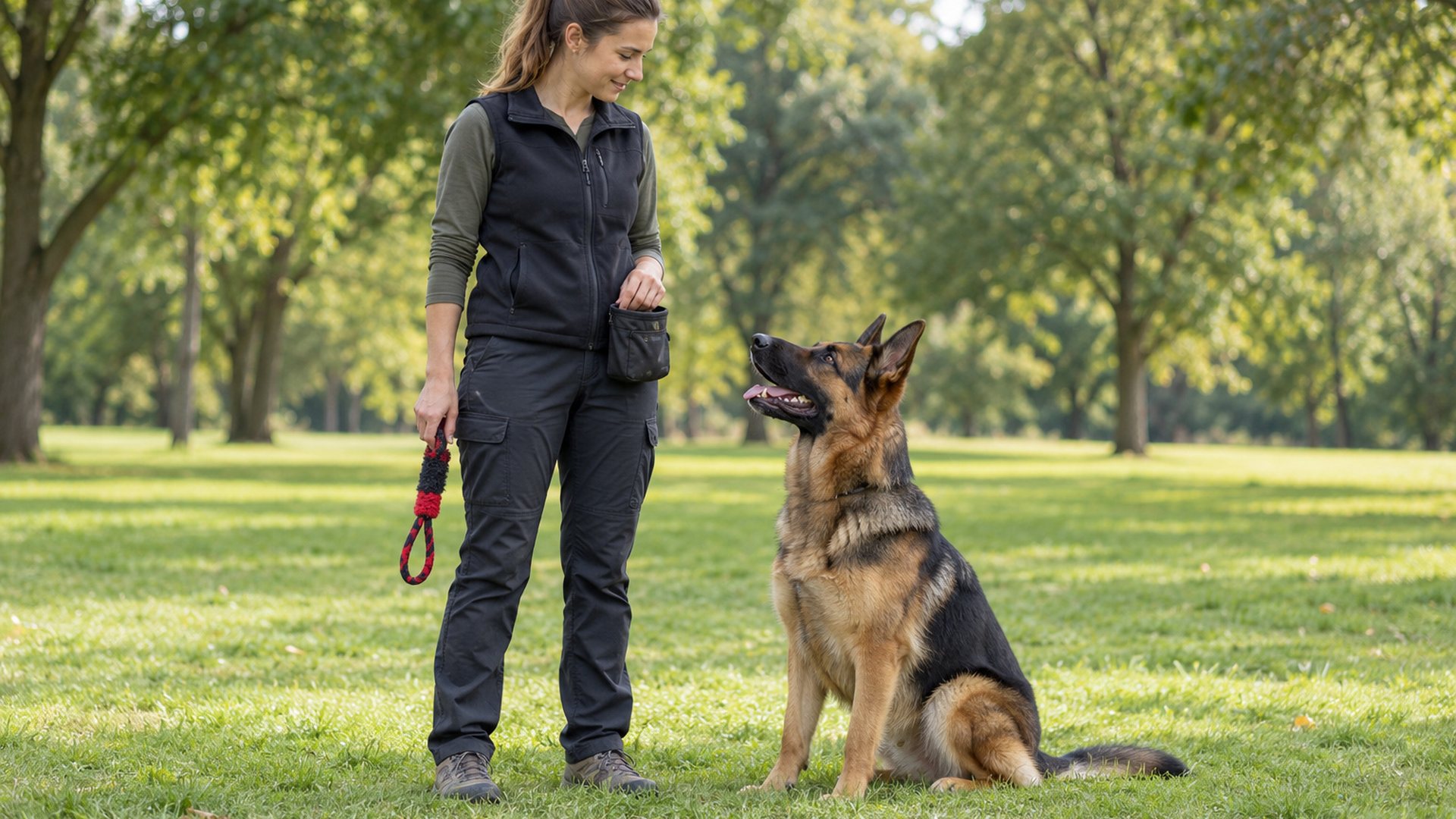
The best way to train a German Shepherd, Belgian Malinois, Border Collie or heeler is to treat their drive as fuel, not a fault: pay them generously with the things they love most (food, tug, chasing a ball), teach clear rules for those games, and practise self-control in short, frequent sessions. Harsh corrections tend to backfire with these sensitive, fast-learning breeds, adding stress and frustration to dogs that already run hot. A reward-based plan, plenty of sniffing and thinking work, and real rest days produce a calmer, more reliable dog.
This guide explains what “high drive” really means, how the main working breeds differ, a step-by-step plan for channelling drive into games with rules, impulse-control exercises, and the mistakes that most often turn an eager young working dog into a frustrated one.
At a glance
- Drive is a resource: the urge to chase, grip, herd or work is the best reward you have, so use it for training.
- Games need rules: tug and retrieve teach self-control when they start and stop on cue.
- Brains tire dogs too: scent work and problem-solving balance physical exercise and help prevent an over-fit, over-aroused dog.
- Corrections cost more than they gain: research links aversive training with more stress and no better results.
- Exercise needs are high: the UK Kennel Club lists more than two hours a day for Border Collies and Malinois, and PDSA suggests at least two hours for German Shepherds.
What “high drive” means in a working breed
“Drive” is a trainer’s word for a dog’s strong, inherited motivation to do a particular job. Herding breeds were selected to watch, stalk and move livestock; protection and police breeds to track, search and grip; retrievers to find and carry. In a pet home, those motivations do not disappear. They show up as chasing cars or children, nipping heels, barking at movement, shredding toys or never seeming to switch off.
High drive is not the same as bad behaviour or dominance. The American Veterinary Society of Animal Behavior’s position statement on dominance explains that many behaviour problems are better explained by learning, fear, frustration or unmet needs than by a dog trying to rank above its owner. That matters, because it points to the right fix: meet the need, teach the skill, and reward the behaviour you want.
How the main working breeds compare
Every dog is an individual, and lines within a breed differ a lot (working lines are often more intense than show or pet lines). These are general patterns to plan around.
| Breed | Original job | Common challenges at home | Outlets that usually work well |
|---|---|---|---|
| German Shepherd | Herding, guarding, police and service work | Guarding and barking at passers-by, wariness of strangers, can be vocal; strong attachment to family | Tracking and scent games, obedience, tug with rules, early, gentle socialisation |
| Belgian Malinois | Herding; widely used in police and military work | Very high energy and intensity, mouthiness, difficulty settling, frustration if under-occupied | Structured tug and retrieve, nose work, trick training, sports such as agility or obedience, taught “off switch” |
| Border Collie | Herding sheep | Chasing and staring at moving things, noise or motion sensitivity, obsessive ball play | Herding-style games, scent work, trick training, agility, controlled fetch with breaks |
| Australian Cattle Dog (heeler) | Driving cattle, often by nipping heels | Nipping ankles, strong attachment to one person, determination | Tug with rules, retrieve, puzzle feeders, scent work, redirecting nips to a toy |
| Siberian Husky | Pulling sleds over long distances | Strong urge to run, prey drive, recall that is harder to perfect | Harness sports with a suitable set-up, long-line sniff walks, scent games |
| Labrador and Golden Retriever | Retrieving game | Mouthiness, carrying and stealing objects, exuberant greetings | Retrieve games, carrying jobs, scent work, calm-greeting practice |
If you are still choosing a dog, the checklist near the end of this guide can help you check whether a working breed fits your lifestyle before you commit.
Why harsh corrections backfire with working breeds
Some popular training content for German Shepherds and Malinois still promotes “corrections”, prong collars, shock collars and leash pops as necessary for “strong” dogs. The evidence points the other way.
- A 2017 review by Ziv in the Journal of Veterinary Behavior concluded that aversive methods can harm dogs’ physical and mental wellbeing, found no evidence that punishment works better than positive reinforcement, and recommended trainers rely mainly on positive reinforcement.
- A 2020 study by Vieira de Castro and colleagues, published in PLOS ONE, compared 92 dogs from reward-based and aversive-based training schools in Portugal. Dogs from aversive schools showed more stress behaviours during training, larger rises in the stress hormone cortisol, and more “pessimistic” responses in a later test.
- The American Veterinary Society of Animal Behavior’s 2021 position statement on humane dog training advises against choke, prong and shock collars and physical corrections, and states that there is no evidence aversive methods outperform reward-based methods.
There is also a practical problem. Working breeds are often fast, sensitive and highly aroused. Adding pain or fear to an already excited dog can increase frustration, make a dog wary of the handler, or teach it to associate people, other dogs or the environment with discomfort. Some dogs simply push through corrections when aroused, which tempts handlers to escalate. Reward-based training avoids that spiral. If you want help, our guide on how to choose a dog trainer lists the questions that separate qualified, reward-based trainers from the rest.
A reward-based training plan for high-drive dogs
Follow these steps in order. Keep sessions short (a few minutes is plenty for a young dog), end while your dog still wants more, and build in calm time afterwards.
- Find your dog’s reward ladder. List what your dog loves, from mildly interesting (dry kibble) to top value (tug, a thrown ball, a favourite treat). Use low-value rewards in easy settings and top-value rewards for hard work. Our positive reinforcement guide explains timing and markers.
- Teach a marker. Pair a word such as “yes” (or a clicker) with a reward, so your dog knows exactly which behaviour earned the pay.
- Set tug rules. Tug only starts when you invite it with a cue such as “take it”. Teach “out” by holding the toy still and trading for a treat, then restarting the game as the reward. If teeth touch skin, the game pauses briefly. These rules turn tug into a self-control exercise.
- Set retrieve rules. Ask for a brief sit or wait before each throw, and use two identical toys so your dog learns that bringing one back makes the other fly. Cap the number of throws and mix in sniffing, so fetch does not become obsessive.
- Practise impulse-control games. Waiting at doors and before food bowls, leaving a treat on the floor until released, and settling on a mat. See how to teach a dog to settle on a mat for a step-by-step version.
- Add daily sniff and thinking work. Scatter feeding, “find it” games and simple searches use the nose and tire the brain without winding a dog up. Our guide to scent work at home is a simple starting point.
- Build recall around drive. Reward coming back with the thing your dog wants most, such as a game of tug, then release them to go again. Use a long line until recall is reliable; our recall training guide covers the stages.
- Teach an off switch. After an exciting game, guide your dog into a calm activity: a chew, a lick mat, or settling on their bed. Reward calm as deliberately as you reward action.
- Plan rest days. Swap high-intensity play for gentle sniff walks and enrichment some days. Over-exercising a high-drive dog can build stamina without building calm.
Sample daily routine for an adult working-breed dog
| Time | Activity | Purpose |
|---|---|---|
| Morning | Sniff-focused walk or long-line exploration | Physical exercise plus mental decompression |
| Mid-morning | Five-minute training session, then a chew | Skills plus practising calm |
| Afternoon | Puzzle feeder or scatter feed | Problem-solving with food |
| Late afternoon | Tug or retrieve with rules, or a dog sport session | Outlet for chase and grip drive, with self-control |
| Evening | Gentle walk, then settling on a mat | Winding down before rest |
Exercise needs vary with age, health and the individual. Our guide on how much exercise a dog needs explains how to adjust for puppies, adults and seniors. German Shepherds are among the breeds affected by hip and elbow dysplasia, so ask your vet about suitable exercise for a growing pup and choose parents that have been health-screened.
Handling specific working-breed behaviours
Nipping heels and chasing
Herding breeds, especially heelers and collies, may nip ankles or chase children, bikes and other pets. Manage first (baby gates, a lead or long line around triggers) so the behaviour is not rehearsed. Then teach an alternative, such as chasing a toy on a flirt pole or tug toy on cue, and reward your dog for looking away from movement. Never let children run while a herding dog chases them.
Mouthiness and grabbing
Malinois, shepherds and retrievers often want something in their mouth. Offer a toy at greetings and during excitement, and teach a “hold” or “carry” cue. Mouthing in young puppies is normal; redirect it to a toy and reward gentle mouths.
Barking and guarding
German Shepherds in particular may bark at passers-by and visitors. Reduce what your dog can see from windows, reward calm looks at people passing, and give your dog a job (go to mat) when visitors arrive. If your dog lunges or barks at people or dogs on walks, see our guide to helping a reactive dog on the lead.
The teenage phase
Many working-breed dogs become more intense and seem to “forget” training between roughly six months and two years. This is normal development. Keep sessions short, lower distractions and stay consistent; our guide to dog adolescence explains what to expect.
Common mistakes
- Only physical exercise. Endless ball throwing builds a fitter, more aroused dog. Balance it with sniffing and calm.
- No rules for tug and fetch. Games without start and stop cues can increase over-arousal.
- Using corrections for “strong” dogs. Evidence shows reward-based methods work at least as well with better welfare.
- Long training sessions. Working breeds learn fast and tire mentally; short, frequent sessions get better results.
- Skipping socialisation. Guarding breeds especially need calm, positive exposure to people, places and dogs as puppies.
- Ignoring stress signals. Panting, yawning, lip-licking and tension during training are signs to make things easier.
- No off switch. Teaching calm is as important as teaching tricks.
- Leaving the dog alone too long. PDSA advises that German Shepherds should not be left alone for more than four hours.
Is a working breed right for you? Quick checklist
- Can you give two or more hours of activity every day, including training and enrichment?
- Will someone be home for much of the day, or can you arrange a sitter or walker?
- Are you willing to learn reward-based training, or pay a qualified trainer?
- Do you have secure fencing and somewhere safe for long-line or off-lead exercise?
- Are you ready for an intense adolescent phase?
- Have you checked health screening for the parents (for example, hips and elbows in German Shepherds)?
Sources this guide draws on: the American Veterinary Society of Animal Behavior position statement on humane dog training (2021); Ziv, “The effects of using aversive training methods in dogs: a review”, Journal of Veterinary Behavior (2017); Vieira de Castro and colleagues, “Does training method matter?”, PLOS ONE (2020), and the UFAW summary of that study; UK Kennel Club breed information for the Border Collie and Belgian Shepherd Dog (Malinois); and PDSA breed information for the German Shepherd.
Handy gear for this guide
Practical picks we think suit this topic. As an Amazon Associate, Mind A Dog earns from qualifying purchases, at no extra cost to you. Prices and availability are set by Amazon and may vary by country.
- Mighty Paw Dog Training Treat Pouch
Magnetic clasp keeps treats handy and stops spills on walks and training sessions.
View on Amazon - Dog Training Clicker with Wrist Strap
A clear, consistent marker sound for reward-based training.
View on Amazon - Zak George’s Dog Training Revolution (book)
A friendly, reward-based guide to raising a well-behaved dog.
View on Amazon
Frequently asked questions
How do you train a German Shepherd puppy?
Start with short reward-based sessions on name response, sit, settle and recall, plus gentle, positive socialisation with people, places and dogs. Use tug and food as rewards, give plenty of chews for mouthing, and build calm time into every day. Ask your vet about suitable exercise while the joints are growing.
Are Belgian Malinois hard to train?
Malinois are quick learners, so they pick up training fast, but their energy and intensity make them hard to live with if under-occupied. They suit experienced owners who can give structured daily training, outlets for drive and a taught off switch. They are not usually a good first dog.
How do I stop my Blue Heeler nipping?
Manage situations where nipping happens, such as running children, and give your dog an alternative, such as chasing a toy on cue. Reward calm behaviour around movement and avoid physical punishment, which can increase arousal. If nipping is persistent or hard, consult a qualified reward-based trainer or veterinary behaviourist.
How much exercise does a Border Collie need?
The UK Kennel Club lists more than two hours a day for an adult Border Collie. That time should include mental work such as training, scent games and problem-solving, not just running. Puppies and older dogs need adjusted, gentler routines.
Is tug of war bad for working dogs?
No. Played with clear rules (start on cue, “out” on cue, pause if teeth touch skin), tug is one of the best rewards and self-control exercises for high-drive dogs. It becomes a problem only without rules or when played until the dog is over-excited.
Do high-drive dogs need a firm hand?
They need clear structure and consistency, not force. Research and veterinary behaviour organisations agree that reward-based methods work at least as well as aversive ones, with lower stress. Clear rules, generous rewards and good management give you the “firm” boundaries you need.
A high-drive working dog can be a brilliant, devoted companion when its drive has somewhere good to go. Use what your dog loves as pay, teach rules for every game, and make calm a skill you practise every day.