
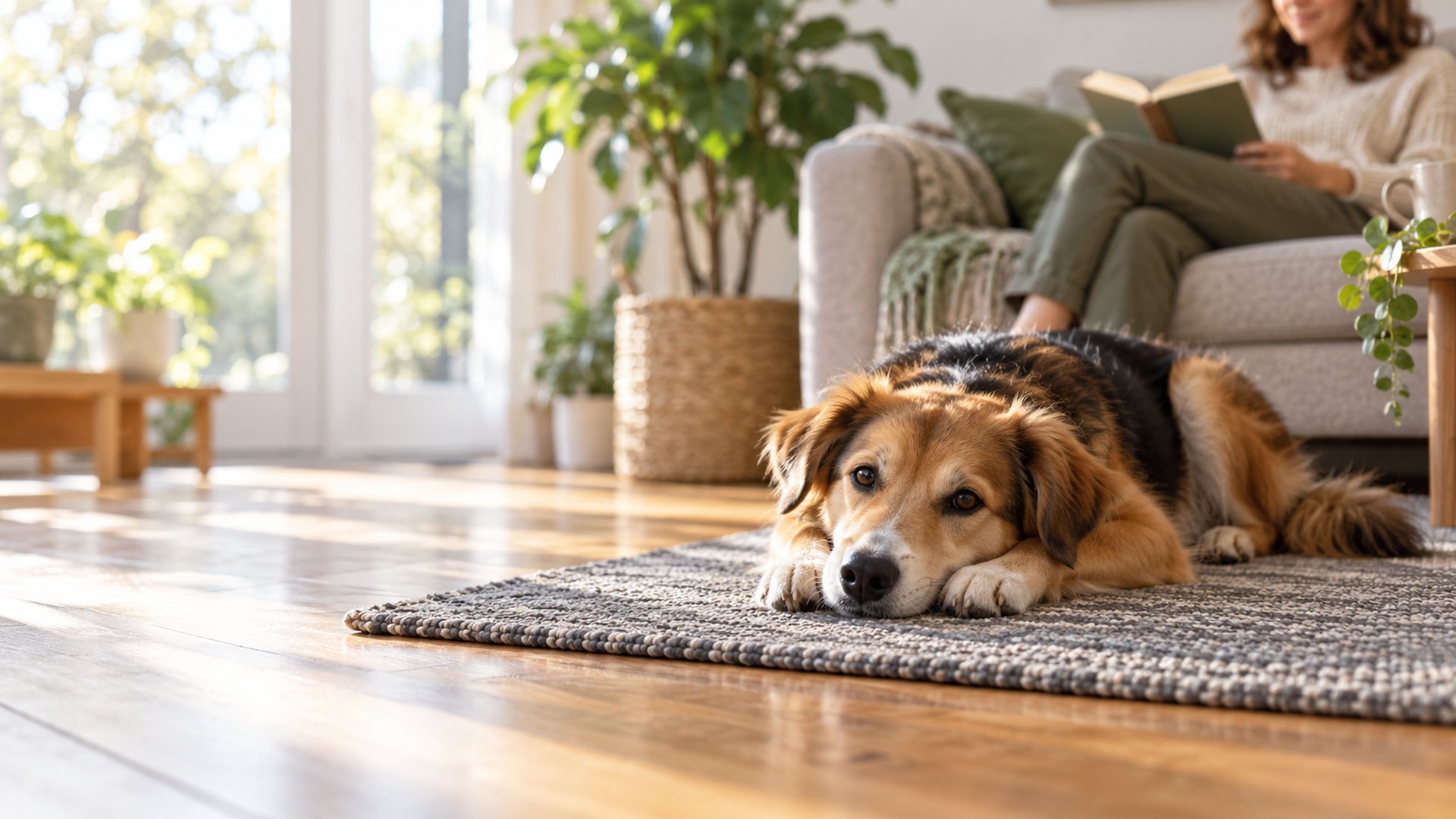
To teach a dog to settle on a mat, reward them for stepping onto it, then for lying down on it, then for staying relaxed there for slowly longer stretches while you add movement and distractions in small steps. Practise for a few minutes at a time when your dog is already a little tired, pay calmly with treats delivered on the mat, and never use the mat as a punishment. Most dogs learn the basics within a week; reliable settling in busy places takes a few weeks of steady practice.
Disclosure: this guide contains affiliate links, marked as such. If you buy through them, Mind A Dog may earn a small commission at no extra cost to you.
This guide gives you a complete five-stage plan, a troubleshooting table for the problems that stall most owners, a weekly practice schedule, and advice on taking the mat to cafés, vet waiting rooms and friends’ homes. Every step uses kind, reward-based training.
At a glance
- Settling is a skill, not a mood. A tired dog settles by accident; a trained dog can settle on purpose, even somewhere new.
- Build in this order: mat, lie-down, duration, your movement, distractions, new places.
- Pay for relaxation, not just position. Head down, hip rolled to one side and a sigh are what you are aiming for.
- Short sessions win. Three to five minutes, once or twice a day.
- If your dog keeps getting up, the step was too big. Go back and make it easier.
Why a mat works
Dogs learn places quickly. A mat gives your dog a clearly defined spot with a clear job, and because it is portable, it carries that meaning wherever you take it. That is why a mat can help a dog relax at a café table or in a waiting room, where nothing about the setting helps them calm down.
Mat work is a long-established approach in reward-based training. Veterinary behaviourist Dr Karen Overall’s widely used Relaxation Protocol, for example, teaches dogs to stay calm on a mat while small distractions are added gradually. A mat is not a substitute for exercise, enrichment or company; it is a skill that sits alongside them.
Mat, bed, crate or “stay”: what is the difference?
| Tool | What it teaches | Best used for | Limits |
|---|---|---|---|
| Settle mat | Choosing to go to a spot and relax there | Cafés, visitors, mealtimes, vet waiting rooms, travel | Needs gradual training to work in busy places |
| Dog bed | A comfortable home sleeping place | Rest and sleep at home | Not portable; less useful as a cue elsewhere |
| Crate | Comfort in an enclosed den | Rest, travel safety, recovery after surgery | Must be taught gently; not for long periods |
| Sit or down-stay | Holding a position on cue | Short pauses, such as at the kerb | Dogs often wait tensely rather than relax |
The mat and the crate work well together. Our guide to crate training without the guilt covers the crate side.
What you need
- A mat or small blanket that is easy to carry and wash and is not already your dog’s bed. A bath mat or folded towel is fine. Using one mat consistently matters more than which mat.
- Small, soft treats your dog likes, cut small enough to eat quickly. For calm work, steady low-excitement rewards help more than very exciting ones.
- A quiet room and a time when your dog is already a little tired, such as after a walk or a meal.
- A marker word such as “yes” that tells your dog the moment they got it right. Our guide to positive reinforcement training explains markers.
Where to buy treats for mat training
Calm, steady rewards help a dog learn to settle. Raw Paws Pet Food sells small freeze-dried and single-ingredient treats that suit short training sessions.
Browse dog treats at Raw Paws → (affiliate link)
See freeze-dried treats at Raw Paws (affiliate link)
Whatever treats you use, count them as part of your dog’s daily food so training does not add unwanted weight.
The five-stage plan
Stage 1: Make the mat valuable
- Put the mat on the floor and stand beside it.
- When your dog looks at it, sniffs it or puts a paw on it, say “yes” and drop a treat on the mat.
- Toss a treat off the mat to reset, then wait for your dog to return to it. Mark and pay on the mat again.
- Continue until your dog walks straight onto the mat with all four paws as soon as you reset.
This is the stage people rush. You are teaching that the mat is where good things happen, and everything else rests on it.
Stage 2: Wait for the lie-down
Once your dog is happily standing on the mat, stop paying for standing and wait. Many dogs offer a sit and then drift into a down. The moment their body lowers, mark and place the treat between their front paws, on the mat. If your dog does not lie down after a minute or two, you can lure it once or twice with a treat held low, then go back to waiting. A dog who works it out for themselves usually holds the position better.
When your dog reliably goes to the mat and lies down, add your cue, such as “mat” or “settle”, saying it just as they start moving toward the mat.
Stage 3: Build relaxed duration
- Pay after one second of lying down, then two, then three.
- Vary the gaps, such as 2, 5, 3, 8 and 4 seconds, so your dog cannot predict the pattern.
- Deliver treats calmly between the paws. Treats thrown or held up draw your dog out of position.
- Pay extra for signs of real relaxation: hip rolled to one side, head resting on the floor, a slow breath out, soft eyes.
- If your dog gets up, say nothing. Quietly reset and make the next try shorter.
A dog lying down with a stiff, alert body is waiting, not settled. You are teaching your dog to switch off, so the calmer the dog, the better the moment to pay.
Stage 4: Add your movement
- Shift your weight, then return to still. Pay.
- Take one step away and back. Pay.
- Take two steps, then three, then walk a circle around the mat.
- Sit down in a chair, stand up, pick up a cup, open a drawer.
- Step out of the room for a second and return. Build up slowly.
Stage 5: Add distractions, then new places
- Background noise first: television or radio.
- Then movement: someone walking past, a door opening, a bag being picked up.
- Then mild excitement: a family member arriving, a toy rolling past.
- Then different rooms, the garden, a friend’s home and finally public places.
Each time you change one thing, make the others easier: shorter durations, more frequent treats and more distance from the action.
A sample four-week practice schedule
| Week | Focus | Typical goal by the end of the week |
|---|---|---|
| 1 | Stages 1 and 2 | Dog goes to the mat and lies down on cue in a quiet room |
| 2 | Stage 3 | Relaxed down for a minute or more with you nearby |
| 3 | Stage 4 and early Stage 5 | Stays settled while you move around the room and with the TV on |
| 4 | Stage 5 | Short, calm settle in a new place such as a friend’s home or quiet café |
These are typical goals, not deadlines. Puppies, adolescent dogs and anxious dogs may need longer, and that is fine.
Taking the mat out into the world
Bring the same mat everywhere you use it. Choose a quiet corner, put the mat down, wait for your dog to choose it, and feed calmly for lying there. A short sniff walk beforehand helps. Keep first outings brief and leave while your dog is still relaxed, rather than after they have given up. Over time the mat comes to mean “relax here” in any room.
The mat is especially useful for visitors arriving, family meals, vet visits, and holidays and travel, where a familiar object helps a dog settle in a strange place.
Troubleshooting
| Problem | Likely reason | What to try |
|---|---|---|
| Dog gets up the moment you move | Movement added too fast | Go back to weight shifts and half steps; pay more often |
| Dog lies down but stays stiff and staring | Paying for position, not calm | Pay slowly and calmly for softer body signs; practise after exercise |
| Dog is too excited to start | Too much energy or exciting treats | Walk or sniffing game first; use lower-value treats |
| Works at home, falls apart outside | Too big a jump in difficulty | Practise in more in-between places; add distance from busy areas |
| Dog avoids the mat | Mat linked with something unpleasant | Use a new mat and rebuild Stage 1; never send the dog there as punishment |
Common mistakes
- Using the mat as a punishment. If it becomes the place your dog is sent when in trouble, they will stop choosing it.
- Asking for long stays too early. Duration is built last, in small steps.
- Training a wired dog. Meet the need for activity first with a walk or a scent game; see our dog enrichment ideas.
- Repeating the cue. Say it once; if your dog does not respond, the task is too hard for now.
- Stopping the rewards. Settling that is never rewarded fades. Keep paying, calmly and now and then, once the behaviour is solid.
- Expecting a mat to fix everything. It does not replace exercise, company or help with anxiety. See how much exercise a dog needs.
When it is not working, and when to get help
If your dog cannot settle even in a quiet room after exercise, look for the reason rather than pushing on. Is your dog getting enough physical and mental activity? Could they be in pain or unwell? A dog who keeps shifting position, cannot get comfortable, pants without reason or is restless at night should see a vet, because pain and discomfort are common causes. Is your dog anxious? Panting, pacing, lip licking and yawning are signs of stress; our guide to the hidden signs of stress in dogs covers them.
If your dog is fearful, or settling falls apart whenever you leave the room, a qualified reward-based trainer or veterinary behaviourist can help; our guide to separation anxiety in dogs is a good place to start.
Your mat training checklist
- One dedicated, washable mat
- Small, calm treats counted into daily food
- Sessions of three to five minutes, after exercise
- Pay on the mat, between the paws
- Only one thing made harder at a time
- Pay for relaxation, not just lying down
- Never use the mat as a punishment
- Vet check if your dog suddenly cannot settle
Once your dog has mastered the mat, you can build on the same skills with more tricks, from touch to tidy up.
Sources this guide draws on: Dr Karen Overall’s Relaxation Protocol, published in her veterinary behaviour texts; American Veterinary Society of Animal Behavior position statement on humane dog training; RSPCA advice on reward-based training.
Handy gear for this guide
Practical picks we think suit this topic. As an Amazon Associate, Mind A Dog earns from qualifying purchases, at no extra cost to you. Prices and availability are set by Amazon and may vary by country.
- EVERLIT Pet First Aid Kit (95 Pieces)
Bandages, gauze and basics in one bag for home, car or hikes while you contact your vet.
View on Amazon - Hepper Bio-Enzyme Pet Stain and Odour Spray
Enzyme cleaner for accidents on carpets, floors and bedding.
View on Amazon - Portable Dog Water Bottle with Food Container
Fresh water and a snack on walks and car trips.
View on Amazon
Frequently asked questions
How long does it take to teach a dog to settle on a mat?
Most dogs learn to go to the mat and lie down within a few short sessions over a week. Reliable settling with distractions and in new places usually takes several weeks. Measure progress by what your dog can do, not by the calendar.
Can I use a bed instead of a mat?
Yes, if you are consistent. A mat is useful because it is portable and clearly different from your dog’s bed, so it carries its own meaning. If you use the bed, follow the same stages.
My dog gets up as soon as I move. What should I do?
You are moving too far or too soon. Go back to a stage where your dog stays down reliably and add movement in smaller steps, such as a weight shift or half step, paying for each success.
Should I give a chew or stuffed toy on the mat?
A chew can help some dogs relax once the basic skill is in place, but it is not a substitute for teaching it. Choose a safe chew and supervise; see our guide to choosing safe dog chews.
Is mat training the same as crate training?
No. A crate is an enclosed space, while a mat is an open place your dog chooses to be. They work well together and both can be taught gently.
Can I teach an older dog to settle on a mat?
Yes. Adult and senior dogs learn mat work well. Choose a thicker, comfortable mat for older joints, keep sessions short, and ask your vet if your dog seems stiff or sore when lying down.
A settle mat is one of the most useful everyday skills you can give your dog: a portable place where calm pays. Start small, keep it kind, and let your dog discover that relaxing is the best deal in the room.
This is general guidance for owners of healthy dogs. It is not veterinary advice. If your dog is restless, distressed or in pain, please speak to your vet and to a qualified, reward-based trainer or behaviourist.