
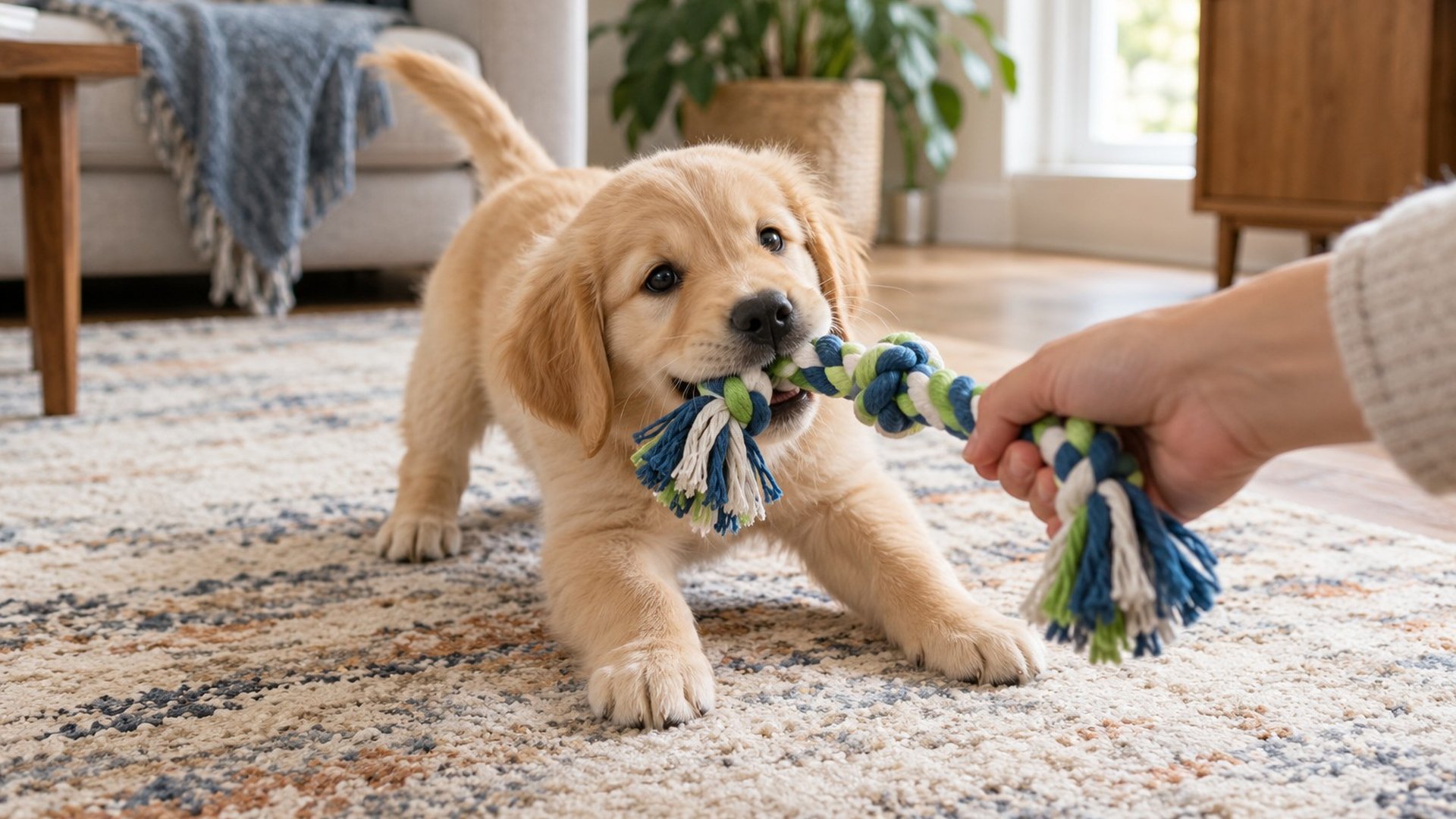
Puppy biting is normal: puppies explore with their mouths, relieve sore teething gums by chewing, and nip when they are overexcited or overtired. The way to stop it kindly is to give your puppy something better to bite, end play calmly the moment teeth touch skin, make sure they get enough sleep, and manage the situations that tip them over. Punishment, including holding the mouth shut or spraying the puppy, makes biting worse for many puppies and damages trust.
This guide explains why puppies bite, how to tell the difference between play biting and something more worrying, a step-by-step plan you can start today, a quick troubleshooting table for the most common biting moments, and when to call your vet or a qualified reward-based trainer.
At a glance
- Mouthing is a normal phase, strongest while teething, and it fades with consistent, calm teaching.
- Redirect to a toy before and during play, so teeth always have a legal target.
- If teeth touch skin, go still, then calmly pause play for a short break.
- Overtired puppies bite more. Many “biting fits” are a sign your puppy needs a nap.
- Never hold the muzzle, tap the nose, shout, push or spray. See your vet if biting is sudden, intense or comes with stiff body language.
Why puppies bite and nip
Understanding the reason behind the bite tells you which fix to use. Most puppies bite for a mix of these reasons.
- Exploring: a puppy’s mouth is how they investigate the world, much as a toddler uses their hands.
- Play: puppies play with each other using their mouths, and they try the same game on people.
- Teething: chewing soothes sore gums while the baby teeth fall out and adult teeth come through.
- Overexcitement: fast games, hands waving and squealing children can push a puppy past the point of thinking.
- Tiredness: Dogs Trust notes that puppies need around 18 to 20 hours of sleep a day. A puppy who has missed naps often becomes bitey and frantic.
- Frustration or boredom: being unable to reach something, or having nothing to do, can lead to nipping.
- Discomfort: pain or illness can change behaviour. Sudden or unusual biting is a reason to see your vet.
The teething timeline
According to PetMD’s veterinary-reviewed teething guide, puppies have 28 baby teeth by about six to eight weeks, begin losing them from roughly three and a half to five months, and most have their full set of 42 adult teeth by around six to seven months. Large breeds often get adult teeth a little earlier than small breeds. Expect chewing and mouthing to peak while the adult teeth are coming through. If a baby tooth still has not fallen out when the adult tooth beside it is in, ask your vet to check it.
Play biting or something more?
Most puppy mouthing is playful. A small number of puppies bite out of fear, guarding or frustration, and that needs professional help early rather than waiting for them to grow out of it. This table, based on guidance from the ASPCA and Dogs Trust, shows the common differences.
| Sign | Usually play | Get help promptly |
|---|---|---|
| Body | Loose, wiggly, bouncy | Stiff, frozen or very still before the bite |
| Face | Soft eyes, relaxed mouth | Lips pulled back, hard stare, whites of the eyes showing |
| Sound | Play growls during a game | Low growl while guarding food, toys or a resting place |
| Bite strength | Nips and grabs, often during play | Bites much harder than usual or that injure |
| Context | Games, greetings, being tired | Being handled, groomed, picked up, approached while eating |
| Pattern | Gradually reduces with teaching | Starts suddenly, worsens, or returns after improving |
If you are not sure what you are seeing, understanding canine body language and the hidden signs of stress in your dog will help you read the moments before a bite.
What actually helps: a step-by-step plan
These steps work best when everyone in the household follows them the same way.
- Keep a toy in your hand. Before you start playing or cuddling, have a long soft toy ready so your puppy’s teeth land on it rather than your fingers. Tug toys and toys on a rope keep hands further from teeth.
- Reward the right choices. When your puppy grabs the toy, chews a chew or licks instead of nips, praise warmly or offer a small treat. Positive reinforcement teaches your puppy what to do, which is faster than trying to teach them what not to do.
- Go still when teeth touch skin. Stop moving your hands. Pulling away fast turns your hand into an exciting moving toy.
- Offer the toy again. Often that is all it takes. If your puppy switches to the toy, carry on playing.
- If biting continues, take a calm break. Stand up quietly, turn away, or step over a baby gate for 20 to 30 seconds. No scolding: the message is simply that the game pauses when teeth meet skin. Then come back and restart gently with a toy.
- Check for tiredness. If your puppy keeps biting after a break, they may need sleep, not more play. Pop them in their resting space with a chew and let them nap.
- Give chewing a job. Offer a food-stuffed rubber toy, a lick mat or a suitable chew several times a day, especially at known bitey times. Chews and chew toys: how to choose safely explains which are suitable for puppies.
- Teach a calm default. Rewarding your puppy for lying on a mat or sitting for attention gives them a better way to ask for interaction. Teaching your dog to settle on a mat walks through the steps.
Management: prevent the bites you can predict
Management means arranging life so your puppy does not get to practise biting while they are still learning. It is not cheating; it is how good habits form.
- Use baby gates or a puppy pen so your puppy can be near you without access to ankles, trouser legs or children.
- Plan naps after walks, meals and visitors, when overexcitement is most likely.
- Keep a basket of toys in every room so a redirect is always within reach.
- Use a house line (a light lead with no handle, only when supervised) to calmly guide your puppy away from trouble without grabbing them.
- Avoid rough wrestling and games with hands, feet or clothing as the toy.
Teething relief
- Offer chew toys with some give, and rotate them so they stay interesting.
- A frozen food-stuffed rubber toy or a chilled damp flannel tied in a knot can soothe sore gums. Supervise and remove anything that starts to tear apart.
- Avoid very hard chews such as bones, antlers and hooves, which Cornell University’s canine health guidance warns can break teeth.
- Talk to your vet if gums look very red or swollen, your puppy stops eating, or you see a broken tooth.
Quick fixes for the most common biting moments
| Situation | What usually helps |
|---|---|
| Biting hands during cuddles | Keep cuddles short, have a chew in your other hand, stroke the chest rather than the head |
| Biting ankles and trousers when you walk | Stop walking, offer a tug toy, use a gate during busy times; scatter a few treats on the floor to change the game |
| Evening “zoomies” and frantic biting | Treat it as overtiredness: a calm chew, then rest in the crate or pen |
| Biting the lead on walks | Bring a tug toy to swap for the lead, keep early walks short, reward walking calmly |
| Nipping children | Supervise every moment, use a gate, teach children to stand still like a tree and call an adult; never leave them alone together |
| Biting when being handled or groomed | Go slower, pair each touch with a treat, stop before your puppy struggles; ask your vet to rule out pain |
What not to do
Some old-fashioned advice is still widely shared online. These methods rely on startling, frightening or hurting a puppy. They can make some puppies bite harder, teach them to fear hands, and undermine the relationship you are building.
- Do not hold your puppy’s muzzle shut or push their lip into their teeth.
- Do not tap or flick the nose, slap, scruff, shake or pin your puppy down.
- Do not yelp and then punish. Some older guides suggest yelping like a littermate; many puppies simply get more excited, and pairing a yelp with any punishment only adds fear. A calm pause works better.
- Do not spray your puppy with water, citronella or any other spray, and do not use shaker cans, rattle bottles or noise devices meant to startle.
- Do not use aversive tools of any kind, including shock, prong or choke collars.
- Do not shout or push your puppy away, which Dogs Trust notes can increase fear and frustration.
- Do not encourage rough play with hands and feet, even as a joke.
How long does puppy biting last?
There is no fixed date. Mouthing tends to be at its most intense while teething, and many puppies become noticeably gentler once their adult teeth are in, around six to seven months, if they have been taught consistently. Some dogs remain mouthy into adolescence, especially when excited; dog adolescence: surviving the teenage phase explains why behaviour can wobble then. For the bigger picture of what to expect month by month, see your puppy’s first year: a stage-by-stage guide.
When to get help
See your vet first if:
- biting starts suddenly, becomes more intense or returns after improving;
- your puppy bites when touched in a particular place, which can point to pain;
- your puppy is off food, unusually quiet or shows other signs of illness.
Ask your vet to refer you to a qualified reward-based trainer or behaviour professional, or to a veterinary behaviourist, if:
- bites break the skin or injure anyone (seek medical advice for the person too);
- biting comes with stiffening, freezing, lips pulled back or a hard stare;
- your puppy guards food, toys or resting places;
- there are children in the home and you feel unable to keep everyone safe;
- nothing has improved after two to three weeks of consistent practice.
Choose a trainer who uses reward-based methods and can explain exactly how they will help. Puppy classes run by such trainers can also give your puppy safe, supervised play with other puppies, which the ASPCA notes can help them learn to moderate their bite. Puppy socialisation explains how to make those early experiences positive.
Common mistakes
- Inconsistency: one person allows hand games while another pauses play. The puppy learns that biting sometimes works.
- Too much play, not enough sleep: a puppy who never naps will struggle to control their mouth.
- Pulling hands away fast: this triggers chasing and grabbing.
- Waiting until the puppy is already frantic before offering a toy, instead of offering it first.
- Long time-outs or isolating the puppy as a punishment. Breaks should be short and calm.
- Expecting overnight results: it usually takes weeks of steady practice.
Related guide: When Do Puppies Lose Baby Teeth? A Simple, Smart Timeline.
Sources this guide draws on: Dogs Trust guidance on mouthing, nipping and puppy biting; the ASPCA’s advice on mouthing, nipping and biting in puppies; PetMD’s veterinary-reviewed guide to puppy teething; and Cornell University’s Riney Canine Health Center on hard chews and fractured teeth.
Handy gear for this guide
Practical picks we think suit this topic. As an Amazon Associate, Mind A Dog earns from qualifying purchases, at no extra cost to you. Prices and availability are set by Amazon and may vary by country.
- Nylabone New Puppy Starter Kit (3 Pack)
Puppy-soft chews sized for teething mouths.
View on Amazon - MidWest iCrate Double Door Dog Crate (36 inch)
Folding wire crate with a divider panel, so it can grow with your dog.
View on Amazon - Zak George’s Dog Training Revolution (book)
A friendly, reward-based guide to raising a well-behaved dog.
View on Amazon
Frequently asked questions
At what age do puppies stop biting?
Many puppies become much gentler once their adult teeth have come through, which is usually by about six to seven months. The change depends on consistent teaching, enough sleep and good chew outlets. Some dogs stay mouthy when excited into adolescence and benefit from continued practice.
Is it normal for my puppy to bite me all the time?
Frequent mouthing is common, especially in the evenings and while teething. If biting is constant, check whether your puppy is getting enough sleep and enough to chew. If it is getting worse or comes with stiff body language, see your vet and a reward-based trainer.
Should I yelp when my puppy bites?
Some puppies stop briefly when you yelp, but many get more excited. A calm approach, going still, offering a toy and pausing play if needed, tends to be more reliable. Never follow a yelp with any kind of punishment.
Why does my puppy bite more at night?
Evening biting is often a sign of overtiredness. Puppies who have missed naps can become frantic and bitey. A calm chew followed by rest in a quiet space usually helps more than extra play.
Is puppy biting a sign of aggression?
Usually not. Most puppy biting is play, exploration or teething. Biting that comes with freezing, stiffening, lips pulled back or guarding needs prompt help from your vet and a qualified reward-based professional.
Should I use a bitter spray to stop puppy biting?
This guide does not recommend sprays. They do not teach your puppy what to do instead, and some puppies find them upsetting. Management, redirection to chews and calm breaks deal with the cause rather than the symptom.
Puppy biting feels endless while you are in the middle of it, but it is a stage, not a personality. Give those teeth a better target, protect your puppy’s sleep, stay calm and consistent, and ask for help early if anything worries you.