
The short version
Dogs pull because it works: every step forward while the lead is tight pays the pulling. To change it, use a well-fitted Y-shaped harness and a fixed-length lead of about two metres, reward your dog for being beside you, stop moving the instant the lead goes tight, and practise first in a boring place before you try a busy street.
Why the walk stopped being fun
A dog who pulls is not being rude or trying to run the household. Pulling is simply the behaviour that has worked so far, repeated a few hundred times.
It also helps to remember that dogs walk faster than we do. A comfortable human pace is a slow amble for most dogs, and staying at our speed is genuinely dull. Add a street full of smells and the pull makes sense.
Loose lead walking is a skill rather than a personality trait, and skills can be taught at any age.
Why dogs pull
Three things are usually running at once.
- It is reinforced. Your dog pulls, the walk continues, and they get where they wanted to go. Every tight-lead step is a small payment.
- Speed. Their natural walking pace is faster than yours, so pressure on the lead is the default state rather than a deliberate act.
- Arousal. The outside world is exciting, and a dog fizzing about a squirrel is not in a good state for learning anything.
None of those are solved by telling your dog off. They are solved by changing what earns forward movement.
Equipment that makes this easier
Kit does not train a dog, but the wrong kit makes the job harder.
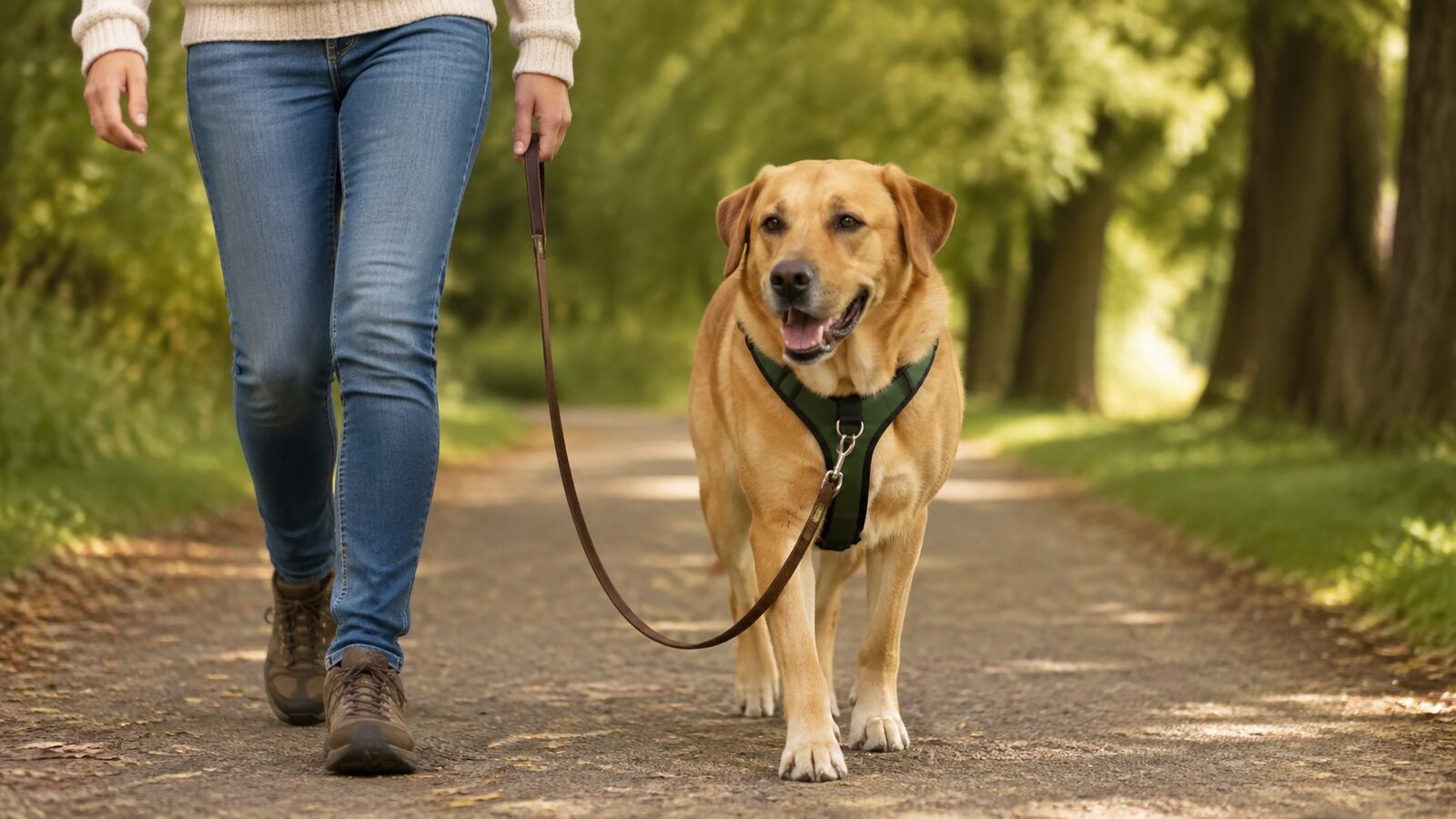
A well-fitted Y-shaped harness is the usual starting point. The Y sits over the front of the chest and leaves the shoulder free to move, rather than a strap running straight across the joint. Look for two attachment points, one on the chest and one on the back. Fitted properly, you can slide a couple of fingers under any strap, and nothing sits in the armpit.
Clip to the back ring in calm places. The front ring gives gentler steering when your dog is stronger than you or the environment is difficult. A double-ended lead clipped to both gives good control without pressure on the neck.
A fixed-length lead of about two metres gives your dog room to move without a running start. Shorter leads lock the pair of you together and make pressure constant; longer ones are hard to manage near roads.
Why retractable leads make pulling worse
A retractable lead has constant tension on it by design, and it releases more lead when your dog pulls harder. That is a training machine, and what it teaches is pulling. It also gives little control at the moments you most want it, and the thin cord can hurt hands and legs.
If you use one in open spaces that is your call, but keep it out of the sessions where you are teaching loose lead walking. A long line in a safe open area does the job better.
Start somewhere boring
The most common mistake is starting on the actual walk. The street is the exam, not the classroom.
Begin in your hallway, kitchen or garden, where nothing much is happening. Your dog can learn what pays with almost no competition, so you reward a lot and they are right a lot. Move to a quiet path only when it is easy indoors, and expect a drop in quality each time the environment changes.
It also helps to split your walks in two. Training sessions are short, deliberate and heavily rewarded. Ordinary walks, where you just need to get somewhere, can happen on a long line in an open space where pulling matters less. Training on every walk exhausts both of you.
The method
Pay the position
Decide which side you want your dog on and stick to it. Every time your dog is beside you with slack in the lead, mark it with a word like “yes” and feed a treat at the level of your leg, on that side.
Feeding low and by your knee matters more than it sounds. It puts your dog exactly where you want them, keeps them from jumping up, and makes that space the best-paid place in the world. Early on, pay generously: every few steps, then every several, then only the good ones.
Stop the instant the lead tightens
When the lead goes tight, stop walking. Say nothing, do not yank, just become a tree. Wait for the lead to soften, which happens when your dog looks back, steps back or gives up leaning.
The moment there is slack, walk on. Forward movement is the reward, so it only arrives when the lead is loose. Your dog does not need to understand the rule for it to work. Expect the first few sessions to be slow and slightly ridiculous. That settles.
Change direction
Instead of stopping, you can turn away and walk in the other direction. Do it cheerfully, not as a correction, and reward your dog as they catch up beside you.
This works well with a dog who ignores the standing-still approach, because it keeps things moving and puts you back in the picture. It also teaches your dog to keep an eye on you, since you are now slightly unpredictable.
The “find it” scatter reset
When your dog is winding up, say “find it” and scatter a small handful of treats on the grass or pavement. Sniffing and searching brings most dogs down a gear, and buys you a few seconds to move away from whatever caused the fizz.
Use it as a reset rather than a reward for pulling. The best moment is just before your dog goes over the top, not after ten seconds of lunging.
Let sniffing pay
Sniffing is not a distraction from the walk. For your dog it is most of the point of the walk, and a good sniffing session tires a dog more thoroughly than distance does.
So use it as wages. When your dog walks nicely beside you for a stretch, release them with a phrase like “go sniff” and let them investigate on a loose lead. Nice walking now buys the thing they wanted, a better deal than pulling.
Many owners find their walks change shape: less ground covered, a more settled dog at home afterwards, and much less arm ache.
What progress actually looks like
Loose lead walking is slow to teach, because you are competing with a habit rewarded on every walk your dog has ever had. Honest expectations help more than any technique.
- Week one: indoors and in the garden. Your dog learns that being beside your leg pays. Three to five minutes, two or three times a day.
- Weeks two and three: a quiet path or empty car park at a dull hour. Short distances, heavy rewards, plenty of direction changes.
- Weeks four to six: ordinary streets at quiet times. Expect it to fall apart near other dogs. Drop back to easier places when it does.
- Beyond: busier places, longer stretches between rewards. Most dogs still need reminding somewhere exciting for a long time.
Progress is rarely a straight line. Adolescent dogs in particular go backwards for a while, which is developmental rather than a sign your training has failed. Keep sessions short, keep rewards good, and measure against last month rather than yesterday.
When to get professional help
A qualified, accredited trainer who uses reward-based methods is worth an hour of anyone’s money here, because so much of this comes down to timing and handling that are hard to see in yourself.
Ask sooner if your dog barks or lunges at other dogs or people, if you are being pulled off your feet, or if the pulling appeared suddenly in a dog who used to walk well. Any sign of pain, stiffness or reluctance to walk is worth mentioning to your vet first.
Frequently asked questions
How long does it take to stop a dog pulling?
Longer than most people hope. Owners who practise in short daily sessions often see real change within a few weeks in quiet places, and considerably longer before it holds up on a busy street. A dog with years of pulling history takes more time than a young puppy.
Are no-pull harnesses cruel?
A well-fitted Y-shaped harness with a front attachment point is not painful; it changes the angle so pulling is less effective. What matters is the fit, that the shoulders stay free to move, and that nothing tightens or pinches. Kit that works by causing discomfort is a different thing, and best avoided.
My dog only pulls when he sees other dogs. Is that the same problem?
Not quite. Pulling towards another dog is usually excitement or worry, and it needs distance rather than more walking practice. Work at a range where your dog can still eat and hear you, reward them for looking at the other dog and then back at you, and close the gap over many sessions.
Should I use a head collar?
Some owners find one useful with a large or strong dog, but it needs slow introduction over several days so the dog is comfortable wearing it, and it should never be used with a jerking lead. For most people, a well-fitted harness with a front attachment point is the easier place to start.
Does the stop-and-wait method work with every dog?
No single method suits every dog. Standing still works well with dogs who check in readily, and poorly with dogs happy to lean into a tight lead all day. If you have stood still for a minute with no change, switch to changing direction and reward your dog for coming with you.
Read next
- The Reactive Dog: What Lunging and Barking on the Lead Really Means
- How Much Exercise Does Your Dog Actually Need?
- Positive Reinforcement Dog Training: A Beginner’s Guide That Actually Works
- Teaching a Recall Your Dog Will Actually Come Back For
More in Training & Communication.
A note on this article
This is general training information for owners, not veterinary or behavioural-medicine advice, and no article can assess the dog on the end of your lead. If your dog is fearful or reactive on walks, or if pulling has appeared alongside a change in movement or mood, talk to your vet and to a qualified behaviourist who can see your dog.