
The short version
Recall usually breaks down because the word has stopped predicting anything good. Choose a brand-new cue, spend a fortnight making it mean something wonderful every single time, and practise on a long line before you trust it in open space. Never call your dog for something they dislike, and never repeat a cue your dog has just ignored.
Almost every owner has stood in a park calling a dog who is very clearly choosing not to come. In the moment it doesn’t feel like a training problem. It feels personal.
It isn’t. Recall is the hardest thing we ask of a dog: leave the thing you chose, come back to the thing I chose. If coming back has ever been dull, your dog has done the maths. The good news is that recall rebuilds well from scratch, and rebuilding it is mostly mechanical.
Why recall breaks down
The cue has been poisoned
Think honestly about what has followed your current recall word this year. The lead going on. The walk ending. The car. The bath. The nail trim. Being shut in the kitchen so you can get on with something.
Dogs are very good at spotting patterns, and none of those are flattering. Your dog hasn’t forgotten the word; they have learned it too well, and what it now predicts is the end of the good bit. Trainers call this a poisoned cue, and it is simply one word doing too many jobs, most of them unpopular.
The competition is genuinely better
Fox scent in long grass, another dog mid-play, a rabbit in a hedge: these are enormous rewards, and a dry biscuit is not in the same league. Recall is a negotiation about value, not obedience, and for a while you have to win it deliberately. Adolescent dogs especially will test this repeatedly.
Start again with a brand-new word
You can rehabilitate a poisoned cue, but it is slower than retiring it. Pick a new word, and demote the old one to a casual “come this way” with nothing riding on it.
Choose something you would never shout in frustration; owners often pick a slightly silly word on purpose, because it is hard to snap it at a dog. A whistle works well for the same reason: it sounds identical every time, it carries, and none of your mood leaks into it.
Whatever you pick: say it once, say it the same way, never use it for anything else.
Build the cue’s value before you test it
The commonest mistake is taking the new word straight outside and trying it on a distracted dog. It means nothing yet, so your dog ignores it and you have poisoned a second cue.
Charging the word indoors
Start in the kitchen, dog a metre away, nothing else happening. Say the cue once, then immediately hand over something excellent. Your dog does not have to do anything at all; you are attaching a reflex of pleasure to a sound.
Ten repetitions, three or four times a day, for several days. Then say it as your dog potters across the room, and pay when they arrive. It should feel absurdly easy.
Paying properly
- Use what your dog doesn’t otherwise get: roast chicken, cheese, a scrap of sardine. Kibble they’d have eaten anyway is not payment.
- Hand over several small pieces one after another, so arriving beside you lasts a few seconds rather than a split second.
- For a ball-obsessed or tuggy dog, the pay might be a thrown toy or a short game instead.
- Pay every single time early on. Advice about rewarding only sometimes applies to keeping a behaviour going, not to building one.
The long-line stage, and why skipping it costs you months
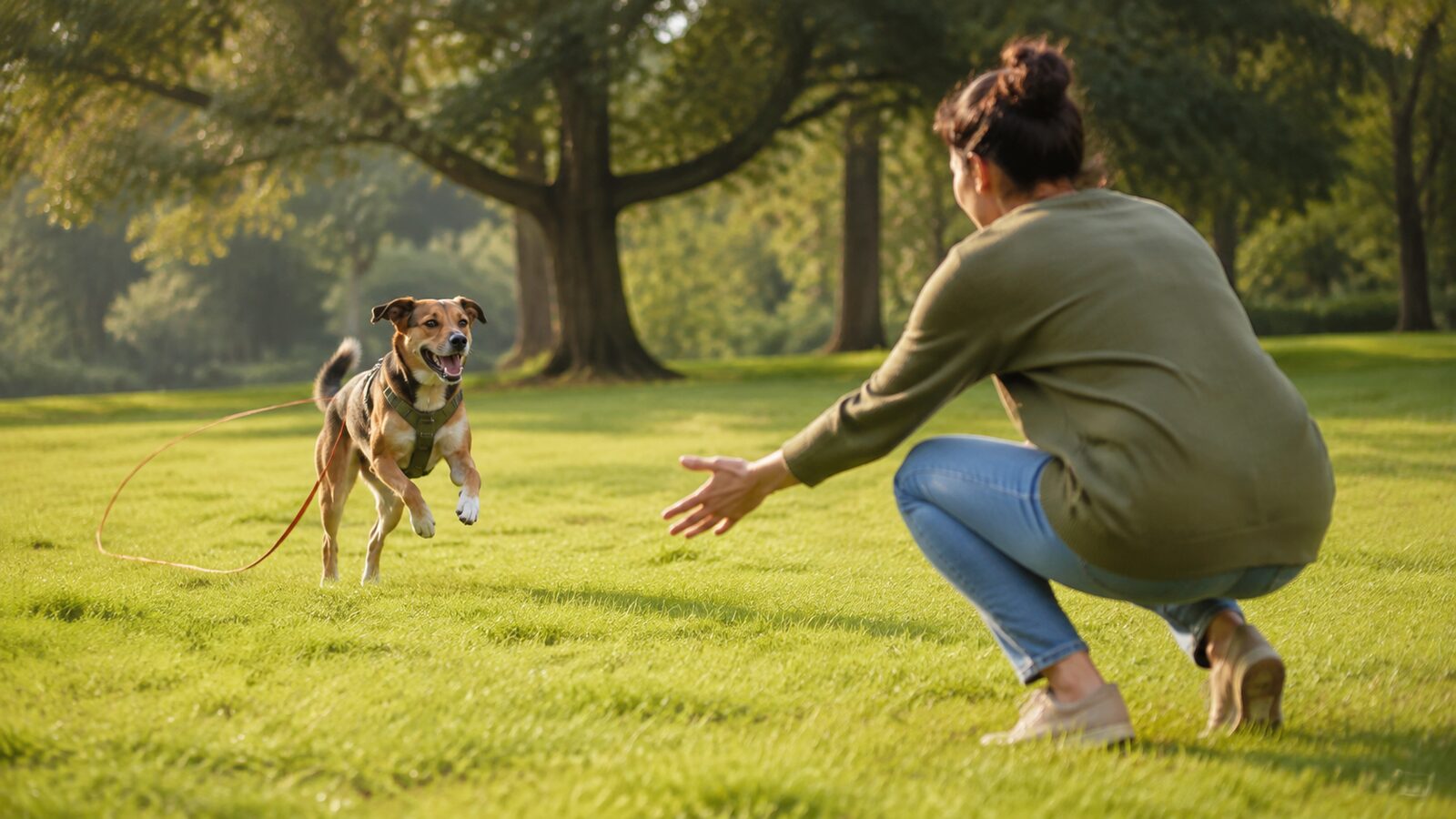
A long line is a five to ten metre lead, clipped to a well-fitted harness rather than a collar so a sudden stop can never jolt your dog’s neck. It trails on the ground as your dog explores.
Its purpose is not to reel your dog in. It is to make it impossible for your dog to practise ignoring you, so every recall becomes one that worked. If your dog doesn’t respond, walk to the line, pick it up, shorten it, encourage them in, and pay anyway. No telling off, no yanking, no dragging.
Raise the difficulty one step at a time: the garden, an empty field, that field with a dog a long way off, then a bit closer. Most dogs need weeks of this, not days. It is the dull stage and the one people skip, and skipping it is the commonest reason an owner is still struggling six months later.
Two habits that keep the cue clean
Never recall for something your dog hates
Don’t use your recall word for the bath, the nail clippers, the end of the walk, or being shut away while visitors arrive. Walk over and collect your dog cheerfully instead. One recall that ends with being bundled into the car undoes a week of training.
Recall, then release back to play
This is the move that changes recalls fastest. Call your dog, pay well, then say something like “off you go” and let them return to what they were doing. Now the word predicts a snack plus more freedom, rather than the end of it.
Most training recalls should end this way, with only the occasional one leading to the lead going on. Do the same with the lead: several times a walk, clip it on, pay, unclip, release.
When your dog ignores you
Do not repeat the cue. Say it four times and you teach your dog that the fourth one is the real one, diluting the word with every unanswered repetition.
Say it once. If nothing happens, stop talking and change what you are doing:
- Turn and move away, or jog off in the opposite direction. Movement away from a dog is far more interesting than shouting at one.
- Crouch and study something on the ground, or scatter food in the grass and let your dog join in.
- If none of that works, calmly collect the long line.
Then ask why it failed. Almost always the place was too hard or the stage moved on too soon, so drop back a level next time. And never tell off a dog who comes back late: they link your tone to arriving, not to the delay, and that is how a recall dies quietly.
Honest limits: prey drive and places recall can’t cover
Some dogs are built to chase. Sighthounds, many terriers, some herding and hunting types and plenty of mixes carry a strong, normal chase sequence, and once it has properly started, a dog is barely processing language.
What helps is catching it earlier: recall before the head locks on, not after. Pay generously for the glance back when your dog notices something, and give the chase urge somewhere legitimate to go with thrown toys, a flirt pole, or scent games.
The honest part: some dogs will never be safely off lead near livestock, roads or wildlife, and that is not a failure of training or of you. A long line in open country, or an hour in a securely fenced field, gives freedom without the gamble. Rules about dogs near livestock and wildlife vary between countries, so check what applies locally.
Your first month
- Week one. Indoors only. Charge the new cue ten times a day in short bursts. No testing. Dig out a long line and a harness.
- Week two. Indoors at distance, then the garden. Let the line trail about so it becomes boring furniture. Start the recall-then-release habit.
- Week three. A quiet outdoor space on the line. Five to ten recalls a walk, paid every time. One distraction at a time.
- Week four. Busier places, longer distances, still on the line. If all is going well, try short off-lead recalls in a fully enclosed space only.
You can start tonight: cut up something excellent, say your new word once, hand it over. Ten times. That is a real first session.
When to get professional help
If your dog’s recall has suddenly deteriorated rather than always being patchy, book a vet check first. Hearing changes, pain and general discomfort all show up as a dog who has stopped responding, especially in older dogs.
Otherwise, an accredited reward-based trainer watching you for an hour will spot timing problems you cannot see from the inside. If fear or guarding is part of the picture, ask your vet to refer you to a qualified behaviourist.
Frequently asked questions
How long does it take to train a reliable recall?
For most dogs, a usable recall in easy places takes a few weeks of short daily sessions, and one that holds up around real distractions takes several months. Adolescent dogs often need longer and may go backwards before settling. Recall is never quite finished: it stays reliable because it keeps being paid.
My dog only comes when I have food in my hand. What do I do?
The food has become part of the cue rather than the payment. Keep treats out of sight in a pocket behind you and only produce them once your dog has arrived. Within a week or two, most dogs stop scanning your hands and start responding to the word itself.
Is it too late to fix recall in an older or rescue dog?
No. Adult dogs often learn a new recall cue faster than puppies, because they concentrate better. A newly adopted dog should stay on a long line for the first few months regardless, since they have no history with you yet and no reason to choose you over an interesting hedge.
My dog comes back but dances just out of reach. How do I stop that?
That is usually a dog who has learned that hands mean the fun ends. For a fortnight, pay your dog while gently holding the harness, then release them, so being held becomes neutral. Avoid reaching, grabbing or leaning over: stand upright, feed at your leg, and let your dog come right in.
Read next
- Scent Work at Home: The Easiest Way to Tire a Dog Out
- Dog Adolescence: Why Your Lovely Puppy Turned Feral at Eight Months
- Positive Reinforcement Dog Training: A Beginner’s Guide That Actually Works
- How to Stop Your Dog Pulling on the Lead
More in Training & Communication.
A note on this article
This is general education for dog owners, so it cannot account for your particular dog, and it is not veterinary advice or behavioural medicine. If your dog’s recall changed suddenly, or there is fear or aggression in the picture, please speak to your own vet or a qualified behaviourist who can meet your dog.