
The short version
The guilty look is appeasement, not confession. Your dog is reading your posture, your face and your tone in the moment and offering calming signals to head off conflict. It is a response to you, not to the chewed cushion. Telling a dog off after the event teaches nothing about the mess, because dogs connect consequences to what is happening now, not to something they did hours ago.
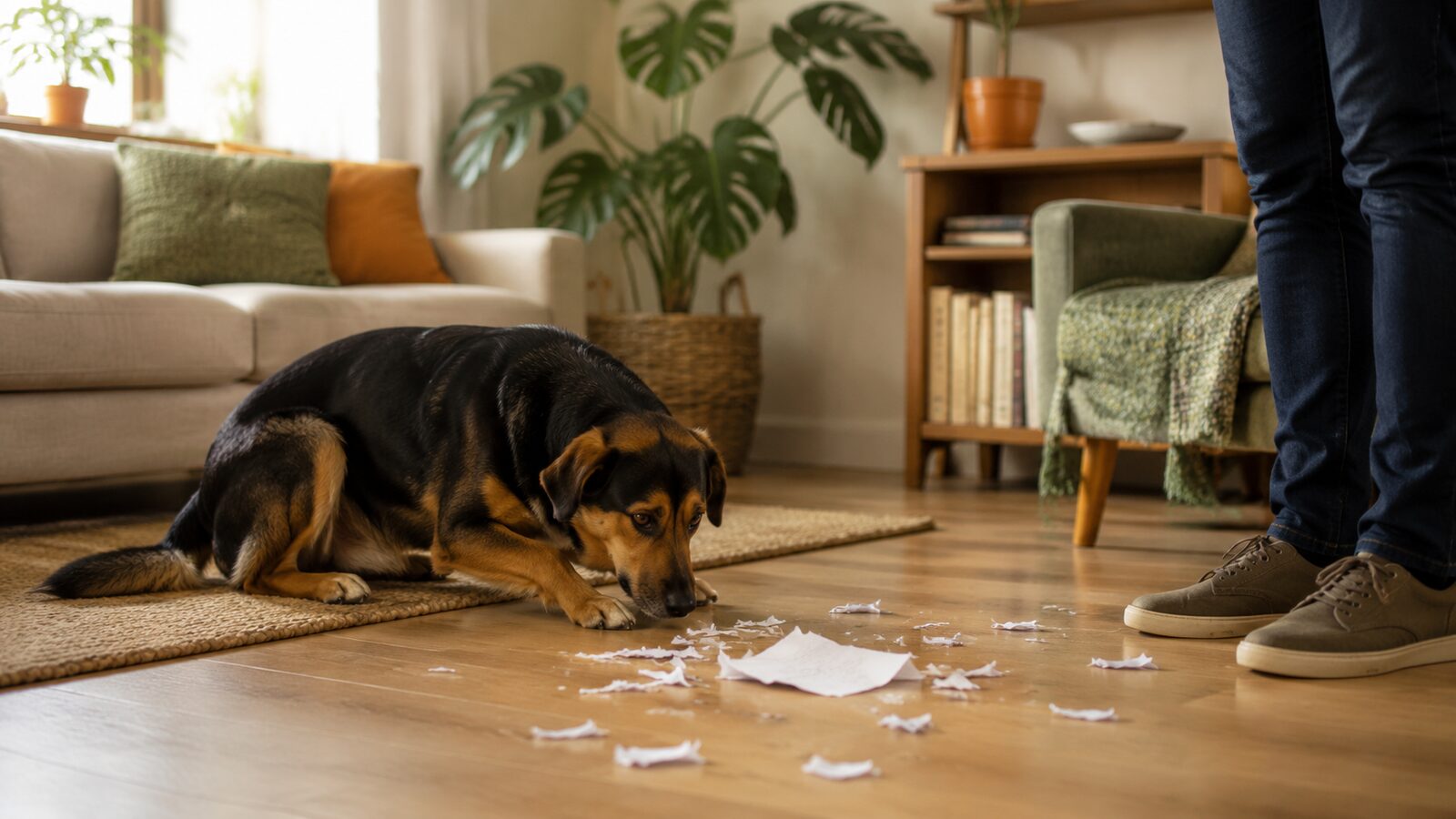
You know the face. The low ears, the slow slink, the eyes sliding away from yours. You walked in, saw the shredded post or the puddle by the door, something in you dropped, and your dog looked exactly like a creature who knows what they have done.
Most of us have told a dog off in that moment. If you did it last night and it has been sitting badly with you since, the truth here is kinder than the story we tend to tell ourselves.
What the guilty look actually is
What you are seeing is a set of appeasement signals. Dogs use them constantly with each other and with us to say “I am no threat, please let this pass”. They are social peacekeeping, and they surface whenever a dog senses tension building.
The tension is coming from you. Dogs are extraordinarily good at reading human bodies, and by the time you have seen the mess your face, your shoulders and your breathing have all changed. Your dog notices in about half a second.
The clearest evidence is something owners spot for themselves. On days when nothing has happened, if you walk in tense and braced for damage, you often get the same face anyway. The look tracks your mood, not your dog’s history.
Many dogs have also learned a pattern: mess plus owner walking in equals trouble. That is a prediction, not remorse.
What appeasement signals look like
Once you can name them, you will see them everywhere, including in situations with no mess involved at all.
- Ears flattened back, head low, body curved rather than square on
- Tail low and wagging fast, sometimes tucked but still wagging
- Eyes turned away, or the whites showing as your dog looks at you sideways
- Lip licking and yawning when nobody is hungry or tired
- Creeping forward low, or rolling over to show the belly
- Freezing, then slipping away to another room
None of these mean sorry. They mean “please, no conflict”. A dog who rolls over as you walk in is not confessing, they are de-escalating.
Why telling your dog off afterwards teaches nothing
Dogs learn by association, and the association has to be close in time. Something needs to happen within a second or two of the behaviour for a dog to link the two. The chewed shoe happened four hours ago, and by the time you found it the moment was long gone.
So the lesson lands on whatever is present instead: you, the hallway, the mess, your voice. That is how you end up with a dog who slinks off the moment the door opens, or looks worried at the sight of their own accident.
Some dogs start toileting behind the sofa or under a bed. Not spite, simply a dog who has learned that going in the open near their person is the risky option. Owners often read that as sneakiness when it is a dog trying to stay out of trouble.
There is a quieter cost too. If homecomings become unpredictable, a dog who was already anxious about being left has more to worry about, and telling off feeds the very thing that caused the mess. None of which means you have ruined anything: dogs are forgiving, and relationships repair quickly once the pattern changes.
What the mess is actually telling you
The mess is information, and it is usually saying one of five things. Each has a different answer.
The day was too empty
Destruction spread around the house: shredded paper, dug-up cushions, stolen laundry. This is a dog with a working brain and nothing to point it at. More sniffing, chewing and problem-solving during the day usually changes it faster than anything else.
Being left alone is hard
Damage focused at doors and windows, drooling, scratched paintwork, barking or howling reported by neighbours, and a mess that appears within the first half hour every time. This is distress rather than boredom, and it needs a gentle, structured plan rather than more exercise.
A physical need went unmet
Accidents in a dog who is usually clean often mean the gap between breaks was too long, especially for puppies, older dogs, or a dog with an upset stomach. If accidents are new, frequent, or your dog seems unwell, that is a conversation with your vet rather than a training problem.
House-training is not finished yet
Young dogs, newly adopted dogs and dogs who have just moved house are often less trained than they appear. Rain, a change of routine or a new floor surface can set things back. This is a gap in learning, not defiance.
Something good was reachable
A raided bin or a counter cleared of dinner is ordinary scavenging, and it worked, which is why it will happen again. This one is solved with lids, latches and gates rather than with feelings.
What to do instead, starting tonight
- Say nothing when you find it. Greet your dog calmly, settle them somewhere pleasant with something to chew, and clean up out of sight. Use a cleaner made for pet accidents rather than anything ammonia-based, which smells like urine to a dog.
- Write down the details. What was damaged, where, and how long your dog had been alone. Three or four entries usually show which of the five causes you are dealing with.
- Change the environment before you change the dog. Bin behind a door, gates across rooms, shoes away, a comfortable space with a food-dispensing puzzle toy. That stops the habit being rehearsed.
- Front-load the day with a sniffing walk, a toilet break right before you leave, and something to chew as you go.
- Shorten the alone time where you can. A midday visit from a neighbour or a walker changes more than any correction could.
- Pay for what you want as it happens. Reward toileting outside at the moment it happens rather than once you are back indoors, and quietly reward chewing the right things.
- Make your arrivals boring. Come in, hang up your coat, breathe out, then say hello. Your dog is watching your body for the forecast.
If you catch something as it happens, a calm “ah, this way” and a swap for the right item is plenty. That is teaching. Anything delivered afterwards is just weather.
When to get professional help
Ring your vet if accidents start suddenly in a house-trained dog, if there is straining, blood, diarrhoea or vomiting, or if your dog is drinking, eating or sleeping differently. These deserve a physical check before anything is treated as behaviour.
If the pattern points to distress at being left alone, ask your vet about a referral to a qualified, reward-based behaviourist. With the right support this often improves a great deal, and it rarely improves on its own.
Frequently asked questions
Does my dog know he did something wrong?
He knows something is wrong right now, because you are upset and standing over a mess. What he almost certainly does not have is a memory of the act connected to your reaction hours later. Dogs learn in the moment, so the guilty face is a response to your body language rather than an admission about the past.
Why does my dog look guilty when he hasn’t done anything?
Because the look is triggered by you, not by the deed. If you come home braced for damage, your posture and tone change before you have even looked around, and your dog answers that with appeasement. Many owners notice the guilty face on perfectly innocent days, which is the clearest sign of what the expression really is.
Is it ever all right to tell my dog off?
Interrupting something as it happens is fair and useful, as long as it is calm and followed by showing your dog what to do instead: a quiet sound, a hand on the bin lid, a swap for an acceptable chew. What does not work is punishment after the event, because your dog connects it to you rather than to the behaviour.
My dog wees on the floor when I tell him off. Is that spite?
No, and dogs do not do spite. Weeing in response to a raised voice, a looming posture or an excited greeting is an appeasement or excitement response, and it is involuntary. Telling a dog off for it reliably makes it worse. Keep greetings low key, crouch sideways rather than leaning over, and it usually fades as confidence grows.
Have I damaged my relationship with my dog by shouting at him?
Almost certainly not permanently. Dogs read patterns rather than single events, so a run of calm, predictable homecomings repairs more than you would expect. Make your arrival undramatic, keep rewarding what you do want, and give it a few weeks. Many owners notice the slinking fade well before then.
Read next
- Separation Anxiety in Dogs: What Actually Helps
- House-Training a Puppy: A Week-by-Week Plan
- Why Dogs Do the Things They Do: A Plain-English Guide to Everyday Dog Behaviour
- What Your Dog’s Tail Is Actually Telling You
- Understanding Canine Body Language: What Your Dog Is Really Telling You
More in Understanding Your Dog.
A note on this article
This piece is general education about dog behaviour, written for owners making sense of what happens at the front door. It is not veterinary advice and cannot account for your own dog. If accidents or destruction are new, worsening, or paired with any sign your dog is unwell or distressed, your vet and a qualified behaviourist are the people to ask.