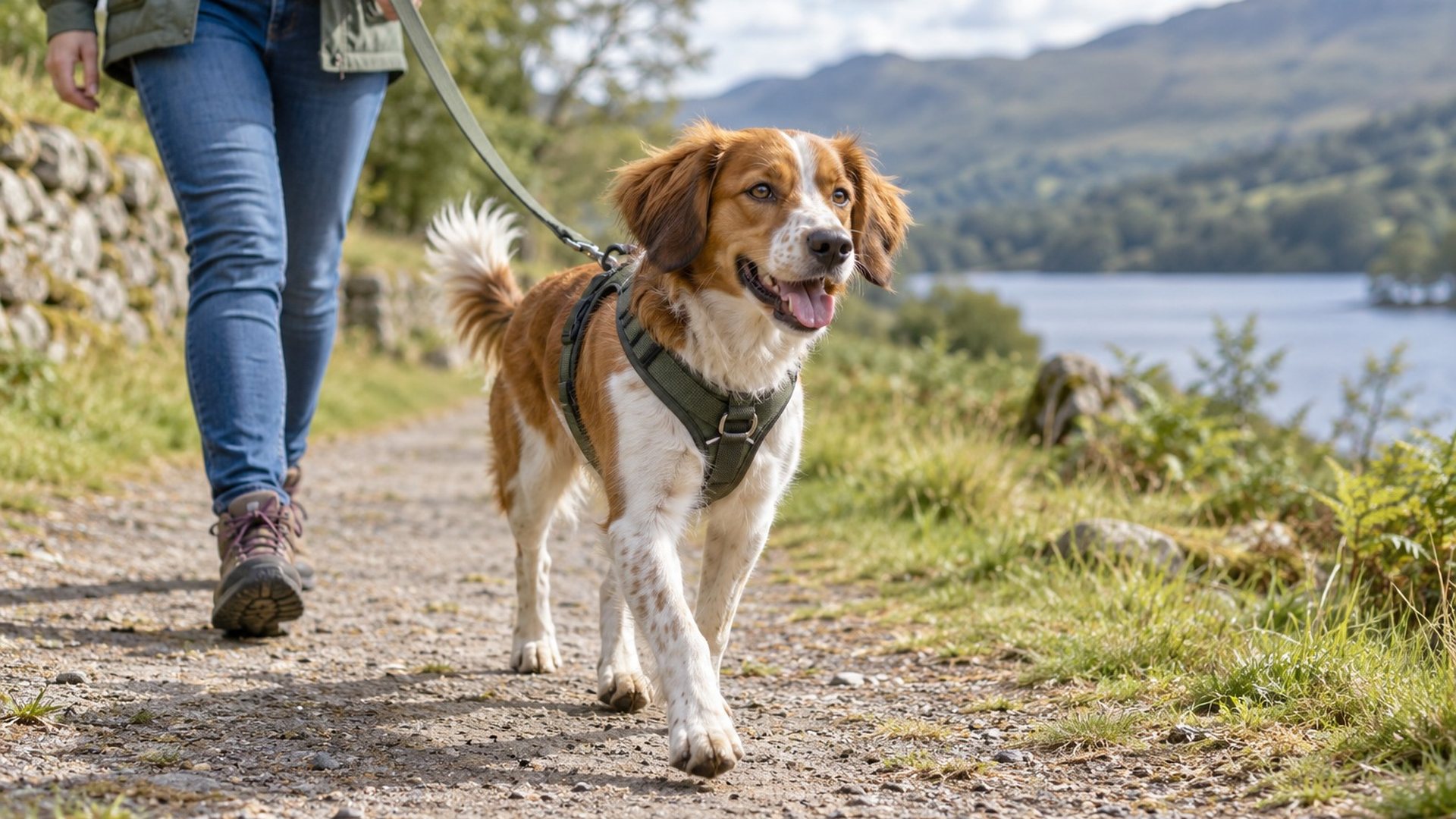
For most dogs that pull, a front-clip harness is the better choice to start with, because the lead attaches at the chest and gently turns the dog back towards you when they surge ahead, which takes the pay-off out of pulling. A back-clip harness is more comfortable for dogs that already walk nicely, but it can make pulling easier for strong dogs. Neither type teaches loose-lead walking on its own: the harness reduces the pulling while you reward your dog for walking beside you.
This guide explains how each type works, how to tell a well-designed harness from one that restricts movement, how to fit it, and how to pair it with kind, reward-based training so you eventually need the gear less, not more.
At a glance
- Front-clip: lead ring on the chest. Best for dogs that pull, because forward pressure turns the dog sideways instead of letting them lean into it.
- Back-clip: lead ring between the shoulder blades. Comfortable and easy, best for dogs that already walk on a loose lead, small dogs and dogs with sensitive necks or throats.
- Dual-clip harnesses have both rings and suit dogs in training, especially with a double-ended lead.
- Fit and shape matter too: straps should sit clear of the point of the shoulder. Research on which harness shapes restrict movement least is limited and so far mixed, so watch how your own dog moves.
- Training does the real work: any harness is a management tool; rewarding a loose lead is what changes the habit.
Why dogs pull in the first place
Dogs pull because pulling works. Every time a dog leans into the lead and gets a step closer to the lamp post, the other dog or the park, pulling is rewarded. Dogs also naturally walk faster than people, find the world outside far more exciting than we do, and many lean into pressure rather than yielding to it, a tendency trainers often call the opposition reflex.
That last point is the key to the whole harness debate. Where the lead attaches changes how that pressure feels to the dog, and therefore whether leaning into it gets them anywhere. If you have not yet read it, the step-by-step method in how to stop your dog pulling on the lead pairs naturally with everything below.
How a front-clip harness works
A front-clip harness has its lead ring on the chest plate, roughly at the breastbone. When the dog moves ahead and the lead tightens, the pressure comes from the front and slightly to one side. Instead of the dog being able to brace and haul forward, their body is turned gently back towards you. Pulling becomes awkward and less rewarding, which gives you a calmer moment in which to reward walking beside you. In a 2024 study of 23 shelter dogs by Johnson and Wynne, published in PeerJ, dogs pulled significantly less on a front-connection harness than on a martingale collar.
Strengths
- Reduces the mechanical advantage of pulling, so even strong dogs are easier to hold.
- Keeps pressure off the neck and throat entirely.
- Gives you better steering, which helps when you need to turn away from a trigger.
- Most dogs adjust to it with the same gradual, reward-based introduction you would use for any harness.
Limitations
- The lead can tangle around the front legs, especially on a long or loose lead, or if the dog sniffs from side to side.
- The ring can slide round to one side if the harness is loose.
- Some front-clip designs use a strap straight across the chest, which may sit over the shoulder joints if poorly fitted; check that it sits clear of the point of the shoulder.
- Not ideal for long-line work or running, where a back attachment moves more freely.
How a back-clip harness works
A back-clip harness has its ring on the top of the back, behind the shoulder blades. It is the most common everyday design, easy to put on and comfortable for the dog. The downside for pullers is that back attachment lets a dog lean their full body weight into the harness, much as working harnesses for sled and draught dogs are designed to let a dog push into the load. For a dog that already pulls, it can make pulling easier and more comfortable rather than less. In a 2021 study of 52 shelter dogs by Shih and colleagues, published in Frontiers in Veterinary Science, dogs pulled harder and for longer on a back-connection harness than on a neck collar when walking towards food.
Strengths
- Very little tangling, because the lead stays above the dog’s body.
- Comfortable for long walks, hikes and sniffing at the end of a long line.
- A good choice for small and toy dogs, flat-faced breeds and dogs with neck, throat or airway concerns, where a collar is not appropriate.
- Simple for anyone in the household to use.
Limitations
- Offers little help against pulling, and may encourage strong pullers to lean harder.
- Less steering control around triggers or in busy streets.
Front-clip vs back-clip: side-by-side comparison
| Feature | Front-clip | Back-clip | Dual-clip |
|---|---|---|---|
| Where the lead attaches | Chest | Top of back | Both, used together or separately |
| Effect on pulling | Reduces it by turning the dog | Little effect; can make pulling easier | Reduces it when the front ring is used |
| Steering and control | Good | Limited | Very good with a double-ended lead |
| Tangling risk | Moderate | Low | Low to moderate |
| Best for | Dogs that pull, early loose-lead training | Dogs that already walk nicely, small dogs, long lines | Strong or reactive dogs, dogs in training |
| Main thing to check | Straps clear of the point of the shoulder | Snug fit so the dog cannot back out | Both rings sit centrally when fitted |
The detail most comparisons miss: harness shape
Clip position gets most of the attention, but the cut and fit of the harness also affect comfort and movement. Broadly, harnesses fall into two shapes:
- Y-shaped (or H-shaped) fronts: a strap runs down the centre of the chest between the front legs, forming a Y with the neck straps. The shoulder joints are left free to move.
- Horizontal-strap fronts: a strap runs straight across the front of the chest, at or just above the point of the shoulder. Many vets and physiotherapists are wary of this design because a badly placed strap can press on the shoulders, although studies have not consistently shown it restricts movement more than other shapes.
The research here is small and its results are mixed. A 2019 study of nine dogs by Lafuente and colleagues, published in Veterinary Record, found that both a so-called restrictive and a non-restrictive harness reduced shoulder extension at walk and trot compared with no harness, and, unexpectedly, the non-restrictive design reduced it slightly more. A 2024 study of 30 dogs in the student research journal Reinvention found that every harness tested reduced shoulder extension compared with a collar, with differences between designs. Neither study shows that one shape is clearly kinder, so the most useful rule of thumb is about fit: choose a well-fitted, adjustable harness whose straps sit clear of the point of the shoulder, and watch your dog walk and trot in it. This matters most for active, sporting and growing dogs, and for older dogs; the guide to joint health in dogs covers why comfortable movement is worth protecting across a lifetime.
Also avoid any harness marketed as no-pull because it tightens around the chest or under the front legs when the dog pulls. That design works by creating discomfort, which is not the approach this site recommends and can make a worried dog more anxious on walks.
Which should you choose? A quick decision guide
- Does your dog pull hard enough that walks are uncomfortable or unsafe? Start with a front-clip or dual-clip harness whose straps sit clear of the shoulders.
- Does your dog lunge or bark at other dogs, people or traffic? A dual-clip harness with a double-ended lead gives the most control. See the reactive dog on the lead for how to work on the underlying emotion.
- Does your dog already walk mostly on a loose lead? A comfortable back-clip harness is perfectly suitable.
- Is your dog small, flat-faced or prone to coughing on a collar? A back-clip or dual-clip harness keeps all pressure off the throat.
- Do you mostly use a long line for sniffing walks or recall practice? Attach the long line to a back ring to reduce tangling.
- Is your dog still growing? Choose an adjustable harness, recheck the fit every couple of weeks and size up as needed.
Who each type suits, and who it does not
| Type | Suits | Less suited to |
|---|---|---|
| Front-clip | Adolescent pullers, large or strong dogs, owners who need more steering | Long-line work, running with your dog, dogs that tangle constantly |
| Back-clip | Calm walkers, small dogs, hiking, sniff walks | Strong pullers, busy urban walking with frequent triggers |
| Dual-clip | Dogs in training, reactive dogs, households with several handlers | Owners who want the simplest possible set-up |
Using a double-ended lead with a dual-clip harness
A double-ended lead has a clip at each end and usually one or two rings along its length so it can be adjusted. Clip one end to the chest ring and the other to the back ring, and hold the lead in two hands like reins. Most of the time the back connection carries the lead, so your dog moves freely. If your dog surges, a light, steady hold on the chest side turns them gently towards you without any jerk. This is about soft guidance, never about snapping or yanking the lead.
How to fit a harness properly
- Measure your dog’s chest at the widest point, just behind the front legs, and their neck where a collar would sit. Use the maker’s size chart, not just weight.
- Introduce the harness before the first walk: let your dog sniff it, reward them, and practise putting it on for a second or two with treats, building up gradually.
- Check you can slide two fingers flat under every strap. Snug, but not tight.
- Make sure the chest ring sits centrally on the breastbone, not low on the belly or up at the throat.
- Look at the shoulders: straps should not cross the point of the shoulder.
- Check the strap behind the front legs sits a couple of fingers’ width back from the armpit so it does not rub.
- Watch your dog walk and trot. A good harness should not change the way they move.
- Recheck after the first few walks for rubbing, hair loss or redness, and again whenever your dog’s coat or weight changes.
Pairing the harness with reward-based training
A harness makes pulling less effective; rewarding a loose lead makes walking beside you worth more than pulling. Both together are what change the habit. The core of positive reinforcement training applies directly here:
- Reward position, often. Deliver small, tasty treats right next to your leg when the lead is loose. Early on, that might be every step or two.
- Stop being a sled. If the lead tightens, stand still and wait. The moment the lead loosens, mark and reward, then walk on.
- Change direction cheerfully. If your dog forges ahead, turn and walk the other way with a friendly cue, rewarding them when they catch up beside you.
- Use the environment as a reward. A loose lead can earn a release to sniff that interesting patch of grass.
- Practise somewhere boring first. Start in the house or garden, then quiet streets, then busier places.
- Keep sessions short. A few minutes of focused practice beats a long, frustrating walk.
Watch your dog for signs that a walk is too much for them right now. Lip licking, yawning, turning away and freezing can all signal that your dog is struggling; the guide to signs of stress in dogs explains what to look for.
Common mistakes to avoid
- Expecting the harness to train the dog. Without rewards for a loose lead, many dogs simply learn to pull at an angle.
- Fitting it too loosely. A loose front-clip harness twists to the side and loses its effect; a loose back-clip harness can let a dog back out.
- Using a retractable lead. Constant tension teaches dogs that pulling extends the lead. A fixed-length lead is clearer.
- Jerking the lead. Pops and yanks are aversive, damage trust and can injure the neck or shoulders even through a harness.
- Choosing a tightening design. Harnesses that squeeze when the dog pulls rely on discomfort; skip them.
- Ignoring growth and coat changes. Puppies, dogs gaining or losing weight, and dogs with seasonal coats all need regular fit checks.
- Using a walking harness in the car. Everyday harnesses are not designed for crash forces; the guide to car travel with your dog covers restraints made for vehicles.
Quick checklist before you buy
- Front ring for pulling, back ring for comfort, or both.
- Straps that sit clear of the point of the shoulder when fitted.
- At least four adjustment points, so it fits now and as your dog changes.
- Soft, padded edges and buckles that are easy to use.
- Sized from chest and neck measurements, not weight alone.
- No tightening or squeezing mechanism.
- A fixed-length lead, or a double-ended lead if you choose dual-clip.
Sources this guide draws on: Johnson and Wynne (2024), PeerJ, comparing pulling on different walking equipment; Shih and colleagues (2021), Frontiers in Veterinary Science, on pulling in a back-connection harness versus a collar; Lafuente and colleagues (2019), Veterinary Record, on harnesses and shoulder extension; a 2024 harness gait study in Reinvention; and the American Veterinary Society of Animal Behavior (AVSAB) position statement on humane, reward-based training.
Handy gear for this guide
Practical picks we think suit this topic. As an Amazon Associate, Mind A Dog earns from qualifying purchases, at no extra cost to you. Prices and availability are set by Amazon and may vary by country.
- MidWest iCrate Double Door Dog Crate (36 inch)
Folding wire crate with a divider panel, so it can grow with your dog.
View on Amazon - rabbitgoo No-Pull Dog Harness (Medium)
Front and back leash clips and adjustable straps for comfortable walks.
View on Amazon - Outward Hound Fun Feeder Slo Bowl
Ridged bowl that slows down dogs who gulp their meals.
View on Amazon
Frequently asked questions
Do front-clip harnesses really stop pulling?
They reduce pulling for many dogs by turning them back towards you when the lead tightens, but they do not teach a dog to walk nicely. Think of them as making training easier. Rewarding a loose lead is what builds the new habit.
Are front-clip harnesses bad for dogs’ shoulders?
Small studies show that most harnesses, of any design, slightly reduce how far the shoulder extends compared with no harness or a collar, but there is no clear evidence that front-clip harnesses cause shoulder problems. Fit matters most: straps should sit clear of the point of the shoulder and should not change the way your dog moves. Ask your vet or a veterinary physiotherapist if your dog has joint problems.
Is a harness better than a collar for a dog that pulls?
For most dogs that pull, yes. A collar concentrates pressure on the neck and throat every time the dog pulls, while a harness spreads it across the chest and body. A flat collar is still useful for carrying identification tags where local rules require them.
Can my dog wear a front-clip harness all day?
It is best to take any harness off when you are home, so it does not rub, trap moisture or catch on furniture. Put it on for walks and outings, and check regularly for redness or hair loss under the straps.
Why does my dog walk sideways in a front-clip harness?
That usually means the dog is still pulling and the harness is turning them, or the harness is loose and twisting. Tighten the fit, centre the chest ring and go back a step in your loose-lead training so your dog is rewarded more often for walking beside you.
When can I switch to a back-clip harness?
Once your dog walks on a loose lead most of the time in the places you usually go, you can try clipping to the back ring. If pulling creeps back, switch to the front ring for a while and keep rewarding a loose lead.
The right harness can turn a tug-of-war walk into a calmer one within days, but the change that lasts comes from showing your dog that staying near you pays. Choose a well-fitted front-clip or dual-clip harness with straps clear of the shoulders, keep the rewards flowing, and enjoy the walks getting easier step by step.