
The short version
A reactive dog is usually asking for distance, not picking a fight. Barking and lunging is what a worried or frustrated dog does when something feels too close and the lead has removed every other option. The work is mostly management: more space, quieter routes, and teaching your dog that the sight of a trigger predicts food from you rather than trouble.
If your dog is calm and funny at home and turns into something you barely recognise at the sight of another dog across the road, you are not doing it wrong. Reactivity is one of the most common reasons owners seek help, and one of the loneliest problems to have, because it happens in public with an audience.
What reactivity actually is
Barking, lunging, growling or spinning at the end of a lead is distance-increasing behaviour. The message is simple: go away, or let me get away.
It is not dominance, and it is not a character flaw. Most reactive dogs are frightened, frustrated, or so over-aroused that they cannot think straight. The usual drivers are:
- Fear. The trigger feels dangerous, and noise usually makes it go away, so the noise gets repeated
- Frustration. The dog badly wants to reach the other dog and cannot, and the tension comes out sideways
- Over-arousal. Movement and excitement tip a dog past the point where they can listen
- Pain or discomfort. A dog who hurts has a shorter fuse, and this is easy to overlook
It looks alarming from outside, but a dog making a great deal of noise at a distance is generally communicating rather than attacking. That does not mean every reactive dog is safe. It does mean the barking is not spite.
Trigger stacking and threshold
Threshold is the point where your dog stops being able to cope. Below it they can hear you, take food and walk past things. Above it they cannot, and talking will not bring them back.
Threshold moves, which is why the same dog passes another at ten metres on Tuesday and explodes at thirty metres on Saturday. What moves it is trigger stacking. The bin lorry, a delivery at the door, a skateboard, then a dog round the corner: none alone would have done it, but together they leave nothing in the tank.
Arousal also takes time to fall. After a big reaction many dogs stay wound up for the rest of the day, which is why two bad walks in a row turn into a bad week. A quiet day after a hard one is not giving up, it is letting the tank refill.
Why the lead changes everything
Loose dogs meeting each other rarely walk head-on. They curve, slow down, sniff the ground and pass at an angle, and that whole language depends on moving freely. On a lead none of it is available: your dog is held facing the thing they are worried about, on a narrow pavement, with no way to add distance.
Tension travels down the lead both ways. You see a dog ahead, your stomach drops, the lead shortens, and your dog concludes that something is indeed wrong. Neither of you intended it.
Equipment matters more than it should have to. A well-fitted Y-shaped harness and a lead with some give in it, held with a loose arm, give your dog room to move. Tools that work by causing discomfort add pain to a situation already full of worry.
The shame is real, and it is not yours to carry
Almost every owner of a reactive dog knows the feeling: the flush of embarrassment as your dog erupts, the tut from a passer-by, the cheerful “he’s friendly!” from someone whose off-lead dog is bearing down on you. Owners describe walking at dawn to avoid being seen, and quietly grieving the easy dog they thought they were getting.
None of that means you have failed. Reactivity is not caused by soft owners or a lack of discipline. It is far more often about genetics, early experience, a frightening event, health, or a sensitive dog in a busy world.
You do not owe strangers an explanation. “We need space, thank you” said loudly and cheerfully is a complete sentence, and stepping behind a parked car mid-conversation is allowed.
Management comes first
Before any training, reduce the number of reactions your dog gets to practise. Every explosion rehearses the pattern, so the first job is having fewer.
- Walk at quiet times. Early morning and late evening change everything for many dogs
- Pick routes with escape options: wide verges, side streets, playing fields
- Learn your dog’s hot spots and stop walking past them for now
- Cross the road early rather than hoping it will be fine
- Use a long line in quiet open space so your dog can move and sniff freely
- If walks are consistently awful, it is fine to skip some. Scent games and puzzle feeding at home tire a dog out with no triggers
If there is any risk of a bite, a well-fitted basket muzzle introduced slowly and kindly is a sensible safety net, not an admission of defeat. Train it over weeks, so your dog is happy to put their nose in, never in a hurry.
Distance is your main tool
Nearly everything that goes wrong on a walk with a reactive dog is a distance problem, and nearly everything that goes right starts by adding some.
Your working distance is wherever your dog can see the trigger and still eat and still respond to their name. If they will not take a treat they normally love, you are too close. Move away and feed there.
Distance can also be borrowed: step behind a van, put a hedge between you, turn into a driveway.
Mark and feed at the sight of a trigger
The exercise is simple, and the order of events makes it work.
- Spot the trigger before your dog does, at a distance they can cope with
- The moment your dog notices it, say a short marker word calmly, such as “yes”
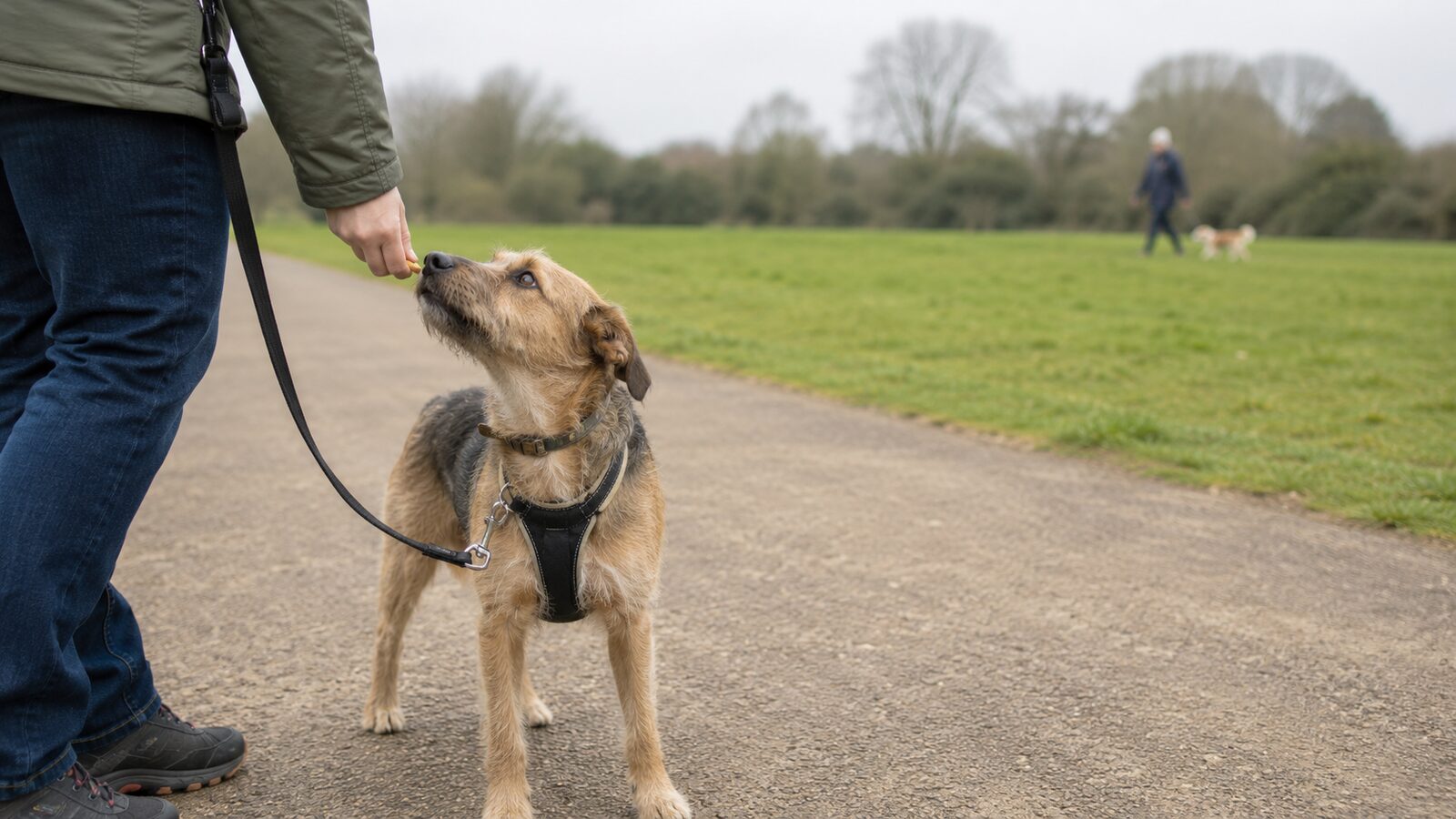
- Immediately feed something excellent: chicken, cheese, sausage. Kibble will not carry this
- Feed while the trigger is visible, and stop once it has gone
- Repeat every time it appears, without waiting for your dog to do anything clever
You are not rewarding the barking. You are marking the sight of the trigger, before any reaction starts, so that over many repetitions a dog across the road predicts food rather than trouble. Owners often notice their dog starting to look up at them when a trigger appears, which is the change you want.
Two common mistakes: waiting until your dog is already lunging, which is far too late, and working so close they cannot eat. If food is spat out, add distance rather than pushing on.
The emergency turn
You also need a way out when something appears from nowhere, because it will.
Teach it at home, with no triggers. Say a cheerful phrase you will always use, something like “this way”, turn on the spot, and feed generously when your dog comes with you. Practise until it is automatic.
Then it is there when a dog rounds the corner at ten metres. Say the words, turn, walk away with energy, and feed. No dragging, no telling off. You are simply leaving.
A walk plan for the next fortnight
- Book a vet check to rule out pain, especially if the reactivity is new or worsening
- Change your times, so most walks happen when the streets are empty
- Take proper food, chopped small, in an easy pocket
- Practise the emergency turn at home before you need it
- Set the bar low: a walk where your dog saw two dogs at a distance and ate happily is a good walk, however short
- Build in decompression: long sniffing time in green space, and calm days after hard ones
- Keep a simple log of what you saw, how close, and how your dog coped, so progress you cannot feel becomes visible
When to get professional help
Start with your vet if the behaviour is new, has changed suddenly or is getting worse. Pain is a common and easily missed contributor, and deserves ruling out first.
Get a qualified, force-free behaviourist involved if your dog has ever bitten or made contact, if you cannot safely hold them, if children or other pets share the space, or if you are frightened. That is not a last resort, it is the sensible first step.
Be wary of anyone promising to fix reactivity quickly, or who wants to correct your dog out of it. Suppressing the warning does not change the feeling underneath, and can leave you with a dog who reacts without warning at all.
Many dogs improve enormously with steady work, and some become genuinely relaxed. Others always need thoughtful management, and a life built around quiet routes rather than crowded parks is still a good life.
Frequently asked questions
Is my reactive dog aggressive?
Usually not in the way people mean. Most lead reactivity is distance-increasing behaviour driven by fear or frustration: the dog wants space, not a fight, and the noise does the job of pushing the other dog away. Any dog can bite in the right circumstances, though, so if you have safety concerns, get a qualified behaviourist involved rather than working it out alone.
Am I rewarding the barking by giving treats?
No, provided you mark and feed at the sight of the trigger rather than after an outburst. You are not paying for the behaviour, you are changing what the trigger predicts. Fear and frustration are emotions, not trained actions, and food arriving alongside a worrying thing gradually shifts how your dog feels.
Should I let my dog say hello to other dogs to socialise them?
On-lead greetings between strangers are a common way for things to go badly, especially for a dog who is already worried. Most reactive dogs do far better passing at a distance with nothing happening. If yours does enjoy other dogs, arrange calm parallel walks with a steady friend instead.
Will my reactive dog ever be normal?
Many dogs improve a great deal, and daily life gets easier for most owners who put the work in. Nobody can promise a cure, and some dogs always need quiet routes and planning. Progress usually looks like shorter reactions, faster recovery, and more days where nothing much happens.
Read next
- How to Stop Your Dog Pulling on the Lead
- Signs of Stress in Dogs That Most Owners Miss
- Separation Anxiety in Dogs: What Actually Helps
- Fireworks, Thunder and Noise Fear: Helping a Frightened Dog
More in Anxiety & Wellbeing.
A note on this article
This is general education for owners, not a behaviour plan for your individual dog and not veterinary advice. Reactivity has many causes and safety matters, so anything involving a bite, an injury or a risk to people or animals belongs with a vet and a qualified behaviourist who can assess your dog in person.