
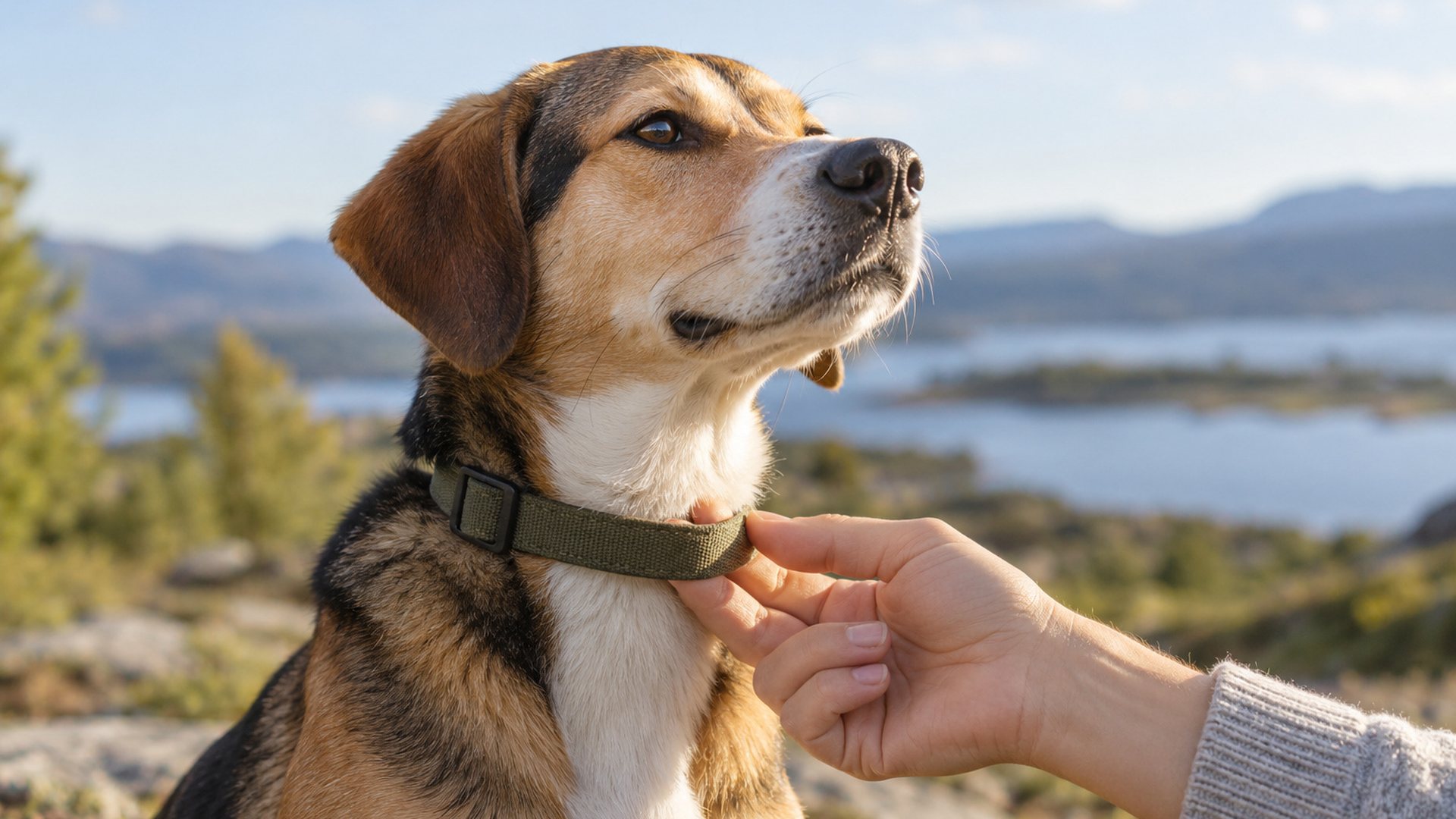
To find the right dog collar size, measure around the middle of your dog’s neck with a soft tape where the collar will sit, then add about two finger-widths of room. A well-fitted flat collar lets you slide two fingers flat underneath it, but will not slip over your dog’s head when they pull back. If you cannot measure, choose an adjustable collar whose size range puts your dog’s neck measurement in the middle, not at either end.
This article contains affiliate links. As an Amazon Associate I earn from qualifying purchases, at no extra cost to you. Affiliate disclosure.
This guide walks you through measuring, choosing between flat, martingale and breakaway collars, picking materials, getting ID tags right for the country you live in, and why prong, choke and shock collars have no place on a kind training plan. You will also find a quick fit check you can repeat every week while a puppy is growing.
At a glance
- Measure, don’t guess: neck measurement plus roughly two fingers is the target fit for a flat collar.
- Two-finger rule: two fingers should slide flat under the collar; more and it can slip off, less and it rubs.
- Collar type matters: flat buckle or clip collars suit most dogs; martingales suit narrow-headed breeds; breakaways suit unsupervised time.
- ID is often a legal requirement: in the UK and across Australian states, dogs in public generally need a collar with owner details, and a microchip is a separate requirement.
- Skip aversive collars: the American Veterinary Society of Animal Behavior advises against choke chains, prong collars and shock collars.
How to measure your dog’s neck for a collar
Most collar problems come from guessing a size from breed or weight. Two dogs of the same breed can have very different necks, especially once coat thickness is added. Measuring takes two minutes and a few treats.
- Get a soft tape measure. A sewing tape is ideal. If you only have a string or a strip of paper, wrap it, mark it, then lay it against a ruler.
- Find the collar spot. Measure the middle of the neck, roughly where an existing collar naturally rests, above the shoulders and below the skull.
- Wrap snugly, not tightly. The tape should touch the fur all the way round without pressing into it.
- Add room. Add about two finger-widths to the measurement. On a toy breed this may be about 2 cm (under an inch); on a giant breed it will be a bit more.
- Reward as you go. Give a treat for standing still, another for the tape touching the neck, and one when you finish. A dog who finds handling pleasant is easier to fit, groom and check at the vet.
- Write down the number and the date. For a puppy, repeat this every week or two.
If your dog already wears a collar that fits well, you can also lay it flat and measure from the end of the buckle to the hole in use. Compare that against the size chart of the new collar, because sizing labels such as “medium” are not standard between makers.
The two-finger fit check
Once the collar is on, slide two fingers flat (not stacked) between the collar and your dog’s neck. They should fit with a little resistance. Then gently try to ease the collar forward over the ears. If it slips over easily, it is too loose and your dog could back out of it on a walk. If you cannot get two fingers under, it is too tight and may rub the skin, flatten the coat or restrict comfort when your dog eats, drinks or lies down.
Puppies, growth spurts and coat changes
Puppies can outgrow a collar fast. An adjustable collar with plenty of range saves money, but it still needs checking: a collar that fitted perfectly two weeks ago can be tight today. Coat changes matter too. A dog with a thick winter coat, or one who has just been clipped, may need the collar adjusted by a hole or two. Our puppy first-year guide covers the main growth stages, and the puppy essentials checklist explains which gear is worth buying early and which can wait.
Which type of dog collar is right for your dog?
The collar’s job is to carry identification and, for many dogs, to clip a lead on. It should never be a tool for causing discomfort. Here is how the humane options compare.
| Collar type | How it works | Best suited to | Watch out for |
|---|---|---|---|
| Flat buckle collar | Fixed circumference set with a pin buckle | Most dogs; holds its size reliably | Holes can stretch on leather or fabric over time |
| Flat quick-release (clip) collar | Adjustable slider with a plastic or metal clip | Everyday wear; fast on and off | Check the slider has not crept looser; cheap clips can crack |
| Martingale (limited-slip) collar | A loop tightens a set amount when the lead is pulled, then stops | Narrow-headed dogs such as greyhounds and whippets that slip flat collars | Must be fitted so it cannot tighten past snug; take it off when unsupervised |
| Breakaway collar | Buckle releases under strong pressure | Dogs at home, in play groups or around fences where snagging is a risk | Will not hold a lead unless the lead clips to both rings; carry ID another way on walks if needed |
| Harness (not a collar) | Spreads pressure across the chest and shoulders | Dogs who pull, small or flat-faced breeds, dogs with neck or airway concerns | Still needs a collar or tag for ID in many places |
For walks, many owners find a well-fitted harness more comfortable for their dog than a collar, particularly if the dog is still learning loose-lead walking. Our comparison of a front-clip vs back-clip harness explains the difference, and the guide on how to stop a dog pulling on the lead sets out a reward-based plan so you never need a correction collar.
A note on martingale collars
A martingale tightens only a limited amount. Fitted correctly, it closes to a snug fit around the neck when the lead goes tight, which stops a narrow-headed dog from slipping out. It should not close so far that it squeezes. Use it to keep your dog safe, never to deliver a “pop” or correction, and take it off at home, because the loose loop can snag.
Collars to avoid: prong, choke and shock
Prong (pinch) collars, choke chains and electronic shock collars work by causing discomfort or pain when a dog does something unwanted. The American Veterinary Society of Animal Behavior’s position statement on humane dog training advises against all three, along with other aversive methods such as lead jerks. It reports that aversive training is linked with more signs of stress during training, and that there is no evidence these tools work better than reward-based methods.
A dog’s neck also contains the windpipe and other delicate structures, which is another reason to avoid any collar designed to tighten without a limit. If pulling, lunging or excitement on walks is the reason you are shopping for a collar, the answer is a comfortable harness plus training. The positive reinforcement training guide is a good place to start.
Materials: nylon, leather, biothane and more
Materials change how a collar feels, lasts and cleans. There is no single best; it depends on your dog’s lifestyle and skin.
| Material | Strengths | Drawbacks | Good choice for |
|---|---|---|---|
| Nylon webbing | Light, inexpensive, many colours, machine-washable in many cases | Can fray; holds smells; edges may rub thin coats | Puppies and everyday wear |
| Leather (flat or rolled) | Soft once worn in; rolled leather can reduce matting on long coats | Needs conditioning; can crack or stretch if often wet | Dry-weather dogs, long-coated breeds |
| Coated webbing (such as biothane) | Waterproof, wipes clean, does not hold odour | Stiffer feel; fewer designer styles | Swimmers, beach and farm dogs |
| Padded collars | Extra comfort on thin-coated or sensitive necks | Padding can trap moisture | Short-coated breeds and sensitive skin |
Designer and cute dog collars are fine as long as the basics hold up: smooth inner edges, solid hardware (a welded D-ring is stronger than a bent wire ring), a buckle or clip that closes firmly, and no dangling decorations your dog could chew off and swallow. Reflective stitching is a useful extra for early-morning or evening walks.
Width and weight
A collar should be in proportion to your dog. A heavy, wide collar on a small dog is uncomfortable, while a thin cord on a large, strong dog can dig in. As a rough guide, small dogs suit narrower collars and large dogs suit wider ones, but always prioritise fit and comfort over looks.
ID tags and the law: what to put on a dog tag
A collar with an ID tag is the fastest way for a stranger to get a lost dog home, because anyone can read it without a scanner. Rules about what the tag must say differ by country and even by local council, so check your local requirements.
United Kingdom
The Control of Dogs Order 1992 requires a dog on a highway or in a place of public resort to wear a collar with the owner’s name and address on it, either inscribed on the collar or on a plate or badge attached to it. There are exemptions, including some working, sporting, rescue and registered guide dogs. The order itself says a breach is a summary offence that can lead to a fine. Many owners also add a phone number. Microchipping is a separate legal requirement in the UK, and the chip does not replace the collar tag.
Australia
Rules are set by each state and territory and enforced by local councils. In New South Wales, for example, councils explain that under the Companion Animals Act a dog must wear a collar and name tag when outside its own property, must be microchipped by 12 weeks of age (or earlier if sold or given away), and must be registered by six months of age, with on-the-spot fines for each breach. Other states have their own registration-tag and microchip rules, so check with your council.
United States and elsewhere
Requirements are set by states, counties and cities. Many areas require dogs to be licensed and to wear a licence tag, and many require a rabies vaccination tag. Check your local animal control or council website for the rules where you live.
What to put on the tag
- Whatever your local law requires (for example, your name and address in the UK).
- A mobile phone number that you actually answer.
- Optionally, “microchipped” so a finder knows a vet or shelter can scan for your details.
- Your dog’s name is optional; some owners leave it off.
An ID tag works hand in hand with a microchip, and some owners add a GPS tracker for extra peace of mind. Our guide to a GPS dog tracker vs microchip explains what each one can and cannot do. Keep the details on your microchip registration up to date whenever you move or change phone number.
Collar safety checklist
- Two fingers slide flat under the collar, and it will not slip over the head.
- Fit checked weekly for puppies and after grooming or coat changes for adults.
- Collar taken off, or a breakaway used, when your dog is in a crate or left alone, as collars and tags can catch on wire or bars.
- Tags are secure, legible and up to date.
- No fraying, cracking, rust or bent hardware.
- Skin under the collar checked for rubbing, redness or hair loss. If you see sores or swelling, see your vet.
- In the car, a crash-tested harness or crate is used rather than clipping a restraint to the collar. See our guide to dog car safety.
Handy for measuring: on Amazon
A soft tape measure makes the neck measurement above quick and accurate.
- Soft Flexible Tape Measure: a soft tailor’s tape that wraps easily around your dog’s neck.
Prices and availability change. Check sizing against your own dog’s measurements and always supervise with new toys or equipment.
Common mistakes
- Buying by breed or weight alone. Necks vary. Always measure.
- Fitting too loose “for comfort”. A collar that slips over the head can let a frightened dog back out of it near traffic.
- Forgetting a growing puppy. Tight collars on puppies can rub and become embedded if left unchecked. Check often.
- Leaving a collar on in the crate. Collars and tags can catch on crate wire. Our crate training guide covers safe set-up.
- Clipping the lead to the collar of a dog who pulls hard. Pressure on the neck adds up over many walks. Switch to a harness and train loose-lead walking.
- Relying on a microchip alone. A chip needs a scanner; a tag can be read by anyone in seconds.
- Choosing a correction collar to fix behaviour. The behaviour is better solved with rewards and management.
Who should consider something other than a collar?
Some dogs are better walked on a harness even if they wear a light collar for ID. These include flat-faced (brachycephalic) breeds, small and toy breeds, dogs who pull strongly, and dogs with a history of neck, back or breathing problems. If your dog coughs, gags or seems uncomfortable when the lead goes tight, stop using the collar for walks and talk to your vet.
Sources this guide draws on: the American Veterinary Society of Animal Behavior position statement on humane dog training (2021); the UK Control of Dogs Order 1992 as published on legislation.gov.uk; New South Wales council guidance on the Companion Animals Act 1998; and the American Kennel Club’s measuring guidance for dog gear.
Frequently asked questions
What size collar does my dog need?
Measure the middle of your dog’s neck with a soft tape and add about two finger-widths. Then pick a collar whose adjustable range puts that number near the middle. Sizing labels differ between makers, so always use the centimetre or inch range rather than “small”, “medium” or “large”.
How tight should a dog collar be?
You should be able to slide two fingers flat under the collar, but it should not slip over your dog’s head when gently pulled forward. Too loose risks escape; too tight risks rubbing and discomfort.
Should my dog wear a collar all the time?
Many owners leave a well-fitted flat collar on for ID, especially if local law requires it in public. Take it off, or use a breakaway collar, when your dog is crated or left alone, and give the skin underneath a regular check.
Is a harness better than a collar?
For walks, a harness is often more comfortable, especially for dogs who pull, small dogs and flat-faced breeds, because it keeps pressure off the neck. Many dogs wear both: a light collar for ID and a harness for the lead.
Are martingale collars cruel?
A correctly fitted martingale is a limited-slip collar that tightens only to a snug fit, so narrow-headed dogs cannot slip out. It becomes a problem only if fitted to tighten too far or used to correct a dog. Use it for security, not discipline.
What information should go on a dog ID tag?
Include whatever your local law requires, such as your name and address in the UK, plus a mobile number you answer. Adding “microchipped” can help a finder. Check your council or local animal control for specific rules.
A good collar is comfortable, secure and carries the details that bring your dog home. Measure carefully, check the fit often, and let rewards rather than pressure do the teaching on walks.