
The short version
Socialisation is not about how many things your puppy sees. It is about how your puppy feels about the things it sees. In the first few months of life a puppy’s brain is unusually open to deciding what counts as normal, so aim for short, calm, happy experiences of everyday life, at a distance your puppy can cope with, and stop before your puppy is overwhelmed.
You have probably been told there is a window, and that missing it sets your puppy up for life. That is enough to make anyone anxious, and anxious owners tend to do the thing that backfires: cram in as much as possible, as fast as possible.
The window is real. What people get wrong is what goes through it.
What socialisation actually means
Socialisation is how a young animal works out what is normal and safe in the world it was born into. A puppy is not born knowing that bin lorries are harmless, that a person in a hat is still a person, or that a tiled floor will not swallow it.
Exposure on its own is not socialisation. A puppy carried through a loud market while rigid and panting has been exposed to the market, and what it learnt is that markets are frightening. Socialisation is the deliberate building of good associations with the ordinary world. Good associations, not tally marks.
The window, and why timing matters
Puppies go through an early sensitive period in which they are unusually willing to accept new things. Novelty is interesting rather than alarming, and a young puppy will walk up to something it has never seen and investigate.
As the puppy matures, that quietly reverses. Caution begins to outweigh curiosity, which makes sense for an animal now mobile enough to get into trouble. The change is gradual rather than a door slamming on a birthday, so nobody can hand you a date. Start early, start gently, and do not save the world up for later.
Flooding: the mistake that does the damage
Flooding means putting an animal into a situation it finds overwhelming and keeping it there. It is the most common socialisation mistake, and it is usually made by owners who are trying hard.
A puppy is taken into a busy café or a crowded dog park. It cannot leave, strangers reach over it, and it goes still and stops taking food. The owner sees a quiet puppy and thinks it is coping. But a puppy that has shut down is not relaxed. It is waiting for it to end, and it learns the opposite of what you wanted: the world is big, and nobody helps me get away from it.
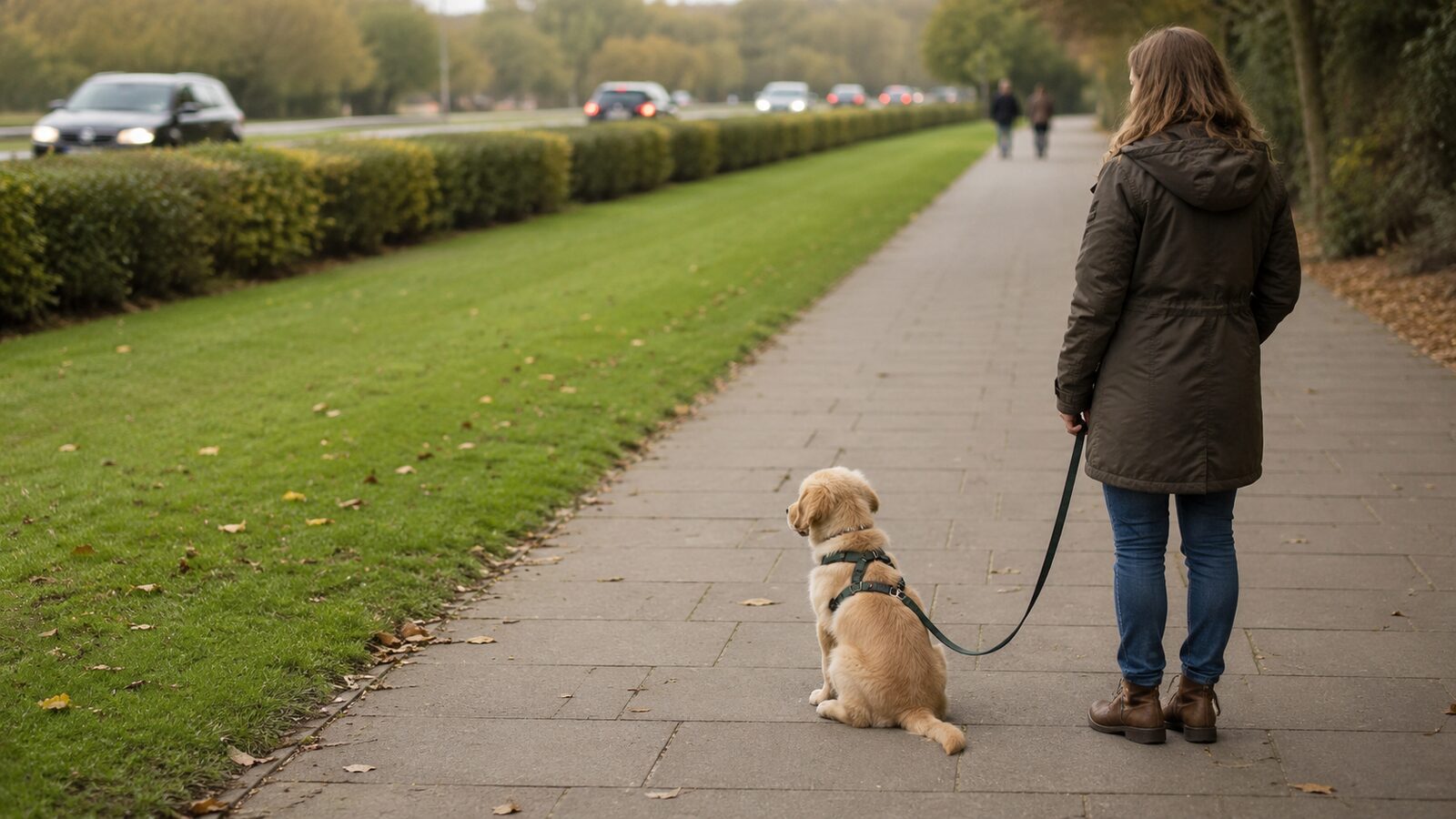
The alternative is not avoiding the world. It is controlling distance, duration and the ability to leave. Watch the school gate from across the road for four minutes, then go home. Let your puppy choose to move closer, and never carry it towards something it has just backed away from.
Quality over quantity: surfaces, sounds, people, situations
Surfaces
A dog who has only known carpet and grass can baulk at a clinic floor for years. Let your puppy potter across gravel, wet grass, lino, a metal drain cover, a wobbly cushion and decking. Scatter a little food on the surface so walking on it pays, and never lift a puppy onto something it is avoiding.
Sounds
Do household noise on purpose: the vacuum cleaner, the washing machine on spin, a dropped saucepan, the doorbell. The trick is pairing. The noise happens quietly or at a distance, something good follows immediately, and the noise starts to predict the good thing.
People
Aim for variety in appearance and movement, not volume of handling: children moving quickly, older people, walking frames, wheelchairs, prams, high-vis jackets, hoods, umbrellas, bicycles.
Here is the counter-intuitive part. Most of those people should not touch your puppy. A puppy who learns that every human is an incoming set of hands becomes either wildly overexcited by strangers or wary of them, and a puppy who learns that most people are simply scenery grows into a dog you can take anywhere.
Situations
The ordinary shapes of your life: the car, stairs, two minutes alone in another room, a bus stop, a dog passing across the road. Do each briefly, and stop while it is going well.
Socialising safely before vaccinations are finished
This is the genuine tension. The most valuable weeks overlap with the weeks your puppy is not yet fully protected, and infectious disease risk varies enormously between countries, regions and even neighbourhoods.
Your vet is the right person to tell you what is safe where you live. Ask at your first appointment what this puppy can do, and where, before the course is finished. Meanwhile, most of socialisation does not need your puppy’s feet on public ground:
- Carry your puppy, or hold it in your lap, and watch the world go by from a quiet spot.
- Sit in a parked car with the window down near a car park or a school.
- Invite calm, healthy, vaccinated adult dogs belonging to friends into your home or garden.
Weigh it up honestly. Problems that start in an under-socialised puppy are hard to undo too, so the answer is rarely “see nothing for weeks”.
Dogs, hands and journeys
Meeting other dogs sensibly, not constantly
Puppies do not need to meet every dog they see, and a puppy who learns that every dog means play often becomes a frustrated, lunging adolescent on the lead. Aim for a handful of friendships with tolerant adult dogs who will tell your puppy off politely and correctly, plus many dogs seen calmly at a distance and walked past. Avoid busy off-lead parks for now: unknown dogs, high arousal and no escape route is the flooding scenario above.
Handling and grooming as socialisation
Handling pays you back every year of your dog’s life: every ear clean, nail trim, tick check and examination depends on it. Do a minute a day in a calm moment: hold each paw briefly, look in the ears, lift a lip, take the collar gently and let go. Pair each with food, and let your puppy move away whenever it likes. Introduce the brush and the nail clippers as objects that predict snacks, long before you need them.
Car travel and the vet clinic
Both are easy to accidentally ruin. A car that only ever goes to the vet becomes a car your dog dreads, so do short, pointless journeys that end somewhere pleasant, starting with a meal in a stationary car with the doors open.
For the clinic, ask whether you can drop in for a weigh-in and a biscuit. A puppy who has been in five times for a fuss is a very different patient from one who only ever comes for needles.
How to tell your puppy has had enough
Puppies rarely say “too much” loudly. They say it quietly.
- Refusing food it would normally take.
- Yawning, lip-licking, or shaking off when nothing is wet.
- Turning away, or trying to get behind your legs.
- Going still and low, with a tucked tail, ears back and a tight face.
- Or the opposite: frantic, mouthy, unable to settle. Arousal and fear look different, both mean stop.
When you see any of that, increase the distance or leave. Leaving early is the outing done well. Then let the puppy sleep it off: a quiet afternoon after a busy morning is part of the work, not a waste of it.
Your first fortnight: a simple plan
This is meant to be light. If a day feels like too much, skip it.
- Daily, five minutes: a minute of handling, one new surface indoors, one household sound paired with food.
- Three or four times a week: ten minutes watching the world from a bench or a quiet corner.
- Twice a week: a visitor who ignores the puppy on arrival and lets it approach in its own time.
- Once a week: a car journey that ends somewhere nice, and if your vet agrees, a two-minute social call at the clinic.
- Every day: long, uninterrupted naps.
If you think you have missed the window
Plenty of people arrive here late, with a rescue of unknown history or simply after a hard few months at home. Later work is slower, but dogs go on learning their whole lives. What changes is the method: a dog who finds the world alarming needs distance and repetition, not novelty.
Find the distance at which your dog can still eat and still look around, and work there. Move closer only when your dog is loose and easy, and be willing to spend weeks on one thing. A dog who stays cautious about certain things is one you manage kindly, not a failure.
When to get professional help
Ring your vet if your puppy seems unwell, is off its food, or if you have any question about what is safe before vaccinations are finished.
Contact an accredited reward-based trainer or a qualified behaviourist if your puppy shows real fear rather than mild caution, freezes or panics regularly, snaps or growls, or if you feel out of your depth. Early help is short help. A good puppy class with small numbers and managed play is also worth seeking out.
Frequently asked questions
How many people should my puppy meet?
Far fewer than you think, and the number matters far less than the quality. Aim for variety in how people look and move rather than a headcount, and let most of them ignore your puppy. A puppy who learns that people are pleasant scenery is easier to live with than one handled by everybody, who now either mobs strangers or fears them.
Can I take my puppy out before the vaccinations are finished?
Ask your vet, because the answer depends on disease risk where you live and no article can know that. In the meantime you can do a great deal safely: carry your puppy to watch the street, invite healthy vaccinated dogs and visitors to your home, and work on surfaces, sounds and handling indoors.
My puppy is frightened of something. Should I push through it?
No. Pushing a frightened puppy closer usually makes the fear stronger and teaches it that you will not help. Increase the distance until your puppy can eat and watch normally, then work there over several short sessions, letting it choose when to move nearer. Comfort does not reinforce fear, so it is fine to reassure a frightened puppy.
Is a dog park good socialisation for a puppy?
Usually not. Busy off-lead parks combine unfamiliar dogs, high excitement and no easy escape route, which is a lot to ask of a young puppy, and one frightening encounter at this age can shape how your dog feels about other dogs for years. A few calm, tolerant adult dogs you already know are worth far more.
Read next
- Positive Reinforcement Dog Training: A Beginner’s Guide That Actually Works
- Building Confidence in a Fearful or Rescue Dog
- Dog Adolescence: Why Your Lovely Puppy Turned Feral at Eight Months
- House-Training a Puppy: A Week-by-Week Plan
- How to Safely Introduce a New Dog to Your Household
More in Puppies & Life Stages.
A note on this article
This is general education, written to help you make sense of your puppy. It is not veterinary advice and not a behaviour plan for your dog. Vaccination and health decisions belong with your own vet, who knows your area and your puppy, and real fear or aggression is worth taking to a qualified behaviourist who can see the dog in front of you.