The short version
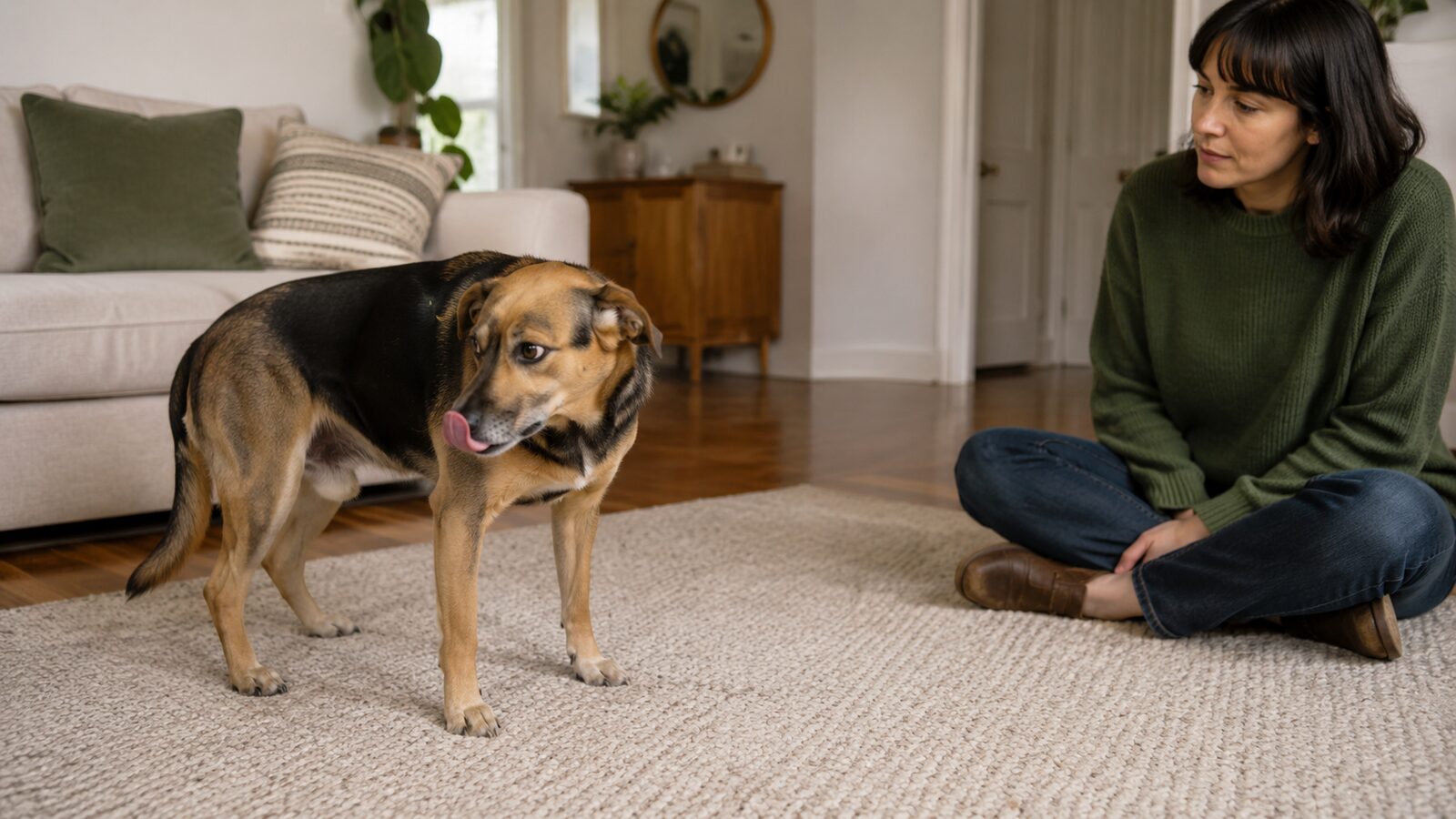
Most stressed dogs never growl. They lick their lips with no food around, yawn when they are not tired, turn the head away, shake off when they are dry, or simply go still. These are normal signals, and they mean your dog is uncomfortable and asking for a little more room. Notice them early, add distance, and let your dog settle.
Stress is usually quiet
By the time a dog growls or snaps, they have usually been saying something much softer for a long time. The loud signals arrive only when the small ones have not worked.
None of this is a failure on your part. The signals are fast and nobody is taught to read them. A yawn looks like tiredness. A scratch looks like an itch. A frozen dog looks, to human eyes, like a dog behaving beautifully.
Why the small signals matter more than the big ones
Think of your dog’s communication as a ladder. The bottom rungs are cheap and polite: a look away, a lick, a slow turn of the body. The top rungs are risky: a growl, a snap, a bite. Dogs would far rather stay at the bottom.
If the quiet signals work, your dog learns the bottom rungs are enough. If they are missed often enough, some dogs stop bothering and go straight to the loud end, which is where most owners first notice anything is wrong.
Answering a lip lick is not reinforcing fear. It is answering a reasonable request, which is the fastest route to a dog who never needs to shout.
The signals most owners walk past
Context decides everything. Each of these is normal in the right setting, and what matters is when it turns up in the wrong one.
Lip licking with no food in sight
A quick flick of the tongue over the nose, often too fast to catch. After dinner it means dinner. In the vet waiting room it means discomfort.
Yawning when your dog is not tired
A stress yawn is wide and deliberate, and it lands at odd moments: as the nail clippers appear, or as another dog approaches. Three in two minutes is information.
Whale eye
The half moon of white at the corner of the eye, seen when your dog holds the head still and swivels their eyes to track something uncomfortable. It appears in countless photos of dogs mid-hug.
Turning the head or the body away
A turn of the head, a shoulder angled off, a curved path around another dog. Your dog is being polite and asking for the same back.
Shaking off when they are not wet
On dry land, that shake marks the end of something: a tense greeting, being held still, a car ride. The moment before was harder than it looked.
Slowing down, stalling or freezing
A dog may drop to half speed, plant their feet, or move stiffly. A dog who has gone completely still is not calm, and is not being stubborn.
Panting that does not match the day
Panting after a run makes sense. Panting in a cool room, or the moment you arrive somewhere new, does not.
Sudden scratching out of nowhere
Your dog stops mid-greeting, scratches hard at the neck, then carries on. Frequent scratching, or sore skin, belongs with your vet instead.
Refusing food they normally love
One of the most useful signals, because it is easy to test. A dog who takes cheese in the kitchen but not the car park has told you something.
Fur all over the consulting room floor
Many dogs shed noticeably more when worried, which is why the vet’s table ends up covered. That is a body responding, not a neglected coat.
Suddenly glued to your leg
A dog who normally potters off and instead presses into your shins wants safety, not affection. New clinginess with no obvious trigger is worth mentioning to your vet.
Several of these at once
One yawn is a yawn. A yawn, a lip lick, a look away and a shake off in thirty seconds is a dog who has had enough.
The dog who is “fine” and the dog who has shut down
A genuinely relaxed dog is loose. Soft mouth, soft eyes, a body that curves rather than holds a line. They notice things and let them go.
A shut down dog is quiet in a very different way. Still, small, low to the ground, ears back, breathing shallow. They stop taking food, stop answering to their name, stop offering anything.
This is regularly mistaken for good manners, and an overwhelmed dog is often described afterwards as having been marvellous at the vet. The tell is what comes next: a relaxed dog carries on with the day, while a dog who shut down often sleeps heavily or seems edgy for hours. If your dog goes quiet and small, treat it as a request to leave, not as proof they are coping.
Trigger stacking: stress that builds across a day
Stress does not reset the moment an event ends. The body takes time to come down, and if the next thing lands first, your dog starts it partway up. Trainers call this trigger stacking, and it explains most of the days that seem to come from nowhere.
A stacked day runs like this. The bin lorry wakes your dog at six. The post arrives at nine. Someone knocks at eleven. A dog barks across the road at lunchtime. Visitors come after lunch. At six a child reaches for the collar and gets a growl, and everyone calls it out of character.
It was not out of character. It was the seventh thing.
So on a hard day, lower the load on purpose: a short sniffy walk instead of the busy park, no visitors, nothing asked of your dog. Allow recovery time too, because many dogs need a long stretch of quiet, and sleep, before they are themselves again.
What to do the moment you spot it
You need ten seconds and a willingness to move.
- Change the distance. Move away calmly, without hauling on the lead. Distance is the fastest tool you have.
- Stop the pressure. Let go of the collar, stop stroking, ask the visitor to sit down, step back yourself.
- Say very little. Repeating your dog’s name or piling on cues adds to the load.
- Give the nose a job. Scatter food on the grass. Sniffing settles most dogs, and a dog who cannot eat is still overwhelmed.
- Let them move. Loose lead, a few minutes, your dog picks the direction.
- Protect the rest of the day. Cut the outing short. Nothing is lost by going home.
Never tell your dog off for the quiet signals, and never punish a growl. A growl is a dog choosing to warn rather than act, and punishing it removes the warning, not the feeling.
Tonight, and this week
Tonight, watch your dog for ten minutes with your phone down, and learn what loose and relaxed looks like on your dog. That is the baseline everything else is measured against.
Then for a week, note two lines each time you see a cluster: what was happening, and what you did. Most owners find a pattern inside seven days, and rarely the one they expected.
When a change in behaviour is a body thing
Behaviour that changes suddenly deserves a physical explanation before a behavioural one. Pain, illness, broken sleep and the changes of age all show up first in how a dog acts.
A dog who has started flinching from a hand, grumbling when lifted, panting at night, going off food, or losing patience with a child they have always tolerated may not have a training problem at all. Ring your vet, say what changed and when, and take a video if you can.
When to get professional help
Book a vet appointment for any sudden or unexplained change, and for stress signals that come alongside limping, licking one spot, or changes in appetite or toileting.
For fear or anxiety that has settled in, look for a qualified behaviourist or an accredited, reward-based trainer who will work with your vet. Ask what they do when a dog gets something wrong. You want distance, choice and your dog’s own pace.
Frequently asked questions
Why does my dog lick their lips when I cuddle them?
Lip licking with no food around is one of the commonest signs of mild discomfort, and plenty of dogs tolerate cuddles rather than enjoy them. Try a test. Stroke your dog for five seconds, then take your hands away. A dog who wants more leans back in. A dog who stays still and licks was tolerating it.
Is my dog yawning because they are stressed or tired?
Look at the context and at what comes with it. A yawn on waking, or on the sofa at night, is almost certainly tiredness. A yawn as another dog approaches usually is not, especially alongside lip licking or a look away.
What is whale eye in dogs?
Whale eye is the crescent of white at the corner of a dog’s eye, visible when they hold the head still and swivel their eyes to watch something. It generally means your dog is uneasy about what they are watching and would like it to move away.
My dog seemed fine all day then snapped at bedtime. Why?
That is the usual shape of trigger stacking. Stress from earlier events does not vanish on its own, so a dog who has already handled several hard things starts the next one partway up. The last event is rarely the cause, it is simply what tipped the balance.
Should I comfort my dog when they are frightened?
Yes. You cannot make fear worse by being kind to a frightened dog. If your dog comes to you, let them come, and stay calm about it. What does not help is holding a dog in place, or insisting they face the thing that frightens them.
Read next
- Why Dogs Do the Things They Do: A Plain-English Guide to Everyday Dog Behaviour
- Building Confidence in a Fearful or Rescue Dog
- Separation Anxiety in Dogs: What Actually Helps
- Fireworks, Thunder and Noise Fear: Helping a Frightened Dog
- Understanding Canine Body Language: What Your Dog Is Really Telling You
More in Anxiety & Wellbeing.
A note on this article
This is general education about canine body language, written to help you read the dog in front of you. It is not veterinary advice, it diagnoses nothing, and it cannot replace a vet or qualified behaviourist who can see your dog. If something has changed, your vet is the right first call.