
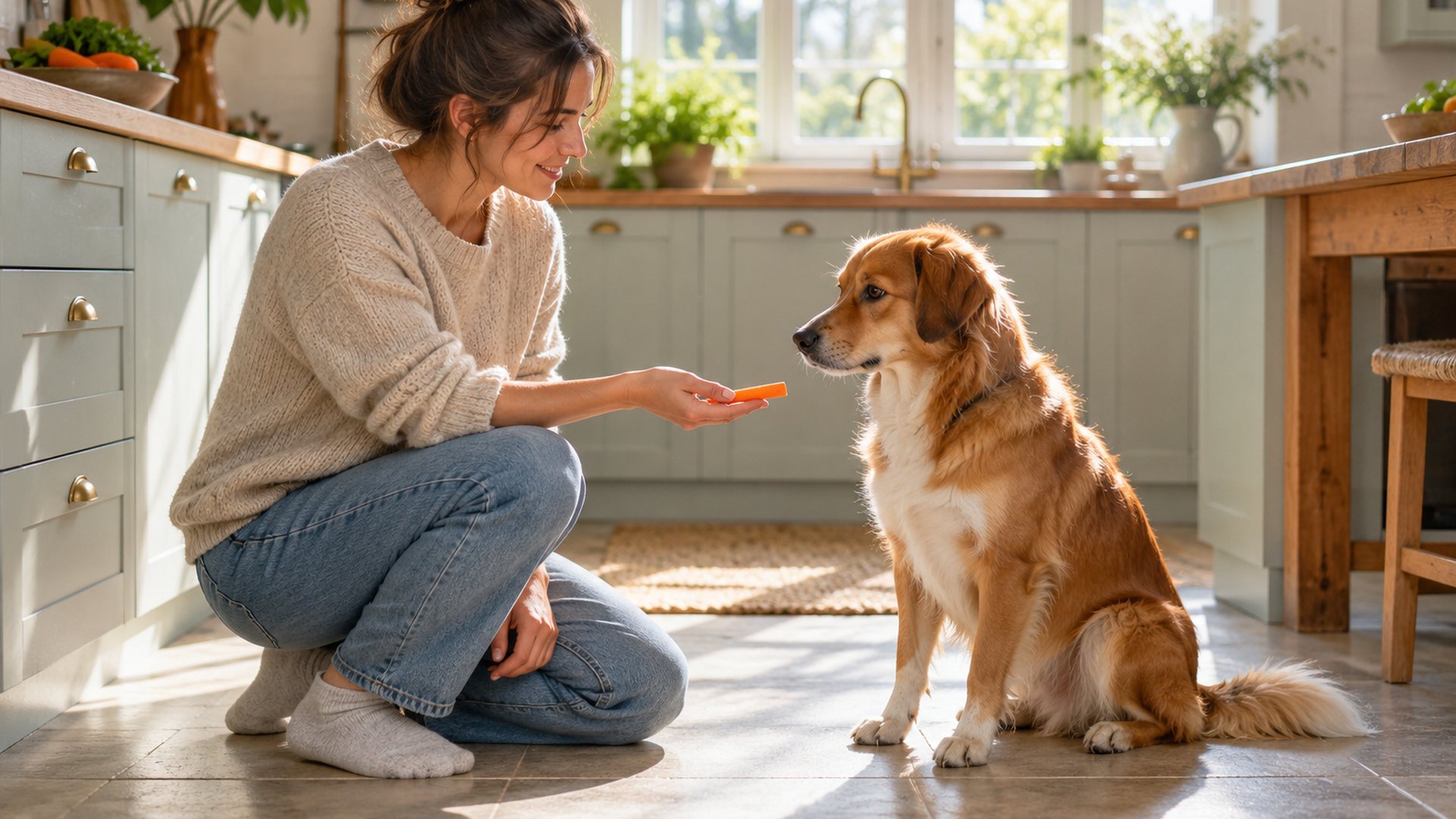
Healthy dog treats are small, low-calorie and simple: plain vegetables such as carrots and green beans, a few pieces of fruit such as apple or watermelon, tiny pieces of plain cooked lean meat, or commercial treats with a short ingredient list and a clear calorie count. Whatever you choose, treats should make up no more than 10% of your dog’s daily calories, so the other 90% comes from a complete and balanced diet.
This guide shows you how to set a daily treat budget for your dog’s weight, which everyday foods make good low-calorie treats, how to read a treat packet without being misled, and how to spot the high-calorie extras that quietly add up. If you want help choosing rewards specifically for training sessions, our guide to the best treats for training your dog goes deeper on value levels and storage.
At a glance
- Keep treats to 10% or less of daily calories, a rule shared by WSAVA and UC Davis veterinary nutritionists.
- For a 10 kg adult dog at a healthy weight, WSAVA’s chart puts that at roughly 47 kcal of treats a day.
- Plain carrots, green beans, zucchini, apple and watermelon are among the low-calorie options UC Davis lists.
- Chews and human “bits” can be huge: WSAVA lists a dried pig’s ear at about 242 kcal and a large rawhide at about 700 kcal.
- Never share chocolate, grapes or raisins, onions, garlic, macadamia nuts or anything containing xylitol.
What makes a dog treat “healthy”?
No treat is healthy in isolation. A treat is a healthy choice when it fits your dog’s calorie needs, suits their digestion and any health conditions, and is safe to chew and swallow. In practice, that means a good treat is:
- Low in calories per piece, so you can give several without blowing the budget.
- Simple, with a short ingredient list you understand.
- The right size and shape for your dog’s mouth, with no sharp edges. WSAVA highlights size and shape as a choking risk factor.
- Free from toxic ingredients such as xylitol, onion or garlic powder, grapes or raisins.
- Appropriate for your dog’s health. Dogs on a veterinary diet, with allergies or with conditions such as pancreatitis or kidney disease may need very specific treats. Ask your vet.
Treats also matter because so many dogs carry extra weight. The Association for Pet Obesity Prevention’s 2022 survey found that 59% of dogs assessed by US veterinary professionals were overweight or obese, and noted that frequent treating and unmeasured portions remained common. Many owners of overweight dogs judged their dog’s shape to be normal.
How many treats a day? Your dog’s treat budget
The 10% rule is simple in principle: if your dog needs 500 kcal a day, no more than 50 kcal should come from treats. UC Davis’s veterinary nutrition team puts it the same way: treats and extra foods should not exceed 10% of daily calories, and the rest should come from a complete and balanced food.
The World Small Animal Veterinary Association (WSAVA) publishes a helpful chart for average, healthy adult dogs at an ideal body condition. Here are selected figures from it.
| Body weight | Maximum treat calories per day (WSAVA guide) |
|---|---|
| 2 kg | 14 kcal |
| 4 kg | 24 kcal |
| 6 kg | 32 kcal |
| 10 kg | 47 kcal |
| 15 kg | 64 kcal |
| 20 kg | 79 kcal |
| 30 kg | 108 kcal |
| 40 kg | 134 kcal |
These are averages. Puppies, seniors, very active or neutered dogs, and dogs that need to lose weight can have very different needs, so ask your vet to confirm your dog’s daily calorie target. If your dog needs to slim down, your vet may suggest a smaller treat allowance or counting treats against the main meal.
Low-calorie treat ideas from the kitchen
Whole foods can make excellent, cheap treats as long as they are plain: no salt, butter, oil, seasoning, sauces or sweeteners. UC Davis lists the following as lower-calorie options suitable for many dogs.
| Food | How to serve | Good to know |
|---|---|---|
| Carrots | Raw sticks or coins sized for your dog, or lightly cooked | Crunchy and filling; cut small for little dogs to avoid choking. |
| Green beans | Plain, fresh, frozen or lightly cooked | Choose plain, not salted canned or buttered beans. |
| Zucchini, butternut squash, spinach | Plain, cooked or raw in small pieces | UC Davis notes these vegetables are low in protein, fat, sodium and phosphorus. |
| Apple | Thin slices with skin | Remove the core and seeds. |
| Watermelon, honeydew | Small cubes of flesh | Remove rind and seeds; a refreshing summer option. |
| Pear, peach | Small slices | Remove the core, seeds and stone. |
| Strawberry, banana | Small pieces | Banana is higher in sugar, so keep portions small. |
| Plain cooked lean chicken or turkey | Tiny pieces, skin and bones removed | Higher in calories than vegetables: WSAVA lists about 47 to 50 kcal per 28 g, so cut it very small. |
Introduce any new food a little at a time, as sudden changes can upset some dogs’ digestion. Our guide to dog gut health explains why. For a broader list of which foods are safe and which are not, see what human foods dogs can eat.
Commercial treats: soft, crunchy, freeze-dried and chews compared
Bought treats are convenient, but calories per piece vary enormously. Compare by type and always check the pack.
| Type | Typical strengths | Watch out for | Best used for |
|---|---|---|---|
| Soft dog treats | Easy to break into tiny pieces; quick to eat | Can be calorie-dense; may contain added sugars or humectants | Frequent small rewards, including for older dogs with sore teeth |
| Crunchy biscuits | Long shelf life, easy to carry | Large biscuits can use up most of a small dog’s budget in one go | Occasional rewards, broken into pieces |
| Single-ingredient freeze-dried or dried meat or fish | Short ingredient list; very appealing | Higher in calories by weight; raw products carry a pathogen risk, so handle hygienically | High-value moments in small amounts |
| Low-calorie dog treats | Designed with fewer calories per piece | Check the actual kcal per treat, not just the marketing claim | Dogs watching their weight |
| Chews (dental chews, pig’s ears, rawhide, tripe sticks) | Longer-lasting, can satisfy the urge to chew | Very high calories, and some are too hard or splinter | Supervised chewing, counted carefully in the daily budget |
The hidden calories in chews are where many treat budgets fall apart. WSAVA lists approximate figures of 217 kcal for a 28 g tripe stick, 242 kcal for a 56 g dried pig’s ear and around 700 kcal for a 190 g rawhide bone. For a small dog, one of these can exceed several days’ worth of treats. If chewing is important to your dog, our guide to choosing safe dog chews explains size and hardness, and dog dental care covers better ways to look after teeth.
How to read a dog treat label
Treat packets are designed to sell, so look past the front and turn the bag over. Rules differ between countries, so not every label carries the same information. The same skills you use for food apply here; our guide on how to read a dog food label walks through them in detail.
- Find the calories. Look for kcal per treat or per kilogram. If calories are missing, WSAVA suggests contacting the manufacturer. Without this number, you cannot fit the treat into a budget.
- Check the purpose statement. Many treats are labelled for intermittent or supplemental feeding only. That means they are not a complete diet and should never replace meals.
- Read the first few ingredients. Ingredients are listed in order of weight, so the first few make up most of the product.
- Scan for toxic or unwanted ingredients, especially xylitol (sometimes listed as birch sugar), onion, garlic, raisins or chocolate.
- Look at the feeding guide. Check how many treats per day the maker suggests for your dog’s weight, then compare it with the WSAVA budget above.
- Check size and texture against your dog’s mouth and chewing style.
Label red flags
- No calorie information anywhere on the pack.
- Vague health claims on the front with nothing to back them up on the back.
- Added sugar or sweeteners high in the ingredient list.
- No clear manufacturer details or batch information, which makes recalls harder to track.
- Very large pieces that cannot be broken down for a small dog.
A simple daily treat plan
A treat budget is easier to stick to with a routine. Here is one way to set it up.
- Ask your vet for your dog’s daily calorie target, or use the WSAVA chart as a starting point for a healthy adult.
- Take 10% of that number as the day’s treat allowance.
- Each morning, put the day’s treats in a small pot. When the pot is empty, treats are finished for the day.
- Cut treats into pea-sized pieces for small dogs and fingertip-sized pieces for large dogs. Dogs care about how often they get something, not how big it is.
- Use part of your dog’s normal food for everyday rewards, and save tastier options for harder moments. Our positive reinforcement training guide explains why frequent small rewards work so well.
- Count chews, table scraps and food from other family members. Agree one rule for the whole household.
- Check your dog’s body condition with your vet at each visit and adjust the plan if your dog gains or loses weight.
Common mistakes
- Not counting chews. A single large chew can be a whole day’s treats or more.
- Giving big pieces. Half a biscuit gives the same pleasure as a whole one; a quarter is often enough.
- Sharing seasoned leftovers. Salt, fat, onion and garlic in human food can cause harm. Keep kitchen treats plain.
- Forgetting the peanut butter check. Some spreads contain xylitol, which is toxic to dogs, and WSAVA lists one tablespoon of peanut butter at about 81 kcal.
- Using cooked bones as treats. WSAVA advises avoiding cooked and raw bones and very hard chews such as antlers and hooves.
- Treats replacing meals. A dog that fills up on treats may refuse its balanced food.
- Several people treating the same dog. Without a shared plan, the extras multiply quickly.
If your dog eats something dangerous
If your dog eats chocolate, grapes or raisins, xylitol, onions, garlic, macadamia nuts or anything else you are worried about, phone your vet or an animal poison helpline straight away, even if your dog seems fine. Do not try home remedies. Our guide on what to do if your dog ate chocolate explains which details to have ready.
Sources this guide draws on: the World Small Animal Veterinary Association (WSAVA) client guide on feeding treats to your dog; UC Davis School of Veterinary Medicine treat guidelines for dogs; and the Association for Pet Obesity Prevention’s 2022 US pet obesity prevalence survey.
Handy gear for this guide
Practical picks we think suit this topic. As an Amazon Associate, Mind A Dog earns from qualifying purchases, at no extra cost to you. Prices and availability are set by Amazon and may vary by country.
- Outward Hound Fun Feeder Slo Bowl
Ridged bowl that slows down dogs who gulp their meals.
View on Amazon - LUKITO Lick Mat for Dogs (2 Pack)
Spread a little dog-safe food over it for a quiet licking activity.
View on Amazon - Amazon Basics Airtight Pet Food Storage Containers (3 Piece)
Keeps kibble and treats fresh and out of reach.
View on Amazon
Frequently asked questions
What are the healthiest treats for dogs?
Plain, low-calorie foods such as carrots, green beans, zucchini, apple slices without the core and watermelon without the seeds are among the healthiest everyday choices for many dogs. Small pieces of plain cooked lean meat and simple commercial treats with clear calorie labelling are good options too. The healthiest treat is still one given in the right amount.
How many treats should a dog have a day?
Treats should provide no more than 10% of your dog’s daily calories. WSAVA’s guide suggests around 47 kcal of treats a day for a healthy 10 kg adult dog and around 108 kcal for a 30 kg dog. Your vet can give a target for your individual dog.
Are low-calorie dog treats worth it?
They can be, especially for small dogs or dogs on a weight plan, because you can give more pieces within the same budget. Check the actual calories per treat rather than relying on the front of the packet, and remember that plain vegetables are often just as effective and cheaper.
Can I use my dog’s kibble as treats?
Yes. Taking a portion of your dog’s daily food and using it as rewards is a simple way to keep calories under control. Many dogs happily work for kibble during easy moments, while tastier treats are kept for harder situations.
Are dental chews healthy treats?
Dental chews can be part of a routine, but many are high in calories and must be counted in the daily treat budget. They are not a substitute for brushing and regular dental checks with your vet. Always choose the right size and supervise your dog while it chews.
Which treats are dangerous for dogs?
WSAVA lists chocolate, macadamia nuts, onions, leeks, shallots, garlic, chives, grapes, raisins, currants, sultanas, xylitol, alcohol, raw yeast dough and caffeinated drinks among the items to avoid, along with cooked and raw bones and very hard chews. If your dog eats any of these, contact your vet immediately.
Healthy treating is less about finding a perfect product and more about small pieces, simple ingredients and an honest daily count. Get those right, and treats can stay one of the happiest parts of your dog’s day without costing them their waistline.