
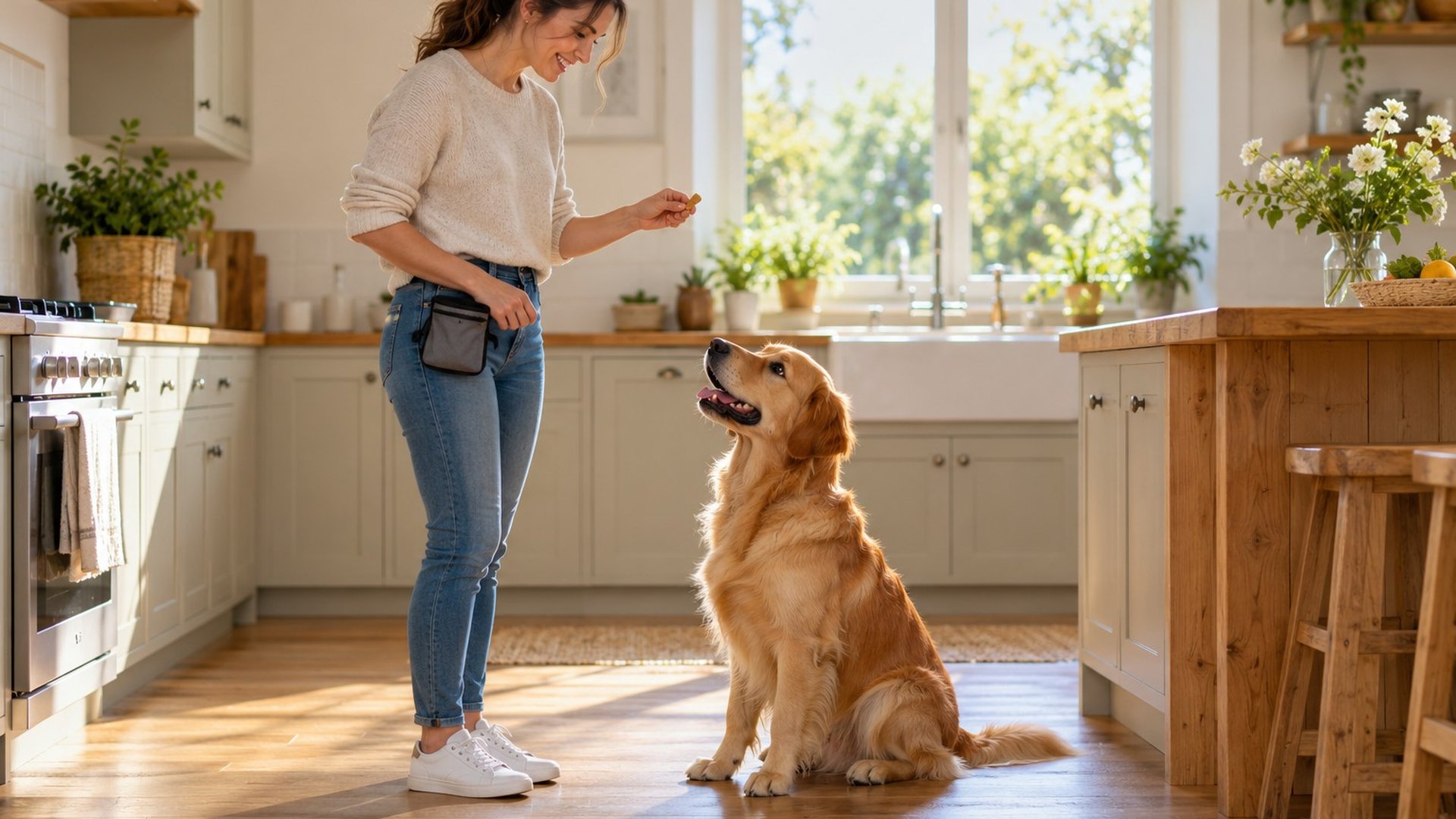
The best treats for training your dog are small, soft, strong-smelling pieces your dog will eat in a second or two and would really work for, such as freeze-dried meat, soft training treats or bits of plain cooked chicken. Match how good the treat is to how hard the job is: everyday rewards for easy practice at home, and your dog’s absolute favourite for recall and busy places. Keep all treats to about a tenth of your dog’s daily calories.
Disclosure: this guide contains affiliate links, marked as such. If you buy through them, Mind A Dog may earn a small commission at no extra cost to you.
This guide covers what makes a good training treat, how the main types compare, how to build a “treat ladder” from everyday rewards to jackpots, how to work out a sensible daily allowance, and how to choose, use and store treats safely. There is a shopping checklist at the end so you can stock up once and train all week.
At a glance
- Small beats big. A pea-sized piece (lentil-sized for tiny dogs) is enough. Your dog cares about taste and smell, not size.
- Soft and smelly wins. Soft treats are swallowed fast, so you get more repetitions; strong smells hold attention outdoors.
- Build a ladder. Low-value rewards for easy work, high-value “jackpots” for hard moments such as recall.
- Mind the 10% guide. Treats and extras should make up no more than about 10% of daily calories, so trim meals on heavy training days.
- Handle safely. Wash your hands after raw or freeze-dried raw treats, store packs as the label says, and never use chocolate, grapes, raisins, onion, garlic or xylitol-sweetened foods.
What makes a good training treat?
A training treat has a different job from a chew or a snack. It is a payment for a behaviour, and in a good session you may hand out twenty or thirty of them in a few minutes. That means it needs to be eaten almost instantly, so your dog’s attention comes straight back to you, and small enough that the session does not turn into a second dinner. Look for these qualities:
- Small. For most dogs a piece the size of a pea is plenty. Tiny dogs may need pieces the size of a lentil.
- Soft or crumbly. Soft treats are swallowed quickly. Hard biscuits take time to crunch and leave crumbs on the floor that pull your dog’s nose away from you.
- Smelly. Strong-smelling treats hold attention, especially outdoors. Freeze-dried meat and fish are popular for this reason.
- Easy to break. If you can snap a treat into several pieces with your fingers, one bag goes much further.
- Simple ingredients. Single-ingredient treats make it easier to see exactly what your dog is eating, which helps if your vet has asked you to avoid particular ingredients.
If you are new to reward-based training, our guide to positive reinforcement dog training explains the timing and the “mark and reward” method these treats are designed for.
Training treat types compared
There is no single best product for every dog, but each type of reward has a natural place in training. This table shows where each one fits.
| Treat type | Typical value to the dog | Best for | Watch out for |
|---|---|---|---|
| Kibble from the daily ration | Low | Easy behaviours at home, puppies practising often | May not compete with outdoor distractions |
| Soft commercial training treats | Medium | Everyday sessions, the backyard, quiet streets | Calories per piece vary a lot between brands; read the pack |
| Freeze-dried meat or fish | High | Recall, lead manners, busy places | Crumbles in pockets; raw versions need careful hand hygiene |
| Plain cooked chicken or lean meat, no seasoning | High | Jackpots and difficult moments | Spoils quickly; keep chilled and use within a day or two |
| Small pieces of cheese | High for many dogs | Occasional jackpots | Rich and fatty; some dogs do not tolerate dairy well |
| Dog-safe vegetables or fruit (such as carrot or apple without seeds or core) | Low to medium | Dogs watching their weight | Not every dog values them; avoid grapes and raisins entirely |
| Long-lasting chews | Varies | Quiet time and settling, not repetitions | Too slow to eat for active training |
Our list of which human foods dogs can eat explains which kitchen extras are safe and which to avoid completely.
Where to buy high-value training treats
Raw Paws Pet Food sells single-ingredient and freeze-dried treats that break easily into small, strong-smelling pieces, ideal for the top of your treat ladder.
Browse freeze-dried treats at Raw Paws → (affiliate link)
See all dog treats at Raw Paws (affiliate link)
Build a treat ladder
Not every behaviour deserves the same reward. Trainers often talk about a “value ladder”: rewards ranked from ordinary to outstanding. Use low-value rewards for easy behaviours in quiet places and save the best rewards for hard behaviours in busy places.
Low value: everyday rewards
For practice at home, many dogs will work happily for pieces of their usual kibble taken from their daily ration. This keeps calories under control and suits behaviours your dog already knows, such as sit or down in the lounge room.
Medium value: soft training treats
When you add a little distraction, such as training in the backyard or on a quiet street, step up to a soft commercial training treat or small pieces of a single-ingredient treat. These are the workhorse of most sessions.
High value: the jackpot
For the hardest jobs, such as coming away from another dog or ignoring a bird, you need something special. Freeze-dried meat or fish, plain cooked chicken, or a treat your dog only gets during training can make the difference between a dog who glances at you and a dog who runs straight to you. Our guide to teaching a reliable recall explains why recall in particular needs your best rewards.
How to find your dog’s favourites
- Choose two different treats and hold one in each closed hand.
- Present both hands at nose height and open them at the same time.
- Note which treat your dog takes first.
- Repeat three or four times, swapping hands so you are not just measuring which side your dog prefers.
- Test again on another day and in another place. Preferences can change with hunger, mood and surroundings.
Dogs have strong individual tastes, and the treat you expect to be a favourite may come last. Rank your dog’s choices from least to most loved, and that is your ladder.
How many treats is too many?
Treats add up quickly. The World Small Animal Veterinary Association’s guidance for owners, which many vets follow, is that treats and extras should make up no more than about 10% of a dog’s daily calories. The other 90% should come from a complete and balanced main diet so your dog still gets all the nutrients it needs.
A worked example
Say your vet tells you your dog needs around 800 kilocalories a day. Ten percent of that is about 80 kilocalories for treats. If the pack says each soft training treat contains 3 kilocalories, that is roughly 26 treats a day. Cut each treat in half and you get around 50 rewards from the same allowance. Swap some of them for kibble from the daily ration and you can train even more without changing the total. The figures here are only an illustration: your dog’s real calorie needs depend on age, size, activity and health, so ask your vet for a target.
Practical ways to stay within the limit
- Cut everything small. Halving each reward can double the repetitions you get from the same amount of food.
- Use part of the daily ration. Set aside a portion of your dog’s normal food each morning for training and feed less at mealtime.
- Keep sessions short. Three five-minute sessions spread through the day usually achieve more than one long session and use fewer treats.
- Weigh or check your dog regularly. If your dog starts gaining weight, reduce the treat allowance and talk to your vet about adjusting meals.
The calorie statement and feeding guide on the pack are your best tools here. Our guide on how to read a dog food label shows you where to find them, and what to feed your dog explains how treats fit around a complete main diet.
Treats for puppies and special cases
Puppies learn fast and need lots of rewards, so tiny, soft pieces matter even more. Check that a commercial treat says it is suitable for your puppy’s age, and lean heavily on kibble from the daily ration so growing puppies still get a balanced diet. Our puppy first-year guide shows what to teach at each stage.
Dogs on prescription or special diets should only have treats your vet has approved, because one unplanned treat can undo the purpose of the diet. Ask whether you can use pieces of the prescribed food itself as rewards.
Dogs who are not food-motivated may simply be full, stressed or in a place that feels too busy. Try training before meals, move somewhere quieter, and test higher-value foods. Toys, a game of tug or the chance to sniff can also work as rewards. If your dog suddenly loses interest in food, see your vet.
Matching the treat to the training job
- Teaching a new behaviour at home: kibble or a soft, medium-value treat. You will reward often, so keep pieces tiny.
- Recall and lead manners outdoors: high-value freeze-dried or fresh treats. The reward has to beat whatever your dog is leaving behind.
- Calm behaviours such as settling on a mat: slow, calm delivery of low or medium-value treats placed between the paws. Very exciting treats can make some dogs too bouncy to settle.
- Fun tricks: medium-value treats keep energy up without overexcitement. Our easy tricks to teach your dog uses a simple reward ladder.
- Quiet time and enrichment: a longer-lasting chew rather than a training treat. See choosing safe dog chews for how to pick the right size and hardness.
Handling and storing treats safely
- Wash your hands after handling treats, especially raw or freeze-dried raw products. The US Food and Drug Administration advises handling raw pet food with the same care as raw meat, because it can carry bacteria such as Salmonella and Listeria.
- Store treats as the label says. Some freeze-dried and fresh treats must be resealed or refrigerated after opening. Homemade cooked meat should be kept chilled and used quickly.
- Use a washable treat pouch rather than your pocket. It keeps rewards within reach, so your timing stays sharp, and is easy to clean.
- Introduce new treats slowly. Offer a little the first time and watch for changes in stools or appetite. If your dog has a sensitive stomach, a known allergy or a health condition, check with your vet first.
- Know the foods to avoid. Never use chocolate, grapes, raisins, onion, garlic or anything sweetened with xylitol. If your dog eats something it should not, contact your vet or an emergency clinic straight away.
Common mistakes to avoid
- Showing the treat before the behaviour. If food is always visible first, some dogs only respond when they can see it. Keep treats in the pouch and bring one out after you mark the behaviour.
- Using the same treat for everything. If your best treat becomes everyday, you lose your jackpot. Save one special reward for the hardest moments.
- Treats that are too big or too hard. Long chewing breaks the flow of the session and adds calories fast.
- Forgetting the calories. Treats count. Adjust meals on heavy training days.
- Slow delivery. A reward that arrives several seconds late may be linked to the wrong behaviour. Have the next treat ready in your hand.
- Training on a full stomach. A dog that has just eaten a big meal is less interested in food rewards. Train before meals instead.
Training treat shopping checklist
- One low or medium-value soft treat for everyday sessions
- One high-value treat, such as freeze-dried meat or fish, for recall and busy places
- Calories per treat checked on the pack
- Suitable for your dog’s age and size
- Ingredients checked against any allergies or vet advice
- Storage instructions read, with space in the fridge if needed
- A washable treat pouch
Related guide: Healthy Dog Treats: How to Choose Smart, Safe Rewards.
Sources this guide draws on: World Small Animal Veterinary Association (WSAVA) Global Nutrition Committee guidance, including “Feeding treats to your dog”; US Food and Drug Administration guidance on handling raw pet food safely; ASPCA Animal Poison Control Center information on foods that are toxic to dogs.
Handy gear for this guide
Practical picks we think suit this topic. As an Amazon Associate, Mind A Dog earns from qualifying purchases, at no extra cost to you. Prices and availability are set by Amazon and may vary by country.
- Mighty Paw Dog Training Treat Pouch
Magnetic clasp keeps treats handy and stops spills on walks and training sessions.
View on Amazon - Dog Training Clicker with Wrist Strap
A clear, consistent marker sound for reward-based training.
View on Amazon - Zak George’s Dog Training Revolution (book)
A friendly, reward-based guide to raising a well-behaved dog.
View on Amazon
Frequently asked questions
What are high-value treats for dogs?
High-value treats are the foods your dog finds most exciting, usually soft, meaty and strong-smelling, such as freeze-dried meat or fish or plain cooked chicken. What counts as high value depends on your individual dog, so test a few options. Save them for difficult moments so they keep their power.
How many training treats can I give my dog a day?
A widely used guide, supported by WSAVA, is that treats should provide no more than about 10% of daily calories. Check the calories per treat on the pack, cut pieces small and use part of your dog’s daily food as rewards. Your vet can give you a calorie target for your dog.
Can I use kibble as a training treat?
Yes. Kibble from the daily ration makes a good low-value reward for easy behaviours at home, and it keeps calories and nutrition balanced. It may not be enough outdoors, where you will usually need something more exciting.
Are freeze-dried treats safe for dogs?
Many dogs enjoy them, but freeze-dried raw products can carry bacteria, so wash your hands after handling them and store them as the label says. Households with young children, older people or anyone with a weakened immune system should take extra care. Ask your vet if your dog has health issues.
The best training treat is the one your dog loves, in a piece small enough to eat in a second. Build a simple ladder, keep treats to around a tenth of daily calories, and handle them with clean hands. With the right reward in your pouch, every walk becomes a chance to practise.