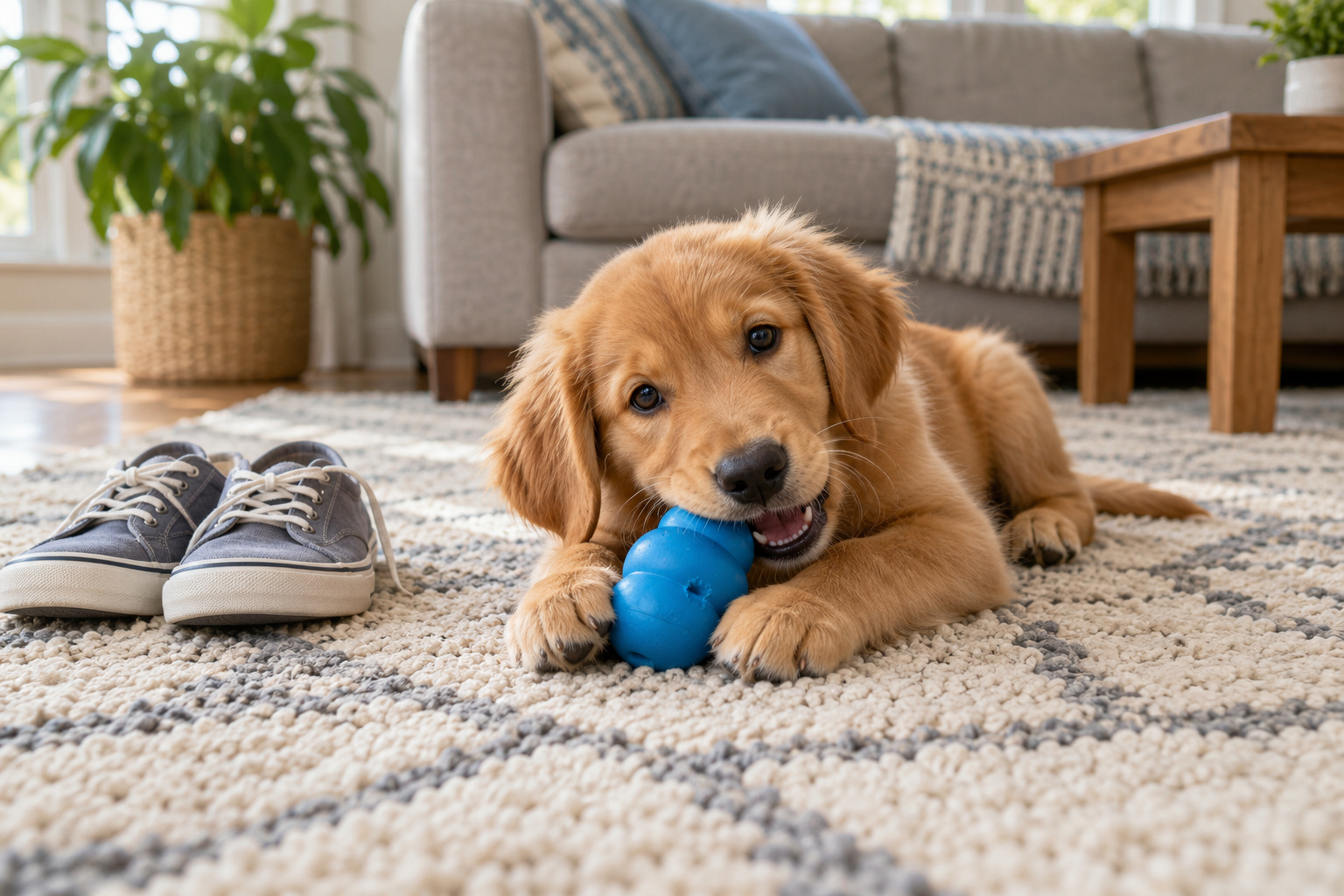
To stop a dog chewing the wrong things, work out why they are chewing, meet that need, and give them something better to chew at the moments they usually go looking. Chewing is normal dog behaviour, so the goal is not to stop it but to move it onto safe, approved items while you manage the home so mistakes can’t happen. Punishment after the fact doesn’t work, because a dog can’t link a telling-off to something they chewed an hour ago.
This article contains affiliate links. As an Amazon Associate I earn from qualifying purchases, at no extra cost to you. Affiliate disclosure.
This guide walks through the six most common reasons dogs chew, matches each one to a kind, reward-based fix, and gives you a simple set-up and toy rotation you can start today. It also covers the signs that chewing is a health or welfare issue that needs your vet or a qualified behaviour professional.
At a glance
- Chewing is a natural behaviour: it keeps jaws strong, helps clean teeth and relieves mild stress or boredom.
- The fix depends on the cause: teething, boredom, too little exercise, separation distress, hunger and frustration all need different answers.
- Management comes first: put tempting items away and use a puppy-proofed room or gate when you can’t supervise.
- Swap, don’t scold: calmly trade the wrong item for a right one, then praise your dog for chewing that.
- See your vet if your dog swallows non-food items, chews suddenly or obsessively, or seems unwell.
Why dogs chew in the first place
Chewing feels good to dogs. The ASPCA describes it as a normal behaviour for dogs of every age that keeps the jaws strong, helps keep teeth clean, and offers stimulation and some relief from mild anxiety or frustration. That means a dog with nothing appropriate to chew will find something, and your shoes, skirting boards and cushions are all within reach.
Chewing becomes a problem when it’s aimed at the wrong things, happens mostly when your dog is alone, or is intense enough to cause damage or injury. The useful question is not “how do I make them stop?” but “what is this chewing doing for my dog?” Once you know that, the fix usually becomes obvious.
Find the cause: a quick matching table
Use the table below to match what you see to the likely reason and the kindest place to start. Many dogs have more than one cause at once, especially young dogs.
| What you notice | Likely cause | Kind first step |
|---|---|---|
| Puppy under about six months, chewing everything, sore-looking gums | Teething | Cold, soft chew toys and frozen wet cloths under supervision |
| Chewing on quiet days, after long rests, or when you’re busy | Boredom or not enough mental stimulation | Food puzzles, scent games and short training sessions |
| Restless, “zoomy” dog who chews in the evening | Under-exercise for their age and breed | More daily movement and play, matched to your dog |
| Chewing mainly or only when left alone, often near doors or windows, plus whining, pacing or toileting | Separation distress | Gradual alone-time training; talk to your vet or a behaviour professional |
| Targets food packets, bins, lunch bags or things that smell of food | Hunger or food-seeking | Check diet amount with your vet; feed part of meals from puzzle toys |
| Chews when blocked from something exciting, such as squirrels at a fence | Frustration | Offer a tug or chew in those moments; reduce the trigger |
| Swallows fabric, stones, plastic or other non-food items | Possible pica or a medical issue | See your vet |
Kind fixes for each cause
Teething puppies
Puppies chew to ease the discomfort of adult teeth coming through. According to the ASPCA, this intense phase usually settles by around six months of age, though many dogs keep a strong urge to chew through adolescence. Our guide to when puppies lose their baby teeth explains the timeline.
Offer soft rubber toys you can chill in the fridge or freezer, or a wet face cloth that has been twisted and frozen, always under supervision so nothing gets swallowed. Keep a toy in your hand or pocket so you can swap quickly. If the chewing is aimed at hands and clothes, treat it as puppy biting rather than object chewing.
Boredom and not enough brain work
A dog who has slept all day and has nothing to do will make their own entertainment. Mental work tires dogs in a way that a walk alone often doesn’t. Try feeding part of each meal from a food puzzle, scattering kibble in the grass for a sniffing game, or doing five minutes of trick training. You’ll find plenty of low-cost options in 20 easy dog enrichment ideas.
Too little exercise
Young, active and working-type dogs often chew most in the evening, when energy builds and nobody is playing with them. Look honestly at how much movement your dog gets each day compared with what dogs of that age and type usually need; how much exercise a dog needs gives a realistic starting point. Exercise before you go out or settle down for the evening, then hand over a chew so your dog has something calm to do as they wind down.
Separation distress
If the damage only happens while your dog is alone, and it’s focused around doors, windows or your belongings, the chewing may be a sign of distress rather than mischief. The ASPCA notes that these dogs often also whine, bark, pace or toilet indoors when left. This is an emotional problem, so the answer is to help your dog feel safe alone, step by small step. Start with how to ease separation anxiety in dogs, and speak to your vet, who can rule out pain or illness and refer you to a qualified behaviour professional if needed. Never shut a distressed dog in a crate to stop the chewing; a panicking dog can injure their teeth and paws trying to escape.
Hunger and food-seeking
Dogs on a reduced-calorie diet, or who simply aren’t getting enough, may chew food packaging, bins and anything that smells of food. Ask your vet whether your dog’s current amount suits their weight and body condition rather than cutting or adding food on your own. In the meantime, use bins with secure lids, keep shopping and school bags off the floor, and feed some of the daily ration slowly from puzzle toys so eating takes longer.
Stress and frustration
Some dogs chew when they’re wound up and can’t do what they want, such as chasing birds at a window or joining a game they’ve been shut out of. Notice the moments it happens and get ahead of them with a tug toy or chew. Reducing the trigger helps too: frosted window film on low windows or moving a bed away from a busy fence line can take the pressure off. If you’re seeing other stress signals, how to spot the hidden signs of stress in your dog is a useful read.
Set up your home so chewing mistakes can’t happen
Training works far faster when your dog doesn’t get to practise the wrong thing. Think of this as temporary; most dogs need less management once good habits are in place.
- Clear the floor. Shoes, socks, remote controls, children’s toys, books and charging cables go up high or behind closed doors.
- Close the laundry. Use a lidded hamper. Worn clothes smell strongly of you and are a favourite target.
- Secure the bins. Sanitary products, food wrappers and bones are dangerous if swallowed, so use a lidded or locked bin.
- Create a safe zone. When you can’t watch, use a puppy-proofed room, a play pen or a baby gate with water, a bed and two or three approved chews.
- Protect fixed items. Cover chair legs or skirting boards in the danger zone, or block access with furniture, until your dog has learned what is theirs.
- Keep chews where the chewing happens. If your dog chews the sofa in the evening, keep a basket of chews next to the sofa.
The swap-and-praise method, step by step
This is the core of teaching your dog what to chew. It uses reward rather than fear, which is what the American Veterinary Society of Animal Behavior recommends for all dog training. Our guide to positive reinforcement dog training explains why rewards work so well.
- Stay calm. If you catch your dog chewing something they shouldn’t, avoid shouting or chasing. Chasing turns the item into a fun game of keep-away.
- Offer something better. Hold out an approved chew or a tasty treat close to their nose.
- Trade. As they let go, quietly pick up the wrong item and give them the approved one.
- Praise the right choice. When your dog settles to chew the approved item, say “good” in a soft voice and, if they’re happy for you to be close, drop a treat beside them.
- Remove the temptation. Put the wrong item out of reach so it can’t happen again.
- Reward what you like, unprompted. Whenever you see your dog choose their own chew, praise them. This is the step most owners forget.
If your dog guards items, stiffens, freezes or growls when you approach, don’t reach for the item. Toss a few treats a short distance away, pick the item up when they move off, and talk to a qualified, reward-based trainer or behaviourist.
Build a chew-toy rotation
Dogs lose interest in the same toy every day. The ASPCA suggests offering a variety of chews and rotating them every couple of days so each one feels new. A simple rotation looks like this:
- A long-lasting chew suited to your dog’s size and chewing strength.
- A stuffable rubber toy filled with part of their meal, frozen for longer-lasting work.
- A soft or textured toy for gentle chewers and teething puppies.
- A food puzzle that makes them think rather than just chew.
Keep two or three out at a time and put the rest away, swapping every few days. Size and hardness matter: anything small enough to swallow whole, or so hard that it won’t give at all, can cause choking or tooth damage. Our guide to choosing safe dog chews explains how to pick the right size and hardness, and never give cooked bones, which can splinter. Always supervise edible chews, and separate dogs while they eat them.
When chewing is a sign to see the vet
Most chewing is behavioural, but sometimes it points to a health problem. Chewing that suddenly starts in an adult dog, or chewing that turns into swallowing non-food items, should always be checked. Swallowing things that aren’t food is called pica. PetMD notes it can be linked to medical problems including anaemia, gut disease, liver or pancreatic disease, parasites, diabetes and an unbalanced diet, as well as being a compulsive habit.
Contact your vet promptly if your dog:
- has swallowed, or might have swallowed, a sock, toy, stone, corn cob, bone or other object
- is vomiting, off their food, straining to pass faeces, passing little or no faeces, or has a bloated or sore tummy
- has dark, tarry faeces
- repeatedly eats fabric, soil, stones or plastic
- has started chewing suddenly, or has broken or bleeding teeth or a sore mouth
- chews or licks at their own skin or paws until it is raw
If you think your dog is choking or has something stuck in their mouth or throat, go to your nearest emergency vet straight away. Swallowed objects can cause a dangerous blockage that may need surgery. Our calm guide to when to call the vet can help you decide how urgent it is.
For chewing that seems compulsive, such as long sessions of sucking or chewing fabric that are hard to interrupt, ask your vet for a referral to a veterinary behaviourist or a certified behaviour consultant.
Our picks on Amazon: safe chew outlets
Giving a dog a better thing to chew is one of the kindest fixes. Choose the right size and replace chews as they wear.
- Benebone Wishbone: a flavoured nylon chew shaped so dogs can hold it easily.
- Nylabone Power Chew (3 pack): durable chews for strong chewers.
- KONG Classic: a stuffable rubber toy that turns chewing into a food puzzle.
Prices and availability change. Check sizing against your own dog’s measurements and always supervise with new toys or equipment.
Common mistakes
- Punishing after the fact. Your dog can’t connect a scolding to chewing that happened earlier. It only teaches them to be wary of you, and can make anxious chewing worse.
- Using deterrents as a lesson. Sprays and taste barriers don’t teach a dog anything about what they can chew. At most, they’re a temporary barrier on a fixed item, and only alongside plenty of approved chews.
- Giving old shoes or socks as toys. Dogs can’t tell an old trainer from your new ones. Keep their toys clearly different from household items.
- Crating for long periods to stop chewing. Long confinement adds frustration and doesn’t meet the need behind the chewing.
- Ignoring the cause. More toys won’t fix separation distress, and more exercise won’t fix hunger. Match the fix to the reason.
- Using harsh or aversive tools. Physical punishment, muzzling to prevent chewing or taping a mouth shut are cruel and dangerous. Reward-based methods work and keep your dog’s trust.
A two-week starter plan
- Days 1-2: Note when and where the chewing happens, and what is being chewed. Use the table above to spot the likely cause.
- Days 1-3: Dog-proof the home and set up a safe zone with approved chews.
- Days 3-7: Add one daily brain game and adjust exercise to suit your dog. Start the swap-and-praise method every time.
- Week two: Start a toy rotation, feed part of meals from puzzles, and keep praising your dog whenever they choose their own chew.
- Any time: If chewing happens only when alone, involves swallowing objects or comes with signs of illness, book a vet visit.
Many dogs, especially adolescents, take longer than two weeks to build new habits. That’s normal, so keep going.
Sources this guide draws on: ASPCA guidance on destructive chewing; the American Veterinary Society of Animal Behavior position statement on humane dog training (2021); PetMD veterinary information on pica in dogs.
Frequently asked questions
At what age do dogs stop chewing everything?
The intense teething phase usually eases by around six months, but many dogs chew a lot through adolescence and into early adulthood. Dogs never fully stop wanting to chew, which is why giving them safe, approved chews for life matters more than waiting for the habit to fade.
How do I stop my dog chewing furniture and carpet?
Block access while you can’t supervise, put chews right where the furniture chewing happens, and swap and praise every time you catch it. Look for the timing too: chewing in the evening often points to boredom or too little exercise, while chewing only when alone points to separation distress.
Should I tell my dog off for chewing?
No. Telling a dog off after the damage is done doesn’t work, because they can’t link it to the earlier chewing. Calmly interrupting, trading for an approved chew and praising the right choice teaches your dog far more, without damaging your bond.
Why does my dog only chew when I leave the house?
Chewing that only happens when your dog is alone can be a sign of separation distress, especially with whining, pacing or toileting indoors. It can also mean boredom if they’re left for long stretches. Your vet can help rule out other causes and point you to a qualified behaviour professional.
Is destructive chewing ever a medical problem?
Sometimes. Sudden new chewing in an adult dog, chewing with mouth pain, or regularly swallowing non-food items can all have medical causes. See your vet if you notice any of these, and straight away if your dog may have swallowed an object.
Chewing is one of the most natural things your dog does. Give it a safe outlet, meet the need behind it and reward the choices you love, and most dogs settle into good chewing habits that last.