
The short version
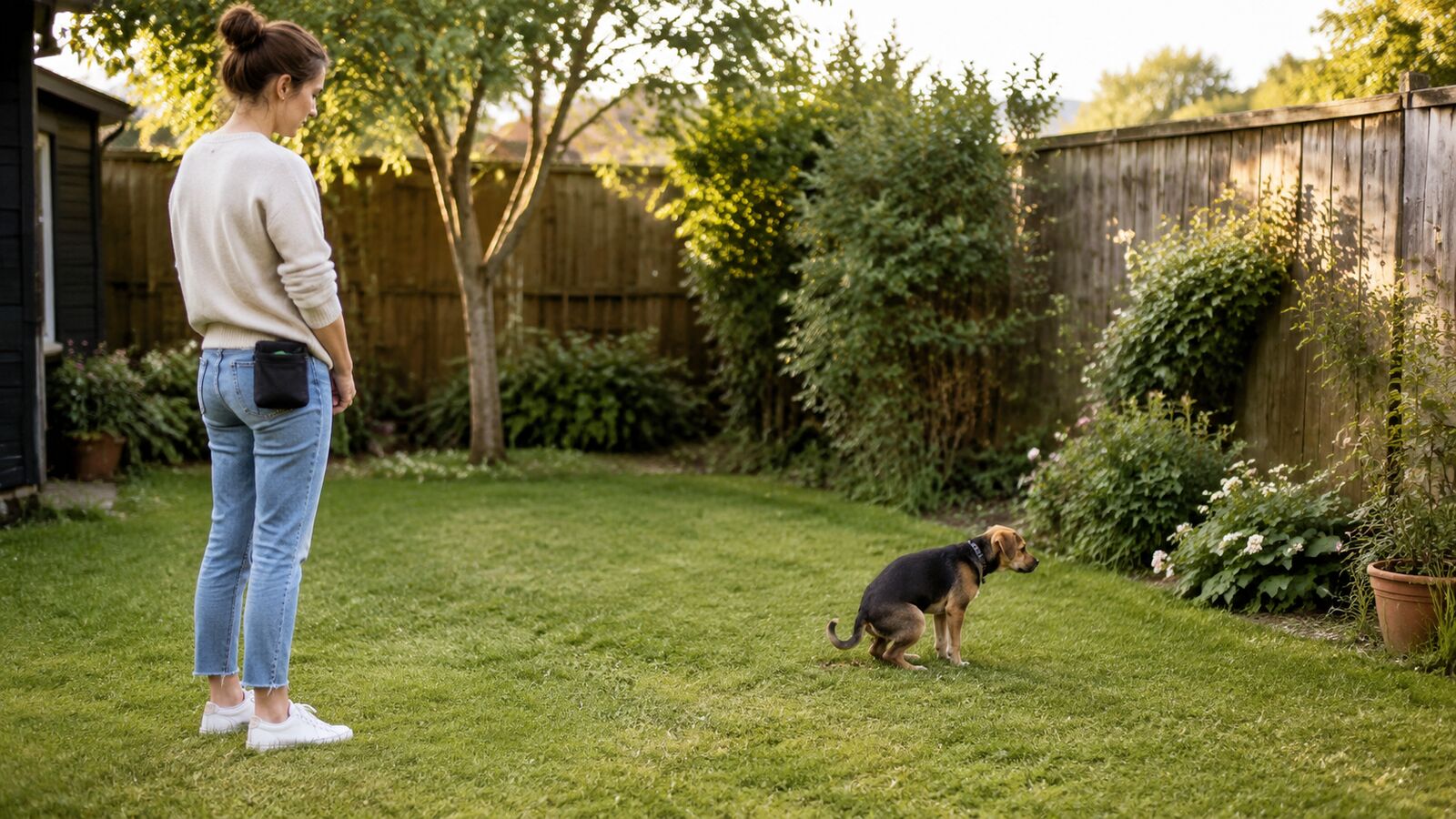
House-training is arranged more than it is taught. Take your puppy outside after waking, after eating, after play and roughly every hour in between, go out with them, and reward the moment they finish. Clean any indoor accident with an enzymatic cleaner so the spot is not re-marked. Never punish. Most puppies are broadly reliable within about a month.
Most owners expect house-training to be a battle of wills, and it almost never is. A puppy who wees on the rug is not defying you. They are a small animal with a very small bladder who did not know the rug was different from the grass.
You are not trying to stop your puppy toileting. You are trying to make sure that nearly every time they need to go, they are outside, with you there to tell them how clever they are. Do that enough and the habit forms itself.
The three rules everything hangs off
Prevent, do not correct. Every indoor accident rehearses the wrong habit, and every clean trip out rehearses the right one. Your job is to tilt the odds, with supervision, a tight schedule and a smaller area of the house than you imagined.
Reward immediately. Puppies learn from what happens a second or two after a behaviour, not from what happens back at the door. Praise and a treat delivered outside, on the spot, do most of the work.
Never punish. Telling a puppy off teaches only that toileting near you is risky, and puppies who have been told off often start going behind the sofa instead. If you catch one mid-flow, interrupt brightly rather than crossly: a cheerful “outside!”, then finish on the grass and reward what lands there.
The schedule that does most of the work
Young puppies cannot hold on for long and give little warning, so you take them out on a timetable rather than waiting for a signal.
- After waking, every time, including short naps.
- After eating or drinking. Food gets the gut moving, so a trip out within ten to twenty minutes of a meal catches most poos.
- After play or excitement. A burst of chasing a toy, or a visitor arriving, very often ends in a puddle.
- Every hour or so in between while your puppy is awake, stretching as they show they can hold on.
A rough guide many trainers use is about an hour of holding on per month of age, plus one. Treat that as a ceiling, not a target.
Within a few days you will see the tell: sudden floor-sniffing, circling, drifting towards a corner, going quiet mid-play. When you see it, move. Keep your puppy in the room you are in, behind a gate or on a lead attached to you if they wander. Free run of the house comes later.
What to do outside, and the mistake almost everyone makes
Go out with your puppy every single time, including in the rain and at half past five in the morning. Let them out alone and you have no idea whether they went, so you cannot reward it.
Use the same spot, because the smell of previous visits is a strong prompt. Then stand still and say nothing. A puppy who is being chatted to will play with you instead of getting on with it.
The mistake: going straight back inside
Your puppy finally goes, you are cold and relieved, so you scoop them up and head indoors. Repeat that for a week and your puppy learns that toileting ends the outdoor trip. Some then hold on outside so the fun continues, and go once back on the carpet.
The fix is small and it changes everything. Once they have finished, stay out a few more minutes for a play, a wander, or treats scattered in the grass. Toileting should start the good part of the trip, not end it.
Marker and reward timing
The moment your puppy finishes, mark it with the same warm word each time, then get the treat to them within a second or two. Do not praise mid-stream, because a startled puppy will stop, come to you, and finish on the doorstep.
A week-by-week plan for the first month
Puppies vary, so read this as a shape rather than a target. A puppy who is slower is not failing, and neither are you.
Week one: you are doing all the work
Expect accidents daily, possibly several. Out every hour while awake, after every nap, meal and play session, and at least once overnight. Keep your puppy in one or two easily cleaned rooms with you. The only goals this week are a consistent routine, a consistent spot and no telling off.
Week two: the pattern starts to show
You will start to recognise your puppy’s rhythm, and may notice them hovering near the door without knowing what to do next. That is the start of understanding, and it counts even when they do not make it in time. Accidents thin out, and after a few clean days you can stretch calm indoor gaps to ninety minutes.
Week three: fewer accidents, more communication
Many puppies are now asking, in their own way: sitting by the door, whining, staring, coming to fetch you. Answer every request instantly, false alarms included, because a puppy who asks and is ignored stops asking. Daytime gaps can stretch to a couple of hours.
Week four: broadly reliable, in the rooms they know
By the end of the month many puppies have only occasional accidents, usually traceable to something specific: a long gap, an excitable visitor, a new room.
House-training is also location-specific. A puppy who is perfect at home may still have an accident at a friend’s house, because the rule they learned is about this floor, not all floors. Supervise closely anywhere new.
Night-time
Very young puppies cannot last a full night. Plan one or two trips out, set an alarm rather than waiting to be woken, and keep the whole thing dull: out, wait, mark, quiet reward, back to bed. No lights on, no play, no conversation.
Sleeping your puppy beside your bed in a crate or pen means you hear the restlessness before the accident. Lifting the water bowl an hour before bed suits most healthy puppies, though never restrict water in the daytime. Nights lengthen on their own within a few weeks.
Accidents, and how to clean them properly
Accidents happen. What matters is what you do next.
Ordinary cleaners remove what you can see but leave what your dog can smell, and dogs return to places that smell like a toilet. Cleaners containing ammonia can make it worse, since ammonia is a component of urine.
Use an enzymatic cleaner, sold for exactly this job, which breaks the residue down rather than masking it. Blot up as much as you can first, apply generously so it reaches as far as the urine soaked, and let it dry on its own. If your puppy keeps returning to one spot, that is a cleaning problem first.
Puppy pads: when they help and when they slow you down
Pads teach a puppy that there is an acceptable indoor toilet, which is the opposite of what most owners want long-term. Many puppies who start on pads need a second round of training to move outdoors, and some keep a lasting preference for soft absorbent surfaces, which is unfortunate news for rugs.
They do earn their place in some homes: an upper-floor flat, an owner with limited mobility, or a vet’s advice to keep a part-vaccinated puppy off shared ground. Use them in one fixed spot near the door you will eventually use, moved gradually beyond it as your puppy matures.
When house-training goes backwards
Regression is common and rarely means the training has failed. The usual causes are adolescence, a house move, a new baby or pet, a change of routine or food, cold weather making trips out unappealing, or a schedule relaxed too early.
The response is always the same. Go back to the supervision and frequency that worked a fortnight ago, hold it a week, then loosen more slowly.
If a dog who has been reliably house-trained for months or years suddenly starts having accidents, treat it as a health question and ring your vet. Sudden loss of house-training in a previously clean dog is a common way for a physical problem to announce itself, and not something to train your way out of.
When to get professional help
Ring your vet if your puppy is straining, going very frequently, having accidents in their sleep, drinking noticeably more than usual, or if there is blood or any sign of discomfort. Ring too if a previously reliable dog loses their house-training, at any age.
An accredited reward-based trainer or a qualified behaviourist is worth involving if your puppy seems frightened to toilet in front of you, hides to go, or if weeks of a clear routine have produced no progress. Fresh eyes usually spot the small thing undoing the rest.
Frequently asked questions
How long does it take to house-train a puppy?
Most puppies are broadly reliable indoors within four to six weeks of consistent routine, with the odd accident afterwards. Full reliability, including in unfamiliar places and when left alone, often takes until four to six months of age. Puppies who had a difficult start sometimes take longer, which is normal.
Why does my puppy wee in the house straight after coming in from the garden?
Usually because your puppy has learned that toileting ends the trip out, so they hold on. Stand still and stay boring until they have gone, then mark, reward, and spend a few more minutes outside playing. It is also worth checking you are not going out so often that there is nothing left to pass.
Should I tell my puppy off when I find a mess?
No. A puppy cannot connect your reaction to something they did minutes ago, so all they learn is that you are sometimes frightening. That often produces a dog who toilets out of sight, which is harder to solve. Clean up without comment, think about what happened beforehand, and adjust the schedule.
How do I teach my puppy to tell me they need to go out?
Use the same door every time, so the door becomes part of the routine, and respond instantly whenever your puppy waits there themselves. Some owners hang a bell at nose height for the puppy to nudge on the way out. Whatever the signal, always answer it, false alarms included, or your puppy stops asking.
Read next
- Crate Training Without the Guilt
- Positive Reinforcement Dog Training: A Beginner’s Guide That Actually Works
- Puppy Socialisation: The Window That Matters Most
- Dog Adolescence: Why Your Lovely Puppy Turned Feral at Eight Months
- How to Safely Introduce a New Dog to Your Household
More in Puppies & Life Stages.
A note on this article
This is general guidance for owners of healthy puppies, written to make a normal stage of growing up less stressful. It is not veterinary advice and cannot account for your own dog’s health or history. Toileting problems sometimes have a physical cause, so if anything worries you, your vet is the right first call.