
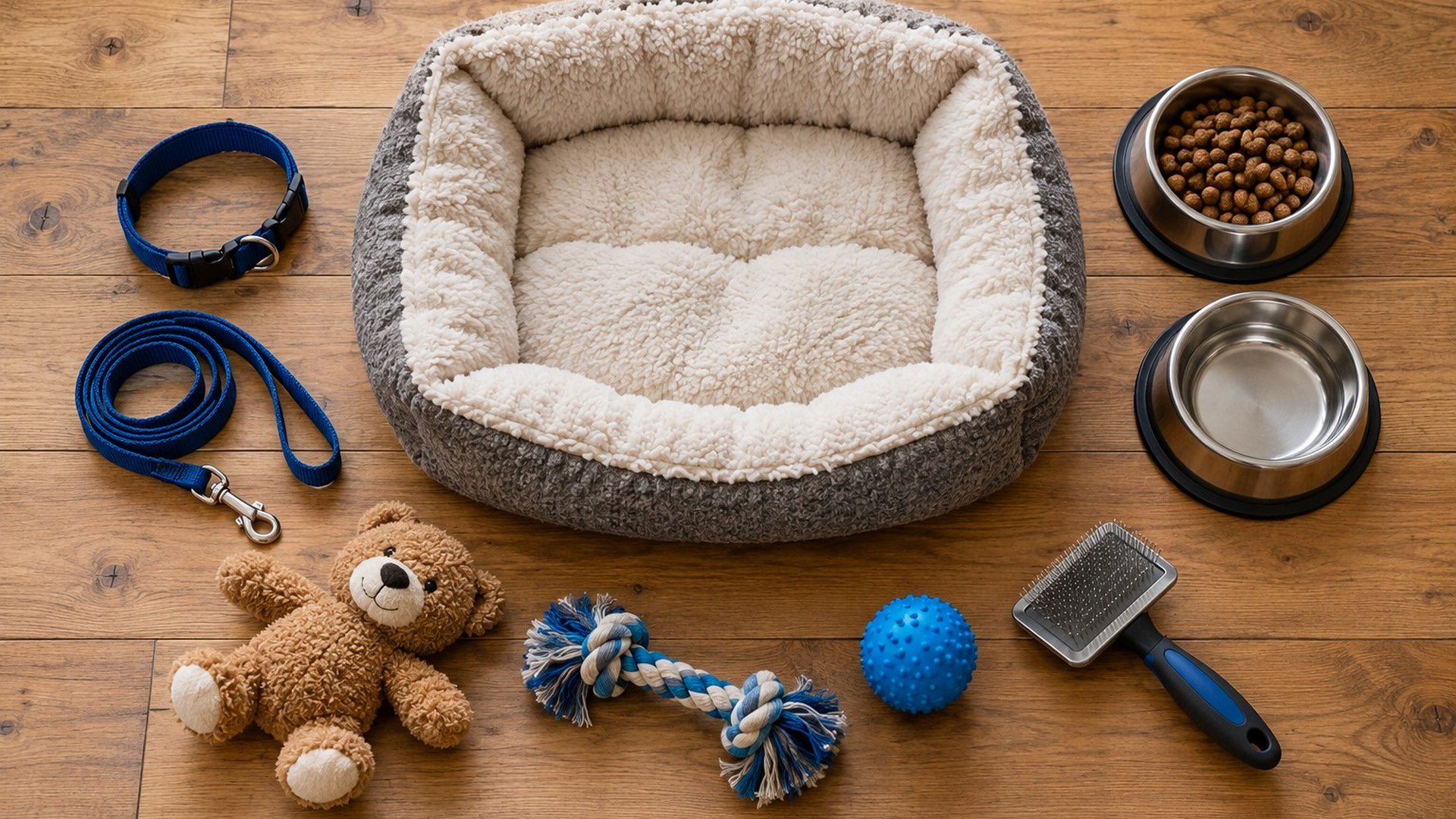
You need surprisingly little for a new puppy. Before the first night, get a safe place to sleep (a crate or puppy pen with a washable bed), the food your puppy is already eating, two bowls, a flat collar or harness with an ID tag, a lead, soft treats, a few chew toys, poo bags and an enzyme-based cleaner. Everything else can wait until you know your puppy’s size, chewing style and habits.
This guide gives you a printable-style checklist sorted into “before day one”, “first fortnight” and “later”, explains how to choose the big items without buying twice, and lists the things most new owners regret buying. It is a shopping and set-up guide; for how to actually crate train, house-train and socialise, it points you to the guides that cover those steps in detail.
At a glance
- The true essentials fit in one shopping bag plus a crate or pen: sleep space, food, bowls, ID, lead, treats, chews, cleaning gear.
- Buy the crate for the dog your puppy will become, then use a divider so it fits the puppy now.
- Choose bedding and toys you can wash or replace cheaply; puppies chew what they love.
- Skip retractable leads, hard bones, expensive beds and anything sold as a quick fix for behaviour.
- Book a vet check for the first few days and keep your puppy on the same food at first.
The puppy essentials checklist
Work through this list in order. If money is tight, the first block is the only part you need before your puppy comes home.
Before day one
- Sleep space: a crate with a divider panel, or a puppy pen, set up where your puppy can hear you at night.
- Washable bed or vet bedding: something you can throw in the washing machine and replace without heartache.
- The same food the breeder or shelter has been feeding: ask for the brand and amount, and enough to last at least the first week or two.
- Two bowls: one for water, one for food, in stainless steel or ceramic.
- Flat collar or a well-fitted harness: adjustable, lightweight and comfortable.
- ID tag: with your contact details, as local law requires.
- A standard lead: a fixed-length lead, not a retractable one.
- Small, soft training treats: tiny pieces you can give often.
- Two or three chew toys: a soft rubber toy you can stuff with food, a soft toy and one safe chew.
- Poo bags.
- Enzyme-based cleaner and kitchen roll: for the accidents that will happen.
- A baby gate or two: to close off stairs and rooms you have not puppy-proofed.
In the first fortnight
- A vet check: booked within the first few days to review vaccinations, parasite control and microchip details.
- Grooming basics: a brush that suits the coat, and puppy-sized nail clippers so you can start gentle handling early (see how to trim dog nails at home).
- A puppy toothbrush and dog toothpaste: human toothpaste is not suitable for dogs.
- A car restraint: a secured crate or a crash-tested harness for car trips.
- A treat pouch: makes rewarding good choices on walks much easier.
- Pet insurance decision: some policies have waiting periods or exclude conditions that show up before cover starts, so decide early.
Later, once you know your dog
- A properly sized adult bed.
- Puzzle feeders and enrichment toys matched to how your dog likes to play.
- A long line for safe recall practice in open spaces.
- Weather gear such as a coat or cooling mat, only if your dog’s coat and climate call for it.
- An adult-sized harness and collar.
Choosing the big items without buying twice
Crate or puppy pen
A crate is a sleeping and resting space, not a place to leave a puppy for long stretches. The usual sizing guidance, used by veterinary hospitals such as Banfield, is that your dog should be able to stand up, turn around and lie down comfortably. A crate much bigger than that can feel less den-like and may invite toileting at one end.
The money-saving trick is to buy a crate sized for your puppy’s expected adult size and use a divider panel, moving it back as your puppy grows. For a mixed breed or a rescue puppy of uncertain size, ask your vet for a rough estimate of adult weight.
A puppy pen gives more room to move and works well for daytime when you are home but busy. Many owners use both: a crate for sleeping and a pen as a safe play zone. If you plan to use a crate, the step-by-step approach in how to crate train without the guilt shows how to make it somewhere your puppy chooses to go.
| Option | Best for | Watch out for |
|---|---|---|
| Wire crate with divider | Night-time sleep, house-training, good airflow, grows with your puppy | Can feel exposed; a cover over three sides often helps |
| Plastic travel crate | Car journeys and dogs who like a cosy, enclosed space | Less airflow; fixed size, so you may need a bigger one later |
| Soft-sided crate | Calm, already crate-trained adult dogs on trips | Easily chewed or scratched open by puppies; not for unsupervised use |
| Puppy pen | Supervised daytime play area, puppies who need more space | Some puppies learn to climb or push them; check the height and stability |
| Baby gates only | Closing off a puppy-proofed kitchen or laundry | Less contained; needs the whole room to be safe |
Bed
Puppies need a lot of sleep. Dogs Trust notes that puppies need around 18 to 20 hours a day, so a comfortable, quiet resting place matters more than any toy. That said, a new puppy often chews or soils bedding. Start with a cheap washable bed, folded blankets or veterinary-style fleece bedding. Save the expensive orthopaedic bed for when your dog is past the chewing stage and you know whether they like to curl up or stretch out.
Collar, harness and lead
A flat collar holds the ID tag; a harness is often more comfortable for walking because it avoids pressure on the throat. A common fit check is being able to slide two fingers between collar and neck. Puppies grow fast, so check the fit every week or two. If you are weighing up harness styles, front-clip vs back-clip harnesses explains how each works.
Choose a fixed-length lead of roughly 1.2 to 1.8 metres (4 to 6 feet). Banfield’s puppy checklist advises avoiding retractable leads until a puppy is older and trained, because the constant tension makes loose-lead walking harder to teach.
ID and microchip
Rules differ by country and region. In some places microchipping is compulsory and a collar tag with the owner’s details is a legal requirement in public; elsewhere it is simply strongly advised. Check your local council or government rules, and make sure the microchip database has your details, not only the breeder’s. For how tags, microchips and trackers compare, see GPS dog tracker vs microchip.
Food and bowls
Keep your puppy on the food they are used to for the first days, then change gradually if you want to switch, ideally with your vet’s input. A sudden change on top of a big move is a common cause of upset tummies. Choose a complete food formulated for puppies or for “growth” or “all life stages”, and if you have a large or giant breed, ask your vet about a formula suited to large-breed growth. What to feed your dog covers how to compare food types.
Stainless steel and ceramic bowls are easy to clean and hard to chew. A non-slip base helps, and a slow-feeder bowl can help puppies who gulp.
Toys and chews
Mouthing and chewing are a normal part of puppyhood, especially while teething, so a few good chew outlets are an essential, not a treat. Puppy teeth are fine and sharp, and their adult teeth are still forming, so choose toys with some give. Cornell University’s Riney Canine Health Center describes the thumbnail test most veterinary dentists use: if you cannot dent a chew with your fingernail, it is probably too hard. Chews and chew toys: how to choose safely explains which chews are lower risk and which to avoid.
Start with three types: something to chew, something to cuddle, and something to stuff with food. Rotate them so they stay interesting.
Puppy-proofing: the free part of the kit
The most useful preparation costs nothing. Before your puppy arrives, get down to puppy height and look around.
- Move cables, chargers and remote controls out of reach or behind furniture.
- Store medicines, cleaning products, garden chemicals and pest baits in closed cupboards.
- Keep shoes, socks, hair ties and children’s small toys off the floor.
- Use a bin with a lid, or put it behind a door.
- Check your garden fence for gaps, and find out which of your plants are toxic to dogs.
- Decide where your puppy will sleep, eat and go to the toilet, and set those spots up in advance.
What to skip (or leave until later)
Pet shops are full of puppy products. These are the ones that most often turn out to be a waste of money or, worse, unsafe.
| Often bought | Why to skip it | Buy instead |
|---|---|---|
| Expensive designer bed | Likely to be chewed or soiled in the first months | Washable fleece or a cheap bed until the chewing stage passes |
| Retractable lead | Teaches puppies that pulling gets them further | A fixed-length lead and, later, a long line for recall practice |
| Hard bones, antlers, hooves and nylon “indestructible” chews | Cornell’s canine health guidance lists antlers, hooves and bones as chews that can break teeth | Softer rubber toys that bend |
| Bulk bag of a new food | You may need to change food, and switching suddenly upsets tummies | The food your puppy already eats, in a small bag |
| Anti-bark, spray or “correction” collars and devices | Aversive tools that can cause fear and pain; not suitable for any dog | Reward-based training and help from a qualified trainer |
| Dozens of toys | Puppies get bored of what is always available | A small set you rotate weekly |
| Puppy clothes and accessories | Rarely needed; many puppies find them uncomfortable | A coat only if your dog’s coat type and climate need one |
| Calming sprays, supplements or gadgets bought “just in case” | Settling-in worries are normal and usually ease with routine | A calm routine, plenty of sleep and a vet chat if worries persist |
Puppy pads are a judgement call. They can help if you live in a high-rise flat or your puppy cannot yet go outside, but they can also teach your puppy that indoors is fine for toileting. If you can get outside easily, it is usually simpler to go straight to outdoor toilet trips, as described in how to house-train a puppy.
A worked example: a lean starter kit
Here is how one sensible first shop might look for a puppy of expected medium adult size, with the “why” for each choice.
- A medium wire crate with a divider, because it will still fit the adult dog.
- Two washable fleece mats, so one can be in the wash.
- One small bag of the breeder’s food plus a small pack of soft treats.
- A stainless steel water bowl and a slow-feeder food bowl.
- A lightweight adjustable collar with ID tag, a puppy harness and a 1.5-metre lead.
- A stuffable rubber toy, a soft cuddle toy and a soft tug toy.
- Poo bags, an enzyme cleaner and one baby gate.
Prices vary widely between countries and shops, so this guide does not quote costs, but the principle holds anywhere: spend on safety and sleep, save on things your puppy will outgrow or destroy.
Who needs extra items
- Flats and apartments: a puppy pen and, possibly, an indoor or balcony toilet area while you build the routine.
- Homes with other pets: extra gates so everyone has their own space during introductions.
- Families with young children: a puppy zone the children do not enter, so your puppy can rest undisturbed.
- Long-coated or curly-coated breeds: the right brush or comb from the start, so grooming becomes routine.
- People who drive often: a properly secured travel crate or crash-tested harness.
Common mistakes
- Buying the crate for today’s size only and needing a new one within months.
- Changing food on day one because a new brand looked better in the shop.
- Leaving every toy out so nothing feels special and chewing moves to the furniture.
- Forgetting the microchip details are still in the breeder’s name.
- Buying “training” gadgets that rely on startling or hurting the puppy. Reward-based training, explained in the puppy first-year guide, works better and keeps trust intact.
- Putting the sleep space somewhere isolated, such as a far-off laundry, when most puppies settle better near people in the first weeks.
Your first week
Once the kit is in place, the first week is about routine: regular toilet trips, short calm play sessions, lots of sleep, gentle handling and your first vet check. Banfield’s puppy guidance suggests booking that first vet visit within about three to five days of bringing your puppy home. The broader month-by-month picture, from settling in through to adolescence, is set out in your puppy’s first year.
Related guide: Dog Collar Size: How to Measure for the Right, Safe Fit.
Sources this guide draws on: Banfield Pet Hospital’s puppy supplies checklist, PetMD’s new puppy checklist, Cornell University’s Riney Canine Health Center on chews and fractured teeth, and Dogs Trust guidance on puppy sleep and mouthing. Local rules on microchipping and ID tags vary, so check with your local council or government.
Handy gear for this guide
Practical picks we think suit this topic. As an Amazon Associate, Mind A Dog earns from qualifying purchases, at no extra cost to you. Prices and availability are set by Amazon and may vary by country.
- Nylabone New Puppy Starter Kit (3 Pack)
Puppy-soft chews sized for teething mouths.
View on Amazon - MidWest iCrate Double Door Dog Crate (36 inch)
Folding wire crate with a divider panel, so it can grow with your dog.
View on Amazon - Zak George’s Dog Training Revolution (book)
A friendly, reward-based guide to raising a well-behaved dog.
View on Amazon
Frequently asked questions
What should I buy before bringing a puppy home?
Get a crate or pen, a washable bed, the puppy’s current food, two bowls, a collar or harness with an ID tag, a fixed-length lead, soft treats, a few chew toys, poo bags and an enzyme cleaner. A baby gate is also very useful. The rest can wait until you know your puppy better.
What size crate should I get for a puppy?
Choose a crate your dog will be able to stand, turn around and lie down in comfortably as an adult, then use a divider so the space fits your puppy now. Move the divider as your puppy grows. If you are unsure of adult size, ask your vet for an estimate.
Do puppies need a bed in their crate?
Most puppies are more comfortable with soft bedding, but choose something washable and cheap at first, because puppies may chew it or have accidents. If your puppy shreds and swallows bedding, remove it and talk to your vet or a reward-based trainer about safer options.
Should I use a collar or a harness on a puppy?
Many owners use both: a flat collar to carry the ID tag and a harness for walks, since a harness keeps pressure off the throat. Whichever you use, check the fit often because puppies grow quickly. Never use choke, prong or shock collars.
Are puppy pads a good idea?
They can help in high-rise living or when a puppy cannot get outside yet, but they may make outdoor house-training slower because your puppy learns that indoors is acceptable. If you can get outside easily, frequent outdoor trips are usually the simpler path.
What toys are safe for teething puppies?
Choose toys with some flex, such as soft rubber toys that can be stuffed with food, and avoid very hard chews like bones, antlers and hard nylon. Supervise chewing, replace toys that break into pieces, and ask your vet if you notice broken teeth or bleeding gums.
A good starter kit is short, safe and washable. Get the sleep space, food, ID and chew outlets right, puppy-proof the floor, and let everything else wait until your puppy shows you what they actually need.