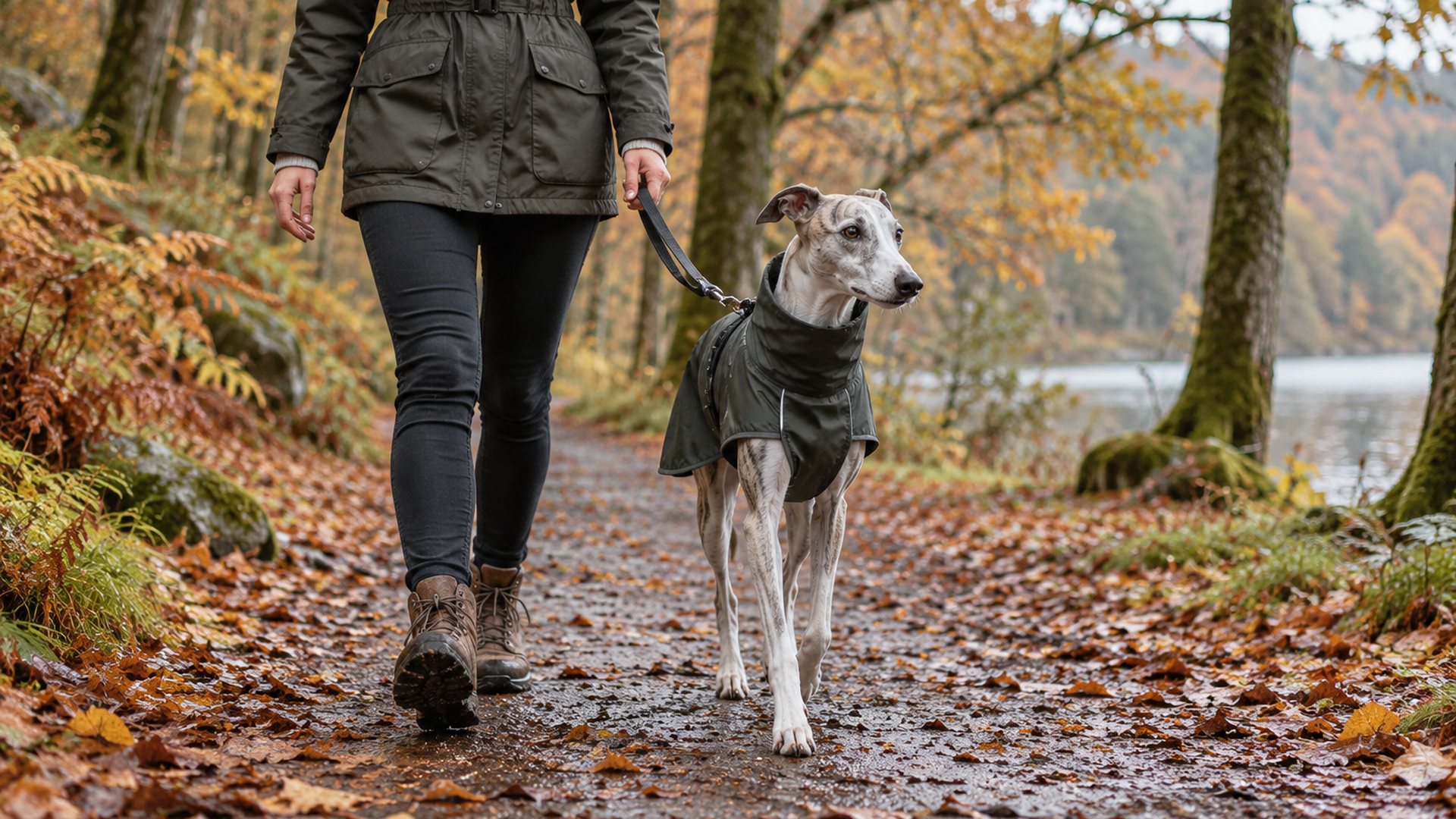
Not every dog needs a coat. Dog sweaters and coats genuinely help small dogs, thin or fine-coated breeds such as greyhounds and whippets, puppies, seniors, and dogs that are underweight or unwell. Fit, healthy dogs with thick double coats, such as huskies and malamutes, usually stay warm without one as long as they keep moving.
This article contains affiliate links. As an Amazon Associate I earn from qualifying purchases, at no extra cost to you. Affiliate disclosure.
This guide helps you decide whether your dog needs a jumper, a raincoat or nothing at all, explains what temperature is too cold for dogs of different sizes, and shows you how to measure for a coat that fits without rubbing. It also covers bandanas, overheating and how to help a dog feel happy wearing something new, using rewards rather than pressure.
At a glance
- Dogs most likely to benefit: small breeds, fine or thin-coated breeds, puppies, older dogs and dogs that are lean, underweight or unwell.
- Dogs that rarely need one: fit, active dogs with thick, weather-resistant double coats.
- Wet and wind make cold far more dangerous. A waterproof coat can matter more than a warm one.
- Measure back length, chest and neck; a good coat lets your dog walk, run, sit and toilet freely.
- Take coats off indoors in heated rooms, and watch for shivering, slowing down or lifting paws as signs your dog is cold.
Does my dog need a coat? A quick decision guide
The UK veterinary charity PDSA advises that fine or thin-coated breeds, small breeds, and very young, elderly, underweight or unwell dogs can benefit from a coat in cold weather, and that those vulnerable dogs should also have shorter spells outside. Fit, healthy dogs with thick fur generally do not need one while they are active, and cold-tolerant breeds such as huskies and malamutes are built for low temperatures.
| Your dog | Coat in cold, dry weather? | Coat in cold rain or wind? | Why |
|---|---|---|---|
| Small or toy breed (for example, Chihuahua, toy poodle, small terriers) | Often yes | Yes, ideally waterproof | Small bodies lose heat faster and sit closer to cold, wet ground. |
| Fine or thin single coat (for example, greyhound, whippet, Italian greyhound) | Usually yes | Yes | Little insulating fur and often very little body fat. |
| Puppy | Often yes on longer outings | Yes | Puppies are less able to regulate body temperature. |
| Senior, underweight or unwell dog | Often yes | Yes | Less muscle, less fat or a health condition can make keeping warm harder. |
| Freshly clipped dog with a normally long coat | Possibly, until it grows back | Possibly | Clipping removes the insulation the dog normally relies on. |
| Medium or large dog with a dense double coat (for example, husky, malamute) | Rarely | Usually not while active | The undercoat traps warm air; a coat can flatten it and cause overheating. |
Coat type matters as much as size. If you are not sure whether your dog has a single or double coat, our guide to grooming by coat type explains how to tell.
What temperature is too cold for dogs?
There is no single number, because size, coat, body condition, wind and wet all change the answer. The best-known guide is the weather safety scale developed at Tufts University’s Animal Care and Condition programme, which rates risk by dog size and adds adjustments for wet weather and shelter. As reported in UK coverage of the scale, temperatures between about 4°C and -1°C are already rated potentially unsafe for small and medium dogs, with large dogs reaching the same level a few degrees lower. Rain, sleet or snow shifts every threshold to a warmer temperature, so a small, wet dog can be at real risk on a day that does not feel especially cold to you.
The Tufts researchers also stress that common sense matters: how long your dog is outside is just as important as the reading on the thermometer. In practice that means:
- A short toilet break at a low temperature is very different from an hour-long walk in it.
- Wind and wet together are the most dangerous combination, especially for small and thin-coated dogs.
- Dogs that are moving keep warmer than dogs standing still, so waiting at a bus stop or a sports ground is when many dogs chill.
Signs your dog is too cold
Watch your dog rather than the forecast. PDSA advises bringing a dog inside straight away if it starts shivering or slowing down. Other common signals include tucking the tail, hunching, lifting paws off the ground, trying to turn back for home or looking for shelter. If your dog seems weak, very lethargic, confused or cold to the touch after being outside, contact your vet immediately, as these can be signs of hypothermia. Our guide to when to call the vet explains how to describe what you are seeing.
Dog sweaters, raincoats and winter coats compared
“Dog coat” covers several quite different products. Choose based on the weather you actually walk in.
| Type | Best for | Strengths | Watch out for |
|---|---|---|---|
| Knitted dog sweater or jumper | Cold, dry days; chilly homes for very thin-coated dogs | Soft, stretchy, easy to wear | Soaks up rain and stays wet; loose knits can snag claws. |
| Fleece layer | Cool, dry weather; layering under a shell | Warm for its weight, dries faster than wool knits | Not waterproof; can build static and pick up debris. |
| Dog raincoat (light shell) | Mild, wet weather | Keeps the coat and skin dry, light to wear | Little warmth on its own; non-breathable fabrics can trap heat. |
| Waterproof insulated winter coat | Cold, wet or windy weather for vulnerable dogs | Warmth plus weather protection, often with belly coverage | Bulkier; easy to overheat on milder days or during energetic play. |
| Dog bandana | Style, visibility (in bright colours) and photos | Light, fun, cheap | Provides no warmth; can catch on things, so supervise and remove it for play and unsupervised time. |
For many dogs a waterproof shell is the most useful single item, because wet fur loses much of its insulating power. Dogs that need more warmth can wear a fleece underneath on colder days. Reflective trim or a bright colour is a real safety bonus on dark winter evenings.
How to measure your dog for a coat
PDSA recommends taking three measurements and noting them in both centimetres and inches, because brands use different systems. Use a soft tape measure and have your dog standing square.
- Back length: measure from the base of the neck, where the collar sits, along the spine to the base of the tail. This is the number most size charts use first.
- Chest girth: measure around the widest part of the chest, just behind the front legs. Slip two fingers under the tape so it is snug, not tight.
- Neck: measure around the neck where the collar normally sits. Our dog collar sizing guide uses the same two-finger method.
- Compare all three to the brand’s chart. If your dog falls between sizes, chest fit usually matters most: a coat that is tight across the chest restricts breathing and movement.
- Check the shape for your breed. Long-backed, deep-chested or very slim dogs such as dachshunds and greyhounds often need coats cut specifically for their proportions.
- Plan for the harness. Decide whether the coat goes under or over the harness, and look for a lead opening if it goes over. Our guide to front-clip and back-clip harnesses helps you choose a harness that works with a coat.
The fit check
Once the coat is on, check that:
- Your dog can walk, trot, sit, lie down, sniff and toilet without the coat pulling or riding up.
- The coat does not rub under the front legs or press on the throat.
- The belly strap sits comfortably and, on male dogs, well clear of where they urinate.
- No straps or toggles dangle where they could catch or be chewed.
- Your dog is not repeatedly biting, scratching or rubbing at the coat. PDSA notes this is a sign the coat does not fit properly.
Helping your dog feel happy wearing a coat
Many dogs are unsure the first time something is placed over their back, and a dog that freezes on the spot is not “being dramatic”; it is uncomfortable. Building a happy association with the coat takes a few short sessions and some tasty rewards. Our guide to positive reinforcement training explains the approach.
- Leave the coat on the floor and reward your dog for sniffing it.
- Touch the coat to your dog’s back for a second, then reward. Repeat until your dog looks happy and relaxed.
- Drape the coat over the back without fastening it, reward, and take it off.
- Fasten one strap, reward generously, then remove the coat. Build up to all fastenings over several sessions.
- Let your dog wear it indoors for a minute or two while you play or feed, then head out for a short walk.
If your dog lowers its body, freezes, lip-licks or tries to move away, go back a step. Our guide to the hidden signs of stress in dogs describes what to look for. Never force a coat on a struggling dog.
Our picks on Amazon: dog coats
Two well-rated coats for cooler, wet weather. Measure your dog’s back length and chest first.
- Kurgo Loft Dog Jacket: a reversible, water-resistant jacket with a reflective trim.
- Kuoser Waterproof Reversible Dog Coat: a warm, waterproof coat with a lead opening.
Prices and availability change. Check sizing against your own dog’s measurements and always supervise with new toys or equipment.
Common mistakes
- Coating every dog by default. Thick-coated, active dogs can overheat. Dress for the dog, not the season.
- Leaving coats on indoors. PDSA warns that dogs can overheat in centrally heated homes. Take outdoor coats off when you come in.
- Using a knitted jumper in the rain. Wet wool sits against the body and makes a dog colder. Use a waterproof layer for wet weather.
- Buying by breed alone. Two dogs of the same breed can need different sizes. Measure every time.
- Ignoring rubbing. Bald patches or redness under the legs mean the fit is wrong. Change the size or style.
- Leaving a wet coat on after a walk. Remove it, dry your dog and let the coat dry fully before the next walk.
- Forgetting the paws. Ice, grit and road salt can sting. Our guide to dog boots and paw protection covers the options.
- Unsupervised bandanas or loose clothing. Anything worn around the neck can snag. Take it off for rough play and when your dog is alone.
Who a coat suits, and who it does not
A coat is a sensible choice if your dog is small, thin-coated, young, old, lean or recovering from illness; if you walk in cold rain or wind; or if your dog has to wait around outdoors, for example at a sports ground.
A coat is often unnecessary if your dog has a thick, weather-resistant double coat, is fit and active, and walks are brisk. These dogs may still appreciate a towel and a warm bed afterwards. If your dog is older or arthritic, though, extra warmth can make walks more comfortable even if the breed is usually hardy; our senior dog care guide explains other cold-weather adjustments.
Sources this guide draws on: PDSA veterinary guidance on whether dogs need coats on winter walks; the Tufts Animal Care and Condition (TACC) weather safety scale developed at Tufts University’s Cummings School of Veterinary Medicine, as reported in UK and US coverage; and Rutgers 4-H Animal Science winter weather safety guidance.
Frequently asked questions
Do dog sweaters actually keep dogs warm?
Yes, for dogs that lack their own insulation, such as small, thin-coated, young or older dogs, a well-fitting sweater adds real warmth in cold, dry weather. Sweaters are less useful in rain because they soak up water. For wet days, a waterproof coat is the better choice.
Should my dog wear a coat indoors?
Usually not. PDSA notes that dogs can overheat in centrally heated homes. A very thin-coated dog in a chilly house may enjoy a light, breathable layer, but check regularly that your dog is not too warm, and give them a cosy bed and blankets they can move away from.
Does a husky or other double-coated dog need a coat?
Generally no. Dense double coats trap warm air close to the skin, and a coat can flatten that layer and cause overheating, especially during active play. Exceptions include very old, unwell or recently clipped dogs, so ask your vet if you are unsure.
How should a dog coat fit?
A good coat runs from the base of the neck to the base of the tail, is snug but not tight around the chest, and lets your dog walk, run, sit and toilet freely. Two fingers should slide comfortably under the straps. If your dog keeps biting or scratching at it, the fit is probably wrong.
Do dogs need a raincoat?
Many dogs benefit from a raincoat, particularly small and thin-coated dogs, because wet fur loses its insulating power and wet weather makes cold more dangerous. Thick-coated dogs often cope fine with a towel-dry afterwards, though a raincoat can save you drying time.
A coat is not a fashion rule; it is a tool. Look honestly at your dog’s size, coat and age, check the weather you really walk in, measure carefully and make the first try-on a happy one. The right dog will step out warmer, drier and more comfortable all winter.