
The short version
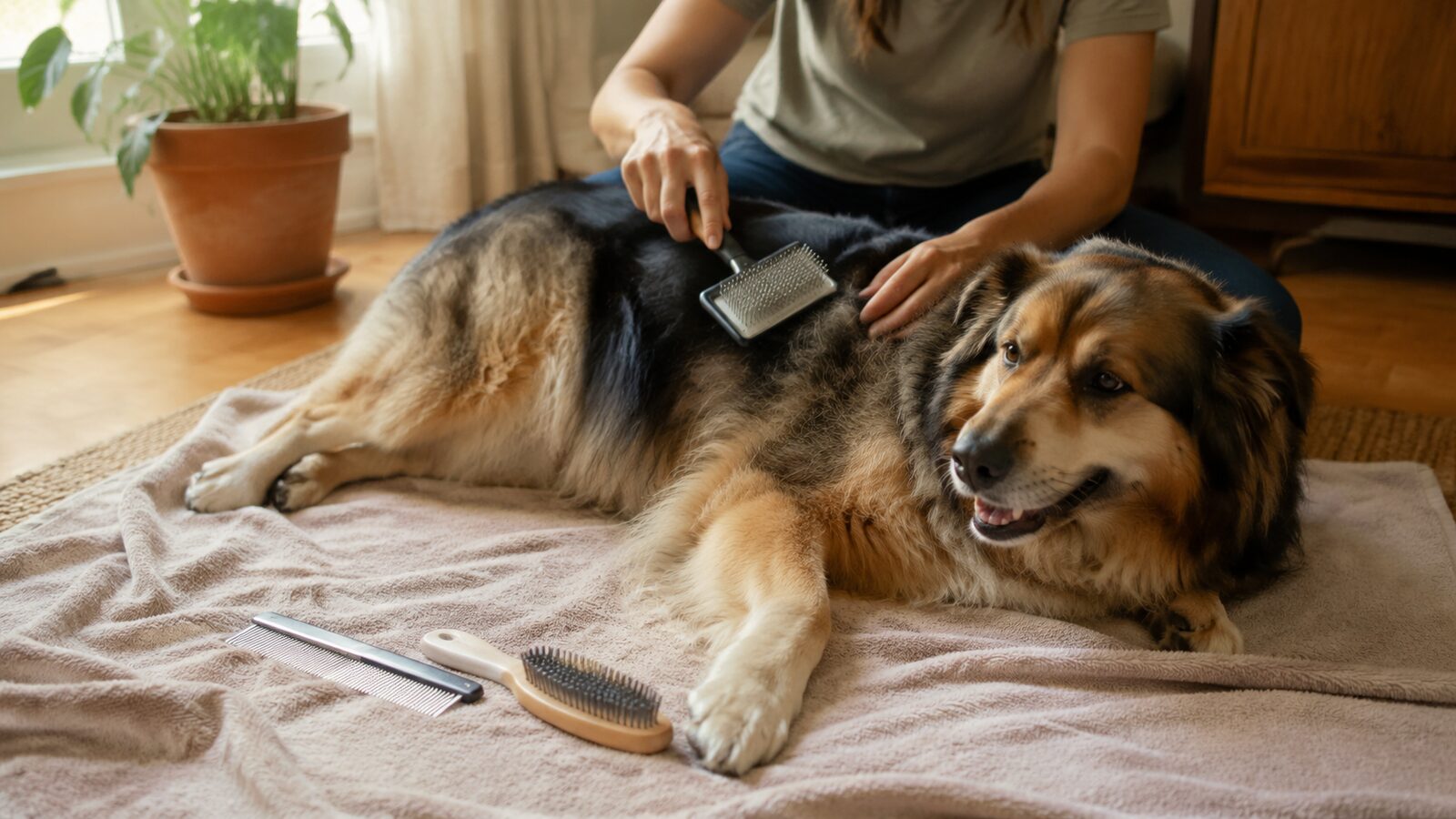
Match the routine to the coat. Smooth coats need a rubber curry now and then, double coats an undercoat rake and more work in moult, wire coats combing and dead hair removed, curly coats brushing right down to the skin or they mat, and long silky coats a comb through the feathering. Short, calm sessions beat long ones.
Most grooming advice starts with a shopping list. It is more useful to start with the coat in front of you, because a brush that suits one dog does nothing for another.
The other half of the job is your dog’s opinion of being handled. A dog who is comfortable having their paws held and ears looked at is easy to groom for life, and that comfort is built in small sessions.
Working out which coat you have
Run your fingers into the coat, down to the skin. You are asking two things: is there a soft dense layer under the top one, and does the hair keep growing or shed out at a set length?
Crossbreeds land anywhere on the map, sometimes with different coat types on different parts of the same dog. Treat the coat you can feel as the guide.
What each coat type actually needs
Smooth and short
Short, close coats look after themselves and still shed a surprising amount, in fine hairs that weave into fabric. A rubber curry or grooming mitt, worked in small circles once or twice a week, lifts dead hair and spreads the skin’s oils.
Many short-coated dogs also carry a dense undercoat and moult heavily for a few weeks each year, which is the time to brush most days, outdoors if you can.
Double coats
A double coat has a weather-resistant top layer over a soft dense undercoat, and sheds most heavily in seasonal moults. The tool that matters is an undercoat rake, with a slicker over the top for finish.
Work in sections and get to the skin, particularly on the trousers, tail base and behind the ears. In moult you may brush daily for a fortnight; the rest of the year, once or twice a week is plenty.
Clipping a healthy double coat is best discussed with a groomer or your vet first. Regrowth can be patchy or different in texture, and the coat does a job in both heat and cold.
Wire coats
A wire coat is harsh on top and sheds mud rather than holding it. It needs a metal comb through it weekly, plus a plan for the dead hair.
Hand-stripping removes dead coat by the roots when it is ready to release, keeping the texture and depth of colour. Clipping is quicker and suits many pet dogs, but the coat tends to soften and fade over time.
Neither is wrong. If you want the texture kept, find a groomer who strips, and tell them if your dog finds handling hard.
Curly and woolly
Curly and woolly coats keep growing, and shed hair stays in the coat rather than falling on the floor. That is why they mat, and why brushing only the surface is worse than useless: it hides a felted layer underneath.
Brush in sections, lifting the coat and working from the skin outwards with a slicker, then check every area with a metal comb. If the comb will not slide to the skin, that patch is not brushed.
Watch the friction points: behind the ears, the armpits, under the collar or harness, the back legs and the tail base. Most of these coats also need a professional clip on a cycle, and keeping to it is easier than rescuing a matted coat.
Long and silky
Long silky coats tangle where they move and rub: the feathering behind the legs, behind the ears and under a harness. A pin brush or soft slicker for the body and a metal comb for the fine areas covers most of it.
Work in layers rather than skimming the top, and never drag a brush through a dry knot. Tease it apart with your fingers, or a conditioning spray made for dogs.
Hairless and sparse coats
With little or no coat, the routine shifts from brushing to skin care: gentle cleaning, keeping the skin from drying out, and sensible protection from sun and cold.
Products are the part to be careful with. Ask your vet what is suitable rather than using anything made for people, and get any new lump or sore looked at.
The tools, in plain terms
- A slicker brush. Fine bent wires on a flat head, for curly, woolly and long coats. Light pressure only.
- An undercoat rake. Widely spaced teeth that pull dead undercoat from a double coat.
- A rubber curry or mitt. For smooth coats, and the easiest start for a dog who dislikes brushes.
- A metal comb. The honesty check for any coat that mats. If it passes to the skin everywhere, you are done.
- Nail clippers or a rotary grinder. Some dogs prefer one, some the other.
Dematting blades and scissors are sharp, and skin lifts more easily than people expect. If a mat needs cutting, that is a groomer’s job.
Teaching your dog to enjoy being handled
Handling is a skill you teach. Ask, do a little, and stop before your dog wants you to.
Touch an area, pause, and watch. A dog who leans in and comes back for more is saying yes. One who turns away, licks their lips or freezes is asking for a break, and giving it is what makes the next session easier.
Keep sessions to thirty seconds at first, paired with something they like. Brush one shoulder, feed, stop. Handle paws and ears on ordinary evenings, so the first time you hold a paw is not the day you need to cut a nail.
Nails
Nails are too long if they click on hard floors or push the toes out of line, and overgrown nails change how a dog stands and moves.
Inside each nail is a living quick, which grows longer as the nail does. Small trims weekly, rather than a big one monthly, keep the nail short and encourage the quick to sit further back.
On pale nails you can see the pink quick and stop short of it. On dark nails, take thin slices and look at the cut surface: a chalky pale circle means keep going, a small dark dot in the centre means stop. If you catch the quick, stay calm and press gently with a clean cloth. Your vet can supply a clotting powder.
Ears
Healthy ears look clean and smell of almost nothing. Once a week, lift the flap for a look and a sniff, and check your dog is comfortable being touched there.
Clean only what you can see, using a damp pad or a cleaner your vet recommends, and never push anything into the canal. Drop ears, hairy canals and swimming all mean checking more often.
Redness, an unusual smell, discharge, head shaking or a head tilt all mean a vet appointment rather than a home remedy. Whether ear hair should be plucked is also a question for your vet.
A routine that fits a real week
Little and often beats one heroic session, so build it into the week.
- Daily, two minutes. Hands over the whole dog while you sit together, checking paws, ears and friction points.
- Two or three times a week. A proper brush with the right tool, in sections, to the skin.
- Weekly. Nail check, ear look and sniff, a glance between the toes.
- Monthly. A bath if the dog is genuinely dirty, with a shampoo made for dogs, brushed out first.
- Every few weeks. A professional groom if the coat needs clipping.
Tonight, do one thing: sit down with a few pieces of food, hold a paw for two seconds, feed, let go. That is the whole session.
When to hand it to a professional
Some jobs are worth paying for, and none of it is a failure.
Matting. A mat tight to the skin cannot be brushed out kindly, the skin underneath can be sore, and pulling at it hurts. A groomer can clip it out safely in minutes.
Anxious or unhappy dogs. If your dog panics, snaps or shuts down when handled, stop rather than push on. A qualified behaviourist or accredited trainer, with a patient groomer, can rebuild it, and your vet should check that nothing hurts.
Anything near the eyes. Trimming hair around the eyes takes one flinch to go wrong, so leave it to a groomer or vet.
Ring your vet for sore or smelly ears, lumps, bald patches, hot or broken skin, a nail grown into the pad, or a dog who no longer wants to be touched where they used to enjoy it.
Frequently asked questions
How often should I brush my dog?
It depends on the coat. Smooth coats are fine with once or twice a week, double coats the same most of the year and daily in moult. Curly or woolly coats need brushing to the skin every day or two, because shed hair stays put and mats.
Can I shave my double-coated dog in summer?
Talk to a groomer or your vet first. Regrowth on a double coat can be patchy or change in texture, and the coat plays a part in managing heat as well as cold. For a dog who struggles in the warmth, removing dead undercoat and walking in cooler hours usually help more.
My dog hates having their nails done. What can I do?
Break it into much smaller pieces. Spend a week just touching a paw and feeding, then holding it, then touching clippers to a nail, then one nail a day, letting your dog move away whenever they want. If there is real fear, ask your vet or groomer.
How do I know if a coat is matted or just tangled?
A tangle lifts away from the skin and comes apart with fingers or a comb. A mat is felted, sits flat against the skin and will not let a comb through at the base. Tangles are a home job; mats belong with a groomer.
Do dogs need regular baths?
Most need far fewer than owners think. Bath when your dog is genuinely dirty, using a shampoo made for dogs, and brush the coat out first, because water turns loose tangles into solid mats. If the skin is itchy or sore, ask your vet first.
Read next
- Building Confidence in a Fearful or Rescue Dog
- Caring for a Senior Dog: What Changes, and What Helps
- How to Read a Dog Food Label Without Getting Fooled
- How Much Exercise Does Your Dog Actually Need?
More in Everyday Care.
A note on this article
This is general guidance on home grooming, written to help you build a routine your dog is comfortable with. It is not veterinary advice, and cannot tell you what is going on with a particular dog’s skin, ears or coat. Anything sore, smelly, swollen or changing is worth a word with your vet.