
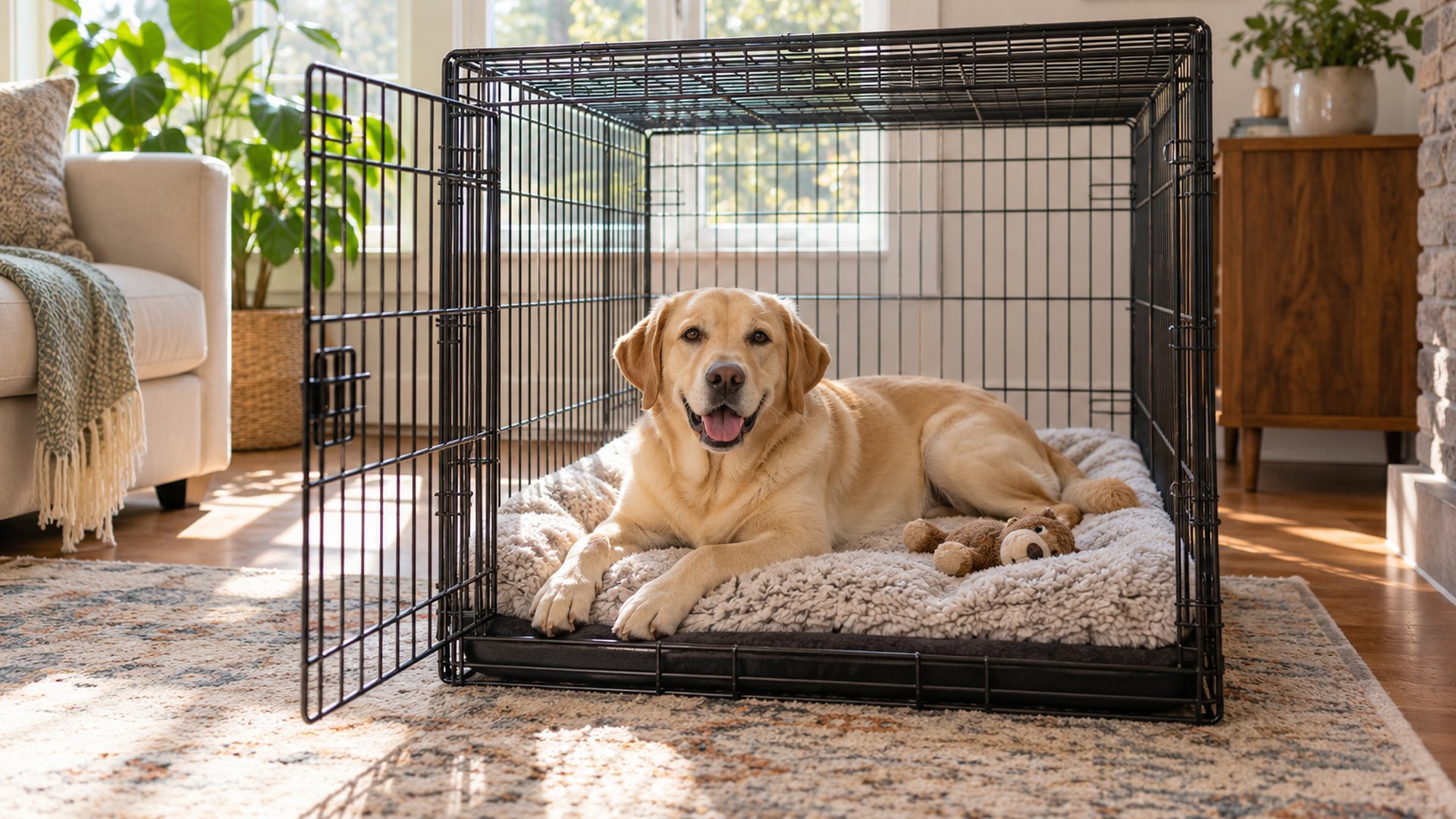
The right dog crate is big enough for your dog to stand at full height, turn around and lie stretched out, but not so big that a puppy can toilet at one end and sleep at the other. For most homes a wire crate with a divider is the most flexible choice, a rigid plastic crate suits travel, and a soft crate suits calm, already crate-trained dogs. Measure your dog (or estimate their adult size) before you buy, rather than relying on breed labels.
This article contains affiliate links. As an Amazon Associate I earn from qualifying purchases, at no extra cost to you. Affiliate disclosure.
This guide covers how to measure for a crate, how wire, plastic, soft, heavy-duty and furniture-style crates compare, what airline and car-safety standards actually mean, and how to set the crate up so it becomes a place your dog chooses to rest. For the training itself, step by step, see our guide to crate training without the guilt.
At a glance
- Size by measurement: length from nose to base of tail plus a little extra, and height from floor to top of head or ear tips plus a little extra.
- Buy for adult size, then divide: a crate with a divider panel grows with a puppy.
- Match the type to the job: wire for home, rigid plastic for flights, soft for calm travel, crash-tested for cars.
- Safety first: remove the collar (or use a breakaway) in the crate, and treat “indestructible” as marketing, not a promise.
- Keep time short: SPCA New Zealand suggests no more than about three hours in the day for a well-adjusted adult dog, with shorter stretches for puppies.
How to measure your dog for a crate
Crate sizes such as “medium” or “36 inch” vary between makers, so measure your dog, then compare against the internal dimensions of the crate, not the outside measurements.
- Length: with your dog standing, measure from the tip of the nose to the base of the tail (not the tip).
- Height: measure from the floor to the top of the head or the tips of upright ears, whichever is higher, while your dog stands or sits tall.
- Add room: add roughly 5 to 10 cm (2 to 4 inches) to each measurement for a home crate, so your dog can stand without ducking and lie fully stretched out.
- Check the width: your dog should be able to turn around comfortably.
- Reward the process: scatter a few treats while you measure so handling stays a pleasant experience.
Sizing a puppy crate
If you buy a crate that fits your puppy today, you will need another within months. A practical approach is to buy for the expected adult size (ask your breeder, rescue or vet for an estimate) and use a divider panel to shrink the space while your puppy is learning to toilet outside. Move the divider back as your puppy grows. Our house-training plan explains why a right-sized space helps with toilet training.
How the IATA travel-crate formula works
If you plan to fly with your dog in the hold, airlines generally follow the International Air Transport Association (IATA) Live Animals Regulations. IATA’s pet container guidance says the dog must be able to stand, sit upright, lie in a natural position and turn around, and offers a guide formula using four measurements:
| Measurement | What to measure | How it is used |
|---|---|---|
| A | Nose tip to base of tail | Internal length = A + half of B |
| B | Floor to elbow joint | Added (halved) to length |
| C | Width across the shoulders or widest point | Internal width = C x 2 for one dog |
| D | Floor to top of head or ear tip, whichever is higher | Internal height = D plus bedding |
IATA also says snub-nosed breeds need a container about 10% larger. The same formula is a useful sanity check for a home crate, even if you never fly.
Types of dog crate compared
| Crate type | Best for | Strengths | Drawbacks |
|---|---|---|---|
| Wire (metal mesh) | Home use, puppies, warm climates | Good airflow and visibility; often folds flat; many include a divider and removable tray | Can rattle; less den-like unless covered; not accepted alone for air travel |
| Rigid plastic (kennel style) | Air travel, dogs who like a cosy den | Enclosed and calming for many dogs; often designed with airline rules in mind | Less airflow; bulkier to store; check the specific airline’s rules |
| Soft-sided (fabric) | Calm, crate-trained dogs; short trips; holidays | Light and portable | Easily chewed or clawed through; not for anxious dogs or puppies; little protection in a car crash |
| Heavy-duty metal | Very large or strong dogs | Sturdy welded construction | Heavy and expensive; does not solve distress, which is the usual reason a dog breaks out |
| Furniture-style (wood or composite) | Living areas where looks matter | Doubles as a side table; blends into the room | Can be chewed; less ventilation; usually heavier and pricier |
| Crash-tested travel crate | Car travel | Independently tested to protect in a collision when secured correctly | Costs more; protection depends on using the exact tested set-up |
Who each type suits, and who it doesn’t
- Puppies and new rescue dogs: a wire crate with a divider, covered on three sides with a breathable cloth if your dog likes a den. Avoid soft crates until your dog is settled.
- Large breeds: check the internal height carefully; many “large dog crates” are too low for tall breeds that carry their heads high.
- Escape artists: before buying a heavier crate, look at why your dog is trying to escape. Panic in confinement is a welfare issue, not a strength issue (more on this below).
- Frequent flyers: a rigid plastic crate that meets IATA container guidance and your airline’s own rules.
- Car travellers: a crash-tested crate or harness, properly anchored. Our dog car safety guide explains the options.
Car and air travel standards: what they really mean
Car crates and crash testing
In the United States there is no compulsory crash-test standard for pet crates. The Center for Pet Safety, a non-profit organisation, crash tests crates and carriers using test dummies rather than live animals, and certifies those that perform best. Certification applies only to the specific model, size and set-up tested, including the anchor straps used, so a certified crate secured differently or modified with untested add-ons may not perform the same way. Certifications can change, so check the Center for Pet Safety’s current list before buying. Most crates sold for home use have not been crash tested at all.
Airline crates
For flights, the key points of IATA’s pet container guidance include:
- Allowed materials include rigid plastic, fibreglass, metal, welded mesh and solid wood; crates made entirely of wire mesh are not allowed.
- Ventilation on all four sides, with openings small enough that noses and paws cannot poke through.
- A secure door with metal hinges and pins on plastic crates; wheels removed or disabled.
- A water container fixed inside that can be filled from outside without opening the door.
- “Live Animals” and “This Way Up” labels.
Airlines can add their own rules and breed restrictions, so always check with the specific airline before you buy.
Why “indestructible” claims are worth questioning
“Indestructible dog crate” is a common search, and some products are marketed that way. No crate can be guaranteed against every dog, and a determined, panicking dog can injure teeth, nails or paws trying to escape a stronger crate. If your dog chews bars, drools heavily, scratches at the door or tries to break out, that usually signals distress rather than naughtiness. Common causes include not enough gradual crate training, too much time confined, or separation-related anxiety. See our guides to signs of stress in dogs and separation anxiety, and talk to your vet or a qualified reward-based trainer. Choosing a sturdy, well-made crate is sensible; relying on it to contain a distressed dog is not.
How to set up a dog crate: step-by-step checklist
- Choose the spot. Put the crate where the family spends time, such as the living area, away from direct sun, heaters and draughts. A second spot near the bedroom can help a puppy at night.
- Remove the collar. Collars and tags can catch on wire or bars. Take the collar off in the crate or use a breakaway collar.
- Add comfortable bedding. A soft blanket or washable bed. For puppies who shred bedding, use a firm mat and supervise.
- Offer water. For longer stays, provide water in a spill-resistant bowl or one that clips to the side.
- Add a safe chew or food toy. Pick items sized and textured for your dog; see how to choose safe dog chews.
- Cover if your dog likes it. A breathable cover over part of a wire crate can feel den-like. Leave the front open and keep airflow clear.
- Leave the door open at first. Let your dog explore, and drop treats inside every time they go in by choice.
- Build duration slowly. Follow a gradual plan; the crate training guide linked above has the full steps, and teaching a dog to settle on a mat builds the same calm habit.
How long can a dog stay in a crate?
SPCA New Zealand advises that a well-trained adult dog who sees the crate as a safe space can cope with about three hours during the day, and should not be left longer than that, and that puppies under six months should have no more than two to three hours without a toilet and play break. Overnight sleep is different for many dogs, but puppies will still need toilet breaks. Exercise, play and enrichment before crate time make settling far easier.
Our picks on Amazon: dog crates
Two popular wire crates with divider panels, so the space can grow with a puppy. Use the sizing steps above to pick the right size.
- MidWest iCrate Double Door Folding Crate: a long-standing favourite with two doors, a divider panel and a removable tray.
- Amazon Basics Collapsible Metal Wire Crate: a budget-friendly folding crate with a removable tray.
Prices and availability change. Check sizing against your own dog’s measurements and always supervise with new toys or equipment.
Common mistakes
- Buying too small. If your dog has to duck or curl tightly, the crate is too small.
- Buying far too big for a puppy without a divider. Extra space can encourage toileting in one corner.
- Using outside dimensions. Always check internal measurements.
- Leaving the collar on. Tags and buckles can catch.
- Using the crate as punishment. The crate should always mean something pleasant; sending a dog there in anger undoes training.
- Crating for too long. Long, regular stretches lead to frustration and distress.
- Trusting a soft crate with a chewer. Fabric crates suit calm dogs only.
- Assuming any crate is car-safe. Only crash-tested crates, secured as tested, have evidence behind them.
Crate buying checklist
- Internal height clears the top of the head or ear tips with room to spare.
- Internal length allows lying fully stretched out.
- Divider included or available, if for a puppy.
- Smooth welds, no sharp edges, gaps too small for paws or jaws to get stuck.
- Secure latch your dog cannot nudge open.
- Removable, easy-clean tray.
- For flights: matches IATA container guidance and your airline’s rules.
- For cars: on the current Center for Pet Safety certified list, with the correct straps.
- Fits through your doors and into your car boot, if you will move it.
Our puppy essentials checklist covers the other gear worth buying at the same time.
Sources this guide draws on: the International Air Transport Association (IATA) pet container requirements under the Live Animals Regulations; the Center for Pet Safety crate and carrier certification programme, as described in published travel-safety guides; and SPCA New Zealand’s advice on crate training and crate time limits.
Frequently asked questions
What size crate does my dog need?
Measure from nose to base of tail and from floor to the top of the head or ear tips, then add roughly 5 to 10 cm (2 to 4 inches) to each. Compare those numbers with the crate’s internal dimensions. Your dog should stand, turn and lie stretched out comfortably.
Is a wire or plastic crate better?
Wire crates are usually better for home use because they offer airflow, visibility and dividers for puppies. Rigid plastic crates feel more den-like and are the usual choice for air travel. Many owners use a wire crate at home and a plastic or crash-tested crate for travel.
Should I put a puppy crate in my bedroom?
Many puppies settle faster at night when they can hear and smell their people, and you will also hear when they need a toilet break. You can move the crate gradually to its daytime spot once your puppy settles well.
Is a dog crate cruel?
A crate introduced gradually, kept comfortable and used for short periods can become a calm, safe resting place. It becomes a welfare problem when used for long hours, as punishment or for a dog who is distressed inside it. Watch your dog’s body language and adjust.
Can I use a dog cage or kennel outside?
An indoor crate is not designed for outdoor living, weather or heat. Dogs left outdoors need proper shelter, shade, water and company. If your dog must be outside for a time, use a secure, weatherproof area designed for the purpose and keep the time short.
Do I need a crash-tested crate for the car?
A crash-tested crate, secured exactly as tested, is one of the better-evidenced ways to protect a dog in a collision. A home crate that has not been tested may not protect your dog, and could break or move in a crash. Check local laws on restraining pets in vehicles too.
A well-chosen crate is a comfortable den at home and a safer way to travel. Measure first, match the type to how you will use it, and build a happy association with plenty of rewards.