
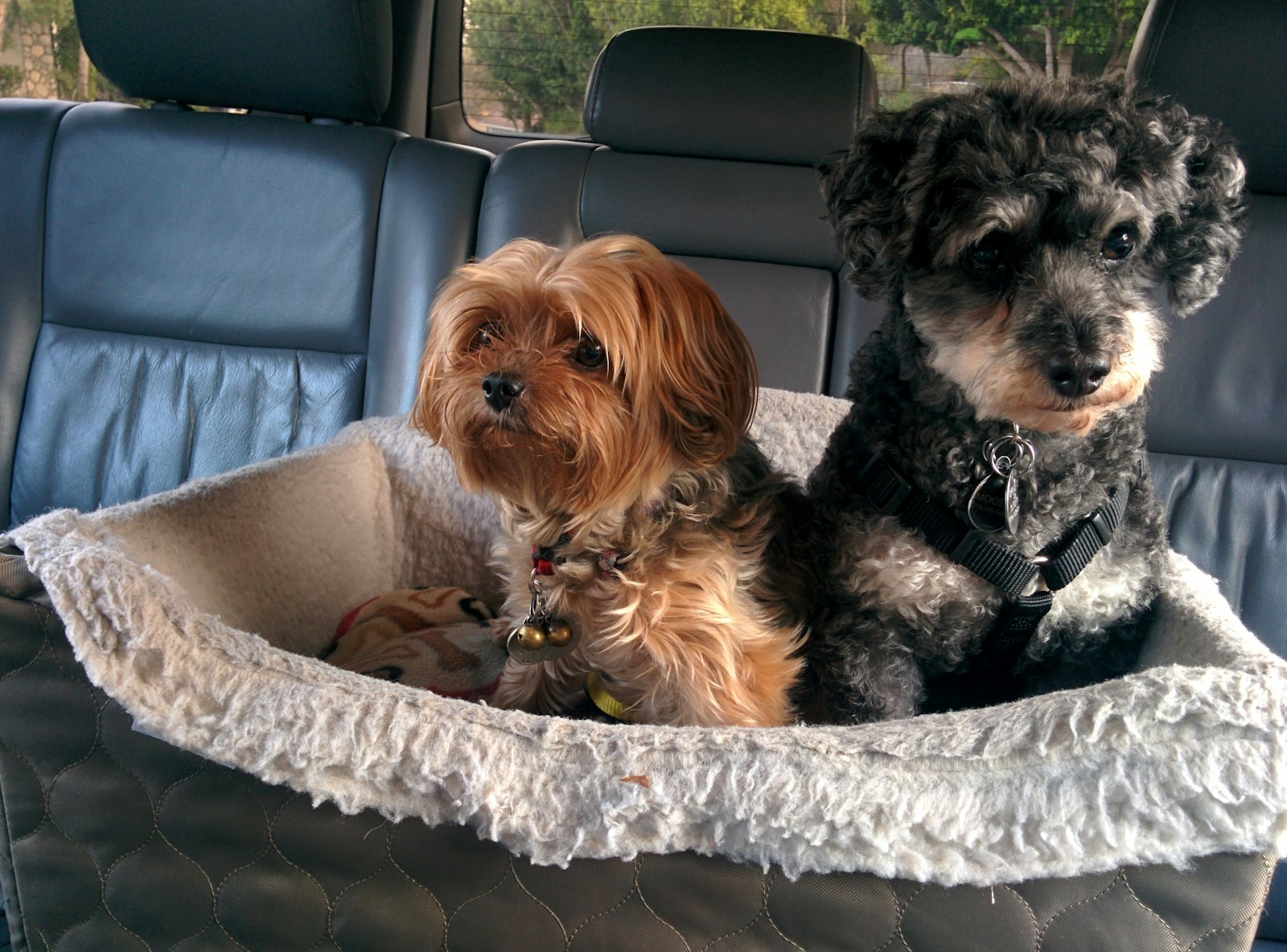
The safest way for a dog to travel in a car is secured in the back, either in a crash-tested harness clipped to the seatbelt system or in a properly anchored travel crate, never loose and never on a lap or in front of an airbag. Pair that with a dog who has learned the car is calm and boring, and a few checks before every trip. And never leave a dog in a parked car on a warm day, even with the windows open.
This guide compares the restraint options and what each one suits, explains how road rules differ around the world, gives a step-by-step plan for teaching a nervous or car-sick dog to travel calmly, and covers the pre-trip checks and emergency kit that make the difference when a journey goes wrong.
At a glance
- Secure every dog, every trip. An unrestrained dog becomes a projectile in a sudden stop and a distraction the rest of the time.
- Back seat or rear load area only. Front airbags can seriously injure a dog.
- “Crash-tested” matters. A walking harness clipped to a seatbelt is not a car restraint. Never attach a restraint to a collar.
- Teach the car before you need it. Short, rewarding practice trips prevent most travel stress.
- Parked cars heat up fast. Most of the rise happens in the first half hour, and a cracked window makes little difference.
Why restraint matters, even for a calm dog
There are two separate risks. The first is physics. In a sudden stop or collision, an unsecured dog keeps moving at the speed the car was travelling and can hit seats, windows or people with great force. Good behaviour does not help, because no dog can brace for a crash it cannot see coming. A loose dog can also be injured escaping onto the road afterwards, or stop rescuers reaching people in the car.
The second risk is distraction. A dog climbing into your lap, moving between the seats or barking at a window takes your attention off the road at exactly the wrong moment. Restraint protects you, your passengers and other road users as well as your dog.
What the rules say: it depends where you live
Road rules about animals in cars vary widely, so check your local rules rather than assuming. A few examples show the range:
- United Kingdom: Rule 57 of the Highway Code says dogs and other animals should be suitably restrained so they cannot distract the driver or injure anyone, themselves included, if the car stops quickly. It names a seat belt harness, pet carrier, dog cage or dog guard as ways to do this. Rule 57 is guidance rather than a law in itself, but the Highway Code can be used in evidence in court to establish liability, a driver distracted by an unrestrained animal could face a careless driving charge, and some insurers may look at how a pet was travelling.
- Australia: The road rules make it an offence to drive with an animal on your lap, and some states have additional animal welfare rules, such as for dogs on the back of utes.
- United States and Canada: Rules vary by state and province. A small number cover restraint or dogs in open truck beds, and many US states have laws about leaving animals in hot vehicles.
Whatever the local law, the safety case for restraint is the same everywhere.
Restraint options compared
| Option | Best for | Strengths | Watch out for |
|---|---|---|---|
| Crash-tested car harness | Most dogs, especially medium and large dogs on the back seat | Spreads load across the chest; fits most cars; takes no extra space | Must be crash-tested as a full system including the tether, and fitted snugly |
| Anchored travel crate | Dogs already happy in a crate; larger dogs; multiple dogs; estate cars and SUVs | Contains the dog fully; gives a familiar den to settle in | Must be strapped or fixed down; a loose crate becomes a projectile; size it so the dog can sit, stand and turn but not be thrown about |
| Soft carrier | Small dogs and short trips | Light and portable | Offers limited crash protection; secure it with the seatbelt or on the floor behind a front seat |
| Booster seat | Small dogs who like to see out | Raises the dog to window height, which settles some dogs | Needs a short internal tether to a harness and must be anchored by the seatbelt |
| Boot barrier or dog guard | Estate cars and SUVs, alongside a crate | Stops the dog coming forward into the cabin | Does not stop the dog being thrown around the boot; protects the driver more than the dog |
In the United States, the non-profit Center for Pet Safety crash-tests pet harnesses, crates and carriers, and its published results are a useful reference wherever you live. Many products marketed as “tested” have only been tested for strength, not in a crash, so look for clear, independent crash-test claims.
Getting the fit right
A car harness should sit snugly, with room for about two fingers under the straps, and the tether should be short enough that your dog can sit and lie down but cannot reach the front seats or fall into the footwell. If you already use a walking harness, our guide to front-clip and back-clip harnesses explains why most walking harnesses are not built for crash forces.
What to avoid
- Attaching any restraint to a collar: in a sudden stop the load goes through the neck.
- Long tethers that let a dog reach the front seats, hang out of a window or fall off the seat.
- Mixing parts from different brands, which creates a system that has never been tested together.
- The front passenger seat, because of airbags. If there is no alternative, check your car’s manual about disabling the airbag and move the seat fully back.
- Dogs travelling loose in the open back of a utility vehicle or pickup.
Teaching your dog to love the car: step by step
A dog who finds the car frightening behaves unpredictably in it, so this is safety work, not a nicety. Go at your dog’s pace and use treats, meals and toys to make every step pleasant. If you are crate-training for the car, do the groundwork at home first using our guide to crate training without the guilt.
- Make the parked car good news. With the engine off, sit near or in the car with your dog and feed treats or a meal. Stop before your dog wants to leave.
- Add the restraint. Clip in the harness or close the crate briefly, reward, then release. Build up to a few minutes.
- Add the engine. Start the engine, reward calm behaviour, switch it off. Repeat over several sessions.
- Take tiny trips. Drive to the end of the street and back. Then around the block.
- End somewhere fun. Drive to a park, a sniff walk or a friend’s house, not only to the vet or groomer.
- Build duration slowly. Increase the length of trips gradually, keeping a routine of a toilet stop and the same set-up each time.
- Back up if needed. Drooling, panting, whining, trembling or trying to escape mean you have moved too fast. Return to the last easy step.
Learn the early signs of discomfort with our guide to the hidden signs of stress in dogs.
Car sickness or travel anxiety?
Car sickness is common, especially in puppies, and many dogs improve as they grow. Signs include drooling, licking lips, yawning and vomiting. Helpful steps include a light meal a few hours before travel rather than just before, a forward-facing position, fresh air, a smooth driving style and frequent short practice trips. Travel anxiety looks similar but is driven by fear, and the dog may be distressed before the engine even starts.
If your dog drools heavily, vomits or panics in the car, talk to your vet. Vets can prescribe medicines for travel sickness or anxiety and will advise on what suits your dog. Never give human travel tablets or sedatives without veterinary advice; some are dangerous for dogs, and sedation can affect how a dog copes with heat and stress.
Pre-trip checklist
- Restraint fitted and tightened, crate strapped down, barrier secure
- Toilet break and a short walk before setting off
- Windows open only a little, never wide enough for a head; wind-borne grit can injure eyes and a leaning dog can fall
- Loose items cleared or stowed, as they can become projectiles
- Comfortable cabin temperature and air flowing to the back of the car
- Water and a bowl; offer it at stops rather than while moving
- Lead, poo bags and a towel within reach
- ID tag on, microchip details up to date
Never leave a dog in a parked car on a warm day
A parked car acts like a greenhouse. Research on parked cars (McLaren and colleagues, published in Pediatrics in 2005) found the temperature inside rose quickly even on mild days, with most of the increase in the first 30 minutes, and that leaving windows slightly open made little difference. Dogs cool themselves mainly by panting, which works poorly in hot, still air. Flat-faced breeds, overweight dogs, puppies, seniors and dogs with heart or breathing problems are at higher risk.
Signs of heatstroke include heavy panting, drooling, bright red or pale gums, weakness, wobbliness, vomiting and collapse. Heatstroke is an emergency: move the dog somewhere cool, wet them with cool (not iced) water, and go to a vet straight away. On hot days, plan stops where your dog can come with you, or leave them at home. Hot ground is a risk at rest stops too; see our guide to judging hot walking surfaces.
Preparing for the trip that goes wrong
A breakdown or collision is when a frightened dog is most likely to bolt. Preparation takes one afternoon.
- Keep identification current. A microchip only works if the registered details are correct. A collar tag can be read by anyone. Our guide to GPS trackers versus microchips explains what each can and cannot do.
- Keep a spare lead where you can reach it from the driver’s seat, and clip it on before opening any door after an incident.
- Know where the nearest emergency vet is on your route, and save your own vet’s number.
- Carry a basic first aid kit: bandage, sterile gauze, wound wash and a towel, for keeping a dog stable on the way to a vet.
- Keep a recent photo on your phone in case your dog goes missing.
If something happens on the road, our guide on when to call the vet lists the signs that always need urgent attention, even if your dog seems fine.
Longer journeys
Stop every two to three hours somewhere your dog can walk, sniff and toilet safely on a lead. Keep meals close to the usual times but lighter than normal on travel days. Bring a familiar bed or blanket, because a known smell helps dogs settle. Allow far more time than you think you need. If the trip is long and your dog travels badly, it may be kinder to leave them in good care; our guide to choosing a boarding kennel or pet sitter can help.
Common mistakes
- Trusting a calm dog to stay put. Behaviour does not protect against a sudden stop.
- Using a walking harness or collar as a car restraint.
- Letting the dog ride in the front or with their head out of the window.
- Leaving a crate unsecured in the boot.
- Only driving to the vet, so the car always predicts something unpleasant.
- “Just five minutes” in a parked car on a warm day.
- Medicating without your vet’s advice.
- Opening the door before clipping on a lead, especially at roadside stops.
Sources this guide draws on: The Highway Code (UK), Rule 57; Australian Road Rules on driving with an animal; Center for Pet Safety crash-test programme; McLaren, Null and Quinn, “Heat stress from enclosed vehicles: moderate ambient temperatures cause significant temperature rise in enclosed vehicles”, Pediatrics (2005); RSPCA and American Veterinary Medical Association owner advice on pets in vehicles and heatstroke.
Handy gear for this guide
Practical picks we think suit this topic. As an Amazon Associate, Mind A Dog earns from qualifying purchases, at no extra cost to you. Prices and availability are set by Amazon and may vary by country.
- EVERLIT Pet First Aid Kit (95 Pieces)
Bandages, gauze and basics in one bag for home, car or hikes while you contact your vet.
View on Amazon - Hepper Bio-Enzyme Pet Stain and Odour Spray
Enzyme cleaner for accidents on carpets, floors and bedding.
View on Amazon - Portable Dog Water Bottle with Food Container
Fresh water and a snack on walks and car trips.
View on Amazon
Frequently asked questions
Where is the safest place for a dog in a car?
The back seat with a crash-tested harness, or a properly anchored crate in the rear load area. Avoid the front passenger seat because of airbags, and never let a dog travel loose or on someone’s lap.
Is it illegal to have a dog unrestrained in the car?
It depends where you live. In the UK, the Highway Code says dogs should be suitably restrained, and driving with an animal on your lap is an offence under Australian road rules. Elsewhere, rules vary by state, province or country, so check locally.
Can a dog travel in the boot of a car?
In an estate car or SUV, a well-ventilated rear load area can work well if the dog is in a crate that is strapped down, ideally with a dog guard as well. Never put a dog in the enclosed boot of a saloon or sedan.
How can I stop my dog getting car sick?
Give a light meal a few hours before travel, keep air flowing, face your dog forward, drive smoothly and build up with short, pleasant practice trips. If sickness continues, ask your vet, who can prescribe suitable medication.
How long can a dog stay in a car on a road trip?
Plan a break every two to three hours for a walk, water and a toilet stop, more often for puppies, seniors and dogs who travel badly. Never leave your dog alone in the parked car during stops on warm days.
Car safety comes down to a few habits done the same way every time: secure your dog in the back, teach the car as a calm place, check before you drive and never leave them in a warm parked car. Decide once that this is how you travel, and every trip gets easier.