
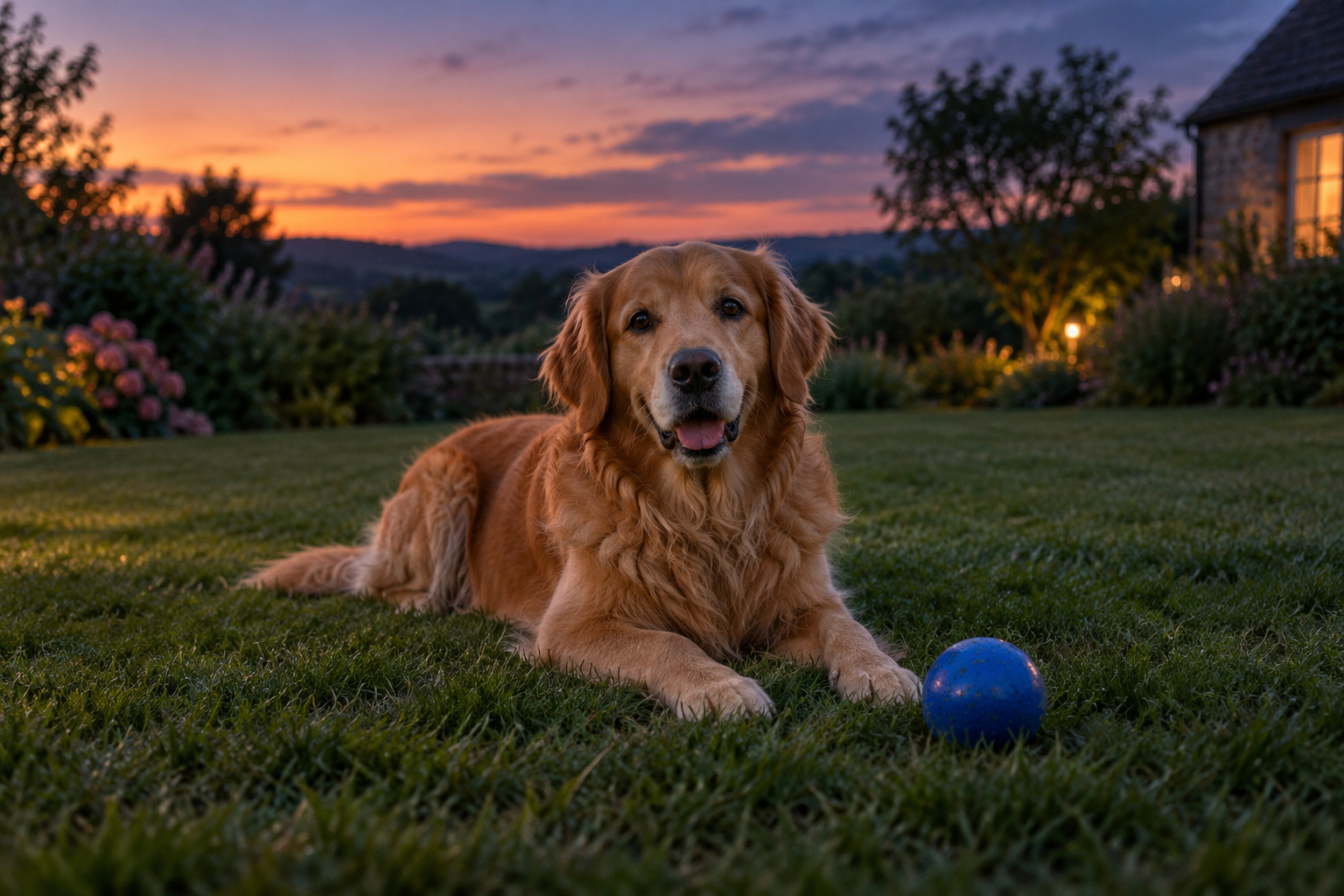
Dogs can see much better than people in dim light, but they can’t see in complete darkness. Their eyes are packed with light-sensitive rod cells and have a mirror-like layer called the tapetum lucidum that bounces light back through the retina, which is why their eyes shine in torchlight. The trade-off is that dogs see less fine detail and fewer colours than we do.
This guide explains how dog vision works in plain language: night vision, colour vision, motion and detail, and what your dog’s world probably looks like. It ends with practical takeaways, from choosing toy colours your dog can actually spot to keeping night walks safe and recognising signs of vision loss that need a vet check.
At a glance
- Dogs see well in low light thanks to a rod-rich retina and the reflective tapetum lucidum, but they still need some light to see.
- Dogs aren’t colour blind in the black-and-white sense. They have two types of colour cone, so they see mostly blues and yellows and struggle to separate red, orange and green.
- Their vision is blurrier than ours; one commonly cited estimate puts it at about 20/75 compared with a typical human 20/20.
- Dogs are tuned to spot movement and have a wider field of view than people.
- Bumping into things, hesitating on stairs at night or cloudy, red or painful eyes are reasons to see your vet.
Can dogs see in the dark better than humans?
Yes, in dim light, though not in total darkness. Two features of the dog’s eye make the difference.
A retina built for low light
The retina contains two main kinds of light-sensing cell. Rods work in dim light and detect movement but don’t see colour; cones work in brighter light and handle colour and fine detail. A review of animal vision in Cataract and Refractive Surgery Today notes that rods are the main type of photoreceptor in dogs’ eyes, and that cones make up only a small fraction. More rods means more sensitivity when light is low.
The tapetum lucidum: a built-in reflector
Behind the retina, most dogs have a reflective layer called the tapetum lucidum. Light that passes through the retina without being absorbed hits this layer and bounces back, giving the rods a second chance to catch it. Veterinary ophthalmologist Ron Ofri, writing in proceedings from the World Small Animal Veterinary Association congress, describes this as roughly doubling the chance that light is absorbed. It’s also why dogs’ eyes glow green, yellow or blue in car headlights or a camera flash. The downside is a little extra blur in bright light, because reflected light scatters.
Together, these features let dogs move confidently at dusk, at dawn and on moonlit nights, when people struggle.
Why total darkness is different
Every eye needs some light to work, and the tapetum can only reflect light that’s already there. In a pitch-black room, a dog relies on their nose, ears and memory of the space rather than their eyes. That’s why most dogs move easily around a familiar house at night but may hesitate in an unfamiliar, very dark place.
Are dogs colour blind?
Not in the way the old myth suggests. Dogs don’t see in black and white. They have colour vision, but it’s simpler than ours.
Humans with typical colour vision have three types of cone (trichromatic vision). Dogs have two (dichromatic vision). Research by Neitz and colleagues, published in 1989, showed that dogs have two cone types, one most sensitive to blue-violet light and one to yellow-green light. A Kennel Club annex on colour vision in the dog explains that this gives dogs a colour world similar to the human blue-yellow system, and notes that dogs may find it hard to tell apart colours we see as green, orange or red. Dogs also have far fewer cones than people, so colours probably look less vivid to them.
A rough idea of how common colours might look to a dog:
| Colour to a human | How a dog probably sees it | How easy it is to spot on grass |
|---|---|---|
| Blue | Blue | Easy: stands out well |
| Purple or violet | Bluish | Fairly easy |
| Yellow | Yellow | Easy, especially on darker grass |
| Green | Yellowish or greyish | Hard: blends with the lawn |
| Orange | Yellowish or brownish | Hard on green grass |
| Red | Dark yellowish-brown or greyish | Hard: often looks dull |
| White and black | White and black | Depends on contrast with the background |
These are simulations based on the cone research, not a dog’s own report, so treat them as a helpful approximation rather than an exact picture.
Detail, motion and field of view
Detail: blurrier than ours
Dogs don’t see fine detail as sharply as people. Dr Ofri’s WSAVA proceedings report a canine visual acuity of about 20/75, against 20/20 for typical human vision, while noting that results vary with how acuity is tested. In everyday terms, something a person could make out clearly at 75 feet might need to be about 20 feet away before a dog sees it with the same sharpness. That’s one reason dogs sometimes bark at a familiar person in the distance until they catch their scent or hear their voice.
Motion: a strong point
Rod-rich eyes are good at picking up movement, and veterinary vision reviews suggest dogs are generally better than people at detecting motion and seeing in low contrast. A dog may ignore a still squirrel but spot it the instant it twitches. Dr Ofri also reports that dog cones respond to flicker at higher rates than human cones, which means older screens that flicker may look different to dogs than to us.
Field of view: wider, with less depth overlap
Because most dogs’ eyes sit further towards the sides of the head, they see a wider panorama. The CRST review, citing Miller and Murphy’s 1995 paper “Vision in dogs” in the Journal of the American Veterinary Medical Association, gives most dogs a visual field of about 240 degrees, compared with about 200 degrees for people, but with a smaller area of overlap between the two eyes. Overlap helps judge depth, so dogs may be less precise than us at judging exactly how far away something close is. Field of view varies with head shape, so flat-faced and long-nosed breeds will differ.
Dog vision vs human vision: a side-by-side
| Feature | Dogs | Humans |
|---|---|---|
| Dim-light vision | Better, thanks to more rods and the tapetum lucidum | Weaker |
| Total darkness | Can’t see; rely on smell and hearing | Can’t see |
| Colour | Two cone types: mainly blues and yellows | Three cone types: blues, greens and reds |
| Sharpness | Lower; about 20/75 by one estimate | About 20/20 in typical vision |
| Motion detection | Very good | Good |
| Field of view | About 240 degrees in most dogs | About 200 degrees |
| Eye shine | Yes, from the tapetum | No tapetum |
What this means for everyday life with your dog
Choose toys your dog can actually see
A red or orange ball on green grass is easy for you to see and much harder for your dog, which may be why some dogs run straight past a thrown toy and then find it by sniffing. Blue and yellow toys usually stand out better outdoors. For more on picking toys by size, safety and play style, see how to choose the right dog toy.
Use their nose as well as their eyes
Dogs build their picture of the world mostly through smell, with sight filling in. Scent games are a great way to play with a dog in the evening or with a dog whose eyesight is fading; scent work at home shows you how to start.
Help your dog read you
Because dogs are so good at motion, big, clear hand signals and body movements are often easier for them to follow than small facial expressions, especially at a distance. In turn, learning how to read dog body language helps you understand what they’re seeing and reacting to.
Night walks: be seen
Your dog may see better than you at dusk, but drivers and cyclists won’t see your dog. A simple night-walk checklist:
- Use a reflective or light-up collar, harness or lead, and a reflective layer or torch for yourself.
- Keep your dog on a lead near roads, even if their recall is good; unseen wildlife can trigger a sudden chase.
- Stick to familiar, well-lit routes where you can see the ground for hazards such as glass.
- Carry a torch so you can check what your dog has picked up or sniffed.
- Take extra care with older dogs and dogs with eye problems, who may be less confident in the dark.
Does my dog need a light on at night?
Most healthy dogs don’t need a light on at night in a familiar home; their low-light vision, nose and memory of the layout are usually enough. A dim night light can help some older dogs, dogs with failing eyesight, or dogs who seem unsettled or confused at night. If your senior dog is suddenly restless or disoriented after dark, mention it to your vet, because night-time confusion can also be a sign of canine cognitive decline, covered in dog dementia signs.
Signs of vision problems that need a vet
Dogs adapt so well, using smell and hearing, that vision loss often goes unnoticed until it’s quite advanced. Book a vet check if you notice:
- bumping into furniture or doorframes, especially in dim light or a new place
- reluctance to go up or down stairs, jump onto furniture or go out at night
- startling easily when approached or touched
- misjudging thrown toys or treats they used to catch
- cloudiness, a bluish or white haze, or a change in the colour of the eye
- pupils that look unusually large or different sizes
Go to your vet the same day if your dog has a red, painful or swollen eye, is squinting or holding an eye shut, has a lot of discharge, an eye that looks bigger than normal, or seems to have lost their sight suddenly. Some eye conditions can damage sight quickly, so speed matters. If you’re unsure how urgent it is, how to know when to call the vet can help. Changes to the third eyelid, such as a red lump in the inner corner, are covered in cherry eye in dogs.
A slight bluish-grey haze in an older dog’s eyes is often a normal ageing change in the lens, but it can look similar to a cataract, so let your vet check which it is. How to care for a senior dog covers other age-related changes.
For puppies, vision develops over the first weeks of life; when do puppies open their eyes explains the timeline.
Common mistakes
- Believing dogs see in black and white. They see colour, just a narrower range than us.
- Buying red or orange toys for fetch on grass. They’re bright to us and dull to many dogs. Blue or yellow is usually easier for dogs.
- Assuming good night vision means total-dark vision. No animal can see without any light at all.
- Relying on your dog to be seen at night. Their eyes help them see, not drivers see them.
- Dismissing cloudy eyes as “just old age”. Some causes are harmless, others aren’t. Let your vet decide.
- Rearranging furniture for a dog with poor sight. Dogs with failing vision rely on a familiar layout, so keep it consistent where you can.
Sources this guide draws on: Neitz, Geist and Jacobs (1989) on colour vision in the dog; Miller and Murphy (1995), “Vision in dogs”, Journal of the American Veterinary Medical Association; Ron Ofri, “Vision in the Animal Kingdom”, WSAVA World Congress proceedings; the Kennel Club annex on colour vision in the dog; a review of animal vision in Cataract and Refractive Surgery Today.
Handy gear for this guide
Practical picks we think suit this topic. As an Amazon Associate, Mind A Dog earns from qualifying purchases, at no extra cost to you. Prices and availability are set by Amazon and may vary by country.
- EVERLIT Pet First Aid Kit (95 Pieces)
Bandages, gauze and basics in one bag for home, car or hikes while you contact your vet.
View on Amazon - Hepper Bio-Enzyme Pet Stain and Odour Spray
Enzyme cleaner for accidents on carpets, floors and bedding.
View on Amazon - Portable Dog Water Bottle with Food Container
Fresh water and a snack on walks and car trips.
View on Amazon
Frequently asked questions
Can dogs see well in the dark?
Dogs see well in dim light, such as at dusk or by moonlight, much better than people. In complete darkness they can’t see, and instead rely on their excellent sense of smell, their hearing and their memory of familiar places.
What colours can dogs see?
Dogs see mainly blues and yellows, plus shades of grey. They have trouble telling red, orange and green apart, which may all look like muddy yellows or browns to them.
Why do dogs’ eyes glow in the dark?
The glow comes from the tapetum lucidum, a reflective layer behind the retina that bounces light back through the eye to improve night vision. When a torch, headlights or a camera flash shines into the eye, some of that light reflects back, making the eyes shine.
What is a dog’s eyesight like compared with ours?
Dogs see less detail and fewer colours than people, but they’re better at seeing in dim light, noticing movement and taking in a wide field of view. One commonly cited estimate puts their sharpness at about 20/75 compared with 20/20 for typical human vision.
How can I tell if my dog is losing their sight?
Watch for bumping into things, hesitating on stairs or in the dark, startling when touched, or cloudy or changed-looking eyes. If you notice any of these, book a vet check, and go the same day if an eye looks red, painful or swollen or your dog seems to have lost their sight suddenly.
Your dog’s world is softer in focus and narrower in colour than yours, but richer in movement and in dim-light detail, and full of scent you’ll never notice. Choose toys they can see, keep them visible on night walks, and keep an eye on their eyes as they age.