
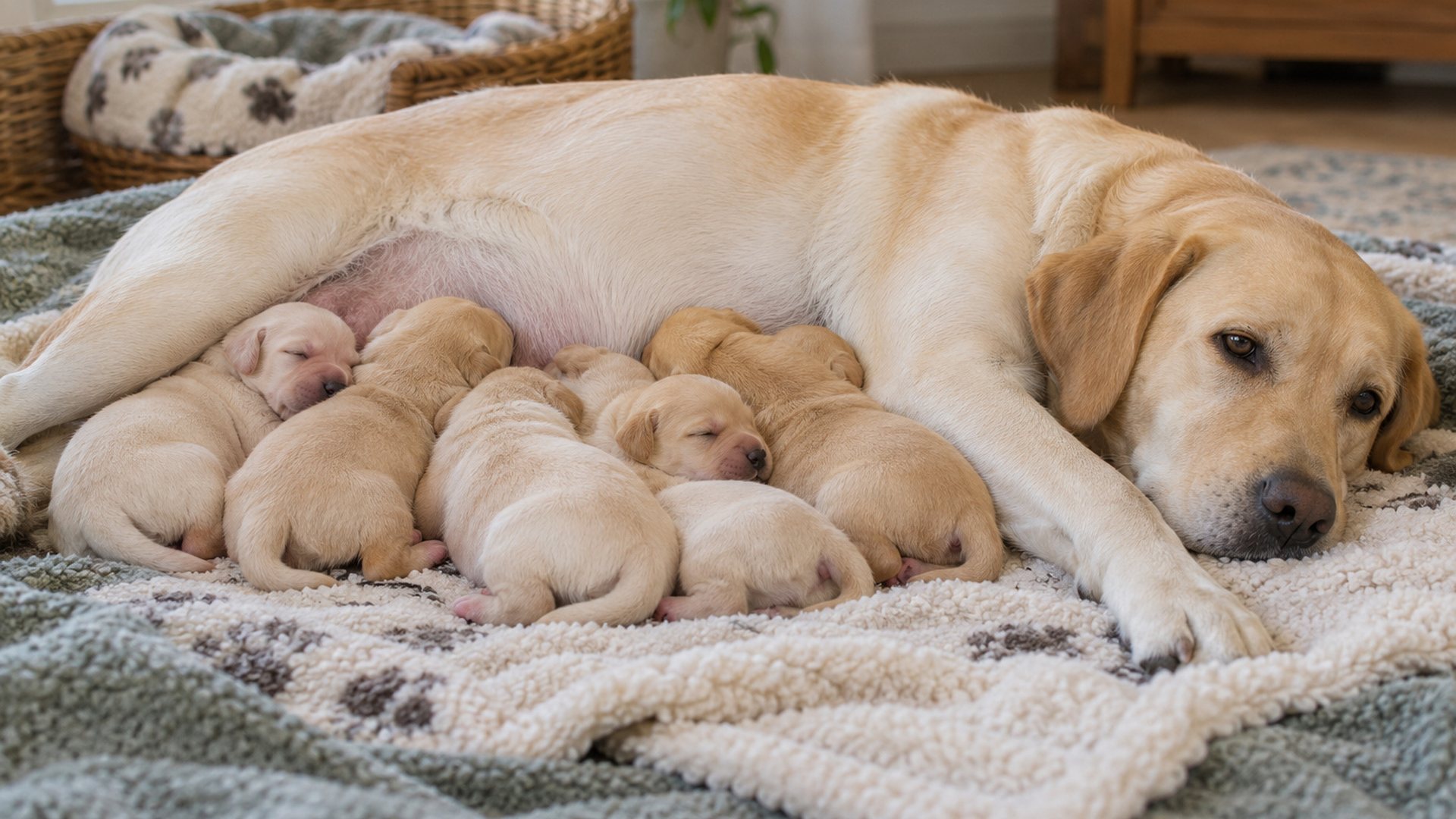
Most puppies open their eyes at around 10 to 14 days old, and some take closer to three weeks. The eyelids part slowly, often one eye before the other, and the eyes are still immature when they first open, so a puppy’s vision stays blurry for several more weeks. Their ear canals open at roughly the same time, at about two weeks.
This guide follows a puppy from birth to 12 weeks: when the eyes and ears open, when puppies start to walk, play and wean, why the socialisation window matters so much, and the minimum age a puppy can leave its mum in the UK, Australia and the United States. It ends where our puppy first-year guide begins, on the day your puppy comes home.
At a glance
- Eyes usually open between 10 and 14 days, sometimes up to about three weeks. Never try to open them yourself.
- Ear canals open at around two weeks, and hearing sharpens quickly after that.
- Vision keeps maturing for weeks after the eyes open; a puppy sees much more clearly by six to eight weeks.
- The socialisation period runs from about 3 weeks to around 12 to 14 weeks, so much of it happens before a puppy leaves the breeder.
- Eight weeks is the widely accepted minimum age to leave mum, and it is written into law in several places.
When do puppies open their eyes?
Puppies are born with their eyelids sealed shut. That is normal and protective: the eye is still developing at birth, and closed lids keep dust, debris and germs away from delicate tissue while the light-sensitive cells at the back of the eye mature.
The eyelids usually begin to separate at around 10 to 14 days old. It tends to happen gradually rather than all at once. You may first see a thin slit at the inner corner, and over the next couple of days the gap widens. It is common for one eye to open a day or so before the other. Some perfectly healthy puppies take up to about three weeks.
What newly opened puppy eyes look like
Newly opened eyes often look cloudy or blue-grey. That is expected. The eyes are far from finished at this point: the retina keeps maturing over the following weeks, and a puppy’s sight goes from fuzzy shapes and light to clearer vision at around six to eight weeks, when they can recognise their mother and littermates by sight. Full adult-like eyesight takes longer still, developing over the first few months.
Why you should never force a puppy’s eyes open
Prising the lids apart can damage the eye and expose it to infection before it is ready. If the eyes have not opened by about three weeks, or you are worried about how they look, the right step is a call to your vet, not intervention at home. Keep the whelping area clean, draught-free and softly lit rather than bright, and let nature take its course.
Eye signs that need a vet
Call your vet promptly if you notice any of the following before or after the eyes open:
- Swelling or a bulge under closed eyelids
- Discharge, crusting or pus at the eyelid edges
- A milky white film or cloudy, smoky patches that do not clear as the eyes mature
- Red, swollen eyelids or an eye the puppy keeps tightly shut once the other has opened
- Pupils that look an odd shape or different sizes
Newborn eye infections can progress quickly and can threaten sight, so this is not something to wait out. Our guide on when to call the vet explains how to describe symptoms clearly when you phone.
When do puppies’ ears open?
The ear canals are also closed at birth, which protects the developing inner ear from sound pressure. They open at around two weeks, close to the time the eyes do. Once the canals open, hearing develops quickly, and puppies start reacting to sounds within days. This is when a litter starts startling at a dropped bowl and turning towards voices.
Puppy development week by week: birth to 12 weeks
Every litter is different, and breed, size and health all shift the timing. Use this table as a rough map, not a deadline. The developmental periods are the ones described in classic research on dog development (often credited to John Paul Scott and John Fuller) and in later veterinary behaviour guidance.
| Age | Stage | What is happening | What carers focus on |
|---|---|---|---|
| Birth to 2 weeks | Neonatal | Eyes and ears closed; puppies feed, sleep and crawl towards warmth. They cannot keep themselves warm and rely on mum and littermates. | Warmth, steady weight gain, a clean nest, checks that every puppy is feeding. |
| About 10 to 21 days | Eyes and ears open | Eyelids part, usually from 10 to 14 days; ear canals open at about two weeks. | Soft lighting, no forcing eyelids, watch for eye discharge or swelling. |
| About 2 to 3 weeks | Transitional | Puppies start to stand, wobble and take first steps; they begin noticing sights and sounds. | Non-slip bedding so legs can get purchase; gentle, brief handling. |
| About 3 to 8 weeks | Early socialisation (at the breeder) | Play with littermates, exploring, first solid food, learning bite inhibition from mum and siblings. | Gentle handling, varied safe surfaces, kind visitors, short positive experiences. |
| About 8 to 12 weeks | Socialisation continues (new home) | Rapid learning; many puppies go through a fear period at around 8 to 10 weeks. | Calm, positive introductions; avoid frightening experiences. |
| About 12 to 14 weeks | Socialisation window narrows | Puppies become more cautious about new things. | Keep up gentle, varied experiences; puppy classes with vaccinated pups. |
When do puppies start walking and playing?
In the first two weeks puppies mostly crawl and paddle, pulling themselves towards mum’s warmth. As the eyes and ears open, the transitional period begins, and at roughly three weeks most puppies push up onto wobbly legs and take their first unsteady steps. Bedding that gives their paws grip helps. Within the following weeks walking turns into toddling, pouncing and rough-and-tumble play with littermates.
That play is not just cute. Littermate play is where puppies learn how hard is too hard when they mouth. A puppy who yelps and stops playing teaches the biter a valuable lesson, and mum adds her own gentle corrections. This is one reason early separation is linked with mouthier, less socially fluent puppies. If your puppy arrives home still nipping hard, our guide on how to stop puppy biting shows kind, reward-based ways to teach softer mouths.
Weaning: how puppies move from milk to food
Weaning is gradual. Puppies begin showing interest in soft, wet food at a few weeks old, and mum slowly reduces how often she lets them feed. RSPCA Australia notes that puppies gradually stop drinking their mother’s milk at around eight to twelve weeks. In other words, weaning starts well before eight weeks but is a process, not a single day.
A puppy should be fully weaned and eating on its own before it goes to a new home. Teeth arrive during this time too; our guide to when puppies lose their baby teeth picks up the story from there.
The socialisation window: why weeks 3 to 14 matter so much
The sensitive period for socialisation runs from about 3 weeks to around 12 to 14 weeks of age, according to guidance from Purdue University’s Canine Welfare Science team and Penn State Extension, with variation between breeds and individuals. During this window puppies are primed to accept new people, animals, sounds and places as normal and safe. After it narrows, new things are more likely to be met with caution or fear.
Because the window opens at three weeks, a good breeder does a lot of this work before you ever meet your puppy. Purdue’s guidance suggests introducing new people between 3 and 8 weeks, letting visitors offer small treats and gentle strokes only when the puppy is comfortable, and keeping every session short and positive. If a puppy seems frightened, exposure is reduced, not pushed.
The American Veterinary Society of Animal Behavior (AVSAB) takes the position that the benefits of early, careful socialisation outweigh the disease risks when sensible precautions are taken. That means meeting healthy, vaccinated dogs, using clean venues and choosing puppy classes that check vaccinations. Your vet can tailor this to local disease risks. Our step-by-step guide to socialising a puppy covers what to do once your puppy is home, and the puppy vaccine schedule explains how vaccinations fit around it.
When can a puppy leave its mum?
Eight weeks is the widely accepted minimum, and several governments have turned that into law. Rules differ by country and region, so check the ones that apply where you live.
| Place | Rule (at the time of writing, October 2026) |
|---|---|
| England | Under the Animal Welfare (Licensing of Activities Involving Animals) (England) Regulations 2018, in force since 1 October 2018, licensed sellers cannot deal in puppies under eight weeks, and breeders must show puppies with their mother before a sale. |
| Australia | Rules vary by state and territory. RSPCA Australia lists age-based rules in the ACT, NSW, South Australia, Victoria and Western Australia; NSW says puppies must not be rehomed before eight weeks. Queensland and the Northern Territory rely on pet shop rules (Queensland requires animals for sale to be weaned and able to feed unaided), and Tasmania has no minimum standard. RSPCA Australia considers eight weeks and fully weaned the minimum everywhere. |
| United States | There is no single national sale-age law. The Animal Legal and Historical Center counts roughly 15 to 18 states with minimum-age rules, almost all set at eight weeks (Virginia uses seven). Federal Animal Welfare Act regulations stop dealers and exhibitors handing a dog to a transport carrier unless it is at least eight weeks old and weaned. |
When do puppies stop growing?
The 2019 AAHA Canine Life Stage Guidelines, as cited by Psychology Today, define the puppy stage as lasting from birth until rapid growth stops, which typically happens somewhere between 6 and 9 months depending on breed and size. Small dogs tend to finish growing earlier, while large and giant breeds keep filling out for longer. Dogs are still maturing physically and socially into young adulthood, so a dog that has reached its adult height may still be broadening and settling for a while yet.
If you want to know how big your puppy will be, or when to switch to adult food, ask your vet at a routine check-up. They can use your puppy’s breed, weight trend and body condition rather than a generic chart. For the year ahead, our guide to what to feed your dog explains how to choose a complete diet for each life stage.
Checklist: questions to ask a breeder about the first eight weeks
You cannot watch your puppy’s first weeks, but you can ask about them. A good breeder will be glad you did.
- Can I see the puppies with their mother, in the place they were raised?
- How old will the puppy be when it comes home, and is it fully weaned and eating on its own?
- Did every puppy’s eyes and ears open normally, and has a vet checked the litter?
- What has the litter been exposed to: household sounds, different floors, visitors, gentle handling of paws and ears?
- Have the puppies spent short periods away from mum and littermates to prepare them for the move?
- Which vaccinations, parasite treatments and microchip will be done before I collect the puppy, and what paperwork comes with it?
- What food is the puppy eating now, so I can keep it the same for the first days?
- Will you take the puppy back or help rehome it if something goes wrong?
Common mistakes
- Trying to open a puppy’s eyes. The lids open on their own schedule. Forcing them risks injury and infection.
- Waiting too long with eye discharge or swelling. Newborn eye infections need a vet quickly.
- Taking a puppy home before eight weeks. Early separation cuts short lessons from mum and littermates, and in many places it breaks the law for sellers.
- Keeping a puppy in a bubble until all vaccinations are done. The socialisation window narrows at around 12 to 14 weeks. Safe, careful experiences, guided by your vet, matter.
- Flooding a puppy with too much at once. Socialisation should be gentle and positive. A frightened puppy needs more distance and less pressure, plus treats for calm curiosity.
- Treating timelines as deadlines. Breed, litter size and health all shift timings. If something worries you, ask your vet rather than comparing to a chart.
Sources this guide draws on: Stanley Coren’s writing on why puppies are born with closed eyes and ears (Psychology Today); Purdue University Canine Welfare Science (Croney Research Group) guidance on puppy socialisation; Penn State Extension’s puppy-raising series; the AVSAB position statement on puppy socialisation; GOV.UK guidance on the Animal Welfare (Licensing of Activities Involving Animals) (England) Regulations 2018; RSPCA Australia Knowledgebase on minimum rehoming age; the Animal Legal and Historical Center’s overview of US puppy sale-age laws; and the AAHA Canine Life Stage Guidelines as summarised in Psychology Today.
Handy gear for this guide
Practical picks we think suit this topic. As an Amazon Associate, Mind A Dog earns from qualifying purchases, at no extra cost to you. Prices and availability are set by Amazon and may vary by country.
- Nylabone New Puppy Starter Kit (3 Pack)
Puppy-soft chews sized for teething mouths.
View on Amazon - MidWest iCrate Double Door Dog Crate (36 inch)
Folding wire crate with a divider panel, so it can grow with your dog.
View on Amazon - Zak George’s Dog Training Revolution (book)
A friendly, reward-based guide to raising a well-behaved dog.
View on Amazon
Frequently asked questions
How long does it take for puppies to open their eyes?
Most puppies open their eyes between 10 and 14 days after birth, and some take up to about three weeks. The lids part gradually over a day or two, and one eye often opens before the other. If the eyes are not open by around three weeks, or you see swelling or discharge, call your vet.
Can puppies see when they first open their eyes?
Only a little. Newly opened eyes are immature, so puppies see blurry light and shapes at first. Vision improves over the following weeks, and by about six to eight weeks puppies see clearly enough to recognise their mum and littermates. Eyesight keeps refining over the first few months.
When can puppies hear?
Puppies are born with closed ear canals, which open at around two weeks of age. Hearing then develops quickly, and within days they start reacting to sounds and voices. This is a good time for breeders to introduce gentle everyday household sounds.
When can puppies go outside?
Puppies can enjoy safe, clean outdoor spaces such as their own garden early on, but public places where unknown dogs go carry more disease risk until vaccinations are complete. Because the socialisation window narrows at around 12 to 14 weeks, ask your vet how to balance safe outings, carrying your puppy to see the world, and puppy classes with vaccinated pups.
Can a puppy leave its mum at 6 weeks?
Leaving at six weeks is not recommended. RSPCA Australia, England’s licensing rules for sellers and most US state laws all set eight weeks as the minimum, and puppies should be fully weaned first. Those extra weeks with mum and littermates teach bite inhibition and social skills.
The first weeks of a puppy’s life move astonishingly fast, from sealed eyes and ears to a bouncing, curious little dog ready for a new home. Give that timeline patience, keep your vet in the loop with any worries, and you will give your puppy the calm, confident start that shapes the rest of its life.