
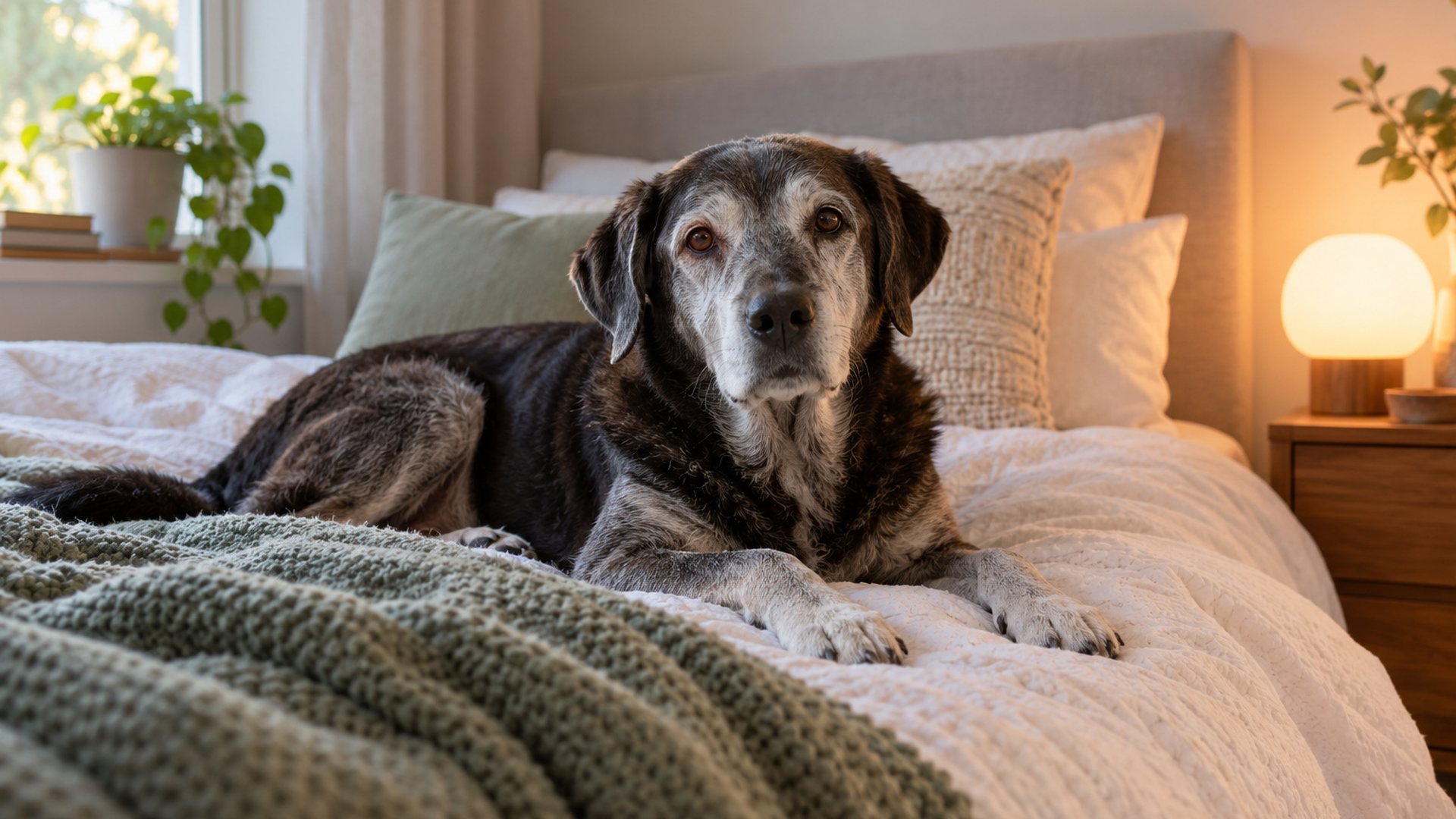
Yes, dogs can get dementia. Vets call it canine cognitive dysfunction (CCD), an age-related decline in brain function that shows up as confusion, changed sleep patterns, new house-soiling, less interest in people and play, and more anxiety. The signs creep in gradually, are easy to mistake for “just getting old”, and overlap with many treatable illnesses, so the right first step is a vet check, followed by daily routines that make your dog’s world simpler and safer.
This guide explains the main dog dementia signs using the DISHAA framework vets use, gives you a simple way to score them at home, and sets out practical daily support: routines, night-time strategies for “sundowning”, gentle enrichment for older brains and home changes that reduce confusion. It does not cover medicines or supplements; your vet is the right person to discuss those.
Try our free dog age calculator to see your dog’s age in human years.
At a glance
- Dog dementia is common and under-recognised: an Australian survey estimated it affects around one in seven dogs aged eight and over, yet few had been diagnosed.
- The six DISHAA areas: disorientation, social interactions, sleep-wake cycles, house-soiling and memory, activity, and anxiety.
- See the vet first: pain, hearing or sight loss, kidney, hormonal and other conditions can look like dementia.
- Routine is the backbone of support: same times, same places, fewer surprises.
- Keep the brain gently busy: sniffing, easy food puzzles and short training sessions suit older dogs well.
What canine cognitive dysfunction is
Canine cognitive dysfunction is a progressive, age-related condition affecting memory, learning, awareness and behaviour. It is often compared with dementia in people. It is a diagnosis of exclusion: your vet rules out other causes of the signs first, because many conditions common in older dogs, such as arthritis pain, dental pain, sensory loss, urinary problems or hormonal disease, can produce similar behaviour changes.
How common is dementia in dogs?
A widely cited Australian survey by Salvin and colleagues, published in The Veterinary Journal in 2010, estimated that about 14 percent of dogs aged eight years and older showed signs consistent with cognitive dysfunction, while only around 2 percent had been diagnosed by a vet. Signs become more frequent with increasing age. The gap between those numbers is the key point for owners: many dogs with dementia are simply never assessed.
Dog dementia signs: the DISHAA checklist
Veterinary behaviourists group the signs into six areas, abbreviated DISHAA. A version of the assessment tool developed by veterinary behaviourist Dr Gary Landsberg is published by the Morris Animal Foundation for owners and vets to use. Each item is scored for changes that have appeared or worsened since about age eight.
| DISHAA area | Examples of what you might notice |
|---|---|
| Disorientation | Getting stuck behind furniture or in corners, waiting at the hinge side of a door, staring into space, seeming lost in a familiar room or garden, not recognising familiar people or pets |
| Interactions (social) | More irritable or fearful with family, visitors or other pets; less interest in greeting, being stroked or seeking company |
| Sleep-wake cycles | Sleeping more by day, waking at night, pacing or restlessness in the evening, barking or whining at night |
| House-soiling, learning and memory | Toilet accidents indoors, no longer asking to go out, forgetting known cues or their name, harder to teach new things, easily distracted |
| Activity | Less play and exploring; more aimless wandering or repetitive behaviours such as circling or licking |
| Anxiety | More upset when apart from you, more fearful of sounds or sights, reluctant to go to new places or even outside |
How to score your dog at home
The published DISHAA tool asks you to rate each of its 18 items as 0 (none), 1 (mild), 2 (moderate) or 3 (severe), counting only changes since around age eight, and then add up the total. On that form, totals in roughly the 4 to 15 range are described as consistent with mild cognitive dysfunction, 16 to 33 with moderate, and above 33 with severe. The form itself stresses that a vet must work out the cause of any signs through examination and testing, so treat your score as information to bring to the appointment, not a diagnosis.
- Choose a quiet moment and think about the past month, not just today.
- Go through each of the six areas and note which behaviours are new or worse since your dog was about eight.
- Rate each one from 0 to 3, and write a short example beside it, such as “stood facing the wall twice this week”.
- Ask other household members to score independently, then compare notes.
- Take short phone videos of puzzling behaviour, especially at night; they are very helpful to your vet.
- Repeat the scoring every one to three months so you and your vet can see whether things are stable or changing.
Why the vet visit comes first
Many signs on the DISHAA list have other explanations. Night-time restlessness can be pain from arthritis. New accidents can come from a urinary infection, kidney disease or hormonal disease. Irritability can be dental pain. Not responding to their name can be hearing loss, and bumping into things can be failing eyesight. Your vet will usually examine your dog, ask about the timeline and may suggest blood and urine tests, blood pressure checks or other investigations depending on what they find.
Bring your DISHAA scores, videos and a list of everything your dog eats and takes. If your vet confirms cognitive dysfunction, they can talk you through management options that suit your dog, which this guide deliberately leaves to them. The guide on when to call the vet also covers which sudden changes, such as collapse, sudden blindness, head tilt or seizures, need same-day care rather than a routine appointment.
Daily support: routines that reduce confusion
Dogs with cognitive decline cope best when the day is predictable. Simple, consistent routines take pressure off a memory that is no longer reliable.
- Keep fixed times for meals, toilet breaks, walks, play and rest.
- Keep things where they belong. Avoid moving beds, bowls and furniture where possible.
- Use the same words and signals, and add a clear hand signal to verbal cues in case hearing is fading.
- Take more frequent toilet breaks, especially after waking, after eating and before bed. Go outside with your dog rather than sending them out alone, and reward them for toileting in the right spot.
- Approach gently. Say your dog’s name or let them see you before touching them, as a startled older dog may react defensively.
- Protect rest. Give your dog a quiet, comfortable bed away from foot traffic. The guide to teaching a dog to settle on a mat can help build a calm resting habit.
Sundowners in dogs: night-time strategies
“Sundowning” is the informal name owners use for evening and night-time restlessness, pacing, panting or vocalising. It is one of the hardest parts of living with dog dementia, for the dog and for the household. These steps can help, and your vet can advise if nights remain difficult:
- Daytime activity: a gentle sniffy walk or short enrichment session during the day can encourage better sleep at night.
- Late toilet break: go out just before bed, and consider a quick, calm one during the night if needed.
- A predictable bedtime routine: the same small sequence each night, such as toilet, a small chew or lick mat, then bed.
- A night light: dim lighting can help a confused dog orient themselves.
- Sleeping near you: many dogs settle better close to their people.
- Safe confinement: a pen or baby gate around the bed area stops wandering into hazards like stairs or getting stuck behind furniture.
- Calm, quiet response: if your dog wakes and paces, guide them gently back to bed; never scold a confused dog.
If night-time distress keeps appearing, mention it to your vet, because pain, needing to toilet more often and anxiety can all play a part.
Enrichment for older brains
Mental activity matters for older dogs, but it should be easy enough to succeed at and short enough not to tire them. Think gentle and frequent rather than long and demanding.
| Activity | Why it suits older dogs | Easy way to start |
|---|---|---|
| Sniff walks | Sniffing is natural, calming and low impact | Let your dog set the pace on a short, familiar route |
| Scatter feeding | Uses the nose and slows eating with no learning required | Scatter part of a meal on grass or a snuffle mat |
| Easy food puzzles | Gentle problem-solving with a guaranteed win | Choose the simplest level and help if needed |
| Short training games | Keeps known skills alive and builds connection | Two or three minutes of hand targeting or old favourite tricks |
| Simple scent games | Strong mental work with little physical strain | Hide a treat under one of three cups and let them find it |
| New, gentle experiences | Novelty supports mental engagement | A different quiet park, a new texture to walk on, a car ride to a calm spot |
For more ideas, see easy dog enrichment ideas, the beginner’s guide to scent work at home, and the guide to choosing a puzzle feeder, picking the easiest options for an older dog. Keep physical comfort in mind too: the article on joint health in dogs covers mobility support that makes activity more comfortable.
Making your home dementia-friendly
- Block off stairs, pools and gaps where a confused dog could fall or get stuck.
- Pull furniture slightly away from walls or block corners so your dog cannot wedge themselves in.
- Use non-slip rugs or runners on hard floors.
- Keep water easy to find, and consider a second bowl near the bed.
- Check that the garden is secure; some dogs with dementia wander.
- Make sure ID and microchip details are up to date.
- Reduce clutter so walkways stay clear and predictable.
The broader guide to caring for a senior dog covers diet, exercise, grooming and health checks that support older dogs generally.
Common mistakes
- Assuming it is just old age. Changes are worth a vet check, both to rule out other illness and to start support early.
- Skipping the vet because “nothing can be done”. Vets have more options than many owners realise, and treatable conditions are often found along the way.
- Telling off accidents or night waking. A dog with dementia is not being stubborn. Punishment adds fear and confusion.
- Rearranging the house. New layouts are harder for a dog with memory problems to learn.
- Stopping all activity. Gentle mental and physical activity is part of good daily support.
- Starting supplements or medicines without advice. Ask your vet first, as some products interact with other treatments.
- Forgetting the carer. Broken sleep is exhausting. Share night duties and ask your vet for support if things are getting too hard.
Sources this guide draws on: DISHAA assessment tool developed by Dr Gary Landsberg, as published by the Morris Animal Foundation, and Salvin and colleagues’ 2010 survey of canine cognitive dysfunction in The Veterinary Journal.
Handy gear for this guide
Practical picks we think suit this topic. As an Amazon Associate, Mind A Dog earns from qualifying purchases, at no extra cost to you. Prices and availability are set by Amazon and may vary by country.
- EHEYCIGA Orthopedic Memory Foam Dog Bed (Large)
Firm, supportive foam with a washable waterproof cover.
View on Amazon - EHEYCIGA 4-Step Dog Stairs
Lets smaller or older dogs reach the couch or bed without jumping.
View on Amazon - EVERLIT Pet First Aid Kit (95 Pieces)
Bandages, gauze and basics in one bag for home, car or hikes while you contact your vet.
View on Amazon
Frequently asked questions
Can dogs get dementia?
Yes. Canine cognitive dysfunction is an age-related decline in brain function that affects memory, awareness, sleep, social behaviour and house training. It is most often seen in dogs over about eight to ten years of age, and becomes more common as dogs get older.
What are the first signs of dementia in dogs?
Early signs are often subtle: changed sleep patterns, mild confusion such as waiting at the wrong side of a door, less interest in greeting family, or a few house-training lapses. Scoring your dog with the DISHAA checklist and sharing it with your vet helps catch these early.
What is sundowners in dogs?
“Sundowners” is an informal term for restlessness, pacing, panting or vocalising in the evening and at night, often seen in dogs with cognitive dysfunction. A predictable bedtime routine, daytime activity, a late toilet break and a night light can help. Talk to your vet if nights stay disturbed.
How is dog dementia diagnosed?
There is no single test. Your vet looks at the pattern of signs, often using a checklist like DISHAA, and rules out other causes such as pain, sensory loss, urinary problems, hormonal or kidney disease with an examination and, where needed, tests.
Does dog dementia get worse over time?
It is usually progressive, though the pace varies between dogs. Regular re-scoring and vet reviews help you notice changes and adjust daily support. Many dogs continue to enjoy a good quality of life for a long time with the right routine and care.
A dog with dementia is still the dog who has shared your life for years. Keep the days predictable, the nights calm and the brain gently busy, and lean on your vet for the parts that need professional help.