
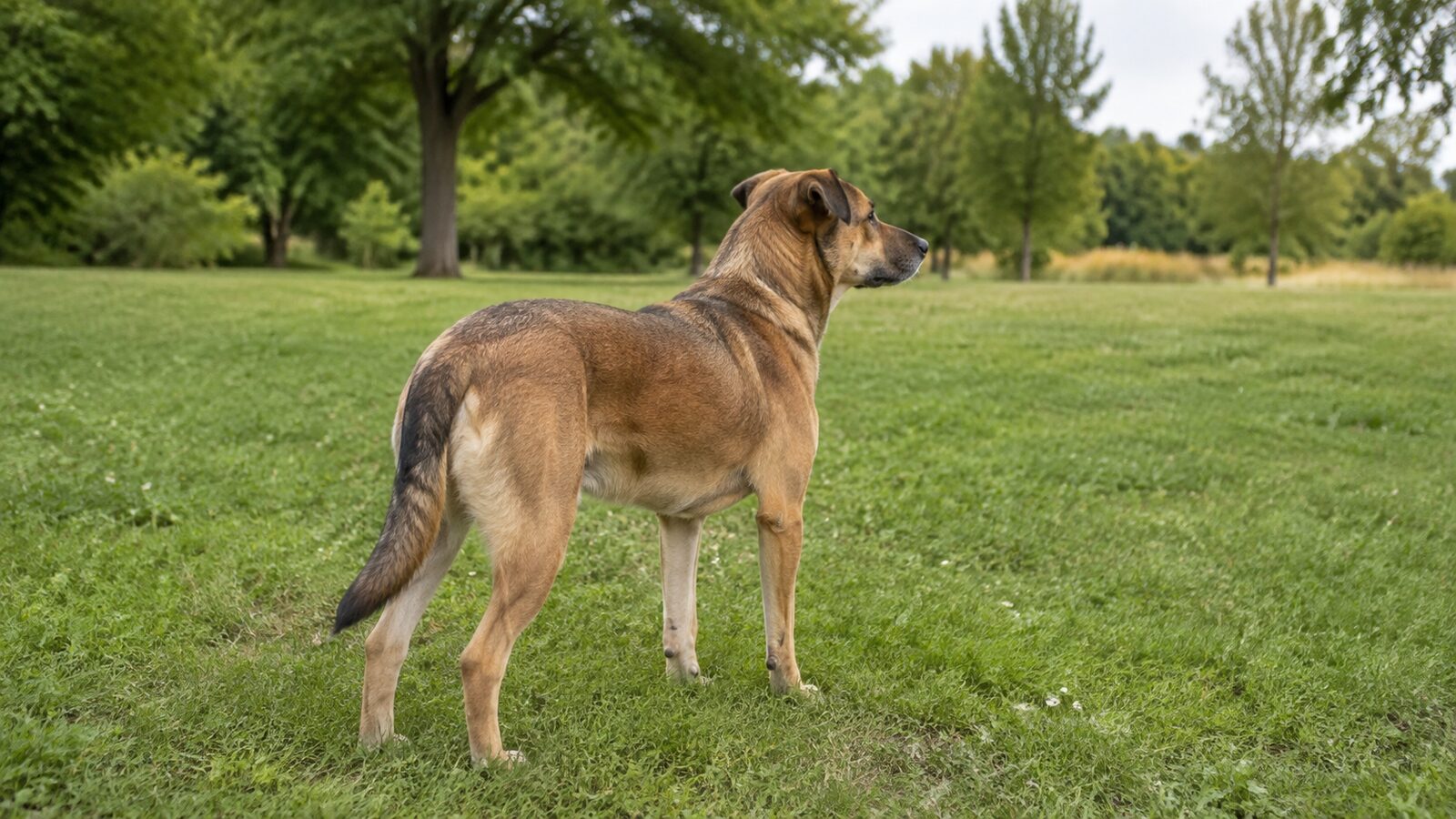
The short version
A wagging tail means your dog is aroused, not necessarily happy. The most useful signal is height: a tail held above your dog’s neutral position suggests confidence or alertness, level suggests calm interest, low or tucked suggests worry. Read speed and stiffness next, and always read the tail alongside the face and body.
Most of us learn one rule about tails as children: wagging means friendly. It is why so many people are surprised when a dog with a moving tail growls or backs away.
The truth is more interesting. A tail is closer to a volume dial than a mood label. It tells you how switched on your dog is, and roughly where that energy is pointing, but never the whole story on its own.
Start with your dog’s neutral
First, learn where your dog’s tail sits when they are relaxed and nothing much is happening. Watch them pottering in the garden or lying about after dinner. That resting position is your baseline.
Neutral varies enormously. Some breeds carry a tail low and sloping, some carry a curl over the back all day, some hold a straight flag naturally. A tail that signals high arousal in one dog is simply Tuesday in another.
With a curled or naturally high tail, look for how much tighter the curl becomes rather than for absolute height. The change is the message.
Height and base position: the main signal
Where the tail sits, and how firmly it is held, carries most of the information. Always measure against that dog’s own neutral:
- Higher than neutral, held firmly: arousal and confidence. Could be excitement, alert interest, or a dog making a point. The rest of the body tells you which.
- Around neutral, loose: a comfortable dog taking the world in. This is what you want to see most of the time.
- Lower than neutral: uncertainty, appeasement, or a dog trying to be less noticeable.
- Clamped under the body: real fear or acute stress. This dog needs space, not a hand reaching towards them.
The base is worth watching too. A tail moving from a loose base reads very differently from one where the rear end has gone rigid and only the tip flicks.
Speed, size and looseness of the wag
Big, loose, sweeping wags
Broad wags at mid height, hips swinging and the body curving, are the classic friendly greeting. The looseness is the important part. A relaxed dog wags like rubber, not wire.
Fast, small, high vibrations
A tail held high and buzzing in tight, rapid movements is a high-arousal signal, and one of the most commonly misread. This dog is very switched on and possibly on the edge of something. It might be intense excitement, or a dog telling another dog to think carefully.
Slow, low, tentative wags
A low tail moving slowly, sometimes just the tip, tends to mean “I am not sure about this, please be kind”. You will see it when a dog is unsure whether they are in trouble, or hedging with someone new.
The stiff, barely moving tail
Stiffness matters more than most people realise. A rigid tail, whether high, level or low, usually means the dog has frozen inside, and freezing often sits just before a bigger reaction.
The two positions worth knowing well
The tucked tail
A tail pressed down or curled tight under the belly is one of the clearest signals a dog gives. It usually comes with a lowered body, ears back, a tight mouth, weight shifted away, perhaps a lifted paw.
The kindest response is to reduce the pressure. Stop approaching, turn side-on, let the dog choose whether to come to you. Coaxing a tucked dog forward, or lifting them up to show them it is fine, usually makes the next encounter harder.
A tail tucked often, in ordinary situations, is a wellbeing question rather than a training one.
The high, stiff flag
A tail carried high and held still, or vibrating in tiny movements, with the dog standing tall and weight forward, is a dog who has made a decision. It is common at fence lines, doorways and dog meetings.
This is not a naughty dog. It is a dog telling you they are extremely engaged and serious. Create distance and give them something else to do before the moment builds.
Breed, docked tails and dogs without much tail at all
Tail shape varies more than almost any other body part, which changes how easy a dog is to read.
Tightly curled tails sit permanently near the high end of the scale. Long, low-slung tails can look worried on a relaxed dog. Heavily feathered tails move slowly and look softer than the arousal underneath.
Dogs with very short, docked or bobbed tails have less signalling equipment. They compensate with the whole rear end, so watch the hips and lean harder on the face, ears and body weight. Other dogs can misread them, so allow extra room in greetings.
Never read the tail alone
This is the part that matters most. A tail on its own is an unreliable narrator, and the same position can mean opposite things depending on what the rest of the dog is doing. Before deciding, take in:
- The eyes: soft and blinking, or hard and staring, with whites showing at the sides.
- The mouth: loose and open, or closed, tight and drawn back at the corners.
- The ears: forward, neutral, or pinned back against the head.
- The body: curved and wiggly, or straight, still and leaning forward.
- The weight: settled evenly, leaning in, or shifted back and ready to leave.
- What just happened: who arrived, what changed, what the dog was doing a moment ago.
A high wagging tail on a loose, wiggly dog with a soft face is a delighted dog. The same high wagging tail on a stiff dog with a hard stare and a closed mouth is a completely different animal.
Practise this week
- Find the baseline. Spend two or three quiet evenings noticing where your dog’s tail rests when nothing is happening.
- Take mental snapshots. A few times a day, freeze the moment and note four things: tail height, tail movement, ears and mouth.
- Predict, then watch. On a walk, look at an approaching dog and call what you think will happen. Being wrong is how the learning happens.
- Film your own dog. Ten seconds of a doorway greeting, played back slowly, teaches more than an hour of reading.
- Act on low and tucked. When you see it, add space. Nothing else. That one habit prevents many problems.
When to get professional help
If your dog’s tail carriage changes suddenly, if they cannot move it normally, if it hangs limp, or if they flinch when it is touched, ring your vet. Tails can be injured, and pain there is easy to overlook.
If your dog is frequently tucked, cowering or tense in ordinary daily life, or you are seeing high, stiff tails in situations that worry you, ask your vet to refer you to a qualified behaviourist. Reading the signals is the first step. Having someone watch your dog is the next.
Frequently asked questions
Does a wagging tail always mean a dog is happy?
No. A wag means the dog is aroused and engaged, and that arousal can be friendly, frustrated, uncertain or confrontational. A loose, sweeping wag from a wiggly body usually is friendly. A fast, tight wag from a high, stiff tail on a still dog is not an invitation. Check the face and body first.
What does it mean when my dog tucks their tail?
A tucked tail signals fear, discomfort or a strong wish to avoid something, and usually appears with a lowered body, ears back and a tight mouth. The most helpful response is to give your dog distance from whatever is bothering them and let them choose to come forward. If it happens often, talk to your vet or a behaviourist.
Why does my dog wag their tail while growling?
Because the two signals mean different things. The wag reports arousal, the growl reports discomfort or a request for space. Together they describe a conflicted dog who is highly stimulated and unhappy about the situation. Take the growl seriously, give the dog room, and never punish growling, since it is early warning you want your dog to keep giving.
Can dogs with docked or curly tails still communicate?
Yes, with less range. Dogs with very short or tightly curled tails use the rest of the body instead, especially the hips, ears and face, and most dogs adapt to reading them. They do get misread more often, so give them extra space in greetings and watch their other signals closely.
What does a tail held high and completely still mean?
A high, rigid tail on a still dog is a strong arousal signal, and it means your dog has locked on to something. It is common at fences, doorways and dog introductions. Treat it as a moment to create distance and redirect rather than something to wait out, since whatever comes next tends to be big.
Read next
- Signs of Stress in Dogs That Most Owners Miss
- Why Dogs Do the Things They Do: A Plain-English Guide to Everyday Dog Behaviour
- Why Dogs Bark: Six Kinds of Bark and What Each One Means
- The Guilty Look: What Your Dog Is Really Doing When You Come Home to a Mess
- Understanding Canine Body Language: What Your Dog Is Really Telling You
More in Understanding Your Dog.
A note on this article
Everything here is general education about canine body language, written to help you observe your own dog more accurately. It is not a diagnosis and not veterinary advice, and no article can assess an individual dog. If you have concerns about your dog’s tail or how they cope, please talk to your vet or a qualified behaviourist who can see them in person.