
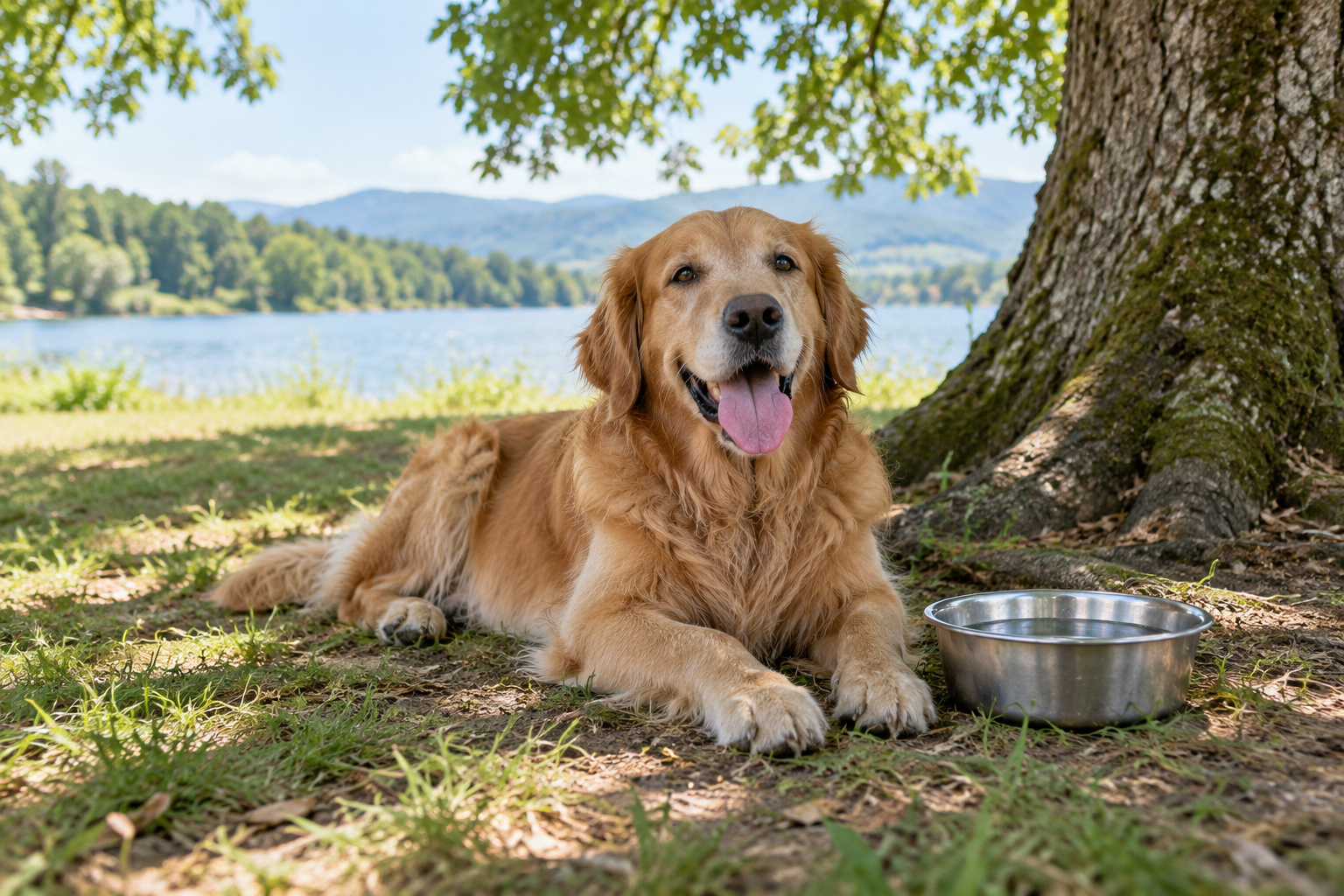
Dogs pant mainly to cool down. They have very few sweat glands, so they push hot air out and draw cooler air in over the moist surfaces of the mouth, tongue and airways, letting water evaporate and carry heat away. Panting after exercise, on a warm day or when excited is normal and should settle within minutes once your dog rests somewhere cool. Panting at rest, at night, for no clear reason, or with restlessness, shaking, weakness or noisy breathing can be a sign of stress, pain, illness or overheating, and deserves a closer look.
This guide separates normal panting from stress panting and from warning signs. It explains why dogs pant at night or while resting, why flat-faced breeds need extra care, how to spot heatstroke early, and gives you a calm-at-home checklist plus a clear list of when to call the vet today and when to go now.
At a glance
- Panting is a dog’s main way of losing heat, and it is normal after exercise, in warm weather and during excitement.
- Normal panting eases within a few minutes of rest in a cool, calm place.
- Panting while resting, at night or “for no reason” can point to stress, pain, heart or hormone problems, or medicine side effects.
- Heavy panting with drooling, weakness, vomiting or collapse on a warm day may be heatstroke, which is an emergency.
- Flat-faced breeds overheat more easily, so loud or heavy panting after little effort is a warning, not “just the breed”.
Why do dogs pant? The normal reasons
Cooling down
Dogs only have sweat glands in places such as their paw pads, which cannot shed much heat. Instead, they rely on panting: rapid, shallow breaths that move air across the wet tongue and airways so that evaporation cools them. That is why a dog who has been running, playing or lying in the sun pants hard, then slows as they cool.
Excitement and effort
Dogs also pant when they are excited, such as when you pick up the lead, when visitors arrive or during a lively game. Effort of any kind, from chasing a ball to climbing stairs, raises body heat and breathing.
Stress, fear and anxiety
Panting is also one of the most common signs of stress. Stress panting often happens when your dog is not hot and has not been active, and it usually comes with other signals: lip licking, yawning, pinned-back ears, a tucked tail, pacing, drooling or sweaty paw prints. Car journeys, vet visits, fireworks, thunderstorms and being left alone are common triggers. Our guide to the hidden signs of stress in dogs explains how to read the full picture, and our guide to noise fear covers fireworks and storms.
Normal, stress or warning sign? A quick comparison
| Type of panting | Typical situation | What it looks like | What to do |
|---|---|---|---|
| Normal cooling | After exercise, play or warm weather | Relaxed face, soft eyes, panting slows within minutes of resting | Offer water and shade; let them rest |
| Excitement | Visitors, walks, mealtimes, games | Wagging, bouncy body, settles once things calm down | Nothing needed; help them settle |
| Stress or fear | Car trips, vet visits, noise, being alone | Tight mouth, ears back, pacing, lip licking, yawning, trembling | Reduce the trigger, give space and a safe spot |
| Possible pain or illness | At rest, at night or for no clear reason | Restless, can’t settle, may hide or be off food | Ring your vet today |
| Possible heatstroke or breathing emergency | Hot day, exercise in heat, hot car, or any time | Frantic or noisy panting, drooling, weakness, wobbliness, vomiting, collapse, blue or grey gums | Start cooling if overheated and go to a vet now |
Why is my dog panting for no reason?
When a dog pants while resting in a cool room with nothing exciting happening, there is usually a reason, even if it is not obvious. Common ones include:
- Pain. Dogs often hide pain, and panting, restlessness and difficulty settling may be the only clues. Arthritis, back pain, tummy pain and injuries can all cause it. Our guide to joint health covers the quiet signs of stiffness.
- Stress or anxiety. A change at home, a noise you cannot hear, or separation distress can all trigger panting.
- Nausea. Some dogs pant, drool and lick their lips before vomiting.
- Heart disease. Faster breathing at rest or during sleep can be an early sign of fluid build-up in dogs with heart disease.
- Hormone conditions. The Merck Veterinary Manual lists panting among the signs of Cushing’s disease (hyperadrenocorticism), alongside increased thirst, weeing and appetite, a pot-bellied appearance, heat intolerance and coat changes. It mostly affects middle-aged and older dogs.
- Medicines. Some medicines, including steroids, can cause panting as a side effect. If panting started after a new prescription, ring your vet; do not stop the medicine on your own.
- Breathing or airway problems. Lung disease, a weak windpipe or a narrowed airway can make a dog work harder to breathe.
- Weight. Dogs carrying extra weight tend to overheat and pant more.
Dog panting at night or while resting
Panting at night stands out because most dogs breathe slowly and quietly when they sleep. Occasional panting after a late game or on a hot night is not unusual. Night-time panting that is new, happens most nights, or comes with pacing, getting up and down, or refusing to lie down is worth a vet check. Older dogs can pant and wander at night because of pain, heart disease, hormone problems or age-related confusion, and our guide to caring for a senior dog covers these changes.
A useful habit is to count your dog’s breathing while they are deeply asleep. Count each rise and fall of the chest as one breath for a full minute. Research on dogs with heart disease, including a 2016 study in The Veterinary Journal, found that most dogs, even those with heart conditions that were well controlled, had average sleeping breathing rates under 30 breaths per minute. If your dog’s sleeping rate is regularly above that, or climbing, tell your vet.
Dog panting and shaking
Panting and shaking together often mean fear or stress, such as during fireworks or a vet visit. But the combination can also be a sign of pain, nausea, fever, overheating or poisoning. If your dog is panting and shaking and there is no obvious frightening trigger, or the shaking comes with vomiting, weakness, wobbliness, twitching or confusion, ring your vet straight away. If there is any chance they have eaten something toxic, ring a vet or an animal poison helpline immediately and follow their advice. Do not try to make your dog sick or give anything by mouth unless a vet tells you to.
Heatstroke: the panting you must never ignore
Heat-related illness is a genuine danger, and not only in hot cars. A 2020 VetCompass study by Hall, Carter and O’Neill, which looked at records from more than 900,000 dogs in UK veterinary practices, found that exercise was the trigger in about 74 percent of heat-related illness cases, far more than hot weather alone (about 13 percent) or being shut in a vehicle (about 5 percent). Flat-faced dogs had higher odds of all three types, and young male dogs had higher odds of exercise-related heatstroke.
Warning signs of overheating include:
- Heavy, frantic or noisy panting that does not ease with rest
- Thick drool, a wide, flattened tongue and very red or pale gums
- Seeking shade, lying down and refusing to move, or stumbling
- Vomiting or diarrhoea
- Confusion, collapse or seizures
If you think your dog is overheating, move them to shade or a cool room, start cooling straight away with cool water poured over their body and moving air from a fan or breeze, offer small amounts of water to drink, and ring your vet so they can prepare while you travel. Keep cooling on the way. Even if your dog seems to recover, they still need a vet check, as heatstroke can cause problems that are not visible at first.
Prevention is easier than treatment. Walk in the cooler parts of the day, cut exercise short in warm or humid weather, and check pavement temperature before setting off; our guide to checking hot walking surfaces shows you how. Never leave a dog in a parked car, and see our dog car safety guide for keeping journeys cool.
Flat-faced breeds and breathing problems
Brachycephalic (flat-faced) breeds such as Pugs, French Bulldogs, Bulldogs and some Shih Tzus can have narrowed nostrils, a long soft palate and a crowded airway, a group of problems known as brachycephalic obstructive airway syndrome (BOAS). These dogs cannot pant as efficiently, so they overheat sooner and struggle to cool down. Loud snoring, snorting, noisy breathing at rest, heavy panting after gentle exercise, or collapse after excitement are not “normal for the breed”; they are signs that your dog is working hard to breathe. Speak to your vet about an airway assessment, keep these dogs lean, use a harness rather than a collar, and be extra careful in warm weather.
Calm-at-home checklist for a panting dog
Use this when your dog is panting but has no emergency signs.
- Check the situation. Have they been active, excited, in the sun or in a warm room? Is anything stressful happening?
- Move them somewhere cool and quiet, out of direct sun, with good airflow.
- Offer fresh water, without forcing them to drink.
- Give them a safe, calm spot, such as a bed or crate they like, and lower noise and activity around them. A well-practised settle on a mat can help.
- Remove the trigger if it is stress, such as turning on background sound during fireworks or giving space from visitors.
- Look at gums, posture and energy. Pink gums, a relaxed body and interest in you are reassuring.
- Time it. Normal panting should ease within a few minutes of rest. Note how long it lasts.
- Write down what you saw: when it started, how long it lasted, the situation, and any other signs. This helps your vet.
When to call the vet
Ring your vet today if
- Panting happens often at rest, at night, or for no obvious reason
- Panting comes with restlessness, pacing, hiding or not settling
- Your dog is also drinking or weeing more, eating more or less, or has a pot-bellied look
- Panting started after a new medicine
- Your dog seems stiff, sore or reluctant to move
- A flat-faced dog is panting heavily after very little effort
- Your dog’s sleeping breathing rate is higher than usual over several days
Go to a vet now if
- You suspect heatstroke, or panting does not ease after rest and cooling
- Breathing is laboured, noisy or open-mouthed at rest, or your dog refuses to lie down
- Gums are blue, grey, very pale or bright red
- There is collapse, weakness, wobbliness, confusion or seizures
- Panting comes with a swollen belly, retching without bringing anything up, or repeated vomiting
- There is any chance of poisoning
If you are unsure which list fits, ring. Our calm guide to knowing when to call the vet sets out a simple three-tier plan you can use for any worry.
Common mistakes
- Assuming all panting means “hot”. Panting in a cool room can be stress, pain or illness.
- Exercising hard in warm weather. Exercise is the most common trigger for heatstroke.
- Accepting noisy breathing in flat-faced breeds as normal. It is a sign of an airway problem.
- Waiting for heatstroke to “pass”. Cool your dog and go to the vet straight away.
- Responding to fear with scolding. A frightened dog needs calm support and a safe space, never a telling-off.
- Ignoring new night-time panting in an older dog. It can be an early sign of pain or illness.
- Stopping a prescribed medicine because of panting. Ring your vet first.
Sources this guide draws on: Hall, Carter and O’Neill’s 2020 VetCompass study of heat-related illness in UK dogs, published in Animals, the Merck Veterinary Manual on hyperadrenocorticism in dogs, and Porciello and colleagues’ 2016 study of sleeping respiratory rates in The Veterinary Journal.
Handy gear for this guide
Practical picks we think suit this topic. As an Amazon Associate, Mind A Dog earns from qualifying purchases, at no extra cost to you. Prices and availability are set by Amazon and may vary by country.
- Dog Cooling Mat (44 x 32 inch)
A cool spot to lie on during hot weather, no power needed.
View on Amazon - Portable Dog Water Bottle with Food Container
Fresh water and a snack on walks and car trips.
View on Amazon - EVERLIT Pet First Aid Kit (95 Pieces)
Bandages, gauze and basics in one bag for home, car or hikes while you contact your vet.
View on Amazon
Frequently asked questions
Why do dogs pant?
Mainly to cool down, because dogs have very few sweat glands and rely on evaporation from the mouth and airways to lose heat. They also pant when excited, after effort and when stressed. Panting that happens at rest or for no clear reason can be a sign of pain or illness.
Why is my dog panting while resting?
If your dog is not hot and has not been active, panting at rest can mean stress, pain, nausea, heart or hormone problems, or a medicine side effect. Check for other signs such as restlessness, changes in drinking or appetite, and ring your vet if it keeps happening.
Is it normal for my dog to pant at night?
Occasional panting on a hot night or after late play is normal. New or regular night-time panting, especially with pacing or not settling, is worth a vet check, particularly in older dogs.
How can I calm a panting dog?
Move your dog somewhere cool and quiet, offer water, reduce noise and activity, and give them a safe place to rest. If stress is the cause, remove the trigger where you can. If panting does not ease within a few minutes, or comes with any warning signs, call the vet.
How do I know if my dog’s panting is an emergency?
Go to a vet now if panting is frantic or noisy and does not ease with rest, or comes with drooling, weakness, wobbliness, vomiting, collapse, or blue, grey or very pale gums. On a warm day, suspect heatstroke and start cooling on the way.
Why does my dog breathe fast while sleeping?
Brief fast breathing and twitching during dreams is normal. A sleeping breathing rate that is consistently fast, or regularly above about 30 breaths per minute, can be a sign of heart or lung problems and should be checked by your vet.
Panting is usually just your dog’s built-in air conditioning at work. Knowing the difference between cooling, excitement, stress and warning signs means you can relax when it is normal, and act quickly and calmly when it is not.