
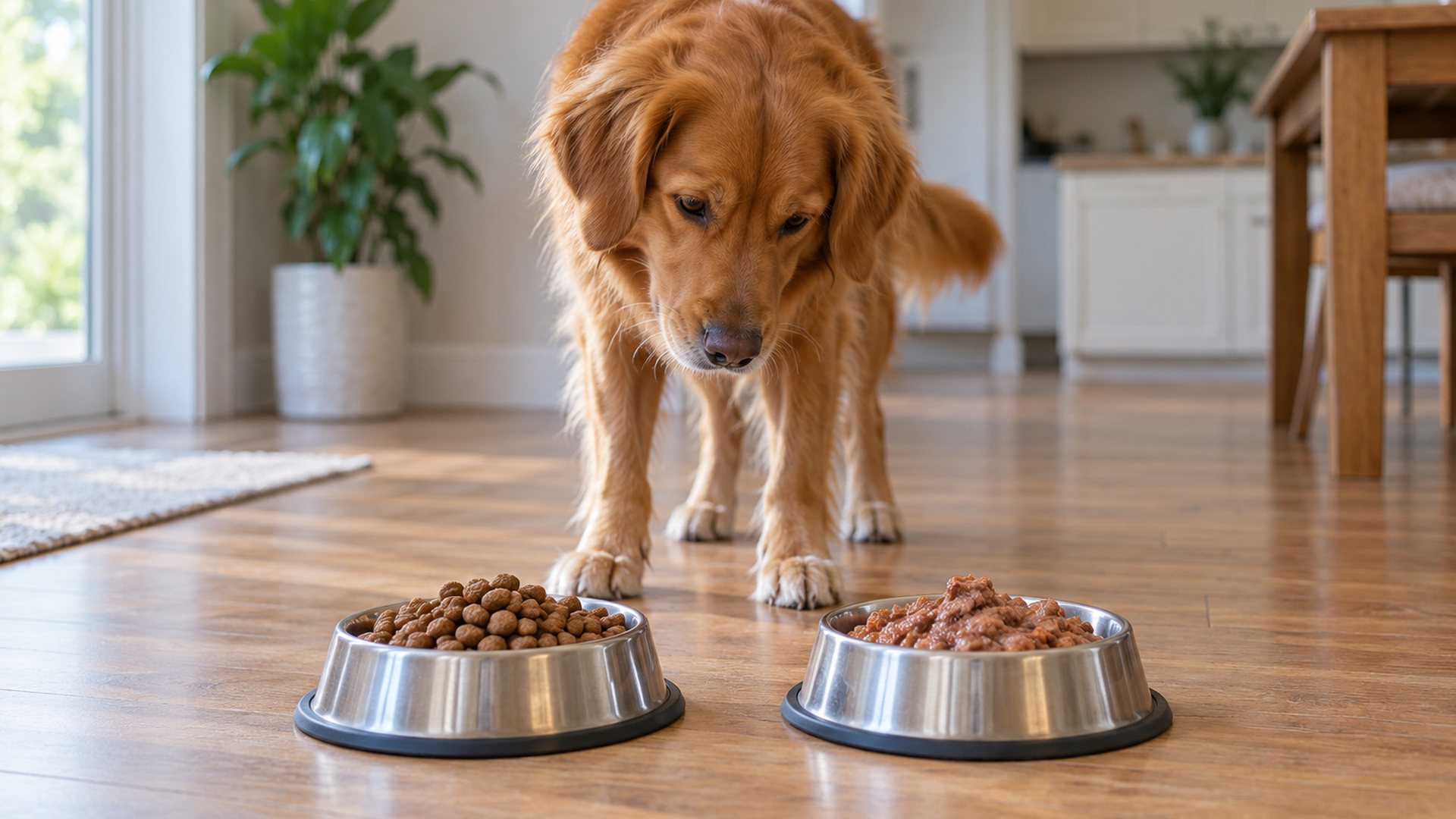
Neither wet nor dry dog food is automatically better: a food labelled “complete and balanced” for your dog’s life stage can be a healthy choice in either form. Dry dog food (kibble) is usually cheaper per day, easier to store and handy for puzzle feeders, while wet or canned dog food adds a lot of water, tends to be more appealing to fussy eaters and has fewer calories per mouthful. Many owners mix the two, which works well as long as the total daily calories stay right.
This guide compares wet, dry and mixed feeding on the things that actually matter day to day: nutrition, cost per day, hydration, palatability, weight control and the common claim that kibble cleans teeth. It also shows how to compare labels fairly and how to mix both without overfeeding. It does not recommend brands; it shows you how to judge any food yourself.
At a glance
- Complete and balanced matters more than format. Check the label for a nutritional adequacy statement for your dog’s life stage.
- Dry food usually costs less per day because you are not paying for water; work out cost per day, not per bag or can.
- Wet food is mostly water (often around three-quarters by weight), which can help dogs that drink little and suits many fussy eaters.
- Ordinary kibble is not a toothbrush. Evidence that standard kibble protects teeth is mixed; daily brushing and tested dental products do far more.
- Mixing both is fine if you reduce each portion so the total calories match your dog’s needs.
Wet vs dry dog food: the side-by-side comparison
| Factor | Dry dog food (kibble) | Wet dog food (canned, pouches, trays) | Mixed feeding |
|---|---|---|---|
| Typical moisture | Low, often around 10% | High, often around 75% or more | In between, depending on the ratio |
| Cost per day | Usually lowest | Usually highest, especially for large dogs | Moderate; topper amounts keep costs down |
| Calories per mouthful | High; small portions | Lower; larger portions look more generous | Needs careful portion maths |
| Palatability | Good for many dogs | Often preferred by fussy or older dogs | Adds interest to a dry base |
| Storage and convenience | Easy to store once opened in a sealed container | Refrigerate after opening; use within the time on the label | Both storage needs apply |
| Feeding enrichment | Ideal for puzzle feeders and scatter feeding | Works in lick mats and freezable toys | Flexible |
| Dental effect | Standard kibble: evidence mixed | No clear disadvantage shown in some studies | Rely on brushing either way |
| Packaging | Less packaging per meal | More cans or pouches per day | In between |
Nutrition: the label beats the format
The most important question is not “wet or dry?” but “is this a complete and balanced diet for my dog’s life stage?” In the United States, pet food labels refer to nutrient profiles set by the Association of American Feed Control Officials (AAFCO). In Europe, the industry body FEDIAF publishes nutritional guidelines that manufacturers use. Other countries have their own rules and standards, so look for an equivalent statement wherever you live.
A food marked as “complementary”, “supplemental” or “for intermittent feeding” (common for some wet foods, toppers and treats) is not designed to be fed alone. Puppies need a food stated as suitable for growth, or for all life stages; large and giant breed puppies may need a food specifically stated as suitable for them. The detailed guide on how to read a dog food label walks through these statements.
Questions the WSAVA suggests asking
The World Small Animal Veterinary Association (WSAVA) Global Nutrition Committee has published guidance on choosing pet foods. Its suggested questions to manufacturers apply equally to wet and dry products:
- Do you employ a qualified nutritionist full time, and what are their qualifications?
- Who formulates your foods, and what are their credentials?
- Are your diets tested with feeding trials, or formulated to meet nutrient profiles?
- What research has your company carried out on its products?
- Has that research been published in peer-reviewed journals?
For the bigger picture on choosing a diet, see what to feed your dog.
Comparing labels fairly: the dry matter method
Because wet food contains so much water, its printed protein and fat percentages look much lower than kibble’s, even when the food is similar once the water is removed. To compare like with like, convert to a dry matter basis:
- Find the moisture percentage in the guaranteed or typical analysis.
- Subtract it from 100 to get the dry matter percentage.
- Divide the nutrient percentage by the dry matter percentage, then multiply by 100.
Worked example: a wet food lists 10% protein and 75% moisture. Dry matter is 100 minus 75, which is 25%. Protein on a dry matter basis is 10 divided by 25, multiplied by 100, which is 40%. A kibble listing 26% protein and 10% moisture works out at about 29% protein on a dry matter basis. On paper the wet food looked lower in protein, but it is actually higher once water is removed.
Cost per day: how to work it out
Price per bag or per can is misleading. What matters is the cost of feeding your dog for a day. Food prices vary widely between countries and change often, so this guide gives the method rather than figures.
- Find your dog’s daily amount on the feeding guide (in grams or cups), as a starting point.
- Work out how many days one bag, can or pouch lasts at that amount.
- Divide the price by the number of days. That is your cost per day.
- For mixed feeding, add the cost per day of each part at the reduced portions.
Because wet food is mostly water and lower in calories per gram, a dog usually needs a much larger weight of wet food than kibble to meet the same energy needs. For a large dog fed only wet food, that difference can add up quickly. Mixing a small amount of wet food into a dry base is a common middle ground. For a wider budget view, see planning dog ownership costs.
Does dry food clean dogs’ teeth? The dental myth
Many people believe crunchy kibble scrapes teeth clean. The evidence is more mixed than that. A veterinary nutrition review presented at a dentistry and nutrition conference noted that standard kibble tends to shatter when bitten, giving limited mechanical cleaning, and that several studies have found moist and dry foods have similar effects on plaque and tartar. Some older studies did favour dry food over soft diets, but many included cats or mixed groups of dogs and cats.
Specially designed dental diets have stronger support. These use larger kibble with a fibrous structure, or added ingredients, and some have been shown in controlled studies to reduce plaque and tartar compared with a standard diet. The Veterinary Oral Health Council (VOHC) reviews submitted trial data and awards a seal to products that meet its standards for helping control plaque or tartar. It does not run the tests itself, so the seal tells you the data were reviewed, not that the product replaces brushing.
The bottom line: whichever format you feed, daily tooth brushing and regular vet dental checks matter most. The guide to dog dental care explains how to build a simple routine, and choosing safe dog chews covers which chews are hard enough to break teeth.
Hydration, weight and fussy eaters
Hydration
Wet food provides a large share of daily water, which some owners find useful for dogs that drink little, older dogs, or dogs whose vet has advised extra water intake. Dogs on dry food simply drink more to make up the difference. Always provide fresh water, whatever you feed.
Weight control
Wet food has fewer calories per gram, so a satisfying-looking portion contains less energy. That can help some dogs feel full. Dry food is calorie-dense, so small overfeeding errors add up fast; weigh kibble with kitchen scales rather than using a scoop. Either way, adjust portions to your dog’s body condition rather than relying only on the feeding guide.
Palatability
Many dogs prefer the smell and texture of wet food, which can help with fussy eaters, older dogs with a reduced sense of smell, or dogs with dental discomfort. A sudden loss of appetite is different from fussiness, though: if your dog stops eating normally, check with your vet.
Wet and dry puppy food
Puppies can thrive on wet puppy food, dry puppy food or a mix, provided it is complete and balanced for growth. Small puppies sometimes find kibble easier if it is softened with warm water at first. Puppies have high energy needs in small stomachs, so follow the feeding guide closely and adjust with your vet’s advice as they grow. The puppy first-year guide covers how feeding changes month by month.
How to mix wet and dry food without overfeeding
- Find the daily calorie needs from each food’s feeding guide or ask your vet for a target.
- Check the calorie content of both foods, usually listed per kilogram, per cup or per can.
- Decide your split, for example three-quarters of calories from dry and one-quarter from wet.
- Reduce each food proportionally. If wet provides a quarter of the day’s calories, feed three-quarters of the normal dry amount.
- Weigh portions for the first few weeks so your mix stays consistent.
- Introduce changes gradually over about a week to avoid stomach upset. The guide to dog gut health explains why gradual switches matter.
- Check body condition every few weeks and adjust.
Kibble can also be used in puzzle feeders and scatter games, while wet food can be spread on a lick mat or frozen in a stuffable toy, so mixing gives you more ways to make mealtimes enriching.
Common mistakes
- Adding wet food on top of a full dry meal. This is one of the easiest ways for dogs to gain weight.
- Feeding a complementary product as a full diet. Check the label says complete and balanced.
- Comparing protein percentages directly between wet and dry. Use the dry matter method.
- Relying on kibble for dental care. Brush teeth and book dental checks.
- Leaving wet food out for hours. Remove uneaten wet food after the meal and refrigerate opened cans as the label directs.
- Switching foods overnight. Change gradually over about a week.
- Judging by price per bag. Work out the cost per day instead.
Sources this guide draws on: WSAVA Global Nutrition Committee guidance on selecting pet foods; AAFCO nutrient profiles and FEDIAF nutritional guidelines for complete and balanced pet food; a veterinary dentistry and nutrition conference review on diet and canine dental health; Veterinary Oral Health Council seal programme information.
Handy gear for this guide
Practical picks we think suit this topic. As an Amazon Associate, Mind A Dog earns from qualifying purchases, at no extra cost to you. Prices and availability are set by Amazon and may vary by country.
- Outward Hound Fun Feeder Slo Bowl
Ridged bowl that slows down dogs who gulp their meals.
View on Amazon - LUKITO Lick Mat for Dogs (2 Pack)
Spread a little dog-safe food over it for a quiet licking activity.
View on Amazon - Amazon Basics Airtight Pet Food Storage Containers (3 Piece)
Keeps kibble and treats fresh and out of reach.
View on Amazon
Frequently asked questions
Is wet or dry dog food better?
Neither is better in every case. A complete and balanced food for your dog’s life stage can be healthy in either form. Dry food is usually cheaper and convenient; wet food adds water and appeals to fussy eaters. The best choice is the one your dog does well on that fits your budget.
Can I mix wet and dry dog food?
Yes. Mixing is common and safe if both foods are suitable for your dog and you reduce each portion so the total calories stay right. Weigh food at first and check your dog’s body condition every few weeks.
Does dry dog food clean teeth?
Not reliably. Evidence that ordinary kibble protects teeth is mixed. Some specially designed dental diets have trial data reviewed by the Veterinary Oral Health Council, but daily brushing and regular vet dental checks remain the most effective approach.
How much wet food equals one cup of dry food?
There is no single answer, because calorie content varies between products. Compare the calories per cup of the kibble with the calories per can or pouch of the wet food, then match the calories rather than the volume.
Is canned dog food good for puppies?
Yes, if it is labelled complete and balanced for growth or for all life stages. Many puppies eat wet, dry or a mix. Follow the feeding guide, monitor growth, and ask your vet if you are unsure about amounts.
Wet, dry or both, the formula is the same: choose a complete and balanced food, compare costs per day and nutrients on a dry matter basis, weigh portions, and brush those teeth. Your dog’s energy, coat and body condition will tell you whether the choice is working.