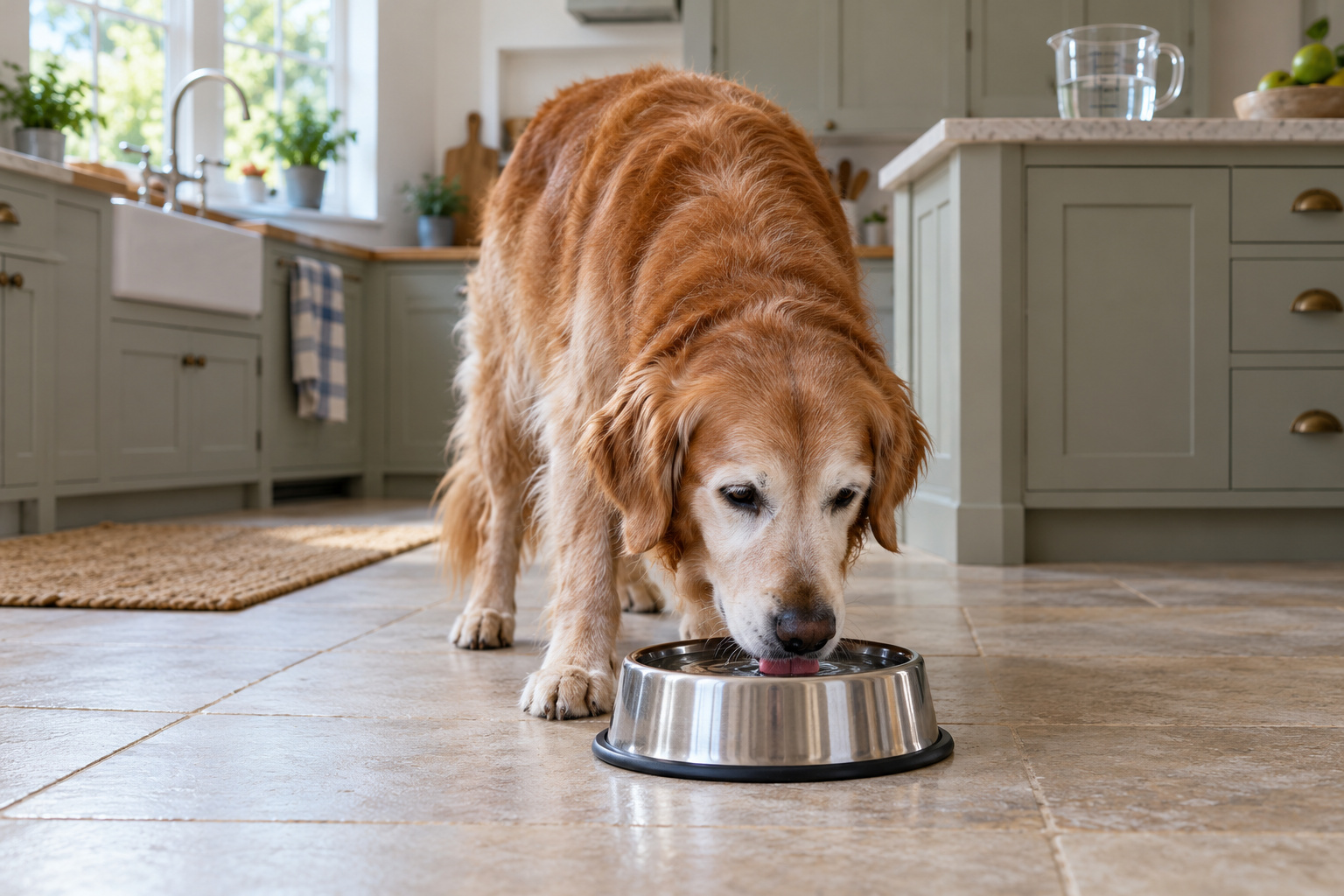
A dog may drink a lot of water simply because it’s hot, they’ve been exercising, they eat dry food, or they’re on a medicine that makes them thirsty. But a lasting increase in drinking, especially with more weeing, can be an early sign of illness such as kidney disease, diabetes or a hormone problem, so it’s always worth measuring and talking to your vet. As a rough guide, veterinary references treat more than 100 ml of water per kilogram of body weight per day as definitely too much.
This guide shows you how to measure your dog’s water intake at home, how to tell everyday thirst from a warning sign, the medical causes vets check for, and exactly what to note before your vet visit. It doesn’t cover treatment or medicine doses; those always come from your vet after a proper examination.
At a glance
- Veterinary references give normal intake for dogs as roughly 20 to 70 ml per kg of body weight per day.
- Over 100 ml per kg per day is considered definitely increased, but some dogs drink abnormally while still under that line.
- Heat, exercise, dry food, salty treats and some medicines can all raise thirst in a healthy dog.
- Drinking more and weeing more together, lasting more than a day or two, is a reason to see your vet.
- An unspayed female who is suddenly thirsty and unwell, especially weeks after a season, needs a vet the same day.
How much water should a dog drink a day?
There’s no single perfect number, because intake varies with weather, activity and diet. A fact sheet from Davies Veterinary Specialists notes that textbooks give normal water intake for dogs as 20 to 70 ml per kg of body weight per day, and that intake over 100 ml per kg per day is considered definitely increased. A continuing-education article in Today’s Veterinary Practice uses the same 100 ml per kg per day line to define excessive drinking, and adds that intake is highly variable and a dog can still have a problem below that figure.
Here’s what those numbers look like for dogs of different sizes:
| Dog’s weight | Typical range (20-70 ml/kg/day) | Definitely increased (over 100 ml/kg/day) |
|---|---|---|
| 5 kg | 100-350 ml | More than 500 ml |
| 10 kg | 200-700 ml | More than 1 litre |
| 20 kg | 400 ml-1.4 litres | More than 2 litres |
| 30 kg | 600 ml-2.1 litres | More than 3 litres |
| 40 kg | 800 ml-2.8 litres | More than 4 litres |
These figures are a guide, not a diagnosis. What matters most is change: if your dog is drinking clearly more than their own normal, that’s worth a conversation with your vet even if the number looks “within range”.
How to measure your dog’s water intake at home
Vets often ask owners to measure how much their dog drinks over 24 hours, because it helps them judge how serious the change is. You don’t need any special equipment.
- Choose one bowl. Pick up any other water bowls in the house and garden for the measuring period, but make sure your dog always has access to water.
- Measure what goes in. Use a measuring jug to fill the bowl with a known amount, for example 1 litre, and write it down.
- Top up and record. Each time you top up, write down how much you added.
- Measure what’s left. After 24 hours, pour what’s left back into the jug and subtract it from the total you put in.
- Repeat for two or three days. A single day can be skewed by a hot afternoon or a long walk, so an average is more useful.
- Do the sum. Divide the daily total in ml by your dog’s weight in kg. For example, 1,200 ml drunk by a 10 kg dog is 120 ml per kg, which is above the 100 ml per kg line.
In homes with more than one pet, measuring is harder. You may need to separate your dogs for a few hours at a time, or simply tell your vet that the household’s total water use has gone up. Allow a little for spills and evaporation on hot days.
One important rule: never limit your dog’s water to see what happens, or to cut down on accidents in the house. A dog who is drinking more because of illness can become dangerously dehydrated if water is restricted.
Everyday reasons dogs drink more
These causes usually explain short-term increases in a dog who is otherwise bright, eating normally and behaving as usual.
- Hot weather. Dogs cool themselves mainly by panting, which uses water. Expect more drinking on warm days; and if you walk in the heat, how to check hot pavement for your dog is worth a read.
- Exercise and play. Active dogs drink more after a run, a swim in the sea or a long game. See how much exercise a dog needs.
- Dry food. Dry food contains far less moisture than wet food, so dogs on kibble naturally drink more from the bowl. A change from wet to dry food can look like a sudden increase in thirst. Our wet vs dry dog food guide explains the difference.
- Salty foods and treats. Salty human food or treats can make a dog thirstier.
- Some medicines. Veterinary sources name corticosteroids (steroids) and diuretics among the medicines that can increase thirst and urination. If your dog has started a new medicine, ask your vet whether thirst is an expected effect. Don’t stop or change any medicine without speaking to them.
- Fluid loss. After vomiting or diarrhoea, dogs may drink more to make up for what they’ve lost. If your dog has diarrhoea too, dog diarrhoea: when it’s serious can help you judge.
- Puppies and nursing mothers. Young, growing dogs and mothers feeding puppies often drink more.
Medical causes your vet will think about
When a dog drinks a lot more and wees a lot more, vets call it polydipsia and polyuria, often shortened to “PU/PD”. The Today’s Veterinary Practice article names chronic kidney disease, diabetes mellitus and Cushing’s disease (an overactive adrenal gland, called hyperadrenocorticism) as the most common disease causes in dogs. Other causes vets consider include:
- Pyometra, a serious infection of the womb in unspayed females, often in the weeks after a season
- Liver disease
- Kidney infection
- High blood calcium, which can be linked to some cancers
- Addison’s disease, an underactive adrenal gland
- Diabetes insipidus, a rare problem with the hormone that helps the kidneys hold on to water
- Leptospirosis, a bacterial infection
- Psychogenic drinking, where a dog drinks excessively for behavioural reasons, which vets usually only consider after ruling out disease
You can’t tell these apart at home, and many look the same at first. VCA Animal Hospitals explains that vets usually start with blood tests, a urine test and a physical exam, and then decide on further tests from the results. Our guide to early signs of kidney disease in dogs covers one of the most common causes in more detail.
Why is my old dog drinking so much water?
Increased thirst is especially worth checking in senior dogs, because several of the most common causes, including kidney disease, Cushing’s disease and diabetes, are more likely in middle-aged and older dogs. It’s easy to put extra drinking down to age or warm weather, but early diagnosis gives your vet more options. Mention it at your dog’s next check-up at the latest, and book sooner if you notice weeing more often, house-training accidents, weight loss, a pot-bellied look, a change in appetite or less energy. How to care for a senior dog lists other changes worth watching.
Normal thirst or warning sign? A quick checklist
Use this as a guide, and if you’re in doubt, ask your vet.
| Probably everyday thirst | Talk to your vet |
|---|---|
| Drinks more on hot days or after exercise, then settles | Drinks more every day for several days, whatever the weather |
| Recently switched from wet food to dry | Empties the bowl repeatedly and goes looking for water elsewhere |
| Bright, eating well, normal energy | Weeing more often, bigger puddles, or accidents in a house-trained dog |
| Increase matches a known cause, such as a vet-prescribed medicine your vet told you about | Weight loss, increased or reduced appetite, vomiting, lethargy or a pot-bellied look |
| Measured intake within the typical range for their weight | Measured intake above 100 ml per kg per day, or clearly above their own normal |
Go to the vet today if:
- your dog is an unspayed female who is drinking more and seems unwell, off her food, lethargic, vomiting or has a discharge from her vulva; pyometra can be life-threatening
- your dog is drinking a lot and also vomiting, very lethargic, weak or collapsing
- your dog is straining to wee, passing blood, or not passing urine
- your dog may have eaten something toxic
- a puppy is drinking excessively and seems unwell
If you’re not sure how urgent things are, our guide to when to call the vet can help you decide.
What to note before your vet visit
- Your measured 24-hour water intake, ideally averaged over two or three days
- When you first noticed the change, and whether it’s getting worse
- How often your dog is weeing, any accidents, and whether the urine looks pale, dark or bloody
- Any change in appetite, weight, energy, coat or tummy shape
- Their current food, treats and any recent diet changes
- All medicines and supplements, with names and when they started
- For females, whether she is spayed and, if not, the date of her last season (our spay vs neuter guide explains why this matters)
- A fresh urine sample if your vet asks for one; collect it in a clean container first thing in the morning and ask your clinic how they’d like it stored
Common mistakes
- Taking water away. Restricting water from a dog who is drinking more can lead to serious dehydration. Always leave fresh water available.
- Putting it down to age. Extra drinking in an older dog is a reason to check, not a normal part of getting old.
- Guessing instead of measuring. “A lot” is hard for anyone to judge. A few days of measuring gives your vet real information.
- Waiting with an unspayed female. Sudden thirst plus being unwell in an entire female can be an emergency.
- Stopping medicines on your own. If you think a medicine is causing thirst, talk to your vet first.
- Ignoring the weeing. More urine, accidents or needing to go out at night are often the first clue, and the most useful one for your vet.
Sources this guide draws on: Davies Veterinary Specialists fact sheet on polydipsia in dogs and cats; Today’s Veterinary Practice continuing-education article on polyuria and polydipsia; VCA Animal Hospitals owner guide to testing for increased thirst and urination; the Merck Veterinary Manual section on diabetes insipidus.
Handy gear for this guide
Practical picks we think suit this topic. As an Amazon Associate, Mind A Dog earns from qualifying purchases, at no extra cost to you. Prices and availability are set by Amazon and may vary by country.
- Dog Cooling Mat (44 x 32 inch)
A cool spot to lie on during hot weather, no power needed.
View on Amazon - Portable Dog Water Bottle with Food Container
Fresh water and a snack on walks and car trips.
View on Amazon - EVERLIT Pet First Aid Kit (95 Pieces)
Bandages, gauze and basics in one bag for home, car or hikes while you contact your vet.
View on Amazon
Frequently asked questions
Why is my dog drinking so much water all of a sudden?
A sudden increase can follow hot weather, more exercise, a switch to dry food, salty food or a new medicine. If none of those fits, or the increase lasts more than a day or two, measure your dog’s intake and call your vet. If your dog also seems unwell, call the same day.
Why is my dog drinking a lot and peeing a lot?
Drinking more and weeing more together is the pattern vets call PU/PD. In dogs, the most common disease causes are kidney disease, diabetes and Cushing’s disease, but there are many others, so your vet will usually recommend blood and urine tests.
How much water is too much for a dog?
Veterinary references treat more than 100 ml per kg of body weight per day as definitely increased, which is just over a litre a day for a 10 kg dog. Some dogs have a problem below that line, so a clear change from your dog’s own normal is also worth checking.
Should I limit my dog’s water if they drink too much?
No. Unless your vet specifically tells you otherwise, always keep fresh water available. A dog drinking more because of illness may need that water to stay hydrated, and restricting it can be dangerous.
Can dry food make my dog drink more?
Yes. Dry food contains much less moisture than wet food, so dogs on dry food drink more from the bowl to make up the difference. If your dog’s thirst rose after a diet change and they’re otherwise well, that may explain it, but mention it to your vet if you’re unsure.
Watching your dog’s water bowl is one of the simplest health checks you can do. A few days of measuring, a quick note of anything else you’ve seen and a call to your vet can catch problems early, while there are the most options to help.