
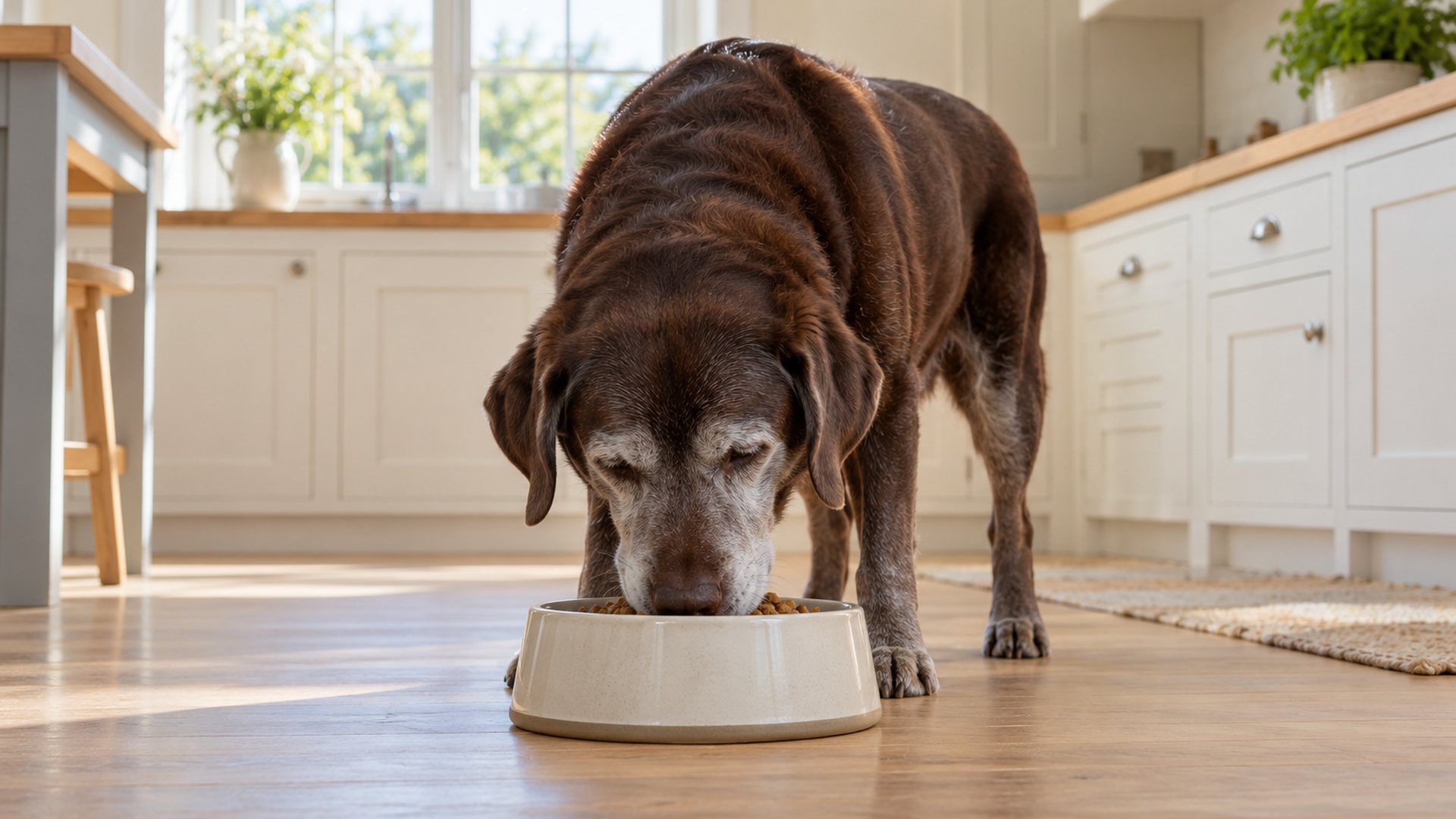
Senior dog food is food marketed for older dogs, but there is no official nutritional standard for it, so two “senior” foods can be very different inside. The right time to switch is not a birthday: it depends on your dog’s size, body condition, muscle and health, and many healthy older dogs do well staying on a good adult food. Choose by what your individual dog needs, usually with your vet’s help, rather than by the word “senior” on the bag.
This guide explains when dogs are considered senior by size, why the label alone tells you little, the truth about protein for older dogs, how to check body and muscle condition at home, and the questions to ask your vet before you change anything.
At a glance
- “Senior” is not a regulated recipe. AAFCO has no senior nutrient profile, so senior foods only have to meet adult maintenance standards.
- Senior foods vary widely. A 2025 comparison of 61 adult and senior diets found that the “senior” label did not reliably mean fewer calories, more protein or any other particular trait.
- Size changes the timing. AAHA describes senior as the last quarter of a dog’s expected lifespan: around 12 for many small dogs, and as early as 7 to 8 for large breeds.
- Healthy older dogs generally should not have protein cut. Current guidance favours maintaining or mildly increasing good-quality protein to help protect muscle, unless a vet has diagnosed a condition that needs restriction.
- Body and muscle condition guide the choice, not age alone. Aim for a lean, well-muscled dog.
When is a dog a senior?
The American Animal Hospital Association (AAHA) explains that there is no single age at which a dog becomes senior. It uses the final 25% of a dog’s estimated lifespan, which means size and breed matter a great deal. Smaller dogs may not be considered seniors until around 12 years old, while large dogs can reach senior status as early as 7 or 8. Dogs with chronic illness may age earlier than their peers.
| Dog size | Typical senior stage (AAHA guide) | Food points to watch |
|---|---|---|
| Small and toy breeds | Around 12 years | Dental health and kibble size; easy weight gain on small portions |
| Medium breeds | Somewhere between the two, depending on expected lifespan | Gradual weight creep as activity drops |
| Large and giant breeds | As early as 7 to 8 years | Keeping lean to protect joints; maintaining muscle |
| Any dog with chronic illness | May be earlier | Diet set with the vet around the specific condition |
A rough sense of your dog’s life stage is helpful, and the site’s dog years to human years guide explains why size changes the maths. But reaching senior age is a prompt for a conversation with your vet, not an automatic food change.
What makes senior dog food different (and what does not)
In the US, AAFCO nutrient profiles cover growth and reproduction, and adult maintenance; there is no separate senior profile. AAHA’s 2023 Senior Care Guidelines state this directly. A 2025 study in Frontiers in Veterinary Science adds that neither AAFCO nor the National Research Council defines a senior life stage, so manufacturers decide for themselves what a senior food should contain. In Europe, the pet food industry body FEDIAF encourages features such as lower energy density and higher protein, fibre and omega-3s for older dogs but has not set specific senior requirements.
The same 2025 study compared 61 adult and senior diets bought in one US city. On average, the senior diets were only modestly lower in calories (mainly the dry foods) and lower in fat. Average protein was almost identical between adult and senior foods, with some companies raising protein in their senior lines and others lowering it. Several companies also had more sodium in their senior version. The authors concluded that senior diets should not be recommended on age alone, and that a “senior” label does not guarantee lower calories, higher protein or any other age-specific feature.
In short: two senior foods can be as different from each other as an adult food is from a senior one. That is why it pays to know how to read a dog food label and compare products on calories and protein, not marketing.
Protein for older dogs: clearing up the myth
For many years, owners were told to cut protein for older dogs to “protect the kidneys”. Current guidance has moved away from that for healthy dogs. Ageing dogs tend to lose lean muscle and gain fat, and AAHA’s 2023 guidelines note that senior diets may include mild increases in protein content and quality to help offset muscle loss. FEDIAF also suggests increasing protein for older dogs when it is not medically contraindicated, and the 2025 study points out that cutting calories without raising protein concentration can leave a dog short of protein.
The important exception is a dog with a diagnosed condition, such as kidney disease or certain liver problems, where a vet may recommend a specific therapeutic diet with controlled protein, phosphorus or other nutrients. That is a medical decision for your vet, based on test results. The site’s guide to kidney disease in dogs explains early signs worth mentioning at check-ups.
Calories and body condition: the most useful number
AAHA notes that energy needs generally fall over a dog’s lifetime, and that senior dogs often need lower calorie density and more fibre to stay in good condition. It cites an ideal body condition score of 4.5 to 5 out of 9 and notes that keeping dogs lean has been linked with longer life. Excess weight also adds strain to ageing joints; see the guide to joint health in dogs.
But not every older dog needs fewer calories. The 2025 study stresses that dogs with chronic disease, poor appetite or those near the end of life may need more energy-dense food. Losing weight without trying, especially with muscle loss, is a reason to see your vet rather than to cut food further.
How to check body condition at home
- Ribs: run your flat hands along your dog’s sides. You should be able to feel the ribs easily under a thin layer of fat, without pressing hard, and without them looking sharp.
- Waist from above: looking down, you should see a gentle inward curve behind the ribs.
- Tummy tuck from the side: the belly line should rise from the chest towards the back legs.
- Muscle: feel over the spine, shoulder blades, hips and back of the head. Bony ridges that feel more prominent than before can mean muscle loss, even in a dog that weighs the same or carries fat elsewhere.
- Weigh and note it: weigh your dog every month or so, at the same time of day, and write it down alongside your observations.
Muscle and body condition are both assessed at vet check-ups. AAHA recommends tracking them regularly because they show when a diet change may be needed. Bring your notes to appointments.
How to choose senior dog food: a step-by-step plan
- Start with a vet check. AAHA advises more frequent exams for senior dogs. Ask for your dog’s body and muscle condition scores, a weight target and, where appropriate, blood and urine tests.
- Decide whether a change is needed at all. A healthy, lean, well-muscled older dog on a good complete adult food may not need to switch.
- Match the food to the problem. Gaining weight: lower-calorie food or smaller portions. Losing muscle: ask about higher-quality protein. Losing weight or appetite: more appealing or energy-dense food after a vet check. Diagnosed condition: the therapeutic diet your vet recommends.
- Compare labels, not names. Check calories per cup or per can, the protein and fat in the guaranteed analysis, and whether the food is “complete and balanced” for adult maintenance or all life stages.
- Consider texture and moisture. Dogs with sore teeth or a fussy appetite may do better with wet food or softened kibble. AAHA notes that added moisture increased nutrient digestibility in senior dogs. The guide on wet vs dry dog food compares the options, and dental care may be part of the answer.
- Switch gradually over about a week, mixing increasing amounts of the new food with the old, unless your vet advises otherwise.
- Review after a few weeks. Recheck weight, body condition, energy, stools and appetite, and adjust portions.
Questions to ask your vet
- What is my dog’s body condition score and muscle condition score today?
- What weight should we aim for, and how many calories a day does that mean?
- Does my dog need a senior food, or is the current food still suitable?
- Is there any medical reason to change protein, phosphorus, sodium or fat?
- Would wet food, softened food or a different kibble size help with teeth or appetite?
- Are any supplements appropriate, and could they interact with my dog’s medicines?
- How soon should we recheck weight and condition after a change?
The World Small Animal Veterinary Association’s Global Nutrition Committee also publishes guidance on questions owners can ask pet food companies, including who formulates their diets and whether the foods are tested in feeding trials.
Who suits senior food, and who does not
| Your older dog | Senior food likely to help? | Better approach |
|---|---|---|
| Healthy, lean, well-muscled | Not necessarily | Stay on a good adult food; monitor condition |
| Gaining weight, less active | Possibly, if it is genuinely lower in calories | Compare calories per cup; adjust portions and treats |
| Losing muscle | Only if it has good-quality protein | Vet check; protein-focused choice; gentle exercise |
| Losing weight or appetite | A low-calorie senior food may make things worse | Vet check first; appealing, energy-dense food |
| Diagnosed kidney, liver or heart disease | Not a substitute for a therapeutic diet | The diet your vet prescribes |
| Dental pain or missing teeth | Texture matters more than label | Dental check; wet or softened food |
Common mistakes
- Switching on a birthday. Age alone is not a reason to change; condition and health are.
- Assuming “senior” means lower calories. Check the calorie content on the label.
- Cutting protein in a healthy dog. This can speed up muscle loss unless your vet has a medical reason.
- Ignoring muscle loss because the scales look fine. Muscle can fall while fat rises.
- Cutting food for a thin older dog. Unplanned weight loss needs a vet check.
- Forgetting treats. Treats and titbits still count towards daily calories.
- Changing food suddenly. Older stomachs often cope better with a gradual switch.
For the wider picture of ageing well, including exercise, comfort and vet visits, see the site’s guide on how to care for a senior dog, and for the basics of choosing any diet, what to feed your dog. Changes in behaviour or appetite can also be linked to cognitive ageing; mention any such changes at your next check-up.
Sources this guide draws on: AAHA 2023 Senior Care Guidelines for Dogs and Cats (nutrition section); AAHA’s guidance on senior life stages; a 2025 Frontiers in Veterinary Science study by German, Melgoza and Torres-Henderson comparing adult and senior dog diets; FEDIAF nutritional guidance as summarised in that study; and the WSAVA Global Nutrition Committee’s guidance on choosing pet foods.
Handy gear for this guide
Practical picks we think suit this topic. As an Amazon Associate, Mind A Dog earns from qualifying purchases, at no extra cost to you. Prices and availability are set by Amazon and may vary by country.
- EHEYCIGA Orthopedic Memory Foam Dog Bed (Large)
Firm, supportive foam with a washable waterproof cover.
View on Amazon - EHEYCIGA 4-Step Dog Stairs
Lets smaller or older dogs reach the couch or bed without jumping.
View on Amazon - EVERLIT Pet First Aid Kit (95 Pieces)
Bandages, gauze and basics in one bag for home, car or hikes while you contact your vet.
View on Amazon
Frequently asked questions
At what age should a dog eat senior food?
There is no fixed age. AAHA treats the last quarter of expected lifespan as the senior stage, which is around 12 for many small dogs and as early as 7 to 8 for large breeds. Whether your dog needs a different food depends on body condition, muscle and health, so ask your vet at the next check-up.
Is senior dog food necessary?
Not always. Because there is no official senior standard, senior foods only have to meet adult maintenance requirements, and many differ little from adult foods. A healthy older dog may do well on a good complete adult food, while others benefit from a change chosen for a specific reason.
Do older dogs need less protein?
Healthy older dogs generally do not. AAHA’s guidelines note that mild increases in protein content and quality may help offset age-related muscle loss. Protein restriction is for dogs with certain diagnosed conditions, under a vet’s guidance.
Is wet or dry food better for senior dogs?
Either can work if it is complete and balanced and suits your dog. Wet food or softened kibble can help dogs with dental pain or poor appetite and adds moisture to the diet. Dry food is often more convenient and lower in cost per calorie. Choose based on your dog’s teeth, appetite and weight.
Can I feed my senior dog puppy food to help them gain weight?
Do not make that switch without your vet. Unplanned weight loss in an older dog can signal illness that needs diagnosing first. Your vet can recommend a suitable energy-dense food if one is needed.
The best senior dog food is the one that keeps your dog lean, strong and eating happily, chosen for your dog rather than for the label. Check condition regularly, compare products on what is actually in them, and let your vet help you make the right change at the right time.