
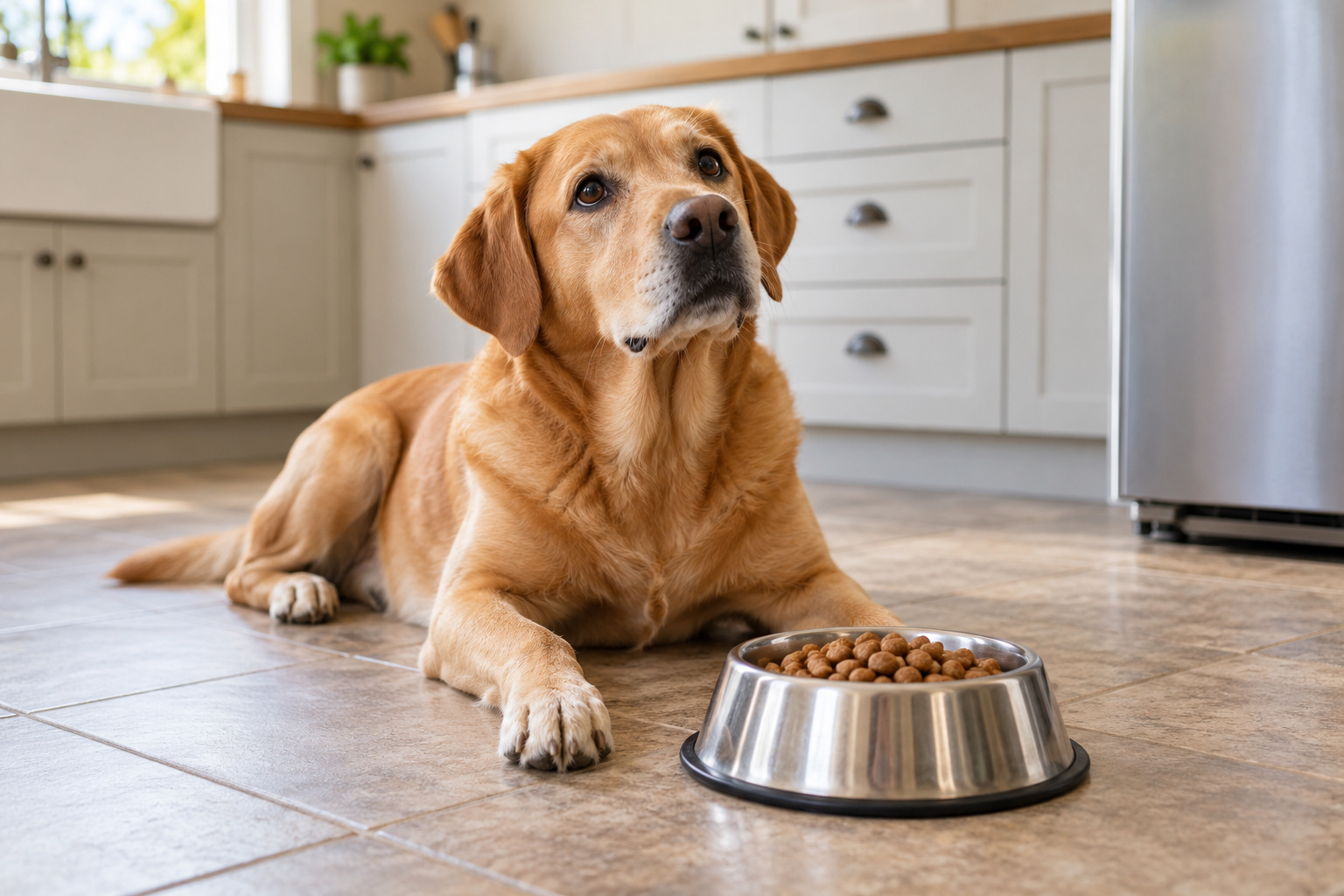
A healthy adult dog who skips one meal but is otherwise bright, drinking and behaving normally is usually not an emergency, but if your dog has refused food for more than 24 to 48 hours, it is time to call the vet. Puppies, toy breeds, older dogs and dogs with conditions such as diabetes need a call much sooner, often the same day. And any dog who stops eating and is also vomiting, lethargic, in pain or struggling to breathe needs to be seen urgently, whatever the hour.
People often search for how long a dog can survive without food, but survival is the wrong target. The useful question is how long you can safely wait and watch before a professional takes a look. This guide gives you time-based guidance for different dogs, a checklist of causes you can observe at home, the signs that move a skipped meal into “go now” territory, and exactly what to tell the vet when you ring.
At a glance
- One missed meal in a healthy, cheerful adult dog can usually be watched for a day, provided they are drinking and acting normally.
- More than 24 to 48 hours without food in an adult dog means a vet call, even if nothing else seems wrong.
- Puppies, toy breeds, seniors and dogs with diabetes or other ongoing conditions should not be left to “see how it goes”: ring the vet the same day.
- Not eating plus vomiting, diarrhoea, lethargy, a swollen or painful belly, or breathing trouble is an emergency.
- Never force-feed, and do not give any human medicine to settle the stomach or tempt the appetite without your vet’s advice.
Why “how long can a dog go without eating” is the wrong question
Most dogs could physically survive far longer without food than any owner should ever allow, and that is exactly why the survival figures quoted online are unhelpful. A dog does not need to be close to the limit of survival to be harmed. Veterinary nutrition guidance published in Today’s Veterinary Practice notes that a short period of poor intake, around one or two days, is generally well tolerated, but that longer periods of eating less can slow recovery and raise the risk of complications. In other words, the clock matters for recovery, not just for survival.
Dogs are good at hiding pain, so a change in eating is often the first clue owners notice. Treat it as information, not fussiness.
Not eating, eating less and wanting to eat but not managing
Vets use a few terms you may hear on the phone. Anorexia simply means a loss of appetite, and hyporexia means eating less than normal. VCA Animal Hospitals also describes pseudo-anorexia: the dog is hungry and interested in food but cannot pick it up, chew it or swallow it comfortably. That distinction is useful at home. A dog who walks away from the bowl without interest is telling you something different from a dog who goes to the bowl eagerly, tries, drops the food and walks off.
How long is too long? Guidance by type of dog
The table below turns the general advice from veterinary sources such as PetMD and VCA into a quick reference. It is a guide to when to ring, not a guide to when it becomes dangerous. If you are unsure, ringing early is never wrong.
| Your dog | Missed one meal, otherwise well | When to ring the vet | Go to a vet urgently if |
|---|---|---|---|
| Healthy adult dog | Watch closely; offer the next meal as normal | No food for more than 24 to 48 hours, or eating less for several days | Vomiting, diarrhoea, lethargy, pain, swollen belly or breathing trouble |
| Puppy | Ring for advice; puppies cannot go as long as adults | The same day | Any vomiting or diarrhoea, weakness, wobbliness or unusual sleepiness |
| Toy or very small breed | Watch very closely; small bodies have smaller reserves | The same day, especially if young | Trembling, weakness, wobbliness or collapse |
| Senior dog | Note it; a slight drop with age can be normal | A clear change lasting more than a day, or a gradual decline over weeks | Any of the urgent signs above |
| Dog with diabetes or another ongoing condition | Do not wait | Straight away | Any change at all in eating, drinking or energy |
| Pregnant or nursing dog | Ring for advice | The same day | Any of the urgent signs above |
Puppies and toy breeds have very little in reserve and can become weak quickly. For dogs with diabetes, eating and any medicine they receive are closely linked, so ring your vet for instructions rather than guessing.
Signs that make it an emergency
A lack of appetite on its own gives you a little time. A lack of appetite combined with other signs does not. PetMD’s guidance lists several of the combinations below as reasons for an emergency visit:
- Vomiting, especially repeated vomiting or vomiting with unproductive retching
- Diarrhoea, particularly in a puppy or if there is blood
- Lethargy, weakness, collapse or reluctance to stand
- A tense, swollen or tight belly, or crying out when the belly is touched
- Laboured, fast or noisy breathing
- Drinking or weeing far more than usual while not eating
- Pale, grey or very dark red gums
- Any chance they have eaten something toxic or swallowed a toy, sock, bone or corn cob
If you think your dog may have swallowed something they shouldn’t, ring a vet or an animal poison helpline straight away and follow their instructions. Do not try to make your dog sick or give anything by mouth unless a vet tells you to. The calm, tiered approach in our guide to knowing when to call the vet covers this in more detail.
A checklist of causes you can observe at home
You cannot diagnose your dog, but you can collect clues. Veterinary sources group the reasons dogs stop eating into a few broad families: illness, pain, mouth problems, stress, food changes and simple overfeeding. Work through this list and jot down anything that applies.
Mouth and teeth
- Do they go to the bowl, try to eat, then drop food or chew on one side?
- Is there drooling, bad breath, pawing at the face or blood on toys?
- Do they still take soft treats but refuse hard biscuits?
These clues point towards pseudo-anorexia, where the dog is hungry but eating hurts. Dental disease is a very common cause, and a simple dental care routine is worth reviewing once your vet has checked the mouth.
Tummy and digestion
- Has there been vomiting, yellow foam, diarrhoea or straining?
- Are they licking their lips, swallowing repeatedly or eating grass more than usual (possible nausea)?
- Have they raided the bin, eaten something on a walk or chewed up a toy?
If vomiting is part of the picture, the advice in our guide to a dog throwing up yellow or foam and our dog diarrhoea guide will help you judge how quickly to act.
Pain elsewhere in the body
- Do they hesitate to lower their head to a floor-level bowl?
- Are they stiff, limping, reluctant to jump or shifting position often?
- Is their posture hunched, or do they flinch when touched?
VCA notes that pain anywhere, including back or neck pain that makes reaching a bowl uncomfortable, can put a dog off food.
Stress and changes at home
- Have you moved house, rearranged furniture or moved the bowl?
- Is there a new pet, baby, visitor, building work or loud weather?
- Have they recently been boarded, groomed or left alone longer than usual?
Stress is a real cause of appetite loss, and it often travels with other quiet signals. The hidden signs of stress in dogs can help you spot them. Even so, a stressed dog who has not eaten for more than a day or two still needs a vet check, because stress and illness can look alike.
Food and feeding
- Has the food changed brand, recipe or flavour, or been switched quickly?
- Has an open bag gone stale, or has wet food been left out?
- Is someone else in the house handing out extra treats or table scraps?
- Is it hot weather, when many dogs naturally eat a little less?
Too many treats are one of the most common reasons a healthy dog “isn’t hungry” at dinner. A widely used rule of thumb is to keep treats to around 10 percent of daily calories, and our guide to choosing healthy treats explains how.
How many times a day should a dog eat?
Knowing your dog’s normal routine makes a missed meal easier to judge. Feeding plans vary with age, size, health and the food itself, so your vet’s advice for your own dog comes first, but common patterns look like this:
- Young puppies are usually fed several small meals a day, with the number reduced as they grow.
- Most adult dogs do well on two meals a day, which also makes a skipped meal easy to notice.
- Toy breeds and some seniors may be better suited to smaller, more frequent meals; ask your vet.
A dog who is fed once a day and misses that one meal has effectively gone a full day without food, so factor the feeding pattern into your timing. If you are reviewing what goes in the bowl, our simple guide to what to feed your dog covers the basics.
What you can safely do while you wait for advice
These steps are about observing and keeping your dog comfortable, not about treating the cause. Use them only for a dog who is otherwise bright and has no emergency signs.
- Make sure fresh water is always available. Note whether they drink normally, less or much more.
- Offer the next meal at the normal time in a quiet spot, then pick it up after 15 to 20 minutes rather than leaving it out all day. This makes it clear whether they ate.
- Stop extra treats and table food for now, so you can tell true appetite loss from a full tummy.
- Raise or move the bowl if they seem stiff or hesitant to bend down, and make sure they can eat away from other pets.
- Write down what you see: when they last ate, how much, any vomiting, diarrhoea, drinking, weeing and energy level.
- Ring the vet once the time limits for your type of dog are reached, or immediately if anything on the emergency list appears.
What not to do matters just as much. Do not force food or liquid into your dog’s mouth, which can cause choking or inhaling food. Do not give painkillers, anti-sickness tablets or appetite remedies meant for people or other pets, as several common human medicines are dangerous to dogs. And do not keep swapping foods every few hours, which can upset the stomach further and makes it harder for the vet to know what is going on.
What to tell the vet when you ring
A clear history saves time and helps the vet decide how urgently to see your dog. VCA notes that a detailed history is the first step in telling true appetite loss from a dog who wants to eat but cannot. Have these answers ready:
- When your dog last ate a normal meal, and how much they have eaten since
- Whether they are drinking, and whether that is more or less than usual
- Any vomiting, diarrhoea, coughing, sneezing or change in toileting
- Energy level, mood and whether they are interested in food but not managing it
- Any change in food, routine, household or environment
- Anything they might have eaten, chewed or found on a walk
- Their age, any known health conditions and any medicines they take
At the appointment, the vet will usually start with a full physical examination, including the mouth and belly. Depending on what they find, they may suggest blood tests, X-rays or an ultrasound scan to look for the underlying cause. The World Small Animal Veterinary Association’s nutritional assessment guidelines encourage vets to check body condition and diet history at every visit, so expect questions about weight and feeding even if the visit is about something else.
Common mistakes
- Waiting for “a few days” because a website said dogs can survive longer. Survival time is not a safe waiting time.
- Treating a puppy or toy breed like an adult dog. Small and young dogs need a same-day call.
- Tempting with rich human food. A fatty or unfamiliar meal can make an upset stomach worse.
- Assuming a fussy eater is just fussy. A long-standing picky eater who suddenly refuses everything is showing a change.
- Missing the “wants to but can’t” dog. A dog who approaches the bowl and walks away may have a sore mouth.
- Giving medicines from the bathroom cabinet. Only give what your vet has prescribed for this dog.
- Ignoring slow change in an older dog. Gradual appetite loss and weight loss in a senior deserve a check, and our senior dog care guide explains what else to watch.
Sources this guide draws on: PetMD’s guidance on dogs not eating, VCA Animal Hospitals’ owner information on anorexia in dogs, Today’s Veterinary Practice on dysrexia and nutritional support, and the World Small Animal Veterinary Association (WSAVA) Global Nutrition Committee’s nutritional assessment guidelines.
Handy gear for this guide
Practical picks we think suit this topic. As an Amazon Associate, Mind A Dog earns from qualifying purchases, at no extra cost to you. Prices and availability are set by Amazon and may vary by country.
- Outward Hound Fun Feeder Slo Bowl
Ridged bowl that slows down dogs who gulp their meals.
View on Amazon - LUKITO Lick Mat for Dogs (2 Pack)
Spread a little dog-safe food over it for a quiet licking activity.
View on Amazon - Amazon Basics Airtight Pet Food Storage Containers (3 Piece)
Keeps kibble and treats fresh and out of reach.
View on Amazon
Frequently asked questions
How long can a dog go without food before it is dangerous?
There is no single safe number, because age, size and health change the picture. As a practical rule, ring the vet if a healthy adult dog has eaten nothing for more than 24 to 48 hours, and the same day for a puppy, toy breed, senior or dog with a health condition. Go straight away if appetite loss comes with any emergency sign.
My dog is not eating but is drinking water. Is that okay?
Drinking is a good sign, but it does not mean everything is fine. Follow the same time limits for appetite, and mention drinking to the vet. A dog who is drinking much more than usual while refusing food needs to be seen promptly.
Why will my dog eat treats but not their food?
This can mean they are full from treats, bored with or put off by their food, or that hard food is uncomfortable to chew. Stop the extras for a day and watch. If they still refuse their meal, or seem to struggle with chewing, ask your vet to check their mouth.
Is it normal for a dog to skip a meal in hot weather?
Many dogs eat a little less on very hot days, and that alone is not usually a worry if they are drinking and acting normally. Feed in the cooler parts of the day. If the reduced appetite lasts beyond a day or two, or comes with heavy panting, weakness or vomiting, call the vet.
How long can a puppy go without eating?
Not long. Puppies have small reserves and can become weak quickly, so a puppy who skips meals should prompt a same-day call to the vet. A puppy who is not eating and has vomiting or diarrhoea needs urgent care.
A skipped meal is your dog’s way of telling you something. Most of the time it is minor, but watching closely, keeping notes and ringing the vet within the right time for your dog means the times it is serious get caught early, while recovery is still easiest.