
A dog limping on a back leg most often has a minor injury such as a sprain, a cut pad or a torn nail, but back-leg limps are also a classic sign of knee problems like a cruciate ligament injury or a slipping kneecap. If your dog will not put any weight on the leg, is in obvious pain or has a serious wound, contact your vet straight away; for any other limp, rest your dog and book a vet check if it has not clearly improved within a day or two.
This guide walks you through a calm, hands-on check you can do at home, the common causes of front and back leg limping by age and breed, a clear “rest and watch, see the vet today, or emergency” table, and what your vet will want to know. It does not replace an examination, and it never suggests giving your dog any medicine without your vet’s advice.
At a glance
- No weight on the leg, severe pain, a dangling or oddly angled limb, or heavy bleeding: treat as an emergency.
- A mild limp that is improving can be rested and watched for a day or two, then checked by your vet if it is not clearly better.
- Back-leg limps in medium and large dogs are often linked to the cruciate ligament; small breeds often have kneecap (patella) problems.
- Never give human painkillers such as ibuprofen, naproxen or paracetamol (acetaminophen); they can poison dogs.
- Film your dog walking at home. Many dogs walk normally once they reach the clinic.
Why is my dog limping? The most common causes
PDSA, the UK veterinary charity, lists minor injuries and arthritis as the most common reasons dogs limp. Beyond those, the cause often depends on which leg is affected, how old your dog is and whether the limp appeared suddenly or crept in over weeks.
Paw and nail problems (any leg)
Cuts to the pads, torn or overgrown nails, grass seeds, splinters, stings, burns from hot pavement and sore spaces between the toes are all common and are the first thing to check. Overgrown nails can change how a dog stands, so regular nail trims at home are worth keeping up, and in hot weather it pays to check pavement temperature before walks.
Back-leg causes
- Cranial cruciate ligament disease. The cruciate ligament stabilises the knee and is the canine version of the human ACL. The American College of Veterinary Surgeons lists breeds such as the Labrador Retriever, Rottweiler, Newfoundland, Mastiff, Akita, Saint Bernard, Chesapeake Bay Retriever and Staffordshire Terrier among those at higher risk, with obesity, poor fitness and age also playing a part.
- Patellar luxation. The kneecap slips out of its groove. It is common in small breeds and often shows as a skipping step, where the dog carries the leg for a few strides and then puts it down as normal.
- Hip dysplasia and arthritis. Often gradual, with stiffness after rest, trouble on stairs or reluctance to jump.
- Legg-Perthes disease in some young small-breed dogs, and Achilles tendon injuries, both listed by PDSA among back-leg causes.
- Spinal problems, such as a slipped disc, which can look like a back-leg limp, wobbliness or weakness.
Front-leg causes
- Elbow and shoulder dysplasia and other developmental joint problems, especially in growing medium and large breeds.
- Soft tissue injuries such as sprains, strains and muscle injuries, often after rough play or a fall.
- Bone growth abnormalities in young dogs.
Causes that can affect any leg
Arthritis, osteochondrosis (a cartilage development problem in young dogs), panosteitis (sometimes called “growing pains” in young large breeds, and a limp that can move from leg to leg), joint infections, nerve or muscle problems and, less often, bone tumours. PDSA includes all of these in its list of causes, which is why a persistent or recurring limp always deserves a proper examination.
Sudden vs gradual limping
| Pattern | What it often points to | Typical next step |
|---|---|---|
| Sudden limp during or after a run, jump or play | Paw injury, sprain, cruciate tear, fracture or dislocation | Check the paw; if the dog will not bear weight or is in pain, see the vet today |
| Sudden skipping step in a small dog | Patellar luxation | Book a vet check, especially if it is becoming more frequent |
| Gradual stiffness, worse after rest | Arthritis, hip or elbow dysplasia, early cruciate disease | Book a non-urgent vet appointment and note when it is worst |
| Limp that moves between legs in a young large-breed dog | Panosteitis or other growth-related problems | Book a vet check; growing dogs need assessing |
| Limp after lying down that eases with walking | Often joint stiffness such as arthritis | Book a vet check; it is still a sign of discomfort |
| Limp with wobbliness, knuckling or weakness | Possible spinal or nerve problem | Contact your vet the same day |
A calm at-home check (five minutes)
Only do this if your dog is relaxed. A sore dog may snap even with a trusted person, so stop at any growl, lip lick, head turn or stiffening, and let your vet do the rest. Calm, quiet handling and a few treats help.
- Watch first. Let your dog walk slowly on a flat, non-slip surface. Note which leg, whether they touch it down, and whether the head bobs. With a front-leg limp, the head usually lifts as the sore leg lands; with a back-leg limp, the hip on the sore side may hitch up.
- Film it. Record 20 to 30 seconds of walking towards and away from you. Cornell University’s Riney Canine Health Center notes that home videos often show what the clinic exam misses.
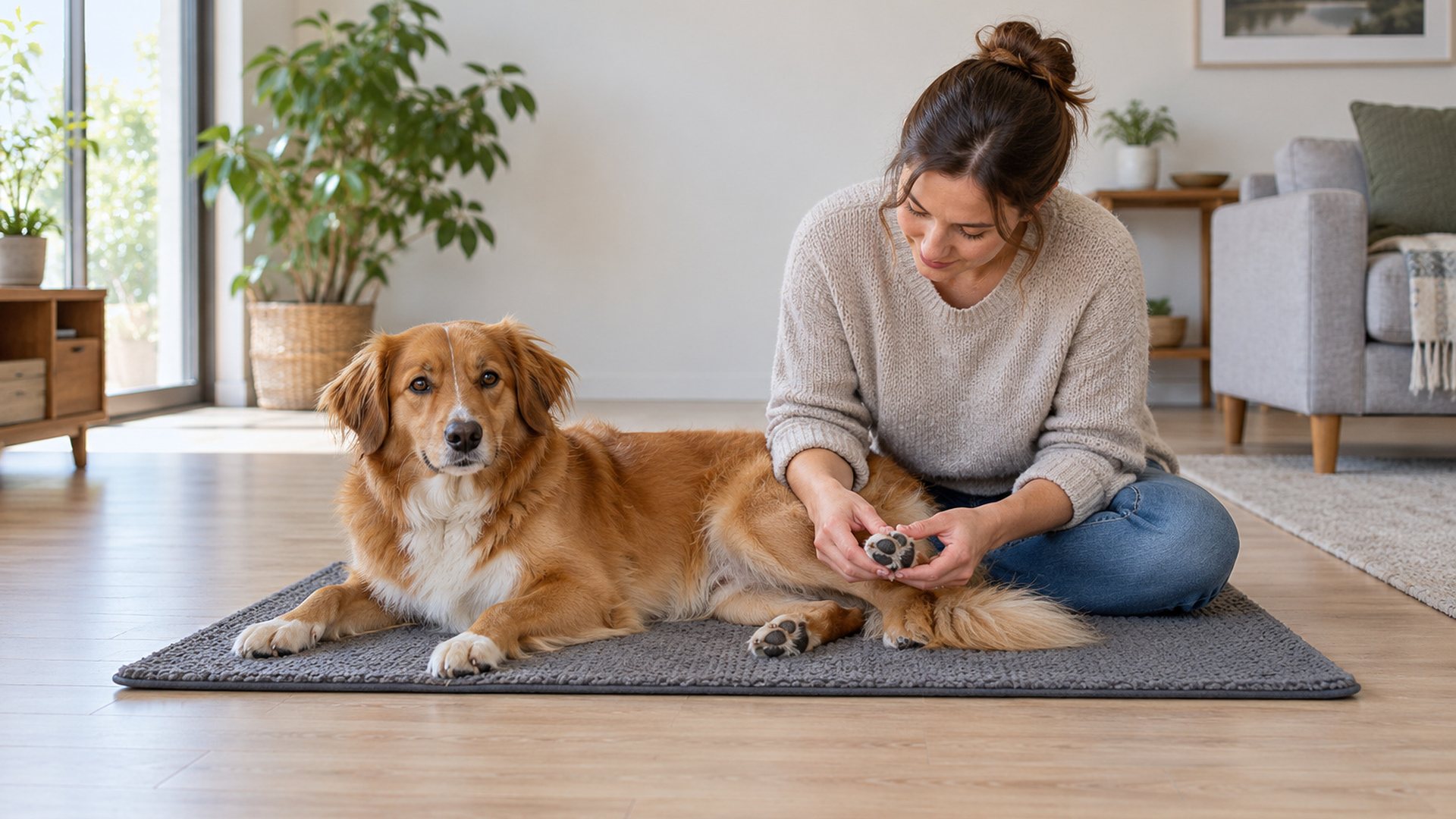
- Check the paw. Spread the toes gently and look between them and at each pad for cuts, swelling, seeds, splinters or redness. Check each nail for cracks, bleeding or one that is pointing the wrong way.
- Feel for heat and swelling. Run your hand gently down both legs at once and compare sides. A warm, puffy or tender spot on one side is useful information for your vet.
- Look for wounds or ticks. Part the fur up the leg and around the joints.
- Do not stretch or bend the joints. Testing range of movement can hurt and is best left to your vet.
- Write it down. When it started, what happened just before, whether it is getting better or worse, and anything you found.
If you find something simple such as a small stone stuck between the pads and it comes away easily, remove it and watch. Anything embedded, such as a grass seed or splinter, is a job for your vet, because pieces left behind can travel under the skin.
Rest and watch, see the vet today, or emergency?
| Situation | What to do |
|---|---|
| Not putting any weight on the leg | Contact your vet immediately |
| Leg looks broken, dangling, twisted or at an odd angle | Emergency: keep your dog still and go now |
| Heavy bleeding or a deep or gaping wound | Emergency: apply gentle pressure with a clean cloth and go now |
| Severe pain, crying out, panting or trembling | Contact your vet immediately |
| Limp after a car accident or fall from height, even if mild | See the vet the same day, as internal injuries can be hidden |
| Limp with wobbliness, weakness or dragging toes | Contact your vet the same day |
| Swollen, hot joint or a dog who seems unwell (off food, lethargic, feverish) | See the vet the same day |
| Mild limp, still bearing weight, dog bright and eating | Rest and watch; book a vet check if not clearly better in a day or two |
| Limp that comes and goes, or stiffness after rest | Book a non-urgent vet appointment |
PDSA’s advice is to contact your vet about any limping or stiffness, even when it seems subtle, because many dogs hide pain well. The guide on when to call the vet explains how to describe urgency when you phone.
My dog is limping but shows no sign of pain
A limp is itself a sign of discomfort. Dogs are very good at carrying on as normal, eating, wagging and greeting visitors while quietly favouring a leg. A dog who limps but does not yelp is not necessarily pain-free; they are simply adjusting how they move to protect the sore area. Treat a “painless” limp the same way as any other: check the paw, rest, and book a vet visit if it is not clearly improving.
What to do while you wait for the vet
- Restrict activity. Lead-only toilet trips, no running, jumping, stairs or rough play.
- Make home safe. Put rugs or mats on slippery floors and block access to sofas and beds.
- Keep the mind busy. Calm activities such as a lick mat or gentle sniffing games help a rested dog stay settled.
- Do not give any medicine without your vet’s advice. The ASPCA Animal Poison Control Center lists human pain relievers such as ibuprofen, naproxen and paracetamol (acetaminophen) among common causes of poisoning in pets. Leftover tablets from a previous pet are not safe to use either.
- Do not bandage or splint a limb unless your vet tells you to; a poorly placed bandage can cut off circulation.
Cruciate ligament signs to know
Because cruciate disease is such a common cause of back-leg limping, it helps to know what it can look like. The American College of Veterinary Surgeons lists these signs:
- Difficulty sitting down or getting up, or sitting with the affected leg kicked out to the side
- Trouble jumping into the car or onto furniture, and less interest in play
- Lameness that may only show after a long rest
- Muscle loss in the thigh of the affected leg and stiffness in the knee
- A clicking or popping sound from the knee
- Firm swelling on the inside of the knee
The same source notes that many dogs with cruciate disease in one knee go on to develop it in the other, which is one reason your vet may talk about long-term weight and fitness management. The guide to joint health in dogs covers the everyday side of keeping joints healthy.
What your vet will ask and do
Cornell’s Riney Canine Health Center describes a typical lameness visit. Being ready with answers saves time:
- When did the limp start, and was it sudden or gradual?
- Is it getting better, worse or moving between legs?
- Any trouble with stairs, jumping, getting up or exercise?
- Any recent injury, change in activity or change in routine?
- Has your dog had any medicine, and did it make a difference?
The vet will usually watch your dog walk and trot, then feel each leg from toes to hip or shoulder, checking for pain, swelling, instability and muscle loss. Depending on what they find, they may suggest X-rays or other imaging, blood tests or referral to a specialist. If cost is on your mind, the guide on whether dog insurance is worth it explains how cover for orthopaedic problems tends to work.
Common mistakes
- Giving human painkillers. They can cause serious poisoning in dogs. Always ask your vet.
- Waiting weeks for a limp to “walk off”. Ongoing limping can mean a problem that is easier to manage when found early.
- Exercising through it. A long walk to “loosen up” a sudden limp can make an injury worse.
- Pulling out embedded objects. Grass seeds and splinters can break and leave pieces behind.
- Assuming no yelp means no pain. Limping itself tells you something hurts.
- Forgetting the video. Many dogs walk perfectly in the clinic, so a home recording is valuable.
- Ignoring weight. Extra weight puts more load on joints and is a recognised risk factor for cruciate disease.
Sources this guide draws on: PDSA Pet Health Hub guidance on limping and stiffness in dogs, the American College of Veterinary Surgeons owner information on cranial cruciate ligament disease, Cornell University College of Veterinary Medicine’s Riney Canine Health Center guidance on taking a limping dog to the vet, and the ASPCA Animal Poison Control Center information on human medicines and pets.
Handy gear for this guide
Practical picks we think suit this topic. As an Amazon Associate, Mind A Dog earns from qualifying purchases, at no extra cost to you. Prices and availability are set by Amazon and may vary by country.
- EHEYCIGA Orthopedic Memory Foam Dog Bed (Large)
Firm, supportive foam with a washable waterproof cover.
View on Amazon - EHEYCIGA 4-Step Dog Stairs
Lets smaller or older dogs reach the couch or bed without jumping.
View on Amazon - EVERLIT Pet First Aid Kit (95 Pieces)
Bandages, gauze and basics in one bag for home, car or hikes while you contact your vet.
View on Amazon
Frequently asked questions
Why is my dog suddenly limping on a back leg?
Common causes of a sudden back-leg limp include a paw or nail injury, a sprain, a cruciate ligament injury or a slipping kneecap. Check the paw first. If your dog will not bear weight, is in pain or the limp does not clearly improve within a day or two, see your vet.
My dog is not putting weight on a back leg. Is that an emergency?
Treat it as urgent and contact your vet straight away. Not bearing weight can mean a fracture, dislocation, ligament tear or a painful paw injury, and your dog needs an examination and proper pain relief from a vet.
Why is my dog limping on a front leg?
Front-leg limps are often caused by paw injuries, sprains and strains, or developmental joint problems such as elbow dysplasia in young dogs. Arthritis is common in older dogs. A vet examination will narrow down the cause.
Why does my dog limp after lying down?
A limp or stiffness after rest that eases as your dog moves is often a sign of joint discomfort, such as arthritis or early cruciate disease. It is not an emergency, but book a vet appointment, as there is a lot that can be done to keep a stiff dog comfortable.
Can I give my dog ibuprofen or paracetamol for limping?
No. Human pain relievers such as ibuprofen, naproxen and paracetamol (acetaminophen) can poison dogs. Only give medicines your vet has prescribed for your dog, at the dose they set.
How long should I wait before taking a limping dog to the vet?
Go immediately if your dog will not bear weight, is in severe pain or has a serious wound. For a mild limp in a dog who is otherwise bright, rest them and book a vet check if it has not clearly improved within a day or two, or straight away if it gets worse.
A limp is your dog’s way of telling you something is sore. Check the paw, rest them, film how they walk and let your vet do the detective work. Acting early, and never reaching for the human medicine cabinet, gives your dog the best chance of getting back to happy, comfortable walks.